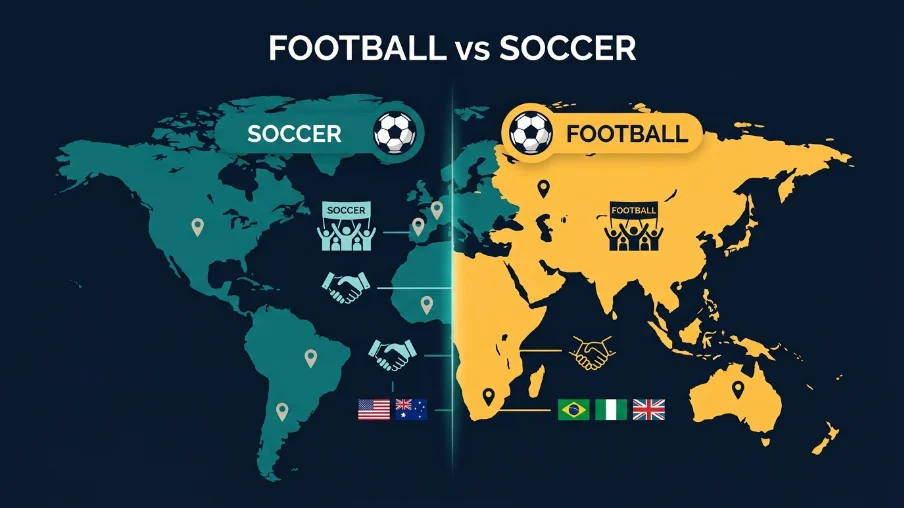
Quick Answer: Football and soccer are the same sport. “Soccer” is a British slang term coined in the 1880s from “association football,” while “football” is the internationally used name. The US, Canada, and Australia use “soccer” to avoid confusion with their own separate football codes.
Ask someone in London to watch “football” tonight, and they’ll picture 22 players chasing a round ball across a green pitch. Ask someone in New York the same thing, and they might assume you mean a game with an oval ball, helmets, and pads. Same word, two completely different sports in their minds and it’s one of the most common points of confusion for new fans discovering the game for the first time.
So which is correct: football or soccer? The surprising answer is that both terms describe exactly the same sport what most of the world calls football is precisely what Americans, Canadians, and Australians call soccer. This guide breaks down where both names actually came from, why the terminology split happened, and how to know which word to use depending on who you’re talking to.
At SportsOrbitX, this guide has been researched using linguistic and sporting history records, including documentation from the Oxford English Dictionary and FIFA’s own historical archives, so you’re getting an accurate answer not just an opinion.
Football vs Soccer: Quick Comparison
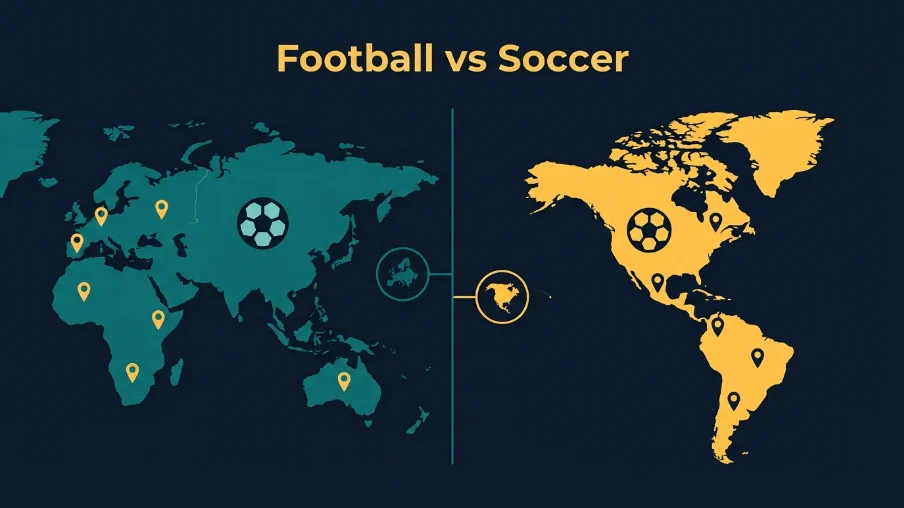
| Football | Soccer | |
| Same sport? | Yes | Yes |
| Governing body | FIFA | FIFA |
| Term origin | Old English/Germanic, describing ball-and-foot games generally | Coined in England, ~1880s, from “association” |
| Primary regions | UK, Europe, South America, Africa, most of Asia | USA, Canada, Australia |
| Rules | IFAB Laws of the Game | IFAB Laws of the Game (identical) |
Football and Soccer Are the Same Sport
Let’s clear up the core confusion immediately: football (soccer) is a team sport played between two teams of 11 players, where the objective is to score by getting a ball into the opposing goal, using any part of the body except the hands and arms (except for the goalkeeper, within the penalty area). Whether you call it football or soccer, the rules, the field, the positions, and the governing body FIFA are identical. There is no separate sport called “soccer” with different rules; it’s simply a different name for the same game, and the distinction exists purely in language, not in how the sport is actually played, coached, or officiated anywhere in the world.
Where Did the Word “Soccer” Actually Come From?
The word “soccer” was coined in England in the 1880s, not America the common belief that it’s an American invention is incorrect. In the late 1800s, English private schools played several different codes of football, including “association football” (played with the feet, under Football Association rules) and “rugby football” (played with the hands, under Rugby Football Union rules). Students at the time had a habit of shortening words with “-er” as slang “rugby football” became “rugger,” and “association football” became “assoccer,” which was later shortened further to “soccer.”
For decades, both “football” and “soccer” were used interchangeably in Britain itself, appearing side by side in newspapers and everyday conversation well into the 20th century.
Why Does America Call It “Soccer” Instead?
The United States already had a hugely popular sport called “American football” by the time association football gained a following there, so the word “football” was effectively taken. To avoid confusion between the two very different games, Americans adopted “soccer” a term that, ironically, the English themselves had coined to specifically refer to association football. Canada and Australia followed a similar path, since both countries also have their own football codes (Canadian football and Australian rules football) that made “football” an ambiguous term.
Which Countries Say “Football” vs. “Soccer”?
- Football: United Kingdom, most of Europe, South America, Africa, and most of Asia
- Soccer: United States, Canada, Australia, and (to a lesser extent) New Zealand and the Republic of Ireland
Interestingly, even within countries that primarily say “football,” the word “soccer” still appears in official contexts for example, some UK football clubs used “soccer” in official names decades ago, and Ireland uses “soccer” specifically to distinguish the sport from Gaelic football, a separate native sport.
The Governing Body: FIFA, Regardless of the Name
No matter which word is used locally, the sport is governed globally by FIFA (Fédération Internationale de Football Association), founded in Paris in 1904. FIFA’s own official name uses “football,” which is part of why “football” remains the internationally recognized term in most official and academic contexts, even in countries where “soccer” is the everyday word. This is also why, regardless of the local slang used, official match reports, coaching certifications, and international competitions almost always default to “football” in their formal documentation.
Common Misconceptions About Football vs. Soccer
- “Soccer is a simplified version of football.” False they are the exact same sport with identical rules under IFAB’s Laws of the Game.
- “Soccer is an American invention.” False the term originated in England in the 1880s.
- “Football and soccer have different governing bodies.” False both are governed by FIFA internationally, and by the same domestic federations within each country.
- “The rules differ between football and soccer leagues.” False a match played under “soccer” rules in the US follows the same IFAB Laws of the Game as a Premier League match in England.
Other “Football” Codes Around the World
Part of why the football-vs-soccer confusion exists is that several completely different sports also use the word “football” in their name. Understanding these helps explain why certain countries needed a separate term in the first place:
- American Football Played with an oval ball, heavy protective gear, and frequent stoppages; teams advance the ball primarily by throwing and running rather than kicking.
- Australian Rules Football (AFL) A fast-paced code played on an oval pitch with an oval ball, allowing both kicking and handballing, with no offside rule.
- Gaelic Football Ireland’s native code, allowing players to carry, kick, and hand-pass the ball, blending elements of association football and rugby.
- Canadian Football Closely related to American football but with notable rule differences, including a larger field and only three downs instead of four.
- Rugby Football (Union and League) Played with an oval ball, heavy emphasis on tackling and ball-carrying, split into two codes (Union and League) with different rules.
Each of these developed largely independently but shares a historical root in the loosely organized “football” games played across British schools in the 1800s, before association football split off with its own standardized rules in 1863.
Why This Naming Split Actually Matters for a Global Sport
This isn’t just trivia it has real implications for how the sport grows in different markets. Broadcasters, marketers, and even FIFA itself have had to navigate which term to use depending on the audience, since using the “wrong” word in a specific country can create genuine confusion about which sport is being discussed. As football’s popularity in the US continues to rise, this naming question has become an active part of how the sport is marketed to new American fans who may still primarily associate “football” with the NFL.
The 1863 Split That Started It All
To fully understand the football-vs-soccer story, it helps to go back to the actual moment the two words became necessary. Before 1863, English schools and clubs played wildly different versions of “football,” with some allowing handling and tackling, and others restricting play to the feet only. In October 1863, representatives from several London clubs met to agree on a single standardized set of rules, forming The Football Association (FA) the world’s first official football governing body. Clubs that wanted to keep the handling-and-tackling version broke away and eventually formed the Rugby Football Union in 1871.
This split is the direct root of both modern terms: “association football” (later shortened to “soccer”) became the kicking-only game overseen by the FA, while “rugby football” (later “rugger”) became the handling game. For roughly the next century, both “football” and “soccer” continued to be used somewhat interchangeably in Britain itself it wasn’t until American football’s popularity exploded domestically in the US that “soccer” became the dominant, near-exclusive term there, to clearly separate the two very different sports.
Does the Terminology Affect How the Game Is Played?
Not at all. Whether a match is labeled “football” or “soccer” on a scoreboard, broadcast, or league name, everything about actual gameplay stays identical:
- Same team size 11 players per side, including a goalkeeper.
- Same match duration 90 minutes across two 45-minute halves.
- Same field dimensions and markings governed by the same IFAB standards worldwide.
- Same scoring system one point per goal, with the ball fully crossing the goal line.
- Same officiating structure a referee, two assistant referees, and VAR at the professional level.
Which Term Should You Use?
A simple rule of thumb: match your terminology to your audience. If you’re speaking with someone from the UK, Europe, or most of the football-loving world, “football” will be understood instantly and is the expected term. If you’re speaking with someone from the US, Canada, or Australia, “soccer” avoids confusion with their own domestic football codes. Global sports media and FIFA itself increasingly use “football” as the standard term, even in American broadcasting, as the sport’s popularity continues to grow in the US following recent World Cup hosting duties. When in doubt, paying attention to how locals refer to the sport in conversation, on TV, or in news coverage is the simplest way to pick up the regionally correct term naturally.
Frequently Asked Questions
Is soccer and football the same sport? Yes. Football and soccer refer to the exact same sport, played under identical FIFA and IFAB rules. The only difference is regional terminology.
Why do Americans call it soccer? Because “football” was already used for American football, a different and hugely popular sport in the US, so “soccer” was adopted to avoid confusion.
Who invented the word soccer? The word “soccer” was coined in England in the 1880s, as slang shortened from “association football.”
Do football and soccer have different rules? No. Both terms refer to the same sport governed by the same IFAB Laws of the Game worldwide, regardless of what it’s called locally.
Which countries use the term soccer instead of football? The United States, Canada, Australia, and, in some contexts, Ireland and New Zealand primarily use “soccer” to avoid confusion with their own domestic football codes.
Is FIFA involved in both football and soccer? Yes. FIFA is the single global governing body for the sport, regardless of whether it’s referred to as football or soccer in a given country.
Will the US eventually just call it football? It’s possible. As the sport’s popularity grows in the US, especially after co-hosting the 2026 World Cup, “football” is being used more frequently in American media, though “soccer” remains the dominant term domestically for now.
Is Gaelic football related to soccer? Only loosely. Gaelic football is Ireland’s native sport, allowing both kicking and hand-passing, and shares distant historical roots with association football but follows entirely different rules.
Conclusion
Football and soccer aren’t two different sports they’re two names for the exact same game, shaped by history, geography, and a bit of Victorian-era English slang that, ironically, the English themselves stopped using. From the 1863 split that created the Football Association, to America’s need for a distinct term once its own football code took hold, the naming difference is really a story about language evolving alongside the sport’s global spread.
Whichever word you grew up using, understanding where the terminology split actually came from makes it a lot easier to follow global football conversations without the confusion and it’s a great piece of trivia to have ready the next time someone insists their version of the word is the “correct” one. Curious to go deeper into the sport itself? Check out our guide on Football World Cup History for the complete rules breakdown.

Daniel Brooks is a sports writer at SportsOrbitX.com, specializing in football, basketball and global sports news. He focuses on delivering accurate reporting, match analysis and timely updates that keep fans informed.