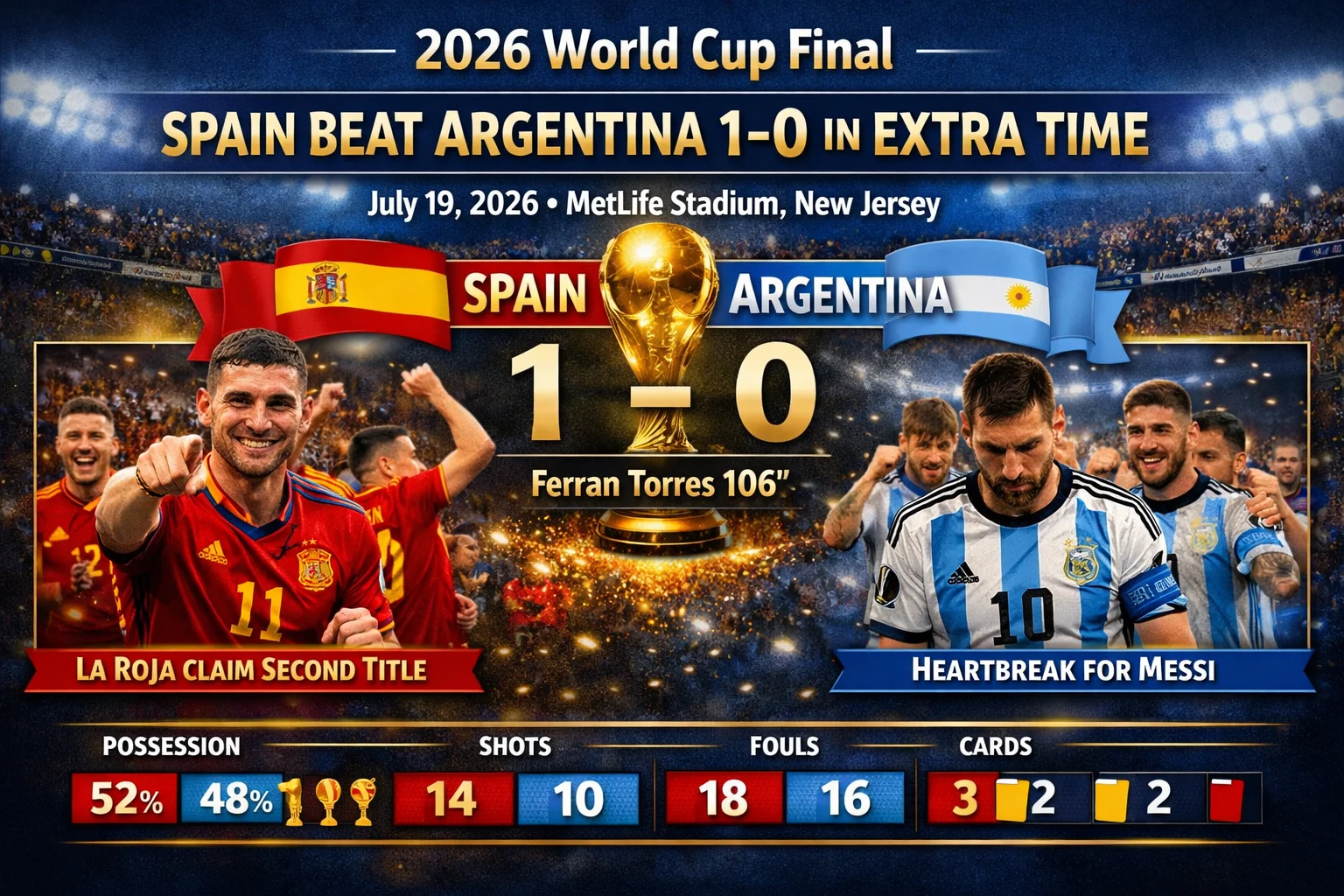
Quick Answer: Spain defeated Argentina 1-0 after extra time in the 2026 FIFA World Cup Final, played on July 19, 2026 at MetLife Stadium in East Rutherford, New Jersey, with Ferran Torres scoring the only goal of the match in the 106th minute.
After 98 goalless minutes and a tension that had settled over MetLife Stadium like a fog, Ferran Torres finally broke Argentina’s resistance in the 106th minute, sending Spain into delirium and confirming them as world champions for the second time in the nation’s history. It was a final that never quite exploded into open chaos, but one that carried the full emotional weight of Lionel Messi’s likely final World Cup appearance, decided by a single moment of composure deep into extra time.
This guide breaks down the complete 2026 World Cup Final result, the key moments that decided the match, the records it set, and what it means for both nations heading into the next cycle of international football.
2026 World Cup Final: Match Result
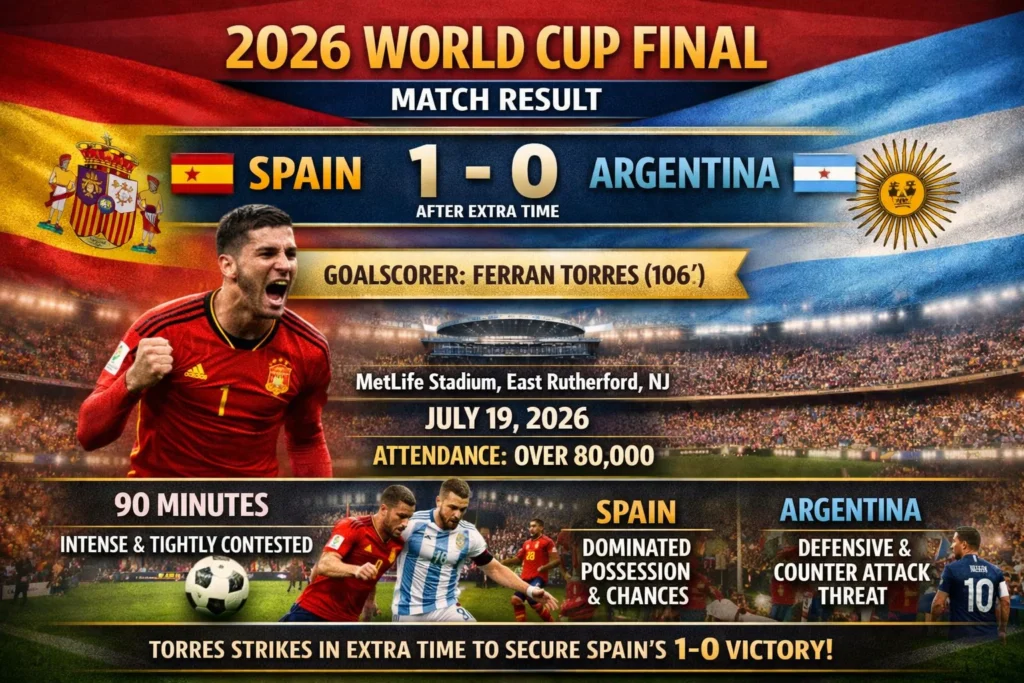
Spain 1-0 Argentina (after extra time) Goalscorer: Ferran Torres (106′) Venue: MetLife Stadium, East Rutherford, New Jersey Date: July 19, 2026 Attendance: Over 80,000
The match remained goalless through a cagey, tightly contested 90 minutes, with both teams wary of conceding an opening in the biggest game of their careers. Spain’s possession-based approach dominated territory and chances, while Argentina, marshaled by a Messi playing in his third World Cup final, looked to hold their defensive shape and search for moments of individual brilliance on the counter-attack.
How the Match Unfolded
Normal Time: A Cagey, Goalless Stalemate
Spain controlled the majority of possession throughout normal time, patiently probing Argentina’s well-organized defensive block without finding a clear breakthrough. Argentina’s own attacking threat was heavily reliant on quick transitions, though Spain’s disciplined defensive structure, marshaled effectively through the middle of the park, limited clear sight of goal for Messi and his teammates. The match reached the 90th minute still scoreless, sending the final to extra time for the first time since 2022.
Extra Time: Torres Delivers the Decisive Moment
Deep into the second period of extra time, with fatigue visibly setting in on both sides, Ferran Torres found the breakthrough Spain had been searching for since kickoff. His finish in the 106th minute proved to be the only goal Spain would need, sealing a hard-fought, ultimately deserved victory built on control and patience rather than a flurry of chances.
Key Statistics From the Final
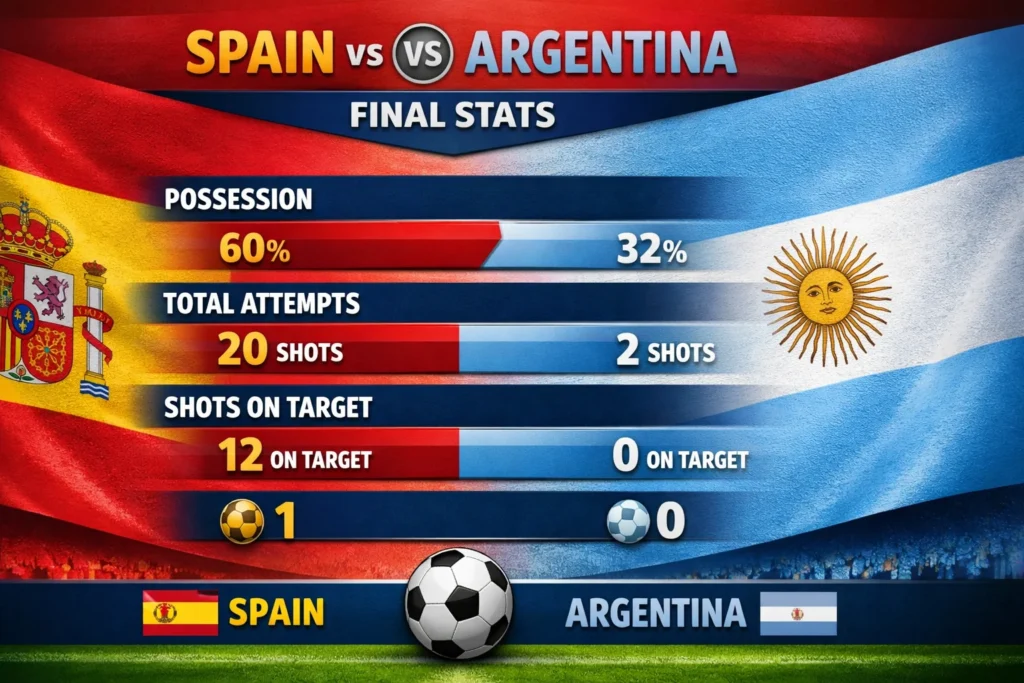
| Statistic | Spain | Argentina |
|---|---|---|
| Possession | 60% | 32% |
| Total Attempts at Goal | 20 | 2 |
| Shots on Target | 12 | 0 |
| Goals | 1 | 0 |
Argentina’s statistical output reflects just how effectively Spain controlled the match throughout, managing just two total attempts across the full 120 minutes, with neither shot registering on target. Rodri’s performance in midfield was widely credited with limiting Messi’s influence on the game, keeping the Argentine captain away from dangerous central areas for the majority of the final.
What This Result Means for Spain
Spain’s victory secures their second FIFA World Cup title, following their previous triumph in 2010. The win also makes Spain the first nation in football history to simultaneously hold both the men’s and women’s FIFA World Cup titles, a landmark achievement reflecting the broader strength and depth of Spanish football at both the senior men’s and women’s international level.
What This Result Means for Argentina and Messi
For Argentina, the final represents a narrow miss at becoming the first nation to win back-to-back World Cup titles since Brazil in 1962, following their triumph at the 2022 tournament in Qatar. For Lionel Messi, this final marked his third World Cup final appearance as a starter, a feat no other player has achieved, and is widely expected to be his last World Cup as Argentina’s captain given his age and the natural progression of the national team’s playing squad heading toward the next cycle.
Records Set by the 2026 World Cup Final
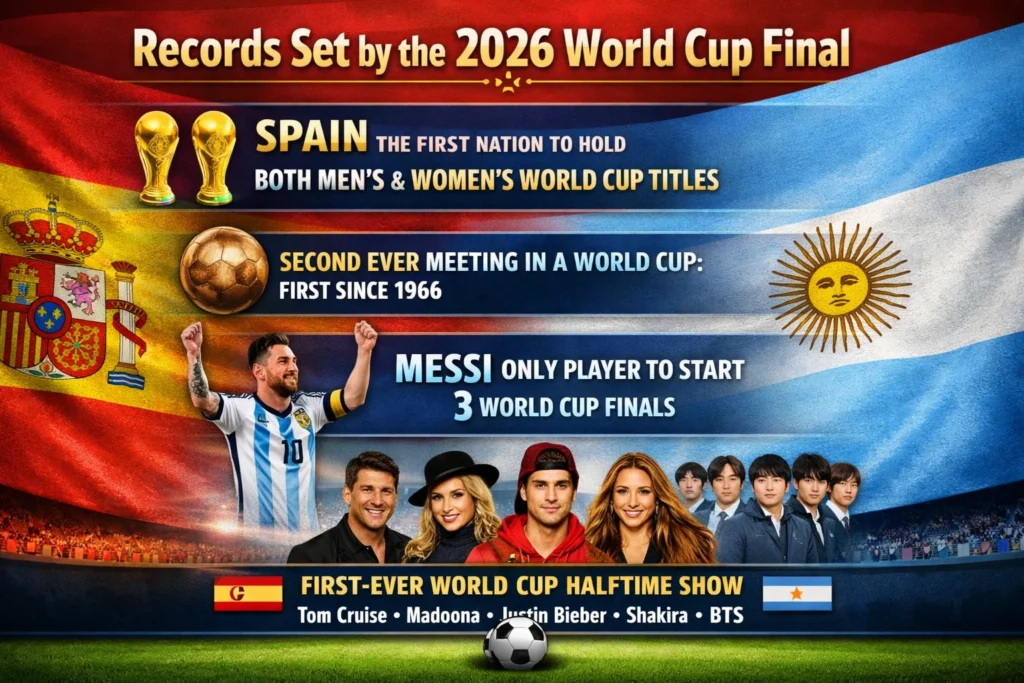
- Spain became the first nation to hold both the men’s and women’s FIFA World Cup titles at the same time.
- The final marked only the second meeting between Spain and Argentina at a World Cup, following a 2-1 Argentina win at the 1966 tournament, sixty years earlier.
- Messi’s appearance made him the only player in World Cup history to start three separate World Cup finals.
- The 2026 final featured the tournament’s first-ever World Cup halftime show, with performers including Tom Cruise, Madonna, Justin Bieber, Shakira, and BTS.
The Road to the Final
Both finalists navigated a demanding, expanded 48-team tournament structure to reach the final, the first World Cup played under this larger format. Spain’s route to the final was built on a consistent, possession-dominant style throughout the knockout rounds, while Argentina leaned on Messi’s continued influence and a well-organized defensive structure to progress through their own bracket. The expanded format meant both nations faced an additional knockout round compared to previous tournaments, adding extra physical and mental demands heading into the final itself.
How the Broader Tournament Unfolded
The 2026 World Cup, hosted jointly across the United States, Mexico, and Canada, opened on June 11 and concluded with the July 19 final, marking the first time three nations have co-hosted the competition. The United States, as one of the host nations, reached the Round of 16 before being eliminated by Belgium in a 4-1 defeat. Kylian Mbappé finished the tournament as the Golden Boot winner with 10 goals, becoming the first player to win the award at consecutive World Cups following his previous Golden Boot at the 2022 tournament in Qatar.
Rodri’s Midfield Masterclass
Much of the post-match analysis centered on Rodri’s influence in central midfield, widely credited by pundits and opposing analysts as the single most important individual factor in Spain’s ability to control the match’s tempo from start to finish. By consistently screening Argentina’s central attacking options and limiting Messi’s touches in dangerous areas, Rodri effectively neutralized Argentina’s primary attacking threat without needing to rely on physical, high-risk challenges that might have exposed Spain defensively. His performance capped a tournament in which Spain’s midfield structure repeatedly proved decisive against opponents who struggled to find sustained possession against their well-drilled press and passing patterns.
The Legacy of the 2026 World Cup
Beyond the final itself, the broader 2026 tournament will likely be remembered as a genuine turning point for the competition’s format and global reach. The expansion to 48 teams, the largest field in the tournament’s history, brought a wider range of nations into the finals than ever before, while the joint hosting arrangement across the United States, Mexico, and Canada marked the first time three countries have shared hosting duties for a single World Cup. The tournament’s unprecedented scale, combined with the emotional weight of Messi’s likely final appearance and Spain’s historic double achievement, gives this edition a strong claim to being remembered as one of the most significant World Cups in the competition’s near-century of history.
How Spain’s Squad Built Toward This Moment
Spain’s triumph reflects a sustained period of squad development and tactical continuity extending back several years before the tournament itself. Building on a core group of technically gifted midfielders and a possession-based playing philosophy consistent with the country’s broader footballing identity, Spain’s coaching staff prioritized control and patience over the tournament’s knockout rounds, a strategy that paid off decisively in a final where taking early risks against a dangerous Argentina side could have proven costly. This measured, disciplined approach throughout the tournament stood in contrast to some of the more chaotic, high-scoring matches seen elsewhere in the expanded 48-team format, reinforcing Spain’s reputation as one of international football’s most tactically consistent national teams over the past two decades.
Frequently Asked Questions
Who won the 2026 FIFA World Cup Final? Spain won the 2026 FIFA World Cup Final, defeating Argentina 1-0 after extra time on July 19, 2026, at MetLife Stadium.
Who scored the winning goal in the 2026 World Cup Final? Ferran Torres scored the only goal of the match in the 106th minute of extra time, securing Spain’s 1-0 victory.
Was this Lionel Messi’s last World Cup? While not officially confirmed at the time, the 2026 final is widely expected to be Messi’s final World Cup appearance for Argentina given his age and career stage.
How many World Cup titles has Spain won? Spain has won two FIFA World Cup titles, in 2010 and 2026, with both trophies coming under different generations of Spanish players.
Who won the Golden Boot at the 2026 World Cup? Kylian Mbappé won the Golden Boot with 10 goals, becoming the first player to win the award at consecutive World Cups (2022 and 2026).
Where was the 2026 World Cup Final played? The final was played at MetLife Stadium in East Rutherford, New Jersey, as part of the tournament jointly hosted by the United States, Mexico, and Canada.
Conclusion
The 2026 World Cup Final will likely be remembered less for end-to-end drama and more for the weight of what it represented: Spain’s return to the summit of world football sixteen years after their first triumph, and the probable final chapter of Lionel Messi’s extraordinary World Cup career. Ferran Torres’s extra-time strike settled a tense, tightly contested contest between two of the tournament’s strongest sides, closing out the biggest World Cup ever held with a result that will be analyzed and remembered for years to come. Want to explore more about the tournament’s full history? Check out our guide on Football World Cup History for the complete century-long story of the competition.