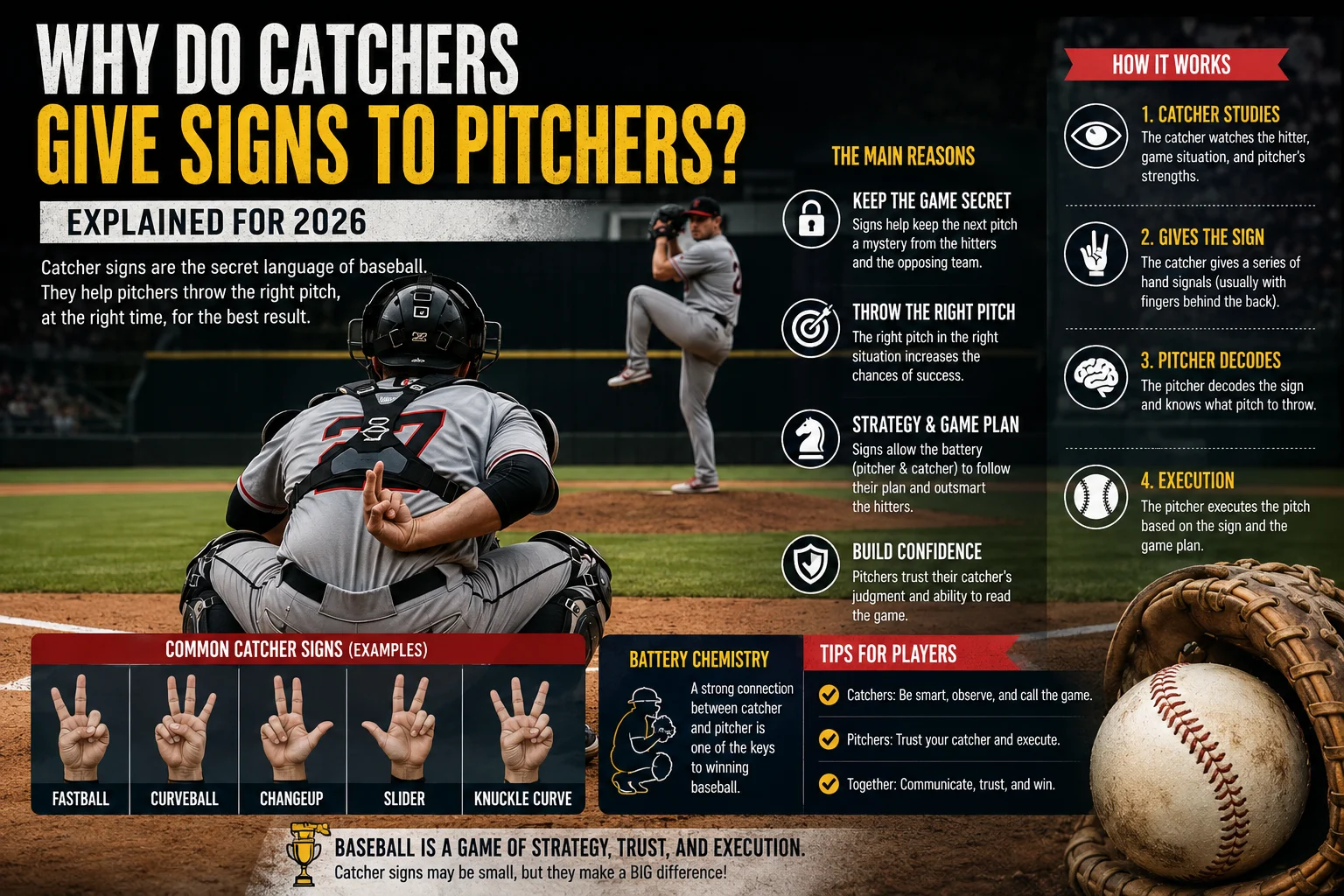
Quick Answer: Catchers give signs to pitchers to communicate which pitch to throw and where to locate it, allowing the two players to coordinate strategy without an opponent overhearing. This system exists both to keep the batter guessing and to prevent baserunners or opposing teams from illegally stealing the signs and relaying the upcoming pitch to the hitter.
Every single pitch in a baseball game is preceded by a silent negotiation, a catcher flashing a sequence of fingers between his legs, a pitcher nodding or shaking his head in response, all happening in under five seconds and largely invisible to anyone not specifically watching for it. This century-old ritual very nearly cost one franchise its reputation entirely, and it directly led to one of the more unusual pieces of technology now built into modern player caps across the league.
This guide explains exactly why do catchers give signs to pitchers, how the finger-signal system actually works, why it has to be hidden, and how a real sign-stealing scandal changed the way signs are communicated across professional baseball forever.
The Basic Purpose of Catcher Signs
At its core, a catcher’s sign exists to answer one critical question before every single pitch: what type of pitch is coming, and where should it be located on the plate. According to Paul Dickson, author of a book examining the history of baseball signs, the system works because “the pitcher’s mind is also the catcher’s mind,” with both players needing to agree on the pitch before it’s ever thrown toward home plate. Without this coordination, a catcher expecting a slow curveball but instead receiving a 99-mile-per-hour fastball risks serious injury from being caught completely off guard, making signs as much a safety mechanism as a strategic one for the entire battery.
How the Traditional Finger-Signal System Works
The most common traditional system involves the catcher using the fingers of his throwing hand, positioned between his legs while squatting, to indicate the pitch type to the pitcher. Generally, one finger signals a fastball, two fingers signal a breaking ball like a curveball or slider, and three fingers signal an off-speed pitch such as a changeup, though specific sequences can vary between different pitcher-catcher pairings and organizations. The pitcher then nods or subtly shakes his head from the mound until both players agree on the selected pitch, completing the silent exchange in just a few seconds before the pitcher begins his windup.
Why Signs Need to Be Hidden From the Batter
The entire value of a sign system depends on the batter having no advance knowledge of what pitch is coming, since a hitter who knows in advance can adjust their timing and significantly increase their chances of making solid contact. Catchers position their throwing hand deep between their legs specifically to block the batter’s direct line of sight, while using their glove hand and body positioning to further obscure the signal from any other angle. This concealment becomes even more critical whenever a baserunner reaches second base, since that position offers a clear, direct sightline into the catcher’s signs that isn’t available from home plate itself.
Legal vs. Illegal Sign Stealing
Not all sign stealing in baseball is considered against the rules, and the distinction matters considerably for how the sport treats different situations. According to baseball historians, legally observing and relaying signs, such as a runner on second base picking up a catcher’s signals through visual observation alone and relaying that information to the batter through a gesture, has always been considered a legitimate part of the game. Illegal sign stealing, by contrast, involves using external mechanical or electronic technology to gain an advantage beyond what a player could observe naturally on the field, a distinction that became the center of one of baseball’s biggest modern scandals.
The Astros Scandal That Changed Everything
In 2017, the Houston Astros were found to have used a center-field camera to illegally capture opposing catchers’ signs during their World Series championship season, relaying the stolen information to players by banging on a trash can in the dugout to signal the upcoming pitch type in real time. The scandal became public in 2019 when former Astros pitcher Mike Fiers spoke publicly about the scheme, triggering a significant MLB investigation and a wave of public criticism that Sports Illustrated writer Tom Verducci described as “too big of a sin in baseball to be washed away ever.” This scandal fundamentally changed how MLB approached sign security going forward, accelerating the league’s search for a more secure communication method.
PitchCom: The Technology That Ended Hand Signals
In direct response to the sign-stealing controversy, MLB introduced PitchCom for the 2023 season, an electronic device that allows catchers to transmit pitch calls directly and securely to the pitcher. The system works through a player-worn transmitter, typically strapped to the catcher’s wrist, that sends a signal to a small speaker embedded inside the pitcher’s cap, allowing the pitcher to hear the pitch call rather than needing to see a visual signal at all. While many teams and players have adopted PitchCom, some pitchers and catchers still prefer traditional hand signal sequencing, particularly in situations where the technology experiences any communication delay or malfunction during a game.
Sign Systems: Traditional vs. Modern Comparison
| Aspect | Traditional Hand Signs | PitchCom |
|---|---|---|
| Method | Finger signals between the legs | Electronic transmitter and earpiece |
| Vulnerable to visual theft? | Yes, especially from second base | No |
| Introduced | Used for over a century | 2023 MLB season |
| Requires visual line of sight? | Yes | No |
| Adoption level | Still used by some teams and pairings | Widely adopted across MLB |
How Signs Change With Runners on Base
The complexity of a sign system isn’t static throughout a game, adjusting specifically based on which bases are occupied by baserunners at any given moment. With no runners on base, catchers can typically use the simplest version of their signs, since neither the batter nor any opposing player has a meaningful vantage point to observe them. Once a runner reaches first or third base, catchers generally maintain the same basic signs but work to hide them deeper within their squat, since neither of those two base positions offers a particularly clear sightline into the signal itself. The real shift happens the moment a runner reaches second base, the only position on the field offering a direct, unobstructed view into the catcher’s signs, prompting teams to switch to more complex, disguised sequences specifically to prevent that runner from relaying the pitch type back to the batter.
Famous “Tells” in Baseball History
Beyond deliberately stolen signs, some pitchers have inadvertently given away their pitch selection through unconscious physical habits known as “tells.” According to baseball historians, legendary player Babe Ruth reportedly curled his tongue before throwing a curveball, an unintentional signal that opposing hitters could learn to recognize and exploit over time. Unlike illegal sign stealing involving electronic equipment, decoding these unintentional tells has always been considered a completely legitimate part of the game, reflecting the same principle that applies to legally observed hand signals: if information can be gathered through pure observation and attention to detail, using it has traditionally been accepted as fair competitive advantage.
Teaching Sign Systems at the Youth and Amateur Level
Youth and amateur baseball programs introduce sign systems considerably earlier in a player’s development than many fans might expect, recognizing that pitcher-catcher communication is a foundational skill regardless of competition level. Coaches typically start with extremely simple systems, often just one or two signs distinguishing a fastball from an off-speed pitch, gradually introducing more complex sequences as players mature and better understand game situations requiring concealment from opponents. Some youth programs teach players to steal opposing signs specifically as a positive, encouraged skill, reflecting an interesting cultural difference compared to the more nuanced “unwritten rules” debate that exists around sign stealing at the professional level.
Frequently Asked Questions
Why do catchers give signs to pitchers? Catchers give signs to communicate which pitch to throw and where to locate it, coordinating strategy silently while preventing the batter from knowing what’s coming.
What does it mean when a catcher puts down one finger versus two? Generally, one finger signals a fastball, two fingers signal a breaking ball like a curveball, and three fingers signal an off-speed pitch, though sequences vary by team.
Is stealing a catcher’s signs against the rules? It depends. Visually observing and relaying signs naturally, such as from a runner on second base, has always been considered legal, while using electronic or mechanical technology to steal signs is illegal.
What was the Houston Astros sign-stealing scandal? In 2017, the Astros used a center-field camera to illegally steal opposing catchers’ signs, relaying the information to batters by banging on a trash can, a scandal that became public in 2019.
What is PitchCom in baseball? PitchCom is an electronic device introduced in 2023 that allows catchers to transmit pitch calls directly to a speaker in the pitcher’s cap, replacing the need for visible hand signals.
Do all MLB teams use PitchCom now? Most teams have adopted PitchCom to some degree, though some pitchers and catchers still use traditional hand signals, particularly as a backup during technical issues.
How do signs change when a runner reaches second base? Since second base offers the only clear sightline into a catcher’s signs, teams typically switch to more complex, disguised sequences specifically to prevent that runner from relaying the pitch to the batter.
What is a “tell” in baseball, and is it legal to use one? A tell is an unintentional physical habit that reveals a pitcher’s upcoming pitch, and decoding these has always been considered a legitimate part of the game, unlike illegal electronic sign stealing.
Conclusion
So, why do catchers give signs to pitchers? At its core, it’s a simple coordination problem, ensuring both players agree on the pitch before it’s thrown, but the system’s need for secrecy has shaped everything from finger sequences to a genuine sport-altering scandal and the electronic technology that followed. From Babe Ruth’s unintentional curveball tell to the Astros’ trash-can scheme and PitchCom’s modern solution, understanding this silent negotiation happening before every single pitch adds a layer of strategic depth to a moment most fans never think to look for.

Emily Parker is a sports journalist at SportsOrbitX.com with a passion for covering cricket, tennis and major international sporting events. She is committed to producing clear, reliable and engaging content for sports enthusiasts worldwide.