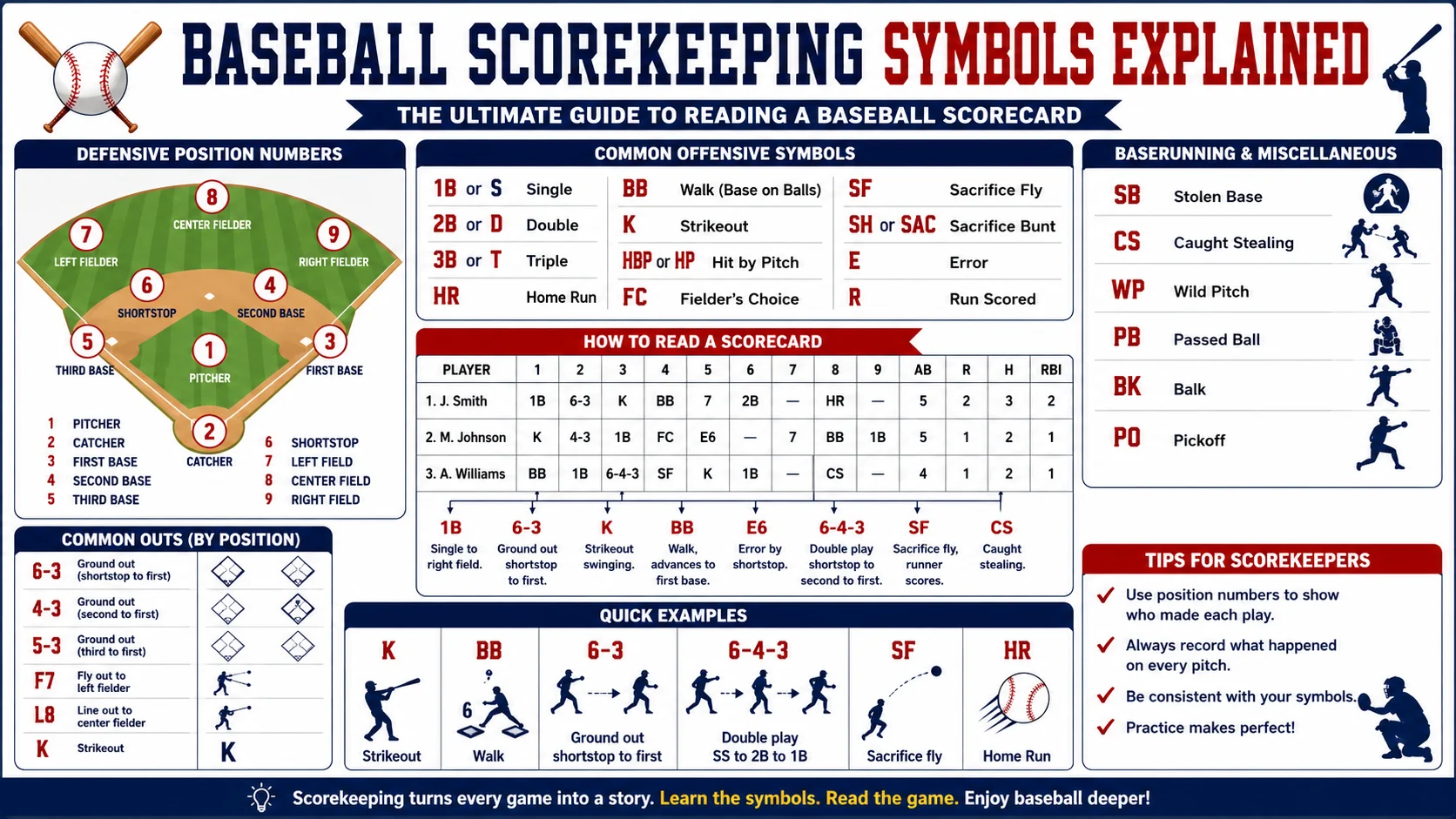
Baseball scorekeeping symbols are shorthand codes used to record every important play in a game. Numbers 1–9 identify defensive positions, while symbols such as K for strikeout, BB for walk, E for error, and 6-3 for a shortstop-to-first-base groundout show exactly what happened. Although scorekeepers may use slightly different personal notations, the basic system is widely understood across baseball.
What Do Baseball Scorekeeping Symbols Mean?
Baseball scorekeeping symbols are a compact language for recording hits, outs, walks, errors, stolen bases, defensive plays, and runs on a scorecard.
The most important symbols to know are:
| Symbol | Meaning |
|---|---|
| 1 | Pitcher |
| 2 | Catcher |
| 3 | First baseman |
| 4 | Second baseman |
| 5 | Third baseman |
| 6 | Shortstop |
| 7 | Left fielder |
| 8 | Center fielder |
| 9 | Right fielder |
| K | Strikeout |
| BB | Walk |
| E | Error |
| HR | Home run |
| 1B / S | Single |
| 2B / D | Double |
| 3B / T | Triple |
| FC | Fielder’s choice |
| DP | Double play |
| SB | Stolen base |
| CS | Caught stealing |
| SF | Sacrifice fly |
| SH / SAC | Sacrifice bunt |
| HBP / HP | Hit by pitch |
| WP | Wild pitch |
| PB | Passed ball |
MLB’s basic scorekeeping guide uses these symbols and notes that different fans may develop their own notation systems.
Why Does Baseball Use Scorekeeping Symbols?
A baseball game can contain hundreds of individual events. Writing a complete sentence for every pitch or play would make a scorecard slow and difficult to read.
Instead, scorekeepers use a shorthand system.
For example:
6-3
can tell you much more than it appears to at first glance.
It means:
- 6 = shortstop
- 3 = first baseman
- The shortstop fielded the ball and the first baseman recorded the putout.
So, 6-3 = groundout from shortstop to first base.
This numbering system gives a scorecard something close to its own baseball language. The standard defensive numbers run from pitcher 1 through right field 9.
Baseball Position Numbers Explained
Before learning individual scoring symbols, memorize these nine numbers.
| Number | Position | Common Abbreviation |
|---|---|---|
| 1 | Pitcher | P |
| 2 | Catcher | C |
| 3 | First Base | 1B |
| 4 | Second Base | 2B |
| 5 | Third Base | 3B |
| 6 | Shortstop | SS |
| 7 | Left Field | LF |
| 8 | Center Field | CF |
| 9 | Right Field | RF |
These numbers are the foundation of traditional baseball scorekeeping.
The Easy Way to Remember Them
Think of the numbers from the middle of the field outward:
1 → Pitcher
2 → Catcher
3 → First Base
4 → Second Base
5 → Third Base
6 → Shortstop
7 → Left Field
8 → Center Field
9 → Right Field
Once these nine numbers become familiar, reading a scorecard becomes dramatically easier.
The Most Common Baseball Scorekeeping Symbols K = Strikeout
K represents a strikeout.
For example:
K
means the batter struck out.
A backward or reversed K is traditionally used to indicate a called third strike, while a standard K commonly represents a swinging strikeout. MLB specifically identifies K as the strikeout symbol.
Why Is a Strikeout Called K?
The K dates back to the early development of baseball scorekeeping by Henry Chadwick. The letter was chosen because “S” was already being used for sacrifice.
BB = Walk
BB means base on balls, commonly called a walk.
If a batter receives four balls and reaches first base without putting the ball in play, the scorekeeper records:
BB
An intentional walk can be recorded as:
IBB
E = Error
E means a defensive error.
For example:
E6
means the shortstop committed an error.
E4
means the second baseman committed an error.
An error is charged when the official scorer determines that a fielder failed to make a play that an average fielder should have made, or made a poor play that allowed runners to advance.
HR = Home Run
HR means home run.
A home run allows the batter to circle all four bases and score.
On many traditional scorecards, the batter’s path around the diamond is also marked as he advances.
1B or S = Single
A single means the batter reaches first base safely on a hit.
Common notations include:
1B
or
S
Some traditional scorekeeping systems also use a short horizontal mark to represent a single.
2B or D = Double
A double means the batter reaches second base safely on a hit.
Common notation:
2B
or
D
Traditional scorecards may represent it with an equal-sign style mark.
3B or T = Triple
A triple means the batter reaches third base safely on a hit.
Common notation:
3B
or
T
MLB’s basic scoring guide lists T/3B as the standard shorthand for a triple.
What Does 6-3 Mean in Baseball?
This is one of the most important scorekeeping codes to understand.
6-3 means shortstop to first baseman.
If a batter hits a ground ball to the shortstop and the shortstop throws to first for the out, the scorekeeper writes:
6-3
The first number tells you who fielded the ball.
The second number tells you who recorded the putout.
For example:
5-3
Third baseman → first baseman
4-3
Second baseman → first baseman
1-3
Pitcher → first baseman
6-3
Shortstop → first baseman
This is why learning the position numbers is so valuable: once you know them, defensive plays become almost instantly readable. MLB uses 6-3 as the standard example of a groundout to first after the shortstop fields the ball.
Understanding Multi-Number Plays
Some defensive plays involve several players.
For example:
6-4-3
means:
Shortstop → Second baseman → First baseman
This is a classic double-play sequence.
The shortstop fields the ball, sends it to the second baseman for one out, and the second baseman throws to first for the second out.
Another example:
5-4-3
means:
Third baseman → Second baseman → First baseman
The numbers are essentially telling the story of the ball.
Baseball Out Symbols Explained
Not every out is recorded with a number sequence.
F = Fly Ball Out
F7 means the batter hit a fly ball caught by the left fielder.
F8 = fly ball caught by center fielder.
F9 = fly ball caught by right fielder.
The fielder’s number identifies who made the catch.
L = Line Drive Out
L6 means a line drive was caught by the shortstop.
L8 means a line drive was caught by the center fielder.
FO = Force Out
FO identifies a force out.
This happens when a runner is forced to advance because the batter becomes a runner.
For example, a ground ball can result in a force play at second base.
FC = Fielder’s Choice
FC means fielder’s choice.
The batter reaches base because the defense chooses to attempt an out on another runner rather than simply recording an out on the batter.
This can look confusing on a scorecard because the batter reaches safely, but the play is not scored as a base hit.
Baserunning Symbols
Baseball scorekeeping doesn’t stop when the batter reaches base. A good scorecard also tracks what happens to runners.
| Symbol | Meaning |
|---|---|
| SB | Stolen base |
| CS | Caught stealing |
| WP | Wild pitch |
| PB | Passed ball |
| BK | Balk |
| PO | Pickoff |
| R | Run scored |
SB = Stolen Base
SB means a runner successfully stole a base.
CS = Caught Stealing
CS means a runner attempted to steal but was thrown out.
WP = Wild Pitch
WP records a wild pitch that allows a runner to advance.
PB = Passed Ball
PB indicates a passed ball charged to the catcher that allows a runner to advance.
These distinctions matter because a wild pitch and passed ball are not simply interchangeable labels; they are separate scoring classifications.
Sacrifice Symbols
Sacrifices are another common part of a baseball scorecard.
SH or SAC = Sacrifice Bunt
A sacrifice bunt is recorded as:
SH
or
SAC
The batter intentionally bunts to advance a runner, usually accepting an out in exchange for the advancement.
SF = Sacrifice Fly
SF means sacrifice fly.
It commonly occurs when a batter hits a fly ball deep enough for a runner to score after the catch.
MLB’s scorekeeping guide lists both SH/SAC and SF as standard abbreviations.
Hit by Pitch: HBP or HP
If a batter is hit by a pitch and awarded first base, the scorekeeper may record:
HBP
or
HP
This is different from a walk because the batter reaches first after being hit by the pitch rather than receiving four balls.
How to Read a Baseball Scorecard Example
Imagine you see this sequence:
6-3
K
BB
7
At first, it may look like random numbers and letters.
But it actually tells a complete story:
- 6-3: Groundout from shortstop to first.
- K: Strikeout.
- BB: Walk.
- 7: Fly out to left field.
That’s the beauty of scorekeeping: a few symbols can preserve an entire sequence of game action.
A Simple Baseball Scorekeeping Cheat Sheet
Save this section if you’re learning to keep score for the first time.
| Category | Symbol | Meaning |
|---|---|---|
| Hit | 1B / S | Single |
| Hit | 2B / D | Double |
| Hit | 3B / T | Triple |
| Hit | HR | Home run |
| Walk | BB | Base on balls |
| Strikeout | K | Strikeout |
| Hit by pitch | HBP / HP | Batter hit by pitch |
| Error | E | Defensive error |
| Fielder’s choice | FC | Fielder’s choice |
| Sacrifice bunt | SH / SAC | Sacrifice |
| Sacrifice fly | SF | Sacrifice fly |
| Stolen base | SB | Stolen base |
| Caught stealing | CS | Caught stealing |
| Wild pitch | WP | Wild pitch |
| Passed ball | PB | Passed ball |
| Balk | BK | Balk |
| Double play | DP | Double play |
| Fly out | F | Fly ball out |
| Line out | L | Line drive out |
Are Baseball Scorekeeping Symbols Universal?
Not completely.
This is an important point for beginners.
There is a widely recognized traditional system, but individual scorekeepers may use slightly different symbols or personal shorthand. MLB itself notes that different fans use different methods of keeping a scorecard.
For example, one scorekeeper might write:
1B
while another uses:
S
for a single.
Both can be perfectly understandable.
The important thing is to use a system consistently and make sure you understand what your symbols mean.
Why Learning Scorekeeping Is Worth It
Scorekeeping may look old-fashioned in an era of digital statistics, but it gives fans something a scoreboard cannot: the story of the game.
A box score can tell you that a player went 2-for-4.
A scorecard can tell you:
- Which inning each hit occurred.
- How the player reached base.
- Who advanced the runners.
- Which fielder made the play.
- How the player eventually scored.
- How the defense created an out.
In other words, a scorecard doesn’t just tell you what happened. It helps you reconstruct how it happened.
Final Thoughts
Baseball scorekeeping symbols may seem complicated at first, but the system becomes surprisingly simple once you learn the position numbers and most common abbreviations.
Remember these first:
1–9 = defensive positions
K = strikeout
BB = walk
E = error
HR = home run
SB = stolen base
FC = fielder’s choice
DP = double play
And remember that a sequence such as 6-3 is not a score it is a description of the defensive play: shortstop to first baseman for the out.
Once those basics become second nature, the mysterious symbols on a baseball scorecard start reading like a miniature play-by-play account. That’s what makes scorekeeping so rewarding: long after the final pitch, the pencil marks can still tell the story of the game.

Emily Parker is a sports journalist at SportsOrbitX.com with a passion for covering cricket, tennis and major international sporting events. She is committed to producing clear, reliable and engaging content for sports enthusiasts worldwide.