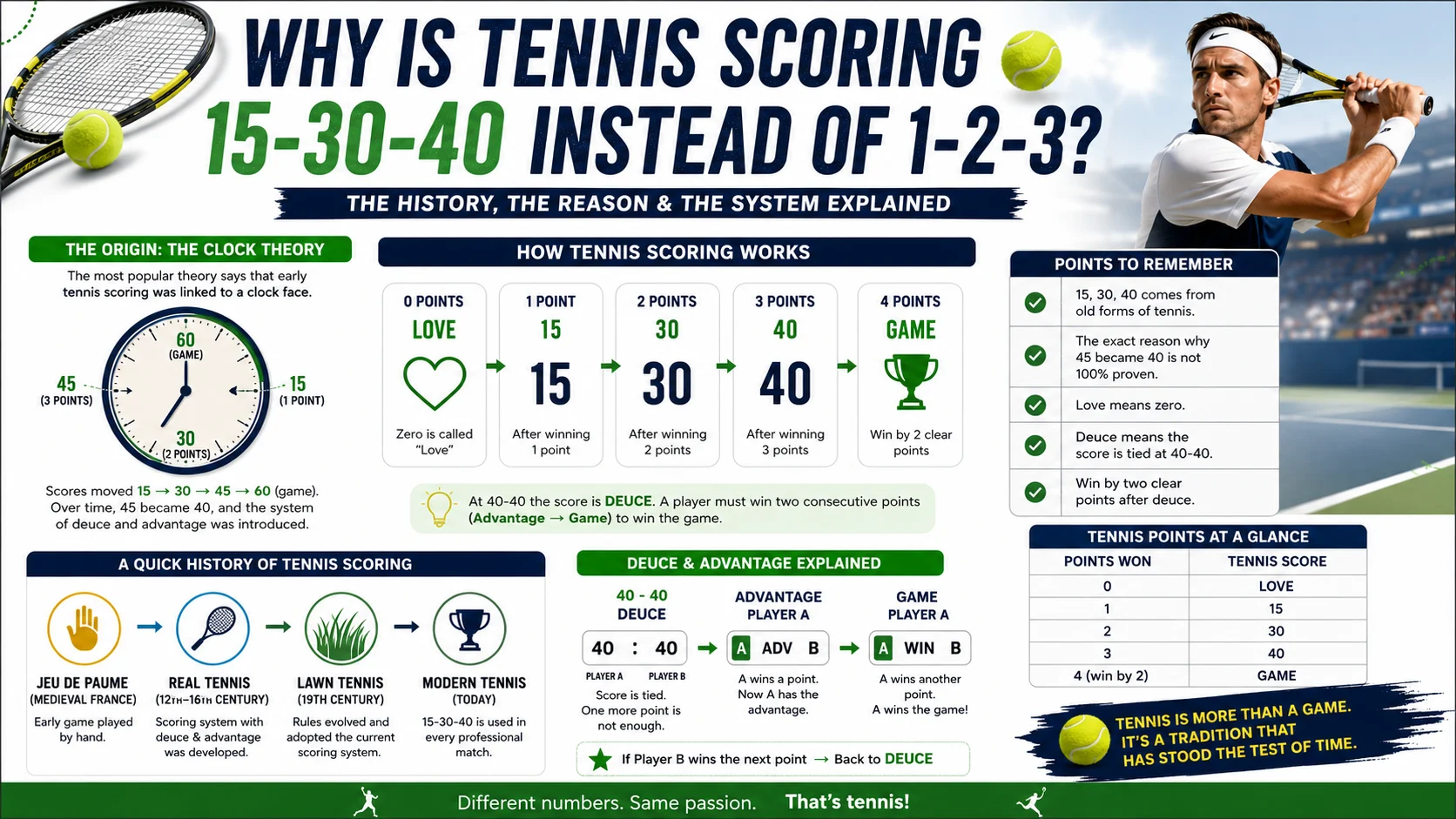
Tennis uses 15, 30 and 40 instead of 1, 2 and 3 because its scoring system developed from older forms of the game, particularly real tennis. The exact origin is not completely proven, but one popular theory connects the numbers to a clock-face scoring system that originally used 15, 30, 45 and 60. Over time, 45 became 40, creating the unusual scoring pattern used today.
Why is tennis scored 15-30-40?
The short answer is: nobody can prove one single explanation with complete certainty.
The most famous theory says that early tennis scoring was connected to a clock face. A point moved the score to 15, then 30, then 45, with 60 representing the game. The 45 was eventually changed to 40, while the older system of deuce and advantage remained.
However, historical evidence is not strong enough to say that the clock theory is definitely the origin. Modern historical accounts describe several theories, and even experts have acknowledged that the precise reason for the numbers remains uncertain.
Tennis Scoring Looks Strange for a Reason
If you’re new to tennis, the first score can sound almost like a secret language:
Love–15.
Then:
15–15.
Then:
30–15.
Then suddenly:
40–15.
And after that?
Game.
Why not simply say 1–0, 2–0, 3–0, 4–0?
It’s a fair question.
Unlike most modern sports, tennis carries a scoring system that has survived centuries of changes to equipment, courts, tournaments and playing styles.
The numbers 15, 30 and 40 aren’t random, but the complete story behind them is more complicated and more interesting than the simple explanations you often see online.
What Do 15, 30 and 40 Mean in Tennis?
At the most basic level, the numbers represent points won within a game.
| Points Won | Tennis Score |
|---|---|
| 0 | Love |
| 1 | 15 |
| 2 | 30 |
| 3 | 40 |
| 4 | Game, if ahead by 2 |
The International Tennis Federation currently defines the scoring sequence as love, 15, 30 and 40. At 40-40, the score becomes deuce, and a player must win two consecutive points from deuce to take the game.
So why isn’t the third point called 45?
That’s where the mystery begins.
The Famous Clock Theory
The explanation you’ll hear most often is that tennis scoring was once associated with a clock face.
Imagine an old scoreboard represented by a clock.
The four major positions would be:
15 → 30 → 45 → 60
Each point would move the score forward by 15.
That makes the sequence look much more logical:
15 + 15 + 15 + 15 = 60
And 60 represents a completed game.
This theory is widely repeated in tennis history and has been popularized by players, commentators and tennis publications.
But there’s an important catch:
The clock theory is a theory not a proven historical fact.
That’s a distinction worth making because many articles present the clock explanation as though historians have conclusively established it.
They haven’t.
So Why Did 45 Become 40?
This is arguably the most interesting part of the story.
If the original sequence was supposedly:
15 → 30 → 45 → 60
why does modern tennis say:
15 → 30 → 40 → Game?
The commonly repeated explanation is that 45 was shortened to 40 to make the scoring system work better with the introduction of deuce and advantage.
Under this explanation, once a player reached 40, winning the next point would put them at advantage rather than immediately ending the game. If they lost that point, the score could return to deuce.
It is a neat explanation.
But again, the historical evidence isn’t strong enough to prove that this was exactly how the change happened.
Recent discussions of tennis history note that records indicate 45 was used in earlier forms of scoring, while the precise reason for changing it to 40 remains uncertain.
That’s why the safest answer is:
We know the scoring system evolved over time, but we don’t know with certainty why 40 replaced 45.
The Real Origin Goes Back to Older Tennis
To understand the scoring system, you have to go further back than modern lawn tennis.
The ancestors of today’s tennis include jeu de paume, an old French handball game that eventually developed into the indoor game known as real tennis.
The International Tennis Federation traces the development of tennis back to medieval France, where early versions were played by hand before rackets eventually appeared.
This matters because modern lawn tennis didn’t invent its entire scoring system from scratch.
When lawn tennis developed in the 19th century, some of its rules and traditions were borrowed from older forms of tennis.
In fact, the ITF notes that in 1876, the Marylebone Cricket Club changed several early lawn-tennis rules, replacing the original first-to-15 scoring with a system based on real tennis, including deuce and advantage.
So today’s strange-looking score is partly a historical inheritance.
Tennis Originally Didn’t Always Use 15-30-40
Here’s a fact many people miss:
Early lawn tennis didn’t necessarily use today’s scoring system.
The version of lawn tennis associated with Major Walter Clopton Wingfield used a scoring system similar to badminton, with games played to 15.
Later, as the sport developed and governing organizations standardized its rules, the scoring system associated with older forms of tennis became part of lawn tennis.
That means 15-30-40 wasn’t simply chosen one day because someone thought it sounded good.
It was the result of rules evolving and older traditions being carried into the modern sport.
Why Does Tennis Say “Love” Instead of Zero?
The weirdness doesn’t stop at 15-30-40.
Tennis also uses “love” for zero.
So instead of saying:
0–15
the umpire says:
Love–15.
The exact origin of “love” is also debated.
One popular explanation connects it with the French word l’œuf, meaning “egg,” because a zero resembles an egg.
Another possibility is that “love” developed from an older expression meaning playing for nothing or without scoring.
The important point is that, like the 15-30-40 system, the origin of “love” isn’t as definitively established as many quick internet explanations suggest.
What we do know is that love means zero in modern tennis.
Why Does Tennis Use Deuce?
Now the scoring system starts to make sense.
Suppose the score is:
40–40
That’s called deuce.
At this point, winning one point isn’t enough.
A player must win two consecutive points:
Deuce → Advantage → Game
If the player with advantage loses the next point:
Advantage → Deuce
This creates one of tennis’s most dramatic situations.
A game can repeatedly move between deuce and advantage until someone finally wins two points in a row.
According to the ITF’s current scoring explanation, this two-point margin is fundamental to winning a standard game.
Why Not Just Change Tennis to 1-2-3-4?
Interestingly, this question isn’t just for beginners.
Tennis players and major figures in the sport have debated whether the traditional scoring system should be simplified.
In 2024, tennis legend Billie Jean King argued publicly for replacing 15-30-40 with a simpler numerical system such as 1-2-3-4, particularly because the traditional scoring can be difficult for newcomers to understand.
And in 2026, Coco Gauff also questioned why tennis still uses 40 rather than simply continuing the numerical progression.
So if you’ve ever watched tennis and thought, “Why don’t they just make this 1, 2, 3, 4?
You’re definitely not alone.
Would Changing the Scoring Make Tennis Better?
That’s where tradition and accessibility collide.
A simpler system could make tennis easier for new fans to understand.
Imagine:
0 → 1 → 2 → 3 → 4
No explanation required.
But traditional scoring is also part of tennis’s identity.
Words like:
- Love
- Deuce
- Advantage
- 15
- 30
- 40
give tennis a vocabulary unlike almost any other major sport.
For longtime fans, changing the scoring would remove something deeply connected to the game’s history.
That’s why the debate isn’t really about whether 1-2-3-4 is easier.
It obviously is.
The bigger question is whether simplicity is worth losing a piece of tennis tradition.
The Fascinating Part: You Can Win More Points and Still Lose
Here’s another reason tennis scoring is so interesting.
A player can win more total points than their opponent and still lose the match.
How?
Because tennis is organized into:
Points → Games → Sets → Match
Winning individual points isn’t enough. Players have to win the right points at the right moments to convert them into games and sets.
That’s why a player can dominate portions of a match but still lose.
It also explains why a score such as 40-0 can feel comfortable while 30-30 can suddenly become extremely important.
Every point changes the structure of the game.
Tennis Scoring Explained in One Example
Imagine Player A and Player B begin a game.
Player A wins the first point:
15-0
Player B wins the next:
15-15
Player A wins another:
30-15
Player B responds:
30-30
Player A wins again:
40-30
Player B wins:
Deuce
Player A wins the next point:
Advantage A
Player A wins again:
Game A
That’s the traditional scoring system in action.
Once you understand the progression, it becomes much easier to follow a professional match.
The Bottom Line: Why 15-30-40?
The most accurate answer is not simply “because of a clock.”
It’s more nuanced.
Tennis scoring developed from older forms of the sport, particularly real tennis, and the modern system evolved over centuries. The clock-face explanation is the most famous theory for the 15-point increments, but historians cannot conclusively prove that it is the sole origin. The original sequence may have included 45 before 40 became standard, but exactly why that change happened remains uncertain.
So the next time you hear:
“15-30-40”
remember that you’re hearing a piece of tennis history that survived long after the people who created it disappeared.
And perhaps that’s what makes tennis scoring so fascinating.
It doesn’t just tell you who won the point.
It tells you how much history the sport has carried onto the court.
Frequently Asked Questions
Why does tennis go 15, 30, 40 instead of 1, 2, 3?
The scoring system comes from older forms of tennis and evolved over centuries. The popular clock-face theory suggests the sequence originally followed 15, 30, 45 and 60, but the exact origin isn’t conclusively proven.
Why is it 40 instead of 45?
Historical records show that 45 was used in earlier scoring systems, but the exact reason it became 40 is uncertain. One common explanation connects the change to the development of deuce and advantage.
What does 15 mean in tennis?
15 represents winning the first point of a standard tennis game.
What does 30 mean in tennis?
30 represents winning two points in a game.
What does 40 mean in tennis?
40 represents winning three points. A player normally needs to win the next point to reach game point, unless the score reaches deuce.
Why is zero called love in tennis?
“Love” means zero. Its exact origin is debated, although several historical explanations have been proposed.
What happens at 40-40?
The score becomes deuce. A player must then win two consecutive points to win the game.
Is the clock theory definitely true?
No. It is the best-known explanation, but it should be treated as a historical theory rather than a proven fact. Modern sources acknowledge that the exact origin of tennis scoring remains uncertain.
Why hasn’t tennis changed to 1-2-3-4?
Tradition is a major reason. Although simpler scoring has been proposed, 15-30-40, love, deuce and advantage have become defining parts of tennis’s identity.
Conclusion
Tennis uses 15-30-40 instead of 1-2-3 because its scoring system evolved from older forms of the sport. The popular clock theory explains the original 15-30-45-60 sequence, although the exact history isn’t completely proven. Today, love, deuce, and advantage remain part of tennis’s unique tradition, making its scoring unusual but deeply connected to the sport’s history.

Daniel Brooks is a sports writer at SportsOrbitX.com, specializing in football, basketball and global sports news. He focuses on delivering accurate reporting, match analysis and timely updates that keep fans informed.