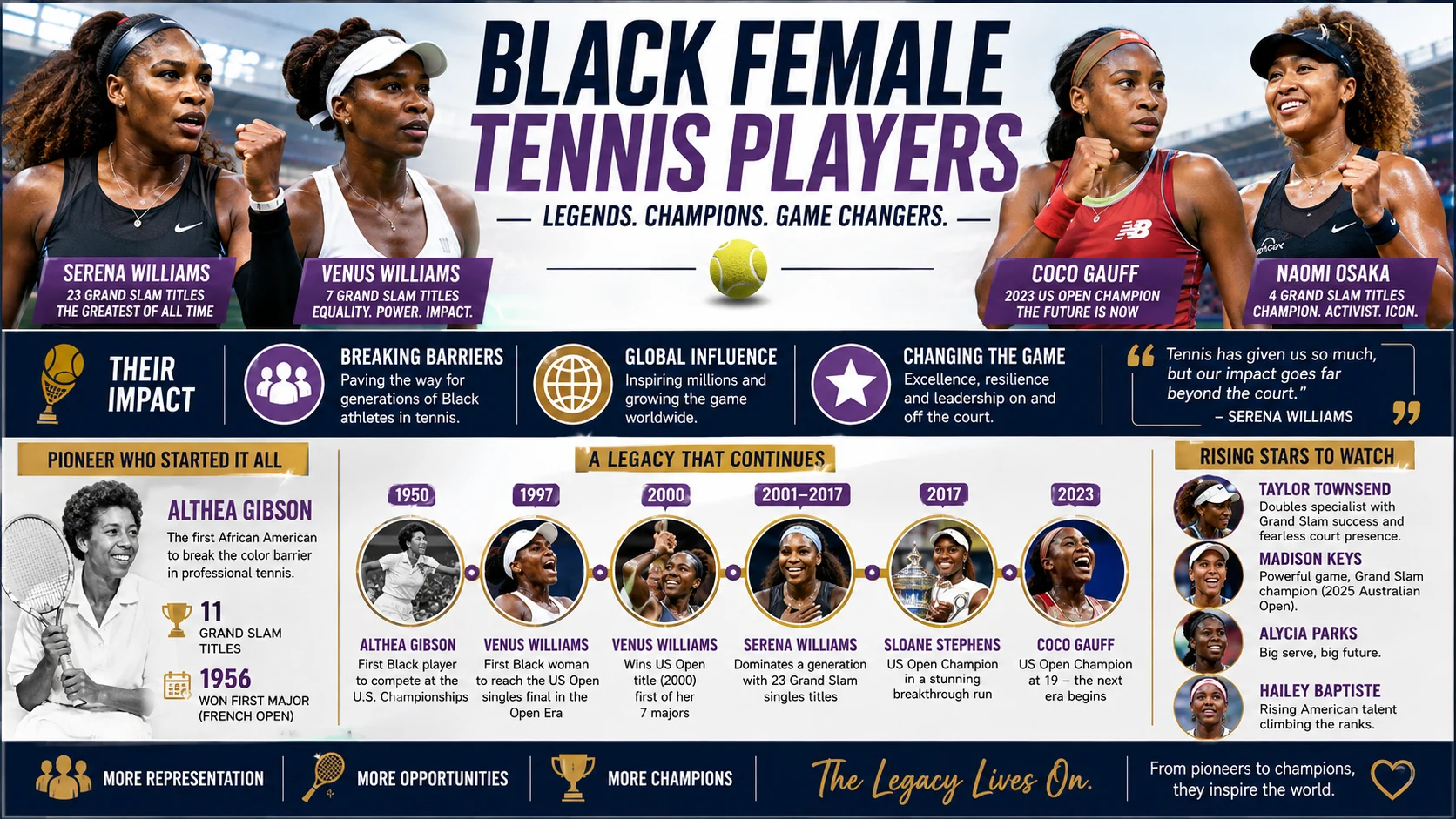
Black female tennis players have transformed the sport through historic victories, Grand Slam success, and barrier-breaking careers. From Althea Gibson and the Williams sisters to Coco Gauff, Naomi Osaka, and Taylor Townsend, these athletes have shaped tennis both on and off the court.
Some of the most influential Black female tennis players include Althea Gibson, Serena Williams, Venus Williams, Coco Gauff, Naomi Osaka, Sloane Stephens, Taylor Townsend, and Madison Keys.
Their impact goes far beyond trophies. They helped challenge racial and gender barriers, brought new audiences to tennis, and inspired a new generation of players to see professional tennis as a place where they belong.
| Player | Best Known For | Major Highlight |
|---|---|---|
| Althea Gibson | Breaking tennis’s color barrier | 11 Grand Slam titles |
| Serena Williams | Dominating the Open Era | 23 Grand Slam singles titles |
| Venus Williams | Power, longevity & equality advocacy | 7 Grand Slam singles titles |
| Coco Gauff | Next-generation American star | 2023 US Open champion |
| Naomi Osaka | Grand Slam success & activism | 4 Grand Slam singles titles |
| Sloane Stephens | Elite hard-court tennis | 2017 US Open champion |
| Taylor Townsend | Doubles excellence & athleticism | Grand Slam doubles success |
| Madison Keys | Powerful baseline game | 2025 Australian Open champion |
Who Was the First Black Female Tennis Player to Make History?
Althea Gibson Changed Tennis Forever
When discussing Black female tennis players, the story begins with Althea Gibson.
Gibson broke tennis’s color barrier in 1950 when she became the first African American player to compete in the U.S. National Championships, the tournament that eventually became the US Open.
Six years later, she became the first Black player to win a Grand Slam singles title when she captured the French Championships in 1956. She went on to win Wimbledon and the U.S. Championships in both 1957 and 1958. Overall, Gibson finished her tennis career with 11 Grand Slam titles across singles, doubles and mixed doubles.
Her importance is difficult to measure purely through statistics.
Gibson competed when racial segregation severely restricted opportunities for Black athletes. Her success proved that Black women could compete and win at the highest level of international tennis.
The modern game looks very different partly because Gibson helped make that future possible.
The Williams Sisters Changed Women’s Tennis
Serena Williams
Serena Williams is widely regarded as one of the greatest tennis players in history.
She finished her career with 23 Grand Slam singles titles, the most by any woman in the Open Era. She also spent 319 weeks ranked world No. 1 and won four Olympic gold medals.
But Serena’s influence was bigger than her trophy collection.
Her combination of power, athleticism, serve speed and mental resilience changed expectations for women’s tennis. She also became one of the sport’s most recognizable athletes, helping tennis reach audiences far beyond traditional tennis circles.
Her first Grand Slam singles title came at the 1999 US Open when she was only 17. That victory began a career that would eventually include six US Open singles championships.
Venus Williams
Venus Williams helped establish the Williams family as one of the most important forces in modern tennis.
Venus won seven Grand Slam singles titles, including five Wimbledon championships and two US Open titles.
Her influence extended beyond competition.
Venus became an important advocate for equality in professional sports, particularly equal prize money and opportunities for women athletes. Her presence also helped normalize the sight of Black women competing at the very highest levels of international tennis.
Her 1997 US Open run was especially significant: at just 17, she became the first Black woman to reach the US Open women’s singles final since Althea Gibson.
Coco Gauff Is Carrying the Legacy Forward
Coco Gauff
Coco Gauff represents the newest generation of Black American tennis stars.
Gauff became a professional at 14 and first captured worldwide attention at Wimbledon in 2019 when, at 15, she defeated five-time Wimbledon champion Venus Williams.
Four years later, she completed another major milestone.
At the 2023 US Open, the 19-year-old Gauff defeated Aryna Sabalenka 2–6, 6–3, 6–2 to win her first Grand Slam singles title. She became the first American teenager to win the US Open women’s title since Serena Williams in 1999.
That victory also placed Gauff in a remarkable historical line.
The US Open noted that she became the fourth Black American female champion at the tournament since 2000, following Venus Williams, Serena Williams and Sloane Stephens.
Gauff’s appeal goes beyond her results. Her speed, defensive ability, competitiveness and willingness to fight through difficult matches have made her one of the defining young personalities in women’s tennis.
Naomi Osaka: A Global Tennis Star
Naomi Osaka
Naomi Osaka occupies a unique place in this conversation.
Born in Japan to a Japanese mother and Haitian father, Osaka became one of the most successful players of her generation while representing Japan.
She won four Grand Slam singles titles and became particularly associated with the US Open. She defeated Serena Williams in the 2018 US Open final and later won the tournament again in 2020.
Her career has also been notable for her willingness to speak openly about mental health, identity and social issues.
Osaka demonstrated that the story of Black women in tennis is not limited to American players. Her Haitian heritage connects her success to a much broader international Black tennis community.
Sloane Stephens Made Her Mark at the US Open
Sloane Stephens
Sloane Stephens produced one of the most memorable Grand Slam breakthroughs of the modern era.
In 2017, Stephens entered the US Open ranked outside the top 80 after returning from a serious foot injury.
She then produced a stunning run through the draw and defeated Madison Keys in the final to win her first Grand Slam title.
The US Open’s historical records list Stephens as the 2017 women’s singles champion.
Her victory is an excellent example of why tennis is so unpredictable. A player can return from injury, rebuild confidence and suddenly produce the best tournament of her career on the sport’s biggest stage.
Taylor Townsend Is One of the Sport’s Most Exciting Doubles Players
Taylor Townsend
Taylor Townsend has built a particularly strong reputation in doubles while continuing to compete in singles.
Her athleticism, net skills and aggressive court positioning make her one of the most recognizable American doubles players of her generation.
Townsend’s significance also goes beyond results.
At the 2025 US Open, her presence was incorporated into the tournament’s celebration of Althea Gibson’s legacy. The USTA described Townsend’s run as another reminder of Gibson’s continuing influence on Black tennis players.
That connection is important: Gibson’s story isn’t simply history. It continues to influence the players competing today.
Other Black Female Tennis Players to Know
The list extends well beyond the biggest Grand Slam champions.
Madison Keys
Madison Keys is known for one of the most powerful games on the women’s tour and won her first Grand Slam singles title at the 2025 Australian Open.
Her explosive forehand and aggressive baseline style have made her one of the tour’s most dangerous big-match players.
Alycia Parks
Alycia Parks is another American player who has attracted attention for her powerful serve and aggressive game.
Hailey Baptiste
Hailey Baptiste represents another generation of American talent working toward establishing herself on the WTA Tour.
These players matter because representation isn’t only about the handful of athletes who become household names. A deeper pool of Black women competing professionally creates more opportunities for the next generation.
Why Black Women in Tennis Matter
The importance of Black female tennis players cannot be reduced to a list of championships.
Their impact can be seen in three major areas.
Breaking Barriers
Althea Gibson had to challenge racial exclusion before she could even compete at the highest level.
Her 1950 U.S. Championships appearance and later Grand Slam victories opened opportunities for generations that followed.
Changing Representation
The Williams sisters helped make Black women central figures in global tennis rather than exceptions to the traditional image of the sport.
Coco Gauff’s rise demonstrates how that influence continues.
Inspiring Young Players
Perhaps the most important legacy is what young athletes see when they watch professional tennis.
A young Black girl watching Serena win Wimbledon, Venus compete in a US Open final or Gauff lift a Grand Slam trophy doesn’t have to wonder whether someone who looks like her belongs on the biggest court in the world.
She has already seen the answer.
Black Female Tennis Players at the US Open
The US Open has been particularly important in this history.
Althea Gibson won the U.S. Championships in 1957 and 1958. Venus Williams won the US Open in 2000 and 2001. Serena Williams won it six times, while Sloane Stephens won in 2017 and Coco Gauff won in 2023.
That creates a remarkable timeline:
Althea Gibson → Venus Williams → Serena Williams → Sloane Stephens → Coco Gauff
Each generation arrived in a different era, but the connection between them is unmistakable.
The US Open itself recognized this continuing legacy when it celebrated 75 years since Gibson broke the color barrier in 2025.
Are There Black Female Tennis Players Outside the United States?
Yes.
Although the United States has produced many of the most famous Black women in tennis, the talent pool is international.
Players with African or Caribbean heritage have represented countries across the tennis world. Naomi Osaka, for example, represents Japan and has Haitian heritage.
The growth of Black tennis has therefore become a global story rather than an exclusively American one.
That matters because tennis is increasingly drawing elite athletes from diverse backgrounds, cultures and countries.
Who Is the Greatest Black Female Tennis Player?
If the question is based on Grand Slam singles success, Serena Williams has the strongest statistical case.
Her 23 Grand Slam singles titles, 319 weeks at world No. 1 and four Olympic gold medals put her among the most accomplished athletes tennis has ever produced.
But “greatest” depends on what you measure.
- Serena Williams: greatest combination of major titles and dominance
- Venus Williams: exceptional longevity, seven major singles titles and influence on equality
- Althea Gibson: greatest pioneer and barrier-breaker
- Coco Gauff: one of the most important young stars of the current generation
- Naomi Osaka: four-time Grand Slam champion with enormous global cultural influence
So there isn’t only one meaningful answer.
Serena may have the strongest statistical argument, but Gibson’s historical importance is impossible to separate from the opportunities later champions received.
The Legacy Continues
The story of Black female tennis players is not finished.
It began with pioneers such as Althea Gibson competing against barriers that extended far beyond the tennis court. It grew through Venus and Serena Williams, whose success reshaped the expectations of women’s tennis. It now continues through Coco Gauff, Naomi Osaka, Taylor Townsend and a growing group of young players.
The most exciting part is that today’s stars are no longer simply proving that Black women can succeed in tennis.
They are competing for Grand Slam titles, reaching the biggest stages and becoming role models in their own right.
That is the real evolution of the sport.
Final Thoughts
The greatest Black female tennis players have given the sport much more than spectacular matches.
Althea Gibson opened the door. Venus and Serena Williams changed what was possible. Sloane Stephens and Naomi Osaka added new chapters. Coco Gauff and today’s rising players are carrying the story forward.
Their achievements show how talent, resilience and opportunity can transform an individual career into something much bigger: a legacy that changes who believes they belong on the court.

Daniel Brooks is a sports writer at SportsOrbitX.com, specializing in football, basketball and global sports news. He focuses on delivering accurate reporting, match analysis and timely updates that keep fans informed.