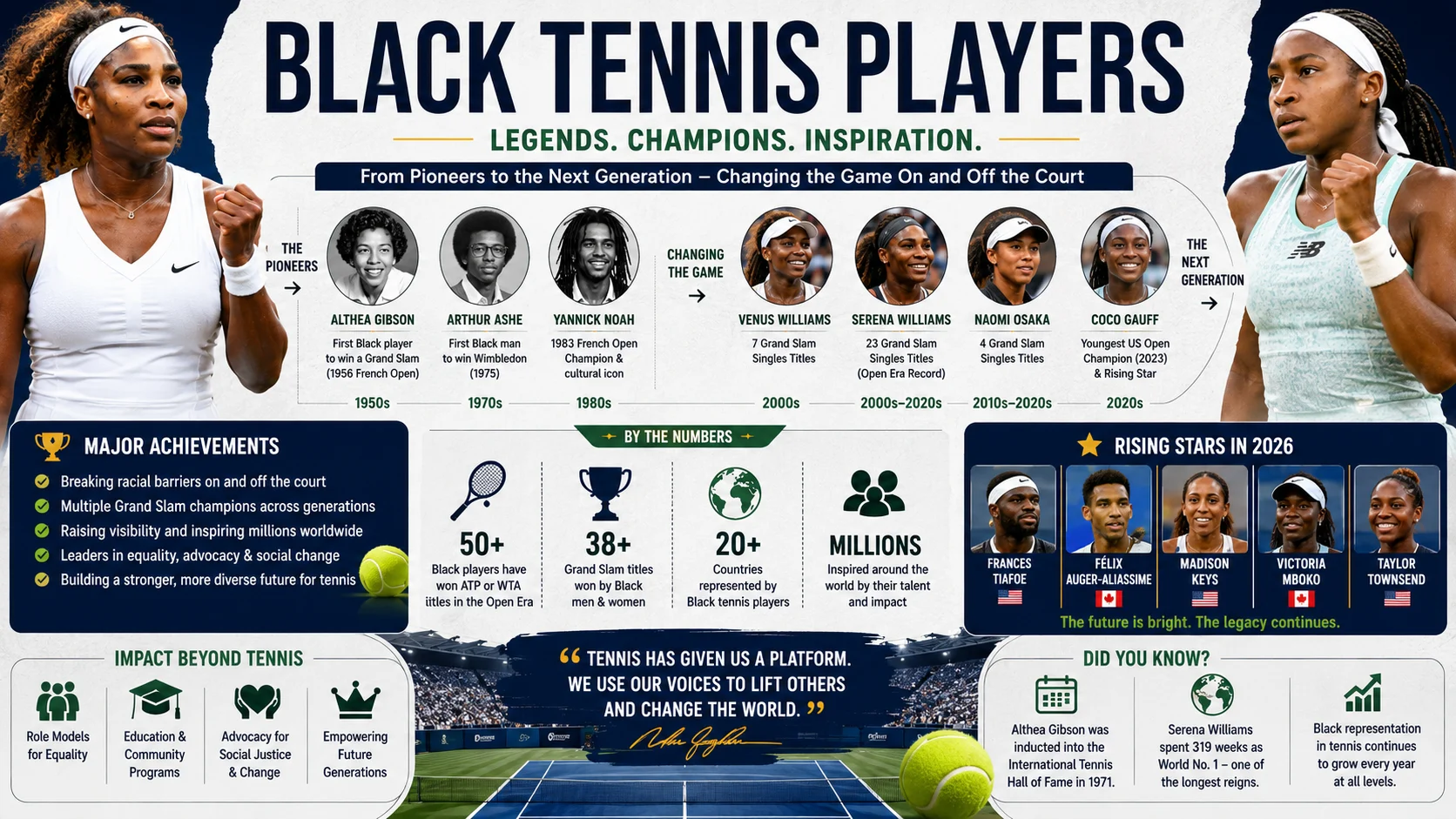
Black tennis players have transformed the sport from Althea Gibson and Arthur Ashe to Serena Williams, Venus Williams, Naomi Osaka, Coco Gauff, and today’s rising stars. Their influence extends beyond Grand Slam victories, helping break racial barriers and inspire a new generation of players worldwide.
Who Are the Most Famous Black Tennis Players?
Some of the most influential Black tennis players in history include Althea Gibson, Arthur Ashe, Serena Williams, Venus Williams, Yannick Noah, Naomi Osaka, Sloane Stephens, Madison Keys, Frances Tiafoe, Coco Gauff, Taylor Townsend, Félix Auger-Aliassime, and Victoria Mboko.
They represent different generations, countries, playing styles, and eras, but they share something important: they helped expand what professional tennis could look like.
| Player | Country | Known For |
|---|---|---|
| Althea Gibson | United States | First Black Grand Slam champion |
| Arthur Ashe | United States | First Black man to win Wimbledon |
| Yannick Noah | France | 1983 French Open champion |
| Venus Williams | United States | 7-time Grand Slam singles champion |
| Serena Williams | United States | 23-time Grand Slam singles champion |
| Naomi Osaka | Japan | 4-time Grand Slam champion |
| Sloane Stephens | United States | 2017 US Open champion |
| Madison Keys | United States | 2025 Australian Open champion |
| Frances Tiafoe | United States | 2022 US Open semifinalist |
| Coco Gauff | United States | Grand Slam champion and leading young star |
| Félix Auger-Aliassime | Canada | ATP Tour star and former world No. 4 |
| Victoria Mboko | Canada | 2025 Canadian Open champion |
Althea Gibson: The Pioneer Who Opened the Door
Any discussion of Black tennis players should begin with Althea Gibson.
Gibson was not simply a successful tennis player. She challenged the racial barriers that restricted Black athletes from competing at the highest levels of the sport.
In 1956, Gibson became the first Black player to win a Grand Slam tournament, capturing the French Championships. The following year, she won Wimbledon and the U.S. Nationals, the tournament that later became the US Open.
Her achievement was even more significant because Black tennis players had already been developing the sport within their own communities. The American Tennis Association, founded in 1916, created opportunities for Black players when major tennis organizations excluded them.
Gibson’s legacy is therefore bigger than her trophy collection. She helped make it possible for future generations to enter tennis’s biggest tournaments.
Arthur Ashe: Champion, Activist and Barrier Breaker
Arthur Ashe became one of the defining Black male tennis players of the 20th century.
His accomplishments included winning the 1968 US Open, the first US Open of the Open Era, and becoming the first Black man to win Wimbledon, which he achieved in 1975.
But Ashe’s importance went beyond tennis.
He used his public platform to speak about racial equality, education, social justice and apartheid. His career demonstrated that an elite athlete could also become an influential voice away from the court.
The history of Black tennis is therefore not simply a story about winning matches. It is also a story about athletes using their visibility to challenge who gets to participate in sport and who gets to be seen as a champion.
The Williams Sisters Changed Women’s Tennis
If Gibson opened the door and Ashe pushed it wider, Venus and Serena Williams helped completely redefine modern women’s tennis.
Their influence can be seen in power, athleticism, fashion, business, media attention and the number of young players who saw professional tennis as a realistic possibility.
Serena Williams
Serena Williams is widely regarded as one of the greatest tennis players of all time.
She finished her career with 23 Grand Slam singles titles, the most in the Open Era. Her Grand Slam record includes seven Australian Open titles, three French Open titles, seven Wimbledon titles and six US Open titles.
Serena’s game combined:
- Explosive serving
- Powerful groundstrokes
- Exceptional athleticism
- Mental toughness
- Aggressive return-of-serve ability
Her influence also extended beyond tennis. She became a major figure in fashion, business, women’s sports and popular culture.
Venus Williams
Venus Williams was a pioneer in her own right.
She won seven Grand Slam singles titles, including five Wimbledon championships and two US Open titles.
Venus was also instrumental in changing perceptions of women’s tennis. Her speed, serve and attacking style helped usher in a more physically powerful era.
The Williams sisters also became one of the most successful sibling partnerships in tennis history, winning numerous Grand Slam doubles titles together.
Naomi Osaka: A Global Face of Modern Tennis
Naomi Osaka represents a newer generation of Black tennis stars whose influence crosses national and cultural boundaries.
Born in Japan to a Japanese mother and Haitian father, Osaka represents Japan in professional tennis and has become one of the sport’s most recognizable global athletes.
She has won four Grand Slam singles titles, including two US Open titles and two Australian Open titles. She also became the first Asian player to reach the WTA singles No. 1 ranking.
Osaka’s significance extends beyond her results.
She has openly discussed identity, representation and social issues, showing how modern athletes can influence conversations far beyond the tennis court.
Her presence has also helped demonstrate that Black tennis representation is global rather than limited to the United States.
Coco Gauff: The Next Generation
Few young Black tennis players have attracted as much attention as Coco Gauff.
Gauff became a global sensation as a teenager, defeating Venus Williams at Wimbledon in 2019 and reaching the top level of women’s tennis remarkably early.
Her biggest breakthrough came at the 2023 US Open, where she won her first Grand Slam singles title.
She added another major singles title at the 2025 French Open, defeating Aryna Sabalenka in the final.
Gauff’s importance is not simply about age.
She represents a generation of Black players who grew up watching Serena, Venus and other pioneers and entered professional tennis expecting to belong there.
That shift in expectation may be one of the most important effects of the previous generation.
Other Black Female Tennis Players to Know
The story does not end with Serena, Venus, Osaka and Gauff.
Several other Black women have made major contributions to professional tennis.
Sloane Stephens
Sloane Stephens became a Grand Slam champion when she won the 2017 US Open. She also reached the 2018 French Open final and achieved a career-high singles ranking of No. 3.
Madison Keys
Madison Keys won her first Grand Slam title at the 2025 Australian Open, defeating Aryna Sabalenka in the final. The championship was the biggest title of her career at the time.
Taylor Townsend
Taylor Townsend has become an important figure in American tennis, particularly in doubles, while also making significant progress in singles.
Victoria Mboko
Canadian teenager Victoria Mboko became one of the most exciting emerging names in women’s tennis after winning the 2025 Canadian Open, her first WTA Tour title.
Her rapid rise is significant because it shows that the next chapter of Black tennis is increasingly international.
Black Male Tennis Players Making Their Mark
Black representation in men’s tennis has also expanded significantly.
Frances Tiafoe
Frances Tiafoe is one of the most recognizable American men’s tennis players of his generation.
His biggest Grand Slam breakthrough came at the 2022 US Open, where he reached the semifinals.
Tiafoe’s athleticism, explosive forehand and energetic personality have made him a fan favorite, while his background has become part of an inspiring story about access to tennis and social mobility.
Félix Auger-Aliassime
Canadian star Félix Auger-Aliassime has established himself among the world’s elite men’s players.
He reached a career-high No. 4 ATP singles ranking in June 2026 and has won multiple ATP Tour titles.
His success adds another important dimension to the modern Black tennis story: elite players are emerging from outside the traditional American tennis pipeline.
Yannick Noah
France’s Yannick Noah remains one of the most important Black male players in tennis history.
In 1983, Noah won the French Open, becoming the first Frenchman to win the men’s singles title at Roland Garros since 1946.
His charisma and attacking style made him one of the sport’s most recognizable personalities.
Why Are Black Tennis Players Important to Tennis History?
The importance of Black tennis players cannot be measured only through Grand Slam titles.
Their impact can be divided into several areas.
Breaking Racial Barriers
Gibson and Ashe competed during periods when racial discrimination directly affected access to tournaments and facilities.
Their success challenged those barriers at the highest level.
Changing Representation
Serena and Venus Williams showed millions of young athletes that Black players could dominate a traditionally exclusive sport.
Expanding the Global Image of Tennis
Osaka, Noah, Auger-Aliassime and other international stars demonstrate that Black excellence in tennis exists across continents.
Inspiring Young Players
Gauff’s generation grew up with visible Black champions. That matters because young athletes are more likely to imagine themselves succeeding when they can see people who look like them competing at the highest level.
Are There Black Tennis Players From Outside the United States?
Absolutely.
Although the United States has produced many of the most famous Black tennis champions, Black tennis is global.
Notable examples include:
- Yannick Noah — France
- Naomi Osaka — Japan
- Félix Auger-Aliassime — Canada
- Victoria Mboko — Canada
- Jo-Wilfried Tsonga — France
- Gaël Monfils — France
This international representation is important because the phrase “Black tennis players” encompasses athletes from many different cultural and national backgrounds.
Who Is the Greatest Black Tennis Player?
There is no objective answer because men and women compete in separate tours and players from different eras faced different conditions.
However, Serena Williams is the strongest statistical candidate among Black singles players, with 23 Grand Slam singles titles and one of the most dominant careers in modern tennis.
For historical significance, Althea Gibson is impossible to overlook because she was the first Black player to win a Grand Slam.
For men’s tennis, Arthur Ashe combines major championship success with extraordinary historical and social significance, while Yannick Noah, Frances Tiafoe and Félix Auger-Aliassime represent different generations of Black male excellence.
So the answer depends on what “greatest” means:
| Category | Player |
|---|---|
| Most Grand Slam singles titles | Serena Williams |
| First Black Grand Slam champion | Althea Gibson |
| First Black Wimbledon men’s champion | Arthur Ashe |
| Modern young superstar | Coco Gauff |
| Four-time major champion | Naomi Osaka |
| 2025 Australian Open champion | Madison Keys |
| 2025 Canadian Open breakthrough | Victoria Mboko |
| Modern American men’s star | Frances Tiafoe |
| Career-high ATP No. 4 in 2026 | Félix Auger-Aliassime |
Black Tennis Players and the Future of the Sport
The most encouraging part of Black tennis history is that today’s players are no longer isolated exceptions.
There is now a visible pipeline stretching from Althea Gibson and Arthur Ashe to the Williams sisters, Naomi Osaka, Coco Gauff, Frances Tiafoe, Madison Keys, Félix Auger-Aliassime and Victoria Mboko.
The International Tennis Hall of Fame’s historical record shows how this progression developed over decades, including the growth of the American Tennis Association and the emergence of successive generations of Black players.
And the story is still being written.
In 2026, Gauff, Osaka, Keys, Tiafoe, Auger-Aliassime, Mboko and other players continue to make Black representation a visible part of elite professional tennis. Current tour coverage also shows that established champions and emerging players remain part of the sport’s evolving landscape.
Frequently Asked Questions
Who was the first Black tennis player to win a Grand Slam?
Althea Gibson became the first Black player to win a Grand Slam tournament when she won the French Championships in 1956.
Who was the first Black man to win Wimbledon?
Arthur Ashe became the first Black man to win the Wimbledon men’s singles championship in 1975.
How many Grand Slams did Serena Williams win?
Serena Williams won 23 Grand Slam singles titles during her career.
How many Grand Slams has Venus Williams won?
Venus Williams won seven Grand Slam singles titles.
Is Naomi Osaka a Black tennis player?
Yes. Osaka has a Japanese mother and Haitian father and represents Japan in professional tennis. She is widely recognized as a Black Japanese athlete and has become an important figure in discussions of race, identity and representation in sport.
Is Coco Gauff a Grand Slam champion?
Yes. Gauff won the 2023 US Open and later won the 2025 French Open, giving her two Grand Slam singles titles.
Who are the best Black male tennis players?
Historically important names include Arthur Ashe and Yannick Noah. Modern players include Frances Tiafoe, Félix Auger-Aliassime, Gaël Monfils and Jo-Wilfried Tsonga.
Final Thoughts
The history of Black tennis players is much bigger than a list of famous names.
Althea Gibson challenged the color barrier. Arthur Ashe combined championship tennis with social activism. Venus and Serena Williams transformed the modern women’s game. Naomi Osaka expanded the conversation around identity and representation. Coco Gauff represents a generation that grew up seeing Black champions as normal rather than unusual.
Meanwhile, players such as Frances Tiafoe, Félix Auger-Aliassime, Madison Keys and Victoria Mboko show that the next generation is already making its own mark.
That is what makes Black tennis history so compelling: it is not only about how far the sport has come it is about who is shaping where tennis goes next.