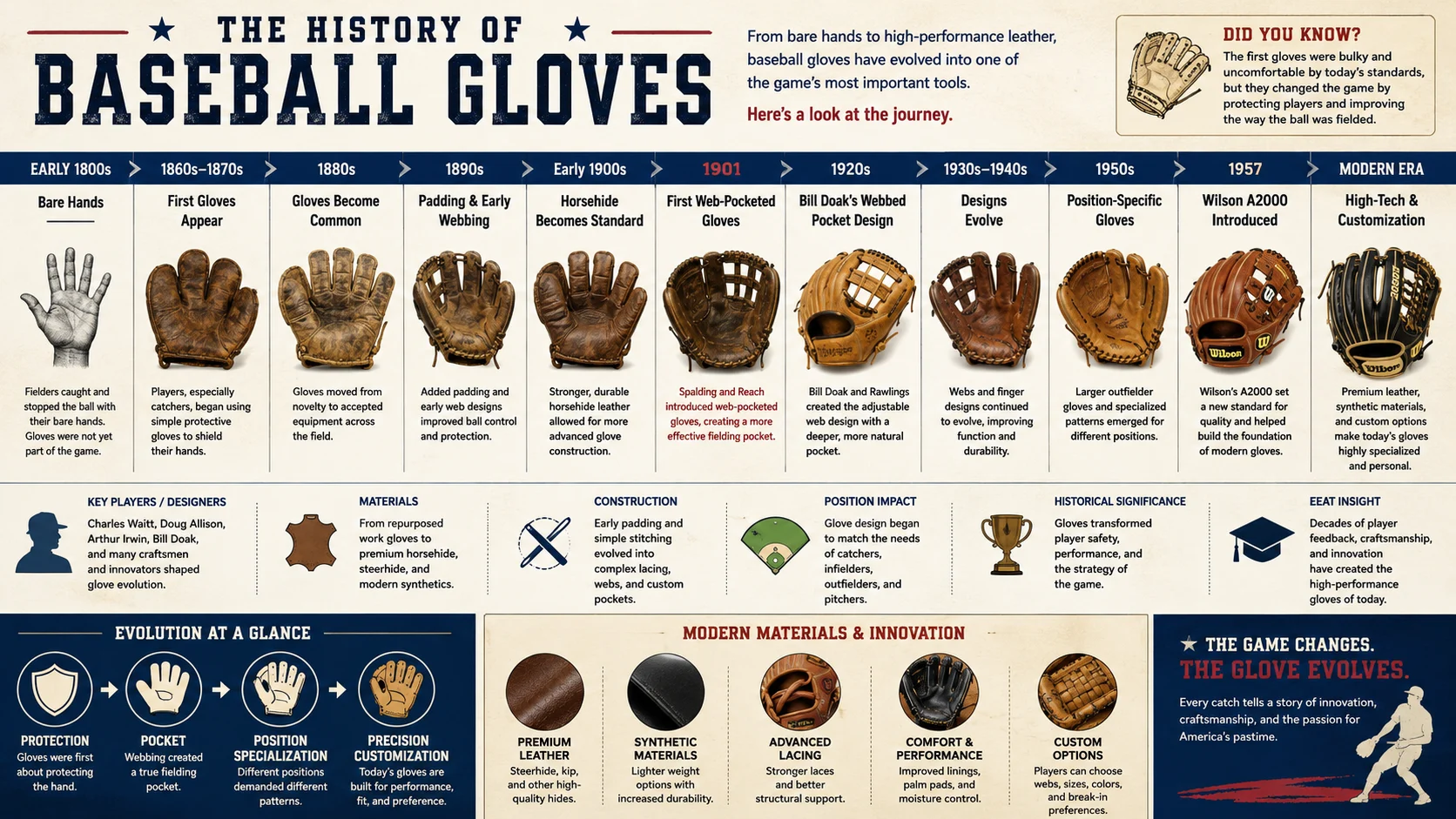
The history of baseball gloves began in the 19th century, when most players fielded without gloves and a few started using simple leather hand protection. By the late 1880s, gloves had become nearly universal, and innovations such as padded pockets, webbing, better leather, and position-specific designs gradually transformed the glove into an essential piece of baseball equipment. Bill Doak’s webbed-pocket design in the 1920s and Wilson’s A2000 in 1957 were two major milestones in the development of the modern baseball glove.
Quick Snapshot: History of Baseball Gloves
| Period | Major Development | Materials / Construction | Key People / Brands | What Changed on the Field | Historical Significance | EEAT Insight |
|---|---|---|---|---|---|---|
| Early–Mid 1800s | Players primarily fielded bare-handed | No dedicated fielding glove | Early baseball players | Fielders caught and stopped the ball directly with their hands | Demonstrates that gloves were not originally considered essential baseball equipment | Early baseball equipment was functional rather than highly specialized |
| 1860s | First protective gloves began appearing | Repurposed work, tradesmen’s, driving, and other leather gloves | Amateur players and catchers | Reduced bruising and hand injuries | Often considered the beginning of glove use in baseball | Early gloves were mainly protective equipment, not performance tools |
| 1870s | Glove use became more visible | Thin leather and adapted work gloves | Charles Waitt, Doug Allison | Players gained basic protection while catching | Waitt’s use in the mid-1870s helped popularize glove use among fielders | The transition was gradual rather than the result of one single inventor |
| 1880s | Gloves became increasingly accepted | Leather with added padding | Arthur Irwin and glove makers | More cushioning made difficult catches less punishing | By the end of the decade, gloves were nearly universal | The glove was moving from a controversial accessory toward normal baseball equipment |
| 1890s | Padded heels and early webbing developed | Leather padding and early leather webs | Sporting-goods manufacturers | Created early pockets and improved ball retention | This was a major step toward a purpose-built catching tool | Webbing fundamentally changed what the glove could do |
| 1895 | Glove-size restrictions introduced | Regulated leather gloves | Baseball rule makers | Limited how much equipment could assist fielders | Shows that glove technology had already become important enough to regulate | Equipment evolution was already influencing the competitive balance of baseball |
| 1901 | Web-pocketed gloves introduced | Leather web sewn between thumb and forefinger | Spalding, Reach | Created a shallow catching pocket and improved control | SABR research identifies 1901 as a crucial point when the glove became a specialized fielding tool | This milestone corrects the overly simple claim that the modern glove began with Doak |
| Early 1900s | One-inch and other web styles evolved | Horsehide and other durable leather | Spalding, Reach, Rawlings and others | Players gained more control over ground balls and line drives | Web-pocket designs became increasingly desirable | The glove was evolving from protection to performance |
| 1910s | Glove shapes and pockets continued improving | Heavier leather, padding and sewn constructions | Multiple sporting-goods makers | Better receiving surfaces and improved durability | The foundation was being laid for modern glove architecture | Manufacturers increasingly responded to the actual needs of players |
| 1919–1922 | Bill Doak’s adjustable web design | Leather glove with laced web and deeper pocket | Bill Doak + Rawlings | Produced a deeper, more natural catching pocket | One of the most influential glove innovations of the first half of the 20th century | Doak was a major evolutionary step not necessarily the first web-pocket inventor |
| 1920s | Position-specific glove design accelerated | Horsehide and increasingly structured leather | Rawlings, Harry Latina | Infielders, outfielders and catchers could use more specialized patterns | Gloves became increasingly tailored to specific defensive roles | Player feedback and glove craftsmanship became central to innovation |
| 1930s | Modern-style web variations emerged | Leather webs, reinforced fingers | Major glove manufacturers | Improved ball control and pocket stability | Web design became a major performance feature | The glove’s geometry was becoming as important as the leather itself |
| 1940s | Improved lacing and structural construction | Leather lacing and reinforced leather | Rawlings and competitors | Better flexibility and long-term durability | Lacing became an important part of glove construction | Small construction changes could significantly affect break-in and feel |
| 1950s | Larger and more specialized gloves developed | Improved leather and larger patterns | Rawlings, Wilson and others | Outfielders gained reach; infielders retained faster-transfer designs | Position-specific glove architecture became firmly established | Modern glove categories began to resemble today’s infield, outfield and mitt designs |
| 1957 | Wilson A2000 introduced | High-quality leather, deeper pocket and structural innovations | Wilson | Improved ball retention while maintaining quick transfer | Widely regarded as a landmark in modern glove design | Wilson’s development process emphasized direct feedback from professional players |
| Late 1950s–1960s | Snap-action heels and new construction patents | Leather with advanced heel and web construction | Wilson, Rawlings | Gloves could close and retain the ball more efficiently | Major manufacturers competed through patented construction improvements | Innovation shifted from simply adding features to refining glove mechanics |
| 1960s | Alternative hides experimented with | Kangaroo, buffalo and other leathers | Major manufacturers | Attempts were made to reduce weight while maintaining performance | Demonstrates the industry’s continuing material experimentation | Not every material innovation proved better; durability and feel still mattered |
| 1970s | Glove specialization became more established | Traditional leather with refined patterns | Major sporting brands | Players increasingly chose gloves based on exact position | Position-specific patterns became normal rather than unusual | The modern “match your glove to your position” philosophy was taking shape |
| 1980s–1990s | Synthetic and artificial materials expanded | Synthetic components and lighter materials | Major glove manufacturers | Reduced weight and introduced alternative construction options | Technology began supplementing traditional leather craftsmanship | Synthetic materials offered new trade-offs between weight, durability and feel |
| 2000s | Customization became increasingly important | Premium steerhide, kip, synthetic materials | Rawlings, Wilson, Mizuno and others | Players could choose specific patterns, webs, sizes and pocket preferences | Gloves became increasingly personalized | Modern glove fitting is partly an exercise in matching equipment to player technique |
| 2010s | Advanced pattern engineering and premium leather expanded | High-grade leather, synthetic materials and specialized linings | Major professional glove brands | Improved consistency, pocket shape and break-in characteristics | Glove design became increasingly data- and player-informed | Professional feedback remains one of the strongest drivers of innovation |
| 2020s–2026 | Highly specialized, customizable modern gloves | Premium leather, synthetics, modern lacing and hybrid materials | Wilson, Rawlings, Mizuno and others | Players can select position, size, web, pocket depth and break-in preference | The glove has become a precision piece of baseball equipment | Modern innovation focuses on optimizing fit, weight, feel, durability and position-specific performance |
The History of Baseball Gloves
A modern baseball glove is easy to take for granted.
Put your hand inside one today and it feels like a carefully engineered extension of your body. The pocket is shaped for catching. The web helps trap the ball. The fingers are reinforced. The wrist can be adjusted. Different positions have different patterns.
Baseball’s earliest players had none of that.
For much of the 19th century, fielders simply used their bare hands.
The transformation from bare-handed baseball to today’s highly specialized gloves took decades. The glove did not appear as one finished invention. Instead, it evolved through hundreds of small changes in leather, padding, webbing, shape, size, and construction.
That makes the history of baseball gloves a story about more than equipment. It is also a story about how the game itself became faster, more competitive, and more technically demanding.
Before Baseball Gloves: Playing With Bare Hands
Early baseball players generally did not use gloves.
Bare-handed fielding was considered normal, particularly during the early development of organized baseball in the 19th century. Players learned to catch, stop, and throw the ball directly with their hands.
There were practical reasons for this.
Early baseballs and playing conditions differed significantly from today’s game, while the culture around equipment was also different. A glove could be viewed as unnecessary protection—or even as something that reduced the challenge of fielding.
As baseball became more organized and competitive, however, players began looking for ways to protect their hands.
That was the beginning of the baseball glove.
When Were Baseball Gloves First Used?
There was no single inventor who suddenly created the modern baseball glove.
Early examples appeared gradually during the 19th century. The National Baseball Hall of Fame and Museum identifies several early players associated with the transition toward glove use.
One frequently cited example is Doug Allison, a catcher for the Cincinnati Red Stockings. According to a well-known historical account, Allison used buckskin gloves in 1870 to protect his sore hands. Charles Waitt is also widely recognized as one of the first fielders to wear a protective glove, doing so in 1875.
These early gloves looked nothing like the gloves used by Major League players today.
They were generally simple leather hand coverings rather than deep-pocketed catching tools.
The original goal was protection.
The modern goal would eventually become protection plus control.
The First Baseball Gloves Were Small and Simple
Early baseball gloves were often thin and relatively small.
They were designed primarily to protect the hands from repeated impact rather than to catch the ball like a modern pocket.
Some early gloves resembled work gloves or simple leather mitts. They lacked the deep pockets, carefully shaped fingers, and sophisticated web designs now associated with baseball equipment.
Players could still field effectively, but the glove offered considerably less assistance than modern equipment.
This distinction is important when looking at glove history.
The first baseball glove was not simply an early version of today’s glove. It represented a completely different philosophy:
Protect the hand first; improve fielding second.
Over time, players discovered that adding leather and padding could actually make fielding easier.
That changed everything.
Baseball Gloves Become Accepted in the 1880s
Glove use expanded rapidly during the 1880s.
According to the National Baseball Hall of Fame and Museum, glove usage was nearly universal by the end of the decade. What had once looked unnecessary or even questionable had become accepted equipment.
This was one of the most important transitions in the history of baseball gloves.
Players were no longer simply tolerating gloves.
They were improving them.
More padding began appearing in gloves, helping absorb the force of a baseball. Designers also started experimenting with ways to create a catching area or pocket.
That meant the glove was beginning to change the way players fielded the ball.
Why Did Baseball Players Start Wearing Gloves?
The simplest answer is protection.
Repeatedly catching baseballs with bare hands can cause bruising, soreness, and injury. A leather glove reduced some of the impact reaching the player’s palm and fingers.
But protection was only the beginning.
As glove designs improved, players discovered that a properly shaped glove could also:
- absorb the impact of the ball
- help keep the ball from bouncing away
- create a catching pocket
- improve confidence on difficult plays
- make repeated fielding easier
The glove gradually became a performance tool rather than merely protective equipment.
The 1890s: The Glove Becomes a Fielding Tool
The 1890s were an important period in glove evolution.
The National Baseball Hall of Fame notes that padded heels were added to the front exterior of gloves to help form pockets, while webs began appearing between the thumb and forefinger. Early webs could be quite large, but later versions became smaller to improve flexibility.
This was a major conceptual change.
Instead of simply covering the hand, the glove was beginning to create a specific place for the ball to land.
That is the basic idea behind the pocket found in modern gloves.
Early Glove Size Rules
As gloves became more useful, concerns about their size also emerged.
In 1895, baseball authorities introduced restrictions on glove size. The National Baseball Hall of Fame reports that the rules limited gloves used by many fielders to 10 ounces and no more than 14 inches in circumference, while catchers and first basemen were treated differently.
The rules reflected an interesting tension in baseball.
A glove could make fielding easier, but the game still wanted boundaries on how much equipment could assist players.
Horsehide and the Early 20th Century
As baseball entered the 20th century, leather quality became increasingly important.
Horsehide became a common glove material after the turn of the century, partly because horse hides were readily available. Cowhide was used as well, but its dominance in glove construction came later.
The material mattered because baseball gloves had to balance several competing requirements.
They needed to be:
- durable enough to withstand repeated impacts
- flexible enough to close around the ball
- strong enough to hold their shape
- comfortable enough for players to wear throughout a game
Leather remained the foundation of glove construction for much of baseball’s history because it could provide that combination.
The 1900s: Experimentation Accelerates
The early 20th century was a period of experimentation.
Manufacturers and players tried different web arrangements, padding systems, glove shapes, and specialized designs.
The National Baseball Hall of Fame highlights several unusual experiments from the period, including gloves with different web structures, ambidextrous designs, and fielding mitts intended for multiple positions.
Not every experiment succeeded.
Some designs disappeared.
Others survived and eventually influenced modern gloves.
This is an important part of equipment history: innovation rarely happens through one perfect invention. It usually happens through repeated trial and error.
Bill Doak and the Baseball Glove Revolution
One of the biggest turning points in baseball glove history came from St. Louis Cardinals pitcher Bill Doak.
In 1919, Doak approached Rawlings with ideas for improving glove design. His central innovation involved creating an adjustable web between the thumb and forefinger. This helped form a deeper, more natural pocket for receiving the baseball. Rawlings introduced the Doak model to the public in 1920, and the design was patented in 1922.
This was revolutionary because the glove was no longer simply cushioning the hand.
It was actively helping the player catch and control the ball.
Why Bill Doak’s Design Was So Important
Think about what happens when a baseball enters a modern glove.
The ball does not simply hit a flat piece of leather.
It enters a shaped pocket formed by:
- the palm
- the thumb
- the fingers
- the web
- the glove’s structure and padding
Doak’s design helped establish the idea that the pocket itself was central to successful catching.
That principle remains fundamental to glove design today.
The 1920s: Baseball Gloves Become More Specialized
The 1920s helped establish the basic architecture of the modern glove.
Webbing became more important. Pockets became deeper and more purposeful. Padding and shape improved. Manufacturers began creating designs that better matched the needs of different players.
Rawlings also expanded its glove design operation during this period, with Harry Latina becoming a leading glove designer in the 1920s and through the following decades.
The glove was becoming an extension of the player’s position.
An infielder needed speed and control.
An outfielder needed reach and a secure pocket.
A catcher needed an entirely different construction.
The era of one basic glove for everyone was fading.
From One Glove to Position-Specific Gloves
Modern baseball players choose gloves based heavily on position.
That specialization has historical roots.
Infield Gloves
Infielders generally need gloves that allow them to:
- transfer the ball quickly
- make rapid throws
- field ground balls
- maintain control during quick exchanges
That helped drive the development of smaller patterns and practical web designs.
Outfield Gloves
Outfielders benefit from more reach and a larger catching area.
Over time, outfielder gloves became longer and deeper, allowing players to track and secure fly balls.
The National Baseball Hall of Fame notes that a 12-inch size rule for outfielder gloves was established in the 1950s, while modern outfield gloves can reach approximately 13 to 14 inches.
Catcher’s Mitts
A catcher’s mitt is structurally different from a typical fielder’s glove.
It is heavily padded and designed to withstand repeated high-speed pitches.
Historically, catchers were among the earliest players to benefit from specialized hand protection, and catcher equipment eventually developed into its own category.
First Baseman’s Mitts
First basemen also use a specialized mitt.
The design emphasizes a large receiving surface and shape suited to catching throws around the bag.
Historically, catchers and first basemen were also treated differently from other fielders in early glove-size restrictions.
The 1930s and 1940s: Better Webs and Better Construction
Glove design continued evolving during the 1930s and 1940s.
The Hall of Fame notes that more modern web designs appeared during the 1930s, including versions using one or two straps. From the late 1940s onward, lacing also became an important part of connecting glove fingers and shaping the glove.
These developments may sound small compared with the invention of the original glove.
They were not.
Every change affected how the glove opened, closed, flexed, held the ball, and maintained its shape.
The best gloves were increasingly designed around how a player actually moved.
Why Glove Webbing Matters
The web is one of the most recognizable parts of a baseball glove.
Its job is not simply decorative.
The web helps form the catching pocket between the thumb and index-finger area while providing additional structure and ball control.
Different web patterns produce different characteristics.
For example, some designs favor visibility, while others create deeper pockets or additional stability.
This is why professional players can be extremely particular about web style.
The history of webbing reflects one of baseball equipment’s biggest lessons:
Small changes in geometry can produce major changes in performance.
The 1950s: The Modern Glove Takes Shape
By the 1950s, baseball gloves had become dramatically more sophisticated than their 19th-century ancestors.
Leather quality improved, pockets became more purposeful, web designs became more established, and different positions required distinct glove patterns.
The outfielder’s glove was becoming larger.
Infield gloves remained relatively compact.
Pitchers began using gloves whose shape and web could also help conceal the baseball before delivery.
And then came one of the most influential glove models in baseball history.
1957: The Wilson A2000 Changes Glove Design
Wilson introduced the A2000 in 1957.
Rather than designing a glove only around what manufacturers believed players wanted, Wilson worked directly with professional players to understand how different positions and playing styles affected glove requirements. The resulting A2000 featured design changes including a deeper pocket, wider web, and construction intended to hold its shape.
The A2000 became one of the landmark designs in baseball glove history.
Wilson describes it as the beginning of a modern approach in which professional player feedback was incorporated directly into glove development.
That concept remains important today.
Modern glove companies continually work with professional players to refine:
- patterns
- pocket depth
- wrist openings
- finger stalls
- web designs
- leather
- weight
- break-in characteristics
The Rise of the Modern Baseball Glove
After the 1950s, baseball gloves became increasingly specialized and refined.
Manufacturers began paying closer attention to the exact needs of each position.
The basic glove shape remained recognizable, but nearly every component continued to evolve.
Better Leather
Leather remained the dominant material because of its strength, flexibility, and ability to develop a customized feel through use.
High-end gloves could be made from carefully selected hides designed to provide durability and a consistent break-in.
Improved Lacing
Leather lacing became increasingly important for connecting and reinforcing glove components.
Players could also adjust or replace laces as gloves aged.
Improved Pocket Design
Pocket placement became increasingly position-specific.
A middle infielder might want a relatively shallow pocket for rapid transfers.
An outfielder may prefer a deeper pocket to secure fly balls.
More Specialized Patterns
Manufacturers increasingly created dedicated models for:
- pitchers
- catchers
- first basemen
- second basemen
- shortstops
- third basemen
- outfielders
The glove had evolved from generic hand protection into a highly specialized piece of sporting equipment.
How Baseball Gloves Changed the Way Players Field
It is easy to think of glove evolution as a simple equipment story.
But better gloves also changed defensive technique.
A glove with a well-designed pocket allows a player to receive a ball rather than simply stop it.
That distinction is enormous.
Instead of worrying about absorbing every impact with the palm, a fielder can concentrate on:
- positioning
- footwork
- timing
- transfer
- throwing accuracy
As gloves improved, defensive skills became more refined.
The equipment and the technique evolved together.
The Glove as an Extension of the Player
Modern players often describe their glove in surprisingly personal terms.
A glove is shaped by its owner.
Repeated catches, break-in, pocket formation, lacing adjustments, and everyday use can create a glove that feels different from a brand-new version of the same model.
That personal relationship is part of what makes baseball gloves culturally different from many other pieces of sports equipment.
A glove can become associated with:
- a first season
- a championship
- a favorite player
- a family tradition
- an important game
- an entire career
The history of baseball gloves is therefore also a history of baseball memories.
Leather Remains Important in the Modern Era
Despite decades of technological development, leather remains central to baseball glove construction.
The National Baseball Hall of Fame notes that leather continues to be the standard glove material, although synthetic alternatives have gained popularity because of characteristics such as lower weight and durability.
This creates an interesting contrast.
Baseball gloves have changed dramatically over more than a century, but one of their most traditional materials remains essential.
Modern glove design combines traditional craftsmanship with newer materials and manufacturing methods.
Synthetic Materials and Modern Glove Technology
Today’s glove market includes both traditional leather gloves and synthetic alternatives.
Synthetic materials can reduce weight and offer durability, while modern manufacturing allows manufacturers to experiment with materials and construction methods that would not have been available to 19th-century glove makers.
Wilson, for example, later introduced SuperSkin, a synthetic material designed to replace portions of traditional leather while reducing weight and providing durability and moisture resistance.
This illustrates the direction glove technology has taken:
Keep the successful principles of traditional glove design while making the equipment lighter, stronger, and more precisely engineered.
Baseball Glove History Timeline
1800s: Bare-Handed Baseball
Most fielders played without gloves. Baseball was developing as an organized sport, and bare-handed fielding remained normal.
1870s: Protective Gloves Appear
Players such as Doug Allison and Charles Waitt are associated with early glove use. These gloves were primarily intended to protect the hands.
1880s: Gloves Become Common
Glove use became nearly universal by the end of the decade.
1890s: Padding and Webbing
Gloves began developing more useful pockets, padding, and web structures. Rules also introduced restrictions on glove size.
Early 1900s: Horsehide and Experimentation
Manufacturers experimented with materials, webs, mitts, and other glove shapes. Horsehide became widely used.
1919–1922: Bill Doak’s Innovation
Bill Doak worked with Rawlings on a webbed glove designed to create a deeper pocket. The Doak model reached the public in 1920 and the design was patented in 1922.
1930s–1940s: Modern Webs and Lacing
Web styles and glove construction continued to improve, with lacing becoming increasingly important.
1950s: Position Specialization
Gloves became increasingly specialized, with different sizes and patterns suited to particular positions.
1957: Wilson A2000
Wilson introduced the A2000, incorporating extensive professional-player feedback into glove design.
Late 20th Century to Today
Gloves became increasingly customized through different patterns, web styles, leathers, materials, pocket shapes, and break-in preferences.
How Baseball Gloves Have Changed Over Time
The easiest way to understand glove evolution is to compare the priorities of different eras.
| Era | Main Glove Priority |
|---|---|
| Early 1800s | No glove; bare-handed fielding |
| 1870s | Hand protection |
| 1880s | Protection and basic catching |
| 1890s | Padding and pocket development |
| Early 1900s | Better leather and experimentation |
| 1920s | Deep pocket and effective webbing |
| 1930s–1940s | Improved webs, lacing, and structure |
| 1950s | Position-specific performance |
| Modern era | Precision, comfort, durability, customization, and performance |
The direction is clear.
Baseball gloves progressed from protection to control, then from control to specialization.
What Was the First Modern Baseball Glove?
There is no universally agreed single answer because the baseball glove evolved through several stages.
However, Bill Doak’s early-1920s design is one of the strongest candidates for a major turning point toward the modern glove. His webbed-pocket concept created a deeper and more practical catching area and influenced glove construction for decades.
Historical research also points to earlier web-pocketed designs, which means the development was more complicated than the popular story sometimes suggests. The Society for American Baseball Research has documented evidence concerning a potentially overlooked 1901 web-pocketed glove.
So the fairest conclusion is that the modern glove was the product of continuous evolution rather than one single invention.
Why Was Bill Doak So Important to Baseball Gloves?
Bill Doak was important because he helped shift glove design toward the concept of a deliberate catching pocket.
His design connected the thumb and forefinger area with webbing, helping the glove receive and retain the ball more effectively. The design was introduced commercially by Rawlings in 1920 and patented in 1922.
That concept remains visible in baseball gloves more than a century later.
Why Are Modern Baseball Gloves Different by Position?
Baseball positions demand different defensive actions.
An infielder needs rapid ball transfer and control.
An outfielder needs reach and security on fly balls.
A catcher needs heavy protection and a large receiving surface.
A first baseman needs a specialized receiving mitt.
Because each position requires different movements, glove manufacturers developed different patterns, pocket depths, sizes, and webs.
The modern glove is therefore not one design.
It is an entire family of specialized designs.
Why Are Baseball Gloves So Difficult to Break In?
Leather gloves are designed to become more comfortable and responsive through use.
A new leather glove can be relatively stiff because the leather and structure need to maintain shape. Players gradually work the glove to create a pocket and closing action that fit their hand and style.
This is another example of the unusual relationship between baseball players and their gloves.
A player is not simply buying a finished object.
They are gradually creating the final feel of the glove.
The Cultural Importance of Baseball Gloves
A baseball glove is more than protective equipment.
For many players, it is one of the first pieces of sports equipment they truly own.
Children remember their first glove.
Parents pass gloves down.
Collectors search for vintage gloves associated with important players.
Museums preserve historical gloves because they provide physical evidence of how baseball equipment developed.
The National Baseball Hall of Fame and Museum maintains a significant glove collection and uses historical gloves to illustrate equipment evolution.
That makes the glove a tangible piece of baseball history.
The Future of Baseball Gloves
The next stage of glove development will likely continue combining traditional craftsmanship with modern materials.
Leather will remain important because players value its feel, durability, and ability to develop a personalized pocket.
At the same time, manufacturers can continue experimenting with:
- lighter synthetic materials
- moisture-resistant components
- stronger lacing
- advanced pattern engineering
- custom-fit designs
- position-specific pocket geometry
- manufacturing techniques that improve consistency
The interesting part is that the future glove will probably still resemble the glove developed during the 20th century.
The basic idea works.
The improvements will come from making that idea more efficient.
Frequently Asked Questions
When were baseball gloves first invented?
Protective baseball gloves began appearing during the 19th century. Charles Waitt is widely recognized as one of the earliest fielders to wear a protective glove in 1875, while accounts also describe Doug Allison using buckskin gloves in 1870.
Did baseball players always wear gloves?
No. Early baseball players commonly fielded without gloves. Glove use became widespread during the 19th century and was nearly universal by the end of the 1880s.
Who invented the modern baseball glove?
There was no single inventor of the modern glove. Many players and manufacturers contributed to its development. Bill Doak was especially influential because his webbed-pocket design of the early 1920s helped establish a key feature of modern gloves.
When did baseball gloves become common?
Gloves became increasingly common during the 1880s and were nearly universal by the end of that decade.
When did baseball gloves get webbing?
Early forms of webbing appeared during the late 19th and early 20th centuries. Bill Doak’s 1920 design became one of the most influential webbed-pocket developments in glove history.
What did Bill Doak change?
Bill Doak helped develop a glove with a web between the thumb and first finger that created a deeper, more natural pocket for catching the baseball. His design was introduced by Rawlings in 1920 and patented in 1922.
When was the Wilson A2000 introduced?
The Wilson A2000 was introduced in 1957. Wilson developed the glove using detailed feedback from professional players, helping establish an influential model for modern glove design.
What were early baseball gloves made from?
Early baseball gloves were made from leather, with horsehide becoming common in the early 20th century.
Why are modern baseball gloves different sizes?
Modern gloves are designed around the requirements of different positions. Infielders generally prioritize quick transfers, while outfielders need greater reach and receiving area. Catchers and first basemen use specialized mitts.
Are modern baseball gloves still made of leather?
Yes. Leather remains the standard material for many baseball gloves, although synthetic materials are also used and can provide advantages such as reduced weight and durability.
Final Thoughts
The history of baseball gloves is the story of an ordinary piece of leather becoming one of the most important tools in the game.
Baseball began with fielders using their bare hands. Simple protective gloves appeared in the 19th century. By the 1880s, gloves had become widely accepted. Padding and webbing gradually transformed them into genuine fielding tools, and Bill Doak’s early-1920s design helped establish the deep-pocket concept that remains fundamental today. Wilson’s 1957 A2000 then helped push glove design into a more modern, player-driven era.
What makes the glove’s history so fascinating is that its basic purpose never changed.
Catch the ball.
But the way baseball players accomplish that task has been refined for more than a century.
From bare hands to webbed leather, from horsehide to modern synthetics, and from one-size-fits-all equipment to highly specialized position patterns, the baseball glove has evolved alongside the game itself.

Daniel Brooks is a sports writer at SportsOrbitX.com, specializing in football, basketball and global sports news. He focuses on delivering accurate reporting, match analysis and timely updates that keep fans informed.