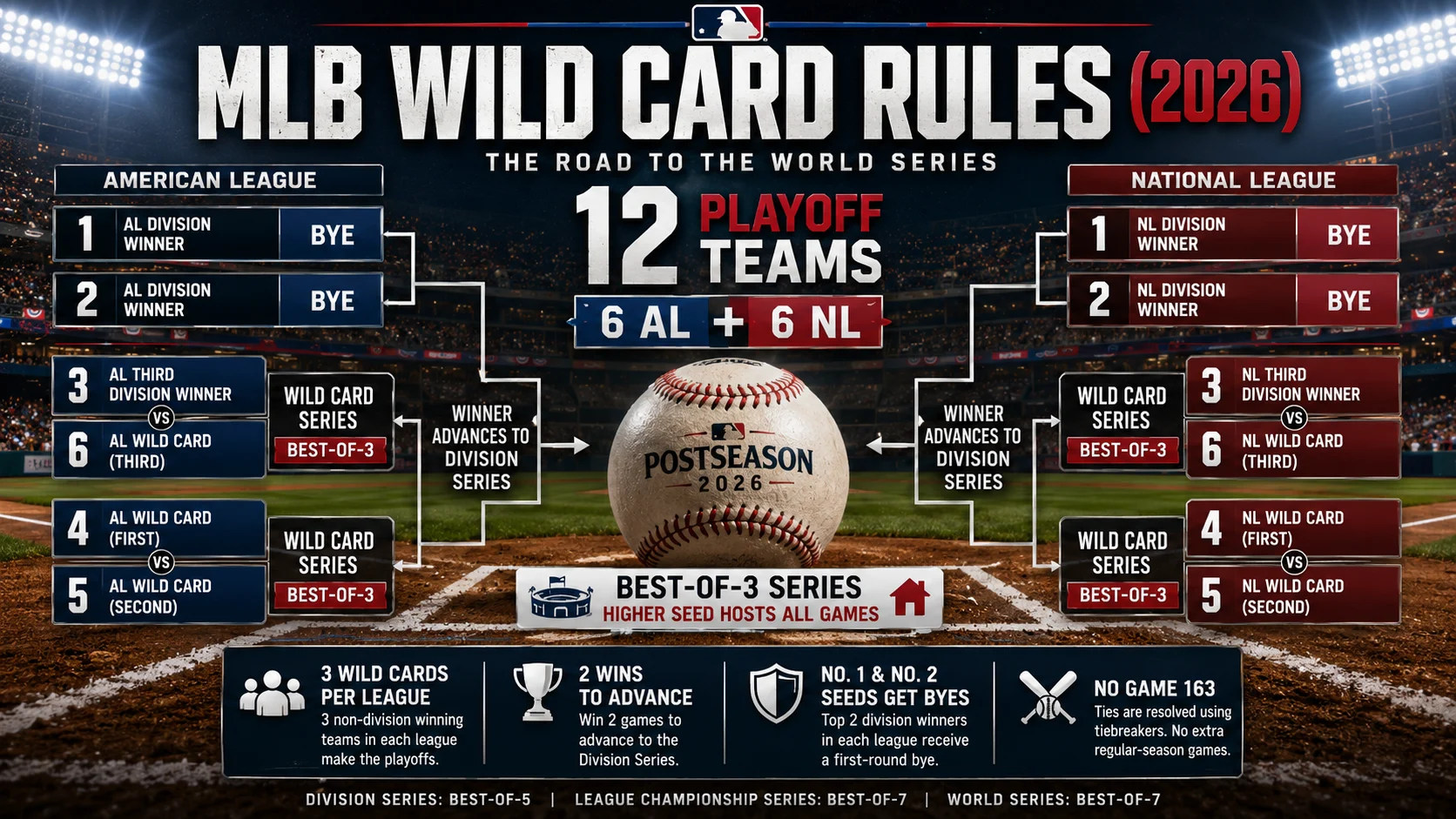
MLB Wild Card rules allow three non-division-winning teams from each league to reach the playoffs. The top two division winners receive a first-round bye, while Seeds 3–6 play a best-of-three Wild Card Series. The higher seed hosts all three games, if necessary, and winning two games advances a team to the Division Series.
The MLB Wild Card is one of the most important parts of Major League Baseball’s postseason. It gives strong teams that did not win their division another route into October baseball while also creating a high-pressure opening playoff round.
The modern Wild Card system is different from the older one-game format many longtime baseball fans remember. MLB expanded the postseason to 12 teams in 2022, creating a structure with three division winners and three Wild Cards in each league. The top two division winners receive byes, while the third division winner and three Wild Card teams compete in the opening round.
This guide explains MLB Wild Card rules in 2026, including how teams qualify, how the seeds are assigned, how the Wild Card Series works, who gets home-field advantage, what happens when teams finish with identical records, and how a Wild Card team can eventually reach the World Series.
What Is the MLB Wild Card?
The MLB Wild Card is a postseason qualification spot awarded to teams that do not win their division but finish with strong enough regular-season records to enter the playoffs.
Each league has three divisions:
- American League East, Central and West
- National League East, Central and West
Under the current system, six teams from each league qualify for the postseason:
- Three division winners
- Three Wild Card teams
That creates a 12-team MLB postseason field overall.
The Wild Card is important because winning a division is no longer the only way to reach October. A team can finish second or third in its division and still qualify by having one of the three best records among the non-division winners in its league.
How Many Wild Card Teams Make the MLB Playoffs?
There are three Wild Card teams in each league.
That means:
| League | Division Winners | Wild Cards | Total Playoff Teams |
|---|---|---|---|
| American League | 3 | 3 | 6 |
| National League | 3 | 3 | 6 |
| MLB Total | 6 | 6 | 12 |
The three division winners are seeded first, second and third according to their regular-season records. The three Wild Card clubs receive Seeds 4, 5 and 6 according to their records after the division winners have been determined.
This creates an important distinction: a Wild Card team can never receive a top-two seed under the current structure, because those positions belong to division winners.
What Are the MLB Wild Card Seeds?
The six playoff teams in each league receive Seeds 1 through 6.
The basic structure is:
| Seed | Team | Wild Card Status |
|---|---|---|
| No. 1 | Best division winner | Bye |
| No. 2 | Second-best division winner | Bye |
| No. 3 | Third-best division winner | Wild Card Series |
| No. 4 | Best Wild Card team | Wild Card Series |
| No. 5 | Second Wild Card team | Wild Card Series |
| No. 6 | Third Wild Card team | Wild Card Series |
The No. 1 and No. 2 seeds receive byes into the Division Series. Seeds 3 through 6 must play in the Wild Card Series.
That means winning a division has an important advantage. A division champion is guaranteed at least the No. 3 seed, while a Wild Card club must play immediately in the opening round.
How Does the MLB Wild Card Series Work?
The MLB Wild Card Series is a best-of-three series.
There are two Wild Card matchups in each league:
No. 3 Seed vs. No. 6 Seed
The third division winner hosts the third Wild Card team.
No. 4 Seed vs. No. 5 Seed
The first and second Wild Card teams face one another, with the higher seed hosting.
The first team to win two games wins the series and advances to the Division Series.
Unlike the old Wild Card Game, there is no single winner-take-all game in the current format.
A team can lose the opening game and still survive by winning Games 2 and 3.
Who Hosts the MLB Wild Card Series?
One of the most distinctive Wild Card rules is that the higher seed hosts all three games.
There is no traditional 2-2-1 or 2-3 home-field arrangement because the series is only three games long.
For example, if the No. 3 seed plays the No. 6 seed:
- Game 1: No. 3 seed home
- Game 2: No. 3 seed home
- Game 3: No. 3 seed home, if necessary
The same rule applies to the No. 4 vs. No. 5 matchup.
This gives the higher seed a substantial advantage because it does not have to travel during the series.
Is the MLB Wild Card Series Best of 3 or Best of 5?
The Wild Card Series is best of three.
A team must win two games to advance.
That is different from the Division Series, which is best of five, while the League Championship Series and World Series are best of seven.
The short Wild Card format creates enormous pressure. One bad pitching performance or one late defensive mistake can dramatically change a team’s postseason chances.
How Does a Team Qualify for an MLB Wild Card?
A team qualifies for the Wild Card by finishing among the three best non-division-winning teams in its league.
For example, imagine the American League standings finish like this:
| Team | Result | Status |
|---|---|---|
| Team A | Division winner | Division Champion |
| Team B | Division winner | Division Champion |
| Team C | Division winner | Division Champion |
| Team D | Best non-division winner | Wild Card |
| Team E | Second-best non-division winner | Wild Card |
| Team F | Third-best non-division winner | Wild Card |
| Team G | Fourth-best non-division winner | Eliminated |
Teams D, E and F would enter the postseason as Wild Card clubs.
A team does not have to finish second in its division to qualify. It can finish third or even lower if its overall record is strong enough compared with the other non-division winners in its league.
Can a Team Win the Wild Card Without Winning Its Division?
Yes.
In fact, that is the entire purpose of the Wild Card system.
A team may have an excellent regular-season record but finish behind a stronger club in its own division. Instead of being eliminated, it can qualify as one of the three Wild Cards.
This is especially important in competitive divisions where two or more teams may have winning records but only one can officially win the division.
The Wild Card gives those strong second-place and third-place teams another opportunity to compete for the World Series.
Do MLB Wild Card Teams Get a Bye?
No.
The three Wild Card teams in each league must play in the Wild Card Series.
The byes go only to the top two division winners in each league. The third division winner also plays in the Wild Card round, despite winning its division.
This makes the difference between finishing as a top-two division winner and finishing third in a division particularly significant.
For example:
- No. 1 seed: Bye
- No. 2 seed: Bye
- No. 3 seed: Wild Card Series
- No. 4 seed: Wild Card Series
- No. 5 seed: Wild Card Series
- No. 6 seed: Wild Card Series
What Happens After the Wild Card Series?
The Wild Card winners advance to the Division Series.
The bracket is predetermined:
No. 3 vs. No. 6 winner advances to face the No. 2 seed.
No. 4 vs. No. 5 winner advances to face the No. 1 seed.
This means the No. 1 and No. 2 seeds know which side of the bracket they occupy before the Wild Card Series begins.
A Wild Card team therefore has a difficult path to the World Series: it must win the Wild Card Series first, then survive the Division Series, League Championship Series and World Series.
What Happens If Teams Have the Same Record?
One of the biggest changes in modern MLB is that teams no longer play Game 163 to break regular-season ties.
Beginning with the current expanded postseason system, MLB eliminated tiebreaker games at the conclusion of the regular season. Instead, ties are resolved mathematically using predetermined tiebreaking procedures.
The first major tiebreaker between two tied teams is:
1. Head-to-Head Record
The team with the better record against the other club wins the tiebreaker.
For example, if two teams finish 88-74 but Team A went 10-8 against Team B, Team A gets the advantage.
2. Intradivision Record
If head-to-head results do not break the tie, MLB moves to the teams’ winning percentages within their division.
3. Interdivision Record
If another tiebreaker is required, MLB can use performance against teams from other divisions within the same league.
MLB’s current tiebreaker system uses additional mathematical criteria when necessary. The key point for fans is that there is no longer a scheduled Game 163 to decide a division title, Wild Card position or postseason seeding.
Why Head-to-Head Games Matter So Much
Because MLB no longer uses a playoff game to settle regular-season ties, individual games during the regular season can have major postseason consequences.
Suppose two teams finish with identical 90-72 records.
If one team won the season series against the other, that result can determine:
- Division winner
- Wild Card qualification
- Wild Card seed
- Home-field advantage
- Whether a team receives a first-round bye
MLB has specifically emphasized head-to-head performance as the first tiebreaker in the current system.
This makes late-season series between playoff contenders particularly important.
Can Two Teams From the Same Division Play in the Wild Card Series?
Yes.
The current MLB postseason format does not prohibit teams from the same division from meeting in the Wild Card Series.
For example, if two American League East teams qualify as Wild Cards and their records produce a No. 4 vs. No. 5 matchup, they can face each other immediately in the postseason.
The same is true for teams from the Central or West divisions.
The current bracket is determined by seeding rather than by avoiding division matchups.
Does the Wild Card Series Go to Extra Innings?
Yes.
The Wild Card Series uses MLB’s regular postseason game rules, so an individual game that is tied after nine innings continues into extra innings until there is a winner.
The automatic runner rule used in regular-season extra innings does not apply to postseason games.
That means postseason extra innings can become much more traditional, high-pressure baseball, with each team attempting to score and defend until the game is decided.
The key distinction is that the series itself has no tie. A club must win two games to advance.
How Important Is Game 1?
Game 1 is extremely important because the Wild Card Series is so short.
A team that wins Game 1 is only one victory away from advancing.
A team that loses Game 1 must win the next two games to survive.
Because the higher seed hosts all three potential games, winning Game 1 can put the home club in a commanding position without requiring travel.
This short format is one reason the Wild Card round can produce surprises. Over a best-of-three series, a strong team has less time to recover from an early deficit than it would in a longer postseason series.
Does Winning the Division Give You an Advantage?
Yes.
Winning a division guarantees a team at least the No. 3 seed, meaning it cannot fall behind all three Wild Card clubs in the seeding structure.
More importantly, winning the division gives a team a chance to earn one of the top two seeds and a first-round bye.
The third division winner does not receive a bye and must play the No. 6 team in the Wild Card Series.
Therefore, there are effectively two levels of division success:
Top two division winners: First-round bye
Third division winner: Wild Card Series plus home-field advantage
What Is the Difference Between a Wild Card and a Wild Card Series?
These terms are related but not identical.
A Wild Card is a team that qualifies for the postseason without winning its division.
A Wild Card Series is the best-of-three postseason round that teams seeded No. 3 through No. 6 compete in.
In the current format, the No. 3 seed is technically a division winner, not a Wild Card team, but it still participates in the Wild Card Series.
That distinction can sometimes confuse new MLB fans.
Why Did MLB Change the Wild Card Format?
MLB has changed its postseason structure several times throughout history.
The modern best-of-three Wild Card Series was introduced when the league temporarily expanded the postseason to 16 teams in 2020. MLB subsequently adopted the 12-team postseason format beginning in 2022, retaining the best-of-three Wild Card round while reducing the number of playoff teams.
The current structure was designed to reward division winners while still allowing more strong teams to participate in the postseason.
The elimination of Game 163 also helps MLB move directly from the regular season into the postseason without requiring additional tiebreaker games.
MLB Wild Card Rules at a Glance
Here is the easiest way to remember the entire system:
| Rule | MLB Wild Card Rule |
|---|---|
| Teams per league | 6 |
| Division winners | 3 |
| Wild Card teams | 3 |
| Total MLB playoff teams | 12 |
| Top two seeds | First-round bye |
| No. 3 vs. No. 6 | Wild Card Series |
| No. 4 vs. No. 5 | Wild Card Series |
| Wild Card format | Best of 3 |
| Games needed to advance | 2 wins |
| Higher seed home games | All 3, if necessary |
| Game 163 | Eliminated |
| First tiebreaker | Head-to-head record |
| Division Series | Best of 5 |
| League Championship Series | Best of 7 |
| World Series | Best of 7 |
Frequently Asked Questions
How many MLB Wild Card teams are there?
There are three Wild Card teams in each league, giving MLB six Wild Card teams overall.
Is the MLB Wild Card a single game?
No. Under the current format, the Wild Card round is a best-of-three series. A team must win two games to advance.
Who hosts the Wild Card Series?
The higher-seeded team hosts all three games, if a third game is necessary.
Does the No. 3 seed get a bye?
No. Only the No. 1 and No. 2 division winners receive first-round byes. The No. 3 seed plays the No. 6 seed in the Wild Card Series.
Do Wild Card teams have to win the Wild Card Series to reach the Division Series?
Yes. A Wild Card team must win its best-of-three Wild Card Series before advancing to the Division Series.
Can two teams from the same division meet in the Wild Card round?
Yes. MLB’s current postseason seeding system allows same-division teams to meet in the Wild Card Series.
Is there still a Game 163?
No. MLB eliminated regular-season tiebreaker games. Ties are resolved through mathematical tiebreakers instead.
What is the first MLB tiebreaker?
For two tied teams, head-to-head record is the first tiebreaker.
Does a Wild Card team get home-field advantage?
It depends on the matchup. A Wild Card team can host the Wild Card Series if it has the higher seed, but Wild Card teams are seeded Nos. 4-6 and therefore cannot receive the top-two first-round byes.
Final Thoughts
The modern MLB Wild Card format makes the final weeks of the regular season more meaningful than ever. Six teams from each league reach the postseason, but only the top two division winners can skip the opening round. The No. 3 division winner and three Wild Card teams must fight through a best-of-three series, with the higher seed receiving the unusual but valuable advantage of hosting every game.
For fans trying to understand the playoff picture, the simplest formula is:
3 division winners + 3 Wild Cards = 6 playoff teams per league.
Then:
Seeds 1 and 2 get byes.
Seed 3 plays Seed 6.
Seed 4 plays Seed 5.
The higher seed hosts every Wild Card Series game.
And because MLB no longer uses Game 163, head-to-head records and other mathematical tiebreakers can ultimately decide who gets into October and who goes home after the 162-game regular season.
Understanding these rules makes the MLB postseason much easier to follow and explains why a late-season series between two contenders can matter just as much as any single playoff game.

Daniel Brooks is a sports writer at SportsOrbitX.com, specializing in football, basketball and global sports news. He focuses on delivering accurate reporting, match analysis and timely updates that keep fans informed.