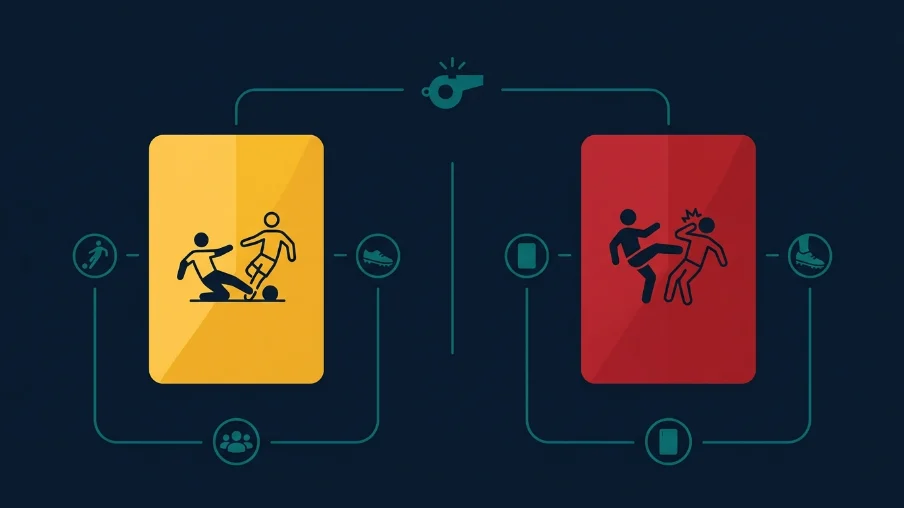
Quick Answer: Football fouls result in either a free-kick or penalty, and can additionally be punished with a yellow card (a caution) or a red card (an ejection), depending on how serious, reckless, or dangerous the referee judges the offense to be.
A player slides in late, the whistle blows, and the referee reaches into a pocket. For new fans, that moment can be genuinely confusing why did that challenge get a yellow card while a similar one earlier in the match received nothing at all? Understanding a foul in football isn’t always as straightforward as it looks from the stands or on television.
Many supporters hear commentators mention football fouls, debate whether a challenge was a football foul, or even search for foul football and fault in football when trying to understand the rules. In reality, a fault or foul football discussion usually comes down to one simple question: what counts as a foul in football? The answer lies in a detailed rulebook that most casual viewers never read, even though it shapes nearly every close match and often influences the outcome of the biggest fixtures in the sport.
Whether you’re wondering how do fouls work in football, when is it a foul in football, or why seemingly similar fouls in football can receive completely different decisions, the explanation comes from the referee applying the official Laws of the Game to the specific circumstances of each incident.
This guide explains exactly what counts as a foul in football, when referees award free kicks instead of allowing play to continue, why some football fouls result in yellow or red cards, and how the disciplinary system works from a single caution to a sending-off. Every explanation is cross-checked against the official IFAB Laws of the Game rather than common myths or assumptions from match commentary.
What Counts as a Foul in Football?
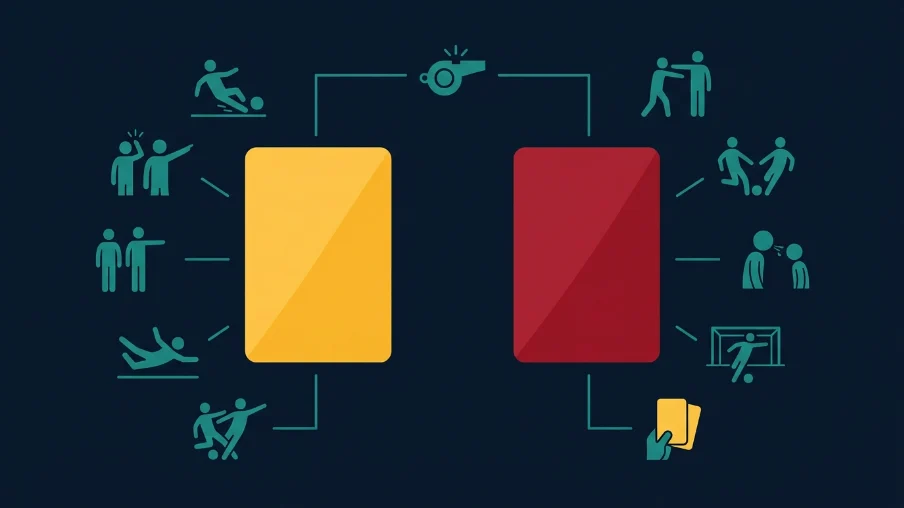
A foul is called when a player commits an offense against an opponent, most commonly through physical contact judged to be careless, reckless, or using excessive force. Under IFAB’s Laws of the Game, referees are trained to distinguish between accidental contact, careless challenges, and genuinely dangerous play, with common fouls including:
- Kicking or attempting to kick an opponent
- Tripping or attempting to trip an opponent
- Jumping at an opponent
- Charging into an opponent
- Striking or attempting to strike an opponent
- Pushing an opponent
- Tackling an opponent in a way that makes contact with the player before the ball
- Holding an opponent
- Handling the ball deliberately (outside the goalkeeper’s own penalty area)
Not every foul results in a card. Most fouls during a match simply result in a free-kick for the opposing team, without any disciplinary action against the player who committed it.
Free-Kicks vs. Penalty Kicks: What’s the Difference?
Where a foul occurs on the pitch determines the type of restart awarded:
- A foul committed outside the penalty area typically results in a direct or indirect free-kick.
- A foul committed by the defending team inside their own penalty area results in a penalty kick, taken from the penalty spot against only the goalkeeper.
This distinction is why fouls near the edge of the penalty box are often the most contested moments in a match a few inches can be the difference between a routine free-kick and a penalty.
Yellow Cards Explained
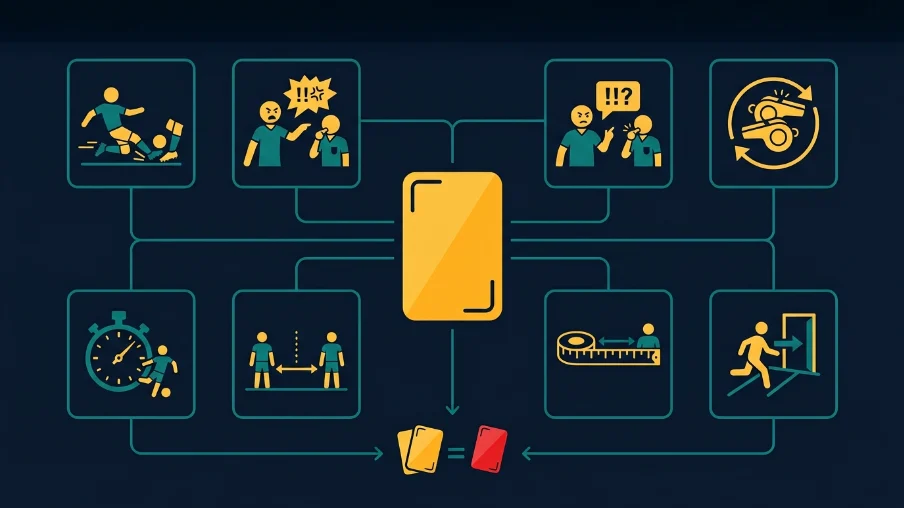
A yellow card is a formal caution shown to a player for specific offenses, serving as an official warning without removing them from the match, though it does carry the risk of escalation if the player continues similar behavior. Common reasons a referee shows a yellow card include:
- Unsporting behavior (such as a reckless tackle or simulation/diving)
- Dissent by word or action toward match officials
- Persistent infringement of the Laws of the Game
- Delaying the restart of play
- Failing to respect the required distance during a free-kick or corner
- Entering or leaving the field of play without the referee’s permission
A player who receives two yellow cards in the same match is shown a second yellow card followed immediately by a red card, resulting in their ejection from the game.
Red Cards Explained
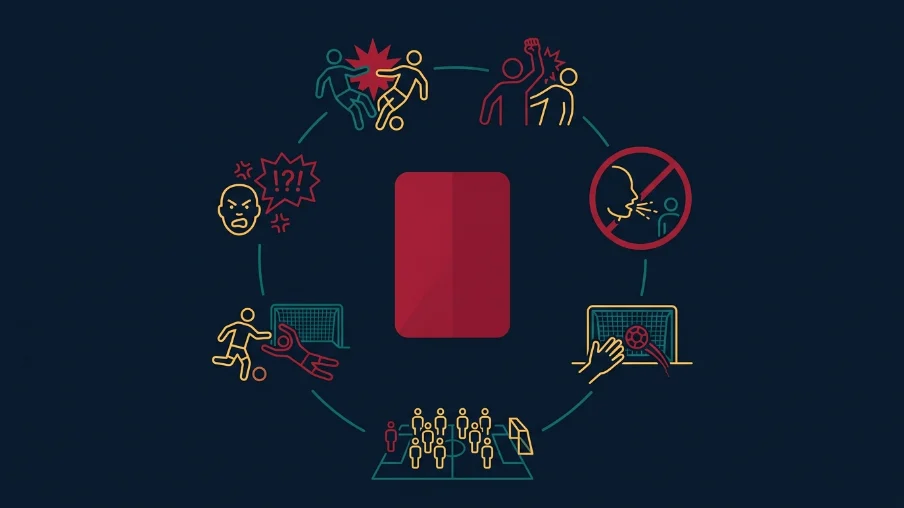
A red card results in a player being sent off the pitch immediately, and their team is not permitted to replace them, meaning they play the remainder of the match with one fewer player. A direct red card can be shown for serious offenses including:
- Serious foul play
- Violent conduct
- Spitting at an opponent or any other person
- Denying an obvious goal-scoring opportunity through a handball offense
- Denying an obvious goal-scoring opportunity by committing a foul
- Using offensive, insulting, or abusive language or gestures
Unlike a yellow card, a red card cannot be reversed once shown, except in rare cases where VAR intervenes to correct a clear and obvious error in the decision itself.
How Do Referees Decide Between a Yellow and Red Card?
Referees weigh several factors when deciding how to punish a foul, including the amount of force used, whether the offense endangered an opponent’s safety, whether the player showed clear intent, and whether the foul denied a clear goal-scoring opportunity. A mistimed but non-malicious tackle often results in a yellow card, while a reckless, high-force challenge that endangers an opponent is far more likely to result in a straight red card, even on a player’s first offense of the match, regardless of the match’s importance or scoreline.
Yellow Card vs. Red Card: Quick Comparison
| Aspect | Yellow Card | Red Card |
| Effect on player | Formal warning, player remains on the pitch | Player is sent off immediately |
| Effect on team | No immediate change | Team plays with one fewer player |
| Accumulation | Two yellow cards in one match equal a red card | N/A a single red card is immediate |
| Suspension risk | Accumulated yellows across matches can trigger a ban | Almost always results in at least a one-match suspension |
Notable Red Card Moments in Football History
Certain sending-offs are still referenced today when discussing the impact a red card can have on a match:
- Zinedine Zidane’s headbutt on Marco Materazzi in the 2006 World Cup final remains one of the most talked-about red cards in the tournament’s history, occurring in Zidane’s final professional match.
- David Beckham’s red card against Argentina at the 1998 World Cup, for a kick aimed at an opponent, became one of the most scrutinized dismissals in English football history due to its impact on the match result.
- Multiple Champions League finals have been shaped by early red cards, with the resulting numerical disadvantage frequently cited by analysts as a deciding factor in the eventual outcome.
How the Disciplinary System Has Evolved
Football’s approach to fouls and cards has changed significantly since yellow and red cards were first introduced at the 1970 FIFA World Cup in Mexico, largely in response to confusion during earlier tournaments where language barriers made it difficult for players to understand when they had been cautioned or sent off. The visual, universally understood card system solved that communication problem immediately and has remained largely unchanged in concept ever since, even as the specific offenses covered under each category have been refined repeatedly by IFAB.
More recently, the introduction of VAR has added a layer of review specifically for red card decisions, allowing officials to correct clear and obvious errors on serious incidents that may have been missed in real time a safeguard that didn’t exist for the majority of the card system’s history.
Fouls in the Penalty Area: Why They’re So Contentious
Fouls committed inside the penalty area draw disproportionate scrutiny compared to identical fouls elsewhere on the pitch, simply because of the direct scoring opportunity a penalty kick represents. A marginal shirt-pull or a minimal push that would go unnoticed in midfield can become the single deciding moment of a match when it happens inside the box. This heightened stakes environment is part of why penalty-area decisions are among the most reviewed incidents under VAR protocol, and why disagreements over contact inside the box remain one of football’s most persistent talking points among fans and pundits alike.
What Happens After a Player Is Sent Off?
Once a red card is shown, the affected team cannot bring on a substitute to replace the sent-off player, meaning they finish the match with 10 players (or fewer, if multiple red cards occur). Red cards also typically carry consequences beyond the match itself most competitions impose an automatic suspension for the player’s next fixture, with more serious offenses sometimes resulting in longer bans determined by the relevant disciplinary committee.
Common Misconceptions About Fouls and Cards
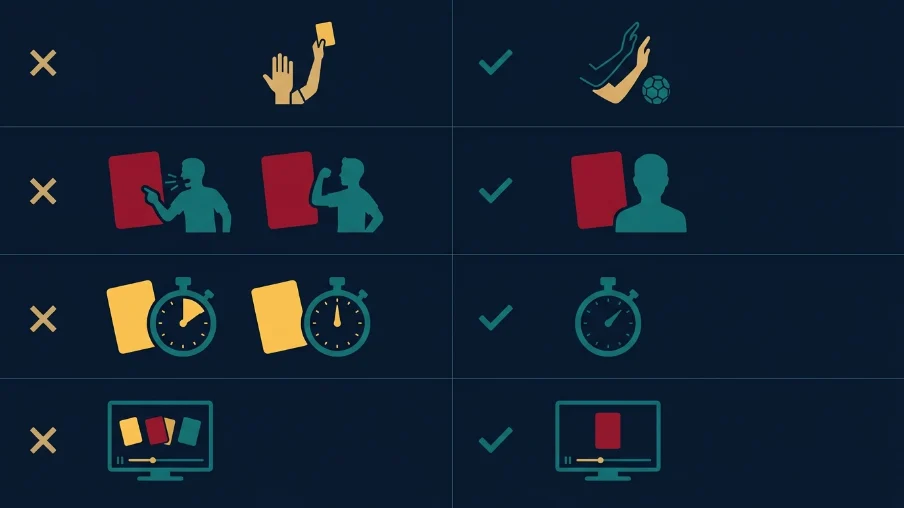
- “Every handball is a foul.” False only deliberate handballs, or those where a player’s arm is judged to be in an unnaturally wide position, are penalized under current IFAB interpretations.
- “A red card always means violent play.” False denying a clear goal-scoring opportunity through a tactical foul can also result in a straight red card, even without aggressive contact.
- Yellow cards carry over into extra time as a fresh count.” False accumulated yellow cards from regular time carry into extra time within the same match.
- “VAR can overturn any card decision.” False VAR can only intervene for clear and obvious errors on red card incidents; yellow card decisions are generally not reviewable under current protocol.
Frequently Asked Questions
What is the difference between a yellow card and a red card in football? A yellow card is a formal warning that allows a player to continue playing, while a red card results in immediate ejection from the match with no substitute allowed.
Can a player get sent off without receiving a card first? No, a red card is always required for a player to be sent off, whether shown directly for a serious offense or as a second yellow card in the same match.
Does a yellow card carry over to the next match? Accumulated yellow cards across multiple matches in a competition typically trigger an automatic one-match suspension once a certain threshold is reached, though the exact number varies by competition.
What happens if a goalkeeper is sent off? If a goalkeeper receives a red card, another player must go in goal, since teams cannot use a substitute solely to replace a sent-off player unless a substitution window is still available.
Can VAR review a yellow card decision? Under current protocol, VAR primarily reviews red card incidents, goals, penalties, and mistaken identity, with yellow card decisions generally left to the on-field referee’s judgment.
Is denying a goal-scoring opportunity always a red card? Not always. If the foul is judged to be an attempt to play the ball with minimal contact and the offense occurs in the penalty area, some cases result in a yellow card alongside a penalty rather than a red card, depending on the offense.
When were yellow and red cards first introduced in football? Yellow and red cards were first introduced at the 1970 FIFA World Cup in Mexico, designed to create a universal, language-independent way for referees to communicate cautions and dismissals.
Do accumulated yellow cards reset each season? Yes, in most competitions, accumulated yellow card counts reset at the start of each new season or competition, though specific rules vary depending on the league or tournament.
Conclusion
Understanding football fouls and cards explained through official IFAB rules rather than assumption makes it far easier to follow the split-second decisions that often shape a match’s outcome. From a routine free-kick to a match-changing red card like Zidane’s dismissal in the 2006 World Cup final, the disciplinary system exists to balance fair play with the physical, competitive nature of the sport, while continuing to evolve alongside technology like VAR.
Want to understand more of the officiating side of football? Check out our guide on What Does VAR Stand For in Football to see how video technology now supports these exact decisions.

Daniel Brooks is a sports writer at SportsOrbitX.com, specializing in football, basketball and global sports news. He focuses on delivering accurate reporting, match analysis and timely updates that keep fans informed.