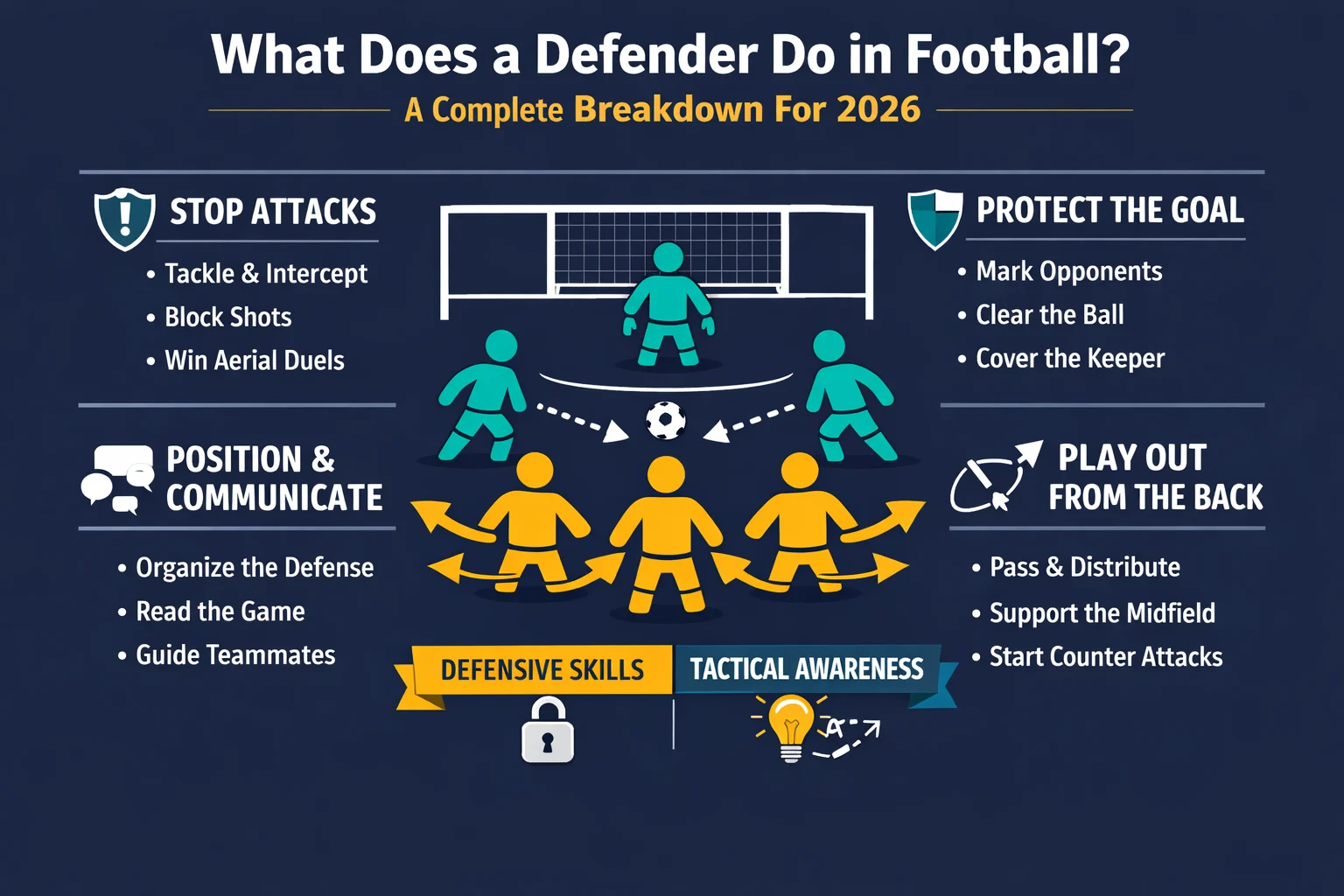
Quick Answer: A defender’s primary job is to prevent the opposing team from scoring by marking attackers, winning tackles and headers, intercepting passes, and organizing the defensive shape, while also increasingly contributing to a team’s build-up play with the ball.
Strikers get the headlines, midfielders get the assists, but a match is often won or lost long before either of them touches the ball in a dangerous position. Somewhere in front of the goalkeeper, a smaller group of players is quietly doing the unglamorous work of stopping attacks before they ever become a threat and understanding exactly what that job involves changes how you watch every single match, no matter which team you’re following.
This guide explains exactly what does a defender do in football, breaking down the different defensive positions, the specific skills each requires, and how the role has evolved well beyond simply stopping goals over the past several decades.
The Core Job of a Defender
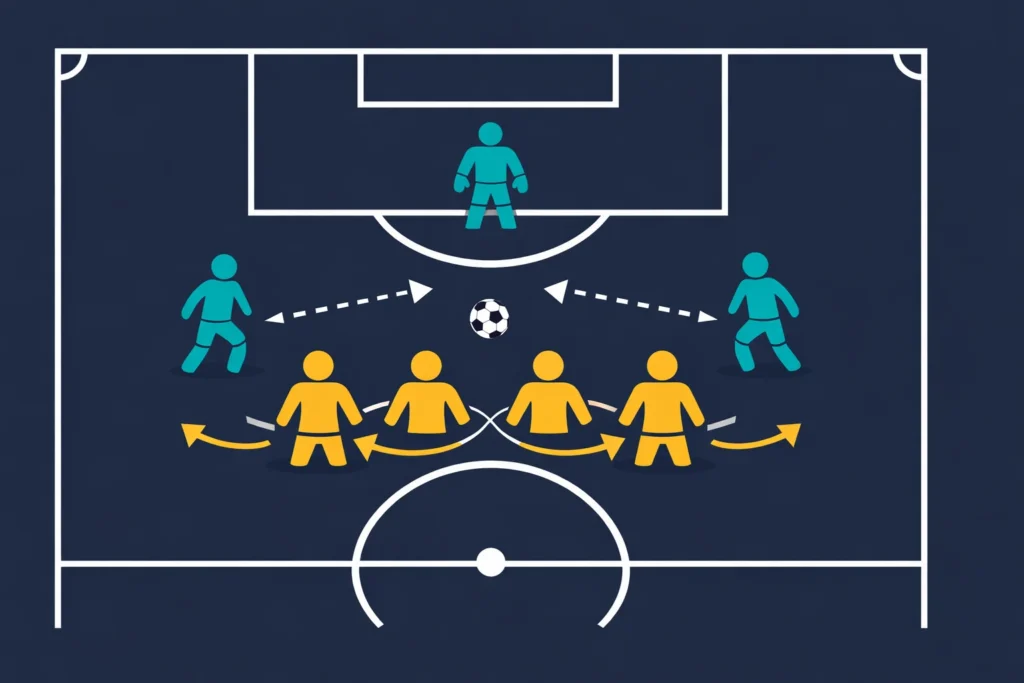
At its most basic level, a defender’s responsibility is to prevent the opposing team from scoring. This involves a combination of physical and mental skills: reading the game to anticipate where danger will come from, positioning correctly to cut off passing lanes, winning individual duels against attackers, and communicating with teammates to maintain a cohesive defensive shape across the width of the pitch throughout the full 90 minutes of a match.
Types of Defenders and Their Specific Roles
Not all defenders do the same job. The position splits into several distinct roles, each with different responsibilities depending on where they line up.
Center-Back
Positioned centrally in front of the goalkeeper, center-backs are primarily responsible for marking opposition strikers, winning aerial duels on crosses and set pieces, and blocking direct shots on goal. Teams typically use two center-backs, though formations like 3-5-2 and 3-4-3 use three. Center-backs are often the tallest, most physically dominant players on a team, given how frequently their job involves aerial contests against similarly imposing opposition forwards.
Full-Back
Full-backs patrol the wide defensive areas, tracking opposition wingers and preventing crosses into the penalty area. In modern football, full-backs are also expected to contribute significantly to attacking play, making overlapping runs down the flank and delivering crosses of their own, making the role one of the most physically demanding on the pitch due to the sheer distance covered in both defensive and attacking directions across a full match.
Wing-Back
A more attack-focused evolution of the full-back role, common in three-at-the-back formations like 3-5-2. Wing-backs are responsible for covering the entire width of the pitch on their side, both defensively and offensively, requiring exceptional stamina to consistently sprint the full length of the touchline throughout a match without significant rest.
Sweeper
A largely historical role, the sweeper played behind the main defensive line, “sweeping up” any attackers who got past the primary defenders. While rare in modern football due to the widespread adoption of the offside trap and zonal marking systems, some elements of the sweeper’s reading-the-game responsibilities have been absorbed into the modern ball-playing center-back role seen across elite football today.
Key Skills Required to Be an Effective Defender
Successful defenders typically combine several specific physical and technical attributes:
- Positional awareness consistently reading the game to anticipate where the next attack will develop
- Tackling technique winning the ball cleanly without conceding unnecessary fouls or free-kicks
- Aerial ability winning headers against attackers during crosses, corners, and long balls
- Communication organizing teammates and maintaining a coherent defensive shape throughout the match
- Passing and ball control increasingly essential as modern football demands defenders comfortable building attacks from the back
- Pace and recovery speed particularly important for defenders facing quick, direct attacking players
Defender Roles: Quick Comparison
| Role | Primary Focus | Typical Positioning |
|---|---|---|
| Center-Back | Marking strikers, aerial duels, blocking shots | Central, in front of the goalkeeper |
| Full-Back | Tracking wingers, supporting width | Wide areas, both defensive and attacking thirds |
| Wing-Back | Covering full touchline width | Wide areas in three-at-the-back systems |
| Sweeper (historical) | Covering behind the main defensive line | Deepest defensive position, now rare |
How the Defender Role Has Evolved
Modern football has significantly changed what’s expected of a defender compared to previous decades. Where defenders were once judged almost entirely on tackles won and goals prevented, today’s elite center-backs and full-backs are also expected to be comfortable in possession, capable of playing accurate long passes, and confident bringing the ball out from the back under pressure from opposing forwards. This shift has been driven largely by the rise of possession-based tactical systems, where a defender who can’t reliably retain the ball becomes a liability regardless of their defensive quality, fundamentally changing how clubs scout and develop young defenders from academy level upward.
Famous Defenders in Football History
Franco Baresi
Widely regarded as one of the greatest center-backs ever, Baresi’s reading of the game and positional discipline at AC Milan helped define the “libero” style of defending during the late 1980s and 1990s.
Paolo Maldini
Playing both center-back and full-back across a remarkable career at AC Milan, Maldini is frequently cited as the benchmark for defensive positioning, rarely needing to make dramatic tackles because his anticipation was so consistently precise.
Roberto Carlos
Known for combining defensive discipline at full-back with devastating attacking ability, Roberto Carlos redefined how far forward a defender could realistically contribute during his time at Real Madrid and with the Brazilian national team.
Virgil van Dijk
A modern example of the complete center-back, van Dijk combines physical dominance in the air and in duels with strong passing range, becoming a central figure in Liverpool’s Champions League and Premier League-winning teams.
Why Defensive Positioning Matters More Than Tackling
Contrary to popular belief among casual fans, elite defenders are often judged more by how rarely they need to make a last-ditch tackle than by how many tackles they actually complete during a match. Strong positional awareness allows a defender to intercept a pass or block a shooting lane before a dangerous situation fully develops, making the more visually dramatic sliding tackle a sign that something has already gone wrong positionally, rather than a pure display of defensive skill on its own merit.
A Brief History of Defensive Roles in Football
Defensive tactics have evolved dramatically since football’s early years, when attacking-heavy formations like the 2-3-5 “pyramid” left teams with as few as two dedicated defenders. The introduction of the WM formation by Arsenal manager Herbert Chapman in the 1920s marked one of the first significant shifts toward a more structured defensive setup, establishing clearer roles that resemble the modern back-line concept. The “libero” or sweeper system gained particular prominence in Italian football during the 1970s and 1980s, popularized by defenders like Franco Baresi, before gradually declining in favor of the flat back-four system that became standard across most of elite football by the 1990s and remains dominant, in various forms, today.
How Young Players Develop Into Defensive Roles
Youth coaches generally look for a specific blend of physical and mental attributes when identifying potential defenders, though these qualities often continue developing well into a player’s late teens and early twenties. Height and physical strength are frequently valued for center-back development, given the position’s heavy reliance on aerial duels, while speed and stamina are prioritized for full-back and wing-back prospects due to the significant ground those roles are expected to cover. Increasingly, academies also place strong emphasis on comfort in possession from an early age, reflecting how thoroughly modern tactical systems have reshaped what clubs consider a “complete” defensive prospect compared to previous generations.
Defensive Statistics That Actually Matter
Evaluating a defender’s performance through statistics is notoriously more complex than judging an attacking player by goals and assists. Analysts increasingly look beyond simple tackle counts, since a high number of tackles can sometimes indicate poor initial positioning rather than defensive quality. More telling metrics include interceptions, which reflect a defender’s ability to read the game and cut out danger before a tackle is even necessary, along with aerial duel success rate, pass completion percentage under pressure, and progressive passes that contribute directly to a team’s attacking transitions from deep positions.
Famous Defensive Partnerships in Football History
Beyond individual defenders, some of football’s most iconic defensive units were built on the chemistry between two or more center-backs playing together consistently over many seasons. AC Milan’s back line during the late 1980s and early 1990s, featuring Franco Baresi alongside Paolo Maldini, is frequently cited as one of the greatest defensive units ever assembled, conceding remarkably few goals across multiple title-winning campaigns. More recently, Virgil van Dijk’s partnership with a rotating cast of center-back partners at Liverpool has been credited with transforming the club’s overall defensive identity, showing how a single elite defender can elevate the performance of those playing alongside him.
Frequently Asked Questions
What does a defender do in football? A defender’s main job is to prevent the opposing team from scoring by marking attackers, winning tackles and aerial duels, and organizing defensive shape, while also contributing to build-up play in modern systems.
What is the difference between a center-back and a full-back? A center-back plays centrally, focused on marking strikers and winning aerial duels, while a full-back plays in the wide defensive areas, tracking wingers and supporting attacking width.
What skills do defenders need most? Positional awareness, tackling technique, aerial ability, communication, and increasingly strong passing skills are considered the core attributes of an effective modern defender.
Do defenders score goals? Yes, particularly from set pieces like corners and free-kicks, where center-backs frequently contribute goals due to their strength in aerial duels.
Is the sweeper role still used in modern football? Rarely in its traditional form, though some of its reading-the-game responsibilities have been absorbed into the modern ball-playing center-back role.
Why are modern defenders expected to pass well? The rise of possession-based tactical systems requires defenders to comfortably retain and distribute the ball under pressure, rather than simply clearing it away whenever an opponent applies pressure.
What statistics are used to judge a defender’s performance? Analysts often prioritize interceptions, aerial duel success rate, pass completion under pressure, and progressive passes over simple tackle counts, since positioning quality often matters more than raw tackle numbers.
Was the sweeper role ever officially banned from football? No, the sweeper was never banned; its decline was driven primarily by tactical trends, particularly the widespread adoption of the offside trap and zonal marking systems that made the role less necessary.
Conclusion
So, what does a defender do in football? Far more than simply stopping goals, as this guide shows from marking strikers and winning aerial duels to increasingly driving a team’s build-up play from deep positions, a shift that traces back through decades of tactical evolution from Herbert Chapman’s WM formation to today’s possession-based systems. Understanding the different defensive roles and the skills each requires makes it much easier to appreciate the players whose best work often goes unnoticed precisely because they prevented danger before it ever became visible. Want to explore more football positions?
Check out our guide on Football Positions and Their Roles for the complete breakdown of every position on the pitch.

Daniel Brooks is a sports writer at SportsOrbitX.com, specializing in football, basketball and global sports news. He focuses on delivering accurate reporting, match analysis and timely updates that keep fans informed.