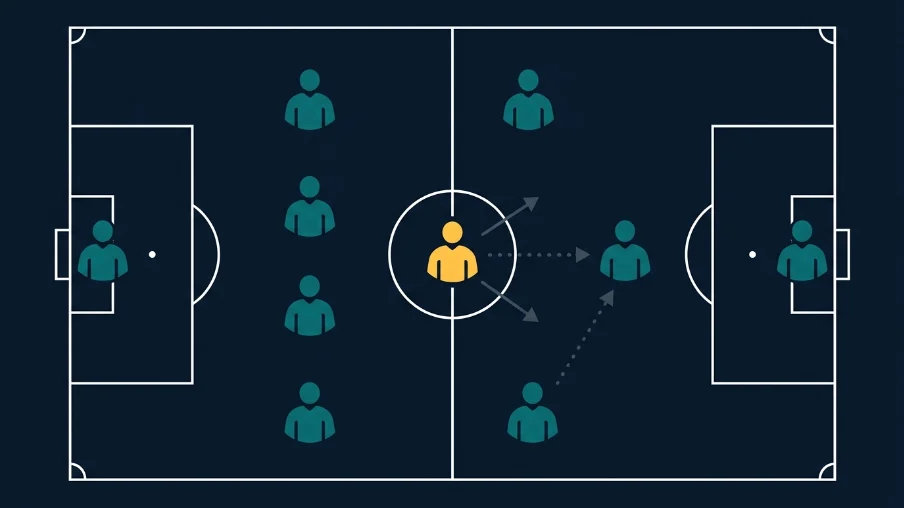
Quick Answer: CDM stands for Central Defensive Midfielder, a position focused on shielding the defense, breaking up opposition attacks, and helping a team transition from defense into attack.
Watch a well-organized football team long enough, and you’ll notice one player who almost never seems to touch the flashy moments no bicycle kicks, rarely a headline goal, but somehow always positioned exactly where the opposition’s attack breaks down. That player is usually the CDM, one of football’s most tactically important yet under-appreciated roles, quietly holding an entire team’s structure together across a full 90 minutes.
This guide explains exactly what does CDM mean in football, the specific responsibilities the role carries, the skills required to play it well, and which players have defined the position at the highest level of the professional game.
What Does CDM Stand For?
CDM stands for Central Defensive Midfielder. It describes a midfielder who plays in a deeper, more defensively focused role compared to central or attacking midfielders, typically positioned directly in front of the back line of defenders and rarely straying far from that zone during defensive phases of play. The role is sometimes also referred to as a “holding midfielder” or “defensive pivot,” particularly in tactical analysis and coaching discussions.
Core Responsibilities of a CDM
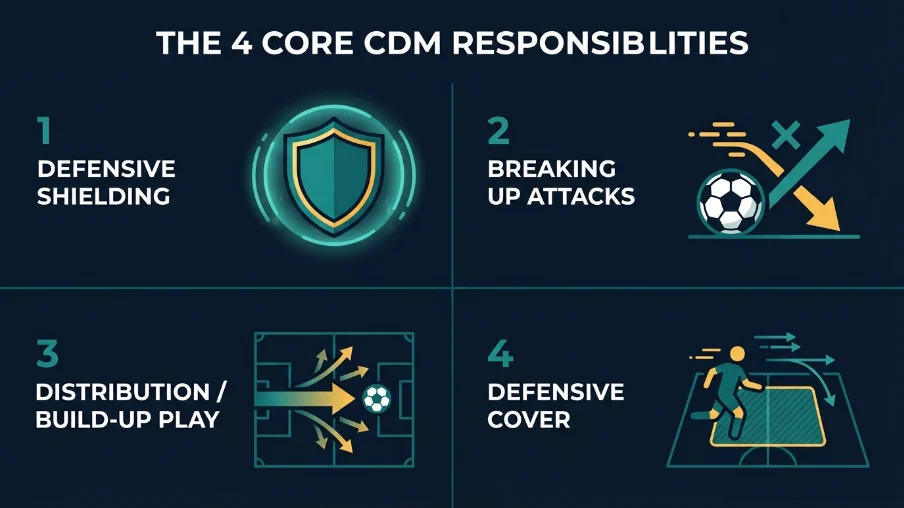
A CDM’s job extends well beyond simply tackling opponents. The role carries several distinct responsibilities that shape how an entire team functions defensively and offensively, often determining whether a team’s overall shape holds together under sustained pressure.
Shielding the Defense
The most fundamental job of a CDM is to sit in front of the center-backs, closing down passing lanes and intercepting through-balls before they reach the defensive line. This positioning acts as a first line of protection, reducing the pressure directly on the back four.
Breaking Up Attacks
CDMs are typically responsible for winning the ball back through tackles, interceptions, and physical duels, disrupting the opposition’s rhythm before they can build a dangerous attack.
Distribution and Build-Up Play
Once possession is won, a CDM often becomes the first player to distribute the ball forward, either through short, safe passes to teammates or, in more progressive systems, longer diagonal passes that switch the point of attack.
Providing Defensive Cover
When full-backs push forward to support attacks, a CDM frequently drops into the space they leave behind, maintaining defensive balance and preventing counter-attacks from exploiting an open flank.
Key Skills Required to Play as a CDM
Not every midfielder is suited to this role. Effective CDMs typically combine several specific attributes:
- Positional discipline knowing exactly when to hold a defensive position rather than press forward
- Tackling and interception ability winning the ball cleanly without conceding unnecessary fouls
- Passing range distributing the ball efficiently under pressure, often in tight spaces
- Physical stamina covering large amounts of ground throughout a full 90 minutes
- Game reading anticipating where the opposition’s next attack is likely to develop
CDM vs. Other Midfield Roles
| Role | Primary Focus | Typical Positioning |
|---|---|---|
| CDM | Defensive shielding, breaking up play | Directly in front of the back line |
| CM (Central Midfielder) | Balanced defensive and attacking duties | Between the CDM and CAM |
| CAM (Attacking Midfielder) | Creating chances, final-third passing | Just behind the forwards |
| Box-to-Box Midfielder | Covers the full length of the pitch | Moves between defensive and attacking phases |
Famous CDM Players in Football History
N’Golo Kanté
Widely regarded as one of the finest defensive midfielders of his generation, Kanté became known for extraordinary work rate, positioning, and ball-winning ability, playing a central role in both Leicester City’s unlikely 2015-16 Premier League title and France’s 2018 World Cup victory, despite standing shorter than many of his midfield peers.
Claude Makélélé
The role is sometimes informally referred to as “the Makélélé role” in football punditry, named after the French midfielder whose disciplined, unglamorous defensive work for Real Madrid and Chelsea in the early 2000s helped define the modern CDM position as tactically essential rather than purely defensive, reshaping how top clubs valued the role in future transfer decisions.
Sergio Busquets
Known for his exceptional passing range and game intelligence, Busquets became a cornerstone of Barcelona and Spain’s dominant possession-based systems, showing that a CDM’s value often extends far beyond tackles and interceptions into the very foundation of how a team builds attacking play.
Casemiro
A key figure in Real Madrid’s Champions League successes across multiple seasons, Casemiro combined physical dominance with strong positional awareness, frequently described by coaches as the defensive foundation that allowed more attack-minded teammates the freedom to push forward without fear of leaving the team exposed.
Why the CDM Role Is Considered So Demanding
Coaches and analysts frequently cite the CDM position as one of the most mentally and physically demanding roles in football. A CDM must simultaneously track opposition runners, anticipate through-balls, cover for teammates out of position, and make quick, accurate passing decisions under pressure often while covering more ground per match than almost any other position on the pitch. Mistakes made by a CDM are also more costly than errors elsewhere on the pitch, since a lost ball or missed interception in this area often leads directly to a high-danger scoring opportunity for the opposition, with little defensive cover remaining behind them.
How CDMs Fit Into Different Formations
The CDM role appears across most modern formations, though its specific responsibilities can shift meaningfully depending on the tactical setup a coach chooses to deploy:
- In a 4-2-3-1 formation, two CDMs often work as a pair, splitting defensive and distribution duties between them.
- In a 4-3-3 formation, a single CDM frequently anchors the midfield alone, requiring exceptional stamina and positional discipline to cover the space effectively.
- In a 3-5-2 formation, a CDM may play alongside a more advanced central midfielder, allowing greater defensive solidity while wing-backs provide attacking width.
The Evolution of the CDM Role in Football History
The concept of a dedicated defensive midfielder existed in various forms throughout football’s history, but the position as it’s understood today gained particular prominence during the late 1990s and early 2000s. Before this era, defensive midfield duties were often shared more loosely among a team’s central midfielders, without a single player being explicitly assigned to sit in front of the back line at all times. Claude Makélélé’s move to Real Madrid in 2000, and later Chelsea in 2003, is frequently cited as a turning point that crystallized the CDM into a distinct, specialized position, one considered essential enough that top clubs began actively recruiting for it as a priority role rather than treating it as a secondary function of a more attack-minded central midfielder.
As football tactics have continued to evolve, particularly with the rise of possession-based systems under managers like Pep Guardiola, the CDM role has expanded to demand not just defensive solidity but genuine technical quality and passing range, reflecting how the position now often serves as the starting point for a team’s entire attacking buildup rather than purely a defensive safeguard.
How Young Players Develop Into the CDM Role
Youth academies rarely place players directly into a specialized CDM role at an early age, instead allowing developing midfielders to experience multiple central positions before naturally settling into a defensive-focused role as their tactical understanding matures. Coaches typically look for players who combine physical attributes like stamina and strength with strong decision-making under pressure, since the position demands constant awareness of both the ball and the surrounding spatial structure of the team. Players who show strong positional discipline and passing accuracy at a young age, even without standout attacking output, are often earmarked for development in defensive midfield roles as they progress toward senior football.
Notable Tactical Battles Involving CDMs
Certain matches are frequently referenced by analysts when discussing how a dominant CDM performance can shape a result:
- Claude Makélélé’s departure from Real Madrid in 2003 was followed by a widely discussed dip in the team’s defensive stability, with several pundits and even teammates publicly noting how much defensive structure his positioning had provided, despite his relatively low public profile compared to Madrid’s more attack-focused stars.
- N’Golo Kanté’s performances during Leicester City’s 2015-16 Premier League title run were repeatedly cited by opposing managers as a central reason for the team’s defensive solidity, with Kanté’s ball recovery numbers that season remaining among the most statistically dominant in Premier League history.
- Sergio Busquets’ role in Spain’s 2010 World Cup-winning midfield demonstrated how a CDM’s passing range and tempo control could serve as the foundation for an entire national team’s possession-based playing identity.
Frequently Asked Questions
What does CDM mean in football? CDM stands for Central Defensive Midfielder, a position focused on shielding the defense and breaking up opposition attacks in front of the back line.
What is the difference between a CDM and a CM? A CDM plays a primarily defensive role positioned directly in front of the defense, while a CM balances both defensive and attacking responsibilities across a wider area of the pitch.
Is CDM a defensive or midfield position? CDM is officially a midfield position, though its responsibilities are heavily weighted toward defensive duties compared to other midfield roles.
Who is considered the best CDM in football history? This is widely debated, but players like Claude Makélélé, N’Golo Kanté, and Sergio Busquets are consistently mentioned among the most influential defensive midfielders in the sport’s history.
Why is the CDM role sometimes called the “Makélélé role”? The term originated from Claude Makélélé’s influential performances at Real Madrid and Chelsea, where his disciplined defensive positioning became closely associated with the tactical value of the role itself.
Do CDMs ever score goals? Yes, though less frequently than attacking players. Some CDMs contribute goals from long-range shots or set pieces, but their primary value is typically measured through defensive contributions and distribution rather than goal output.
How has the CDM role changed with modern possession-based football? Modern CDMs are increasingly expected to combine strong passing range and technical quality with their traditional defensive duties, often serving as the starting point for a team’s attacking buildup rather than purely a defensive safeguard.
What statistics are commonly used to evaluate a CDM’s performance? Analysts often look at metrics like tackles won, interceptions, pass completion rate, and progressive passes, alongside more traditional defensive statistics, to assess how effectively a CDM balances defensive and distributive responsibilities.
Conclusion
So, what does CDM mean in football? At its simplest, it stands for Central Defensive Midfielder but as this guide shows, the role carries far more tactical weight than the name alone suggests. From shielding the back line to dictating the tempo of build-up play, a strong CDM often determines whether a team’s entire structure holds together under pressure, a reality reflected in how top clubs have increasingly prioritized recruiting specialized players for the position since Claude Makélélé helped define its modern importance.
Understanding this role makes it much easier to appreciate the players whose contributions rarely appear on a highlight reel but consistently shape match outcomes. Want to explore more football positions? Check out our guide on Football Positions and Their Roles for the complete breakdown of every position on the pitch.

Daniel Brooks is a sports writer at SportsOrbitX.com, specializing in football, basketball and global sports news. He focuses on delivering accurate reporting, match analysis and timely updates that keep fans informed.