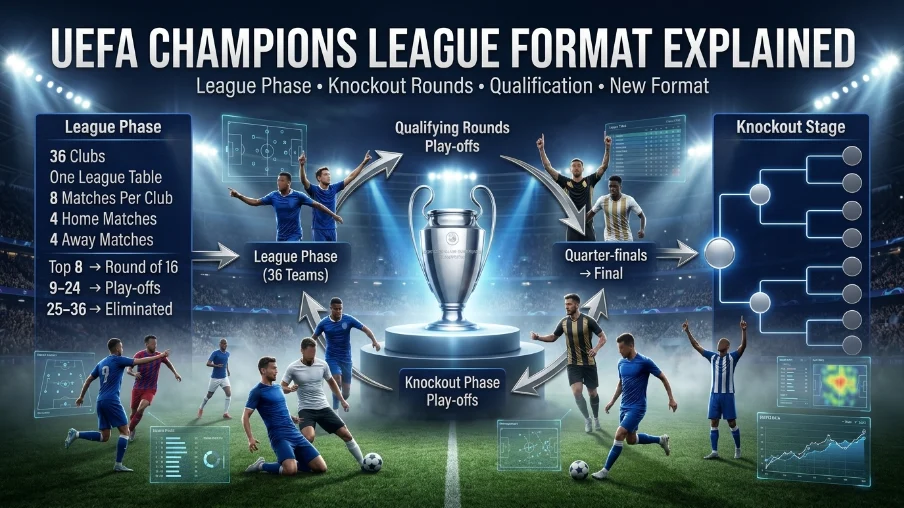
The UEFA Champions League introduced a brand-new competition format beginning with the 2024–25 season, replacing the traditional group stage with a single league phase. In the 2026 edition, 36 clubs compete in one league table, where every match matters. This guide explains how teams qualify, how the league phase works, how clubs reach the knockout rounds, and why UEFA made these historic changes.
The UEFA Champions League is widely regarded as the most prestigious club football competition in the world. Every season, Europe’s strongest clubs battle for continental supremacy, producing unforgettable matches, legendary moments, and some of football’s biggest rivalries.
For more than two decades, fans became familiar with the traditional format of eight groups containing four teams each. However, football has evolved, and UEFA introduced the biggest structural change in the competition’s history beginning with the 2024–25 season. That new system remains in place for the 2026 season, creating more high-profile matches, more competitive balance, and greater excitement from the opening matchday.
If you’re new to the Champions League or simply confused by the new format you’re not alone. Many supporters still ask questions such as:
- Why are there 36 teams instead of 32?
- Why doesn’t every club play home and away against the same opponents?
- How do teams qualify for the knockout stage?
- What happened to the traditional groups?
This guide answers each of those questions in simple language while also exploring the strategy behind UEFA’s biggest competition overhaul.
What Is the UEFA Champions League?
The UEFA Champions League (UCL) is Europe’s premier annual club football tournament, organized by the Union of European Football Associations (UEFA). It features the continent’s top-performing clubs based on their domestic league positions and qualifying competitions.
Unlike international tournaments such as the FIFA World Cup or UEFA European Championship, the Champions League is contested by professional clubs rather than national teams.
Each season brings together elite clubs from leagues including:
- English Premier League
- La Liga (Spain)
- Serie A (Italy)
- Bundesliga (Germany)
- Ligue 1 (France)
- Eredivisie
- Primeira Liga
- Belgian Pro League
- Scottish Premiership
- And many other UEFA member associations
Winning the Champions League is considered one of football’s greatest achievements because it requires defeating the strongest clubs across Europe over several months.
Quick Snapshot
| Category | Details |
|---|---|
| Competition | UEFA Champions League |
| Organizer | UEFA |
| Current Format | Single League Phase + Knockout Stage |
| Teams | 36 |
| League Matches Per Club | 8 |
| Home Matches | 4 |
| Away Matches | 4 |
| League Table | One combined table |
| Automatic Round of 16 Qualification | Top 8 clubs |
| Knockout Play-off Qualification | Teams ranked 9–24 |
| Eliminated After League Phase | Teams ranked 25–36 |
| Final | Single match at a neutral venue |
A Brief History of the UEFA Champions League
The competition began in 1955 as the European Champion Clubs’ Cup, commonly known as the European Cup. At that time, only the reigning champions from each country’s domestic league participated.
The tournament quickly became the highest level of European club football, featuring legendary clubs that built their reputations through continental success.
A major transformation arrived in 1992, when UEFA rebranded the competition as the UEFA Champions League. This change introduced group stages, expanded participation, and significantly increased television coverage, turning the tournament into a global sporting event.
For more than thirty years, the group-stage format remained largely unchanged. Each group contained four teams that played six matches three at home and three away with the top two progressing to the knockout rounds.
By the early 2020s, however, football’s landscape had changed dramatically. Clubs played more matches, broadcasting demands increased, and supporters wanted to see Europe’s biggest clubs face one another more often. UEFA responded by introducing a completely new format.
Why UEFA Changed the Format
The previous group-stage system served football well for decades, but it had limitations.
Many groups became predictable before the final matchday, and some elite clubs rarely met until the later knockout rounds. UEFA wanted a format that would create meaningful matches throughout the competition while giving supporters more opportunities to watch top-level contests.
The new league phase was designed with several goals in mind:
More Competitive Matches
Instead of playing only three opponents twice, clubs now face eight different teams. This creates a wider variety of fixtures and increases the number of blockbuster encounters.
Reduced Dead Rubbers
Under the old system, some clubs had already qualified or been eliminated before the final group match. The new league table keeps more teams in contention for longer, making late-stage league fixtures far more meaningful.
Increased Variety
Supporters now see clubs from different leagues playing one another more frequently, adding fresh storylines and reducing repetitive matchups.
Better Commercial Value
More high-profile matches attract larger global audiences, benefiting broadcasters, sponsors, clubs, and fans alike.
How Teams Qualify for the Champions League
Although the competition format has changed, qualification still depends primarily on domestic league performance.
The strongest leagues in Europe receive the highest number of qualification places based on UEFA’s coefficient rankings.
Typically, clubs qualify by:
Finishing Near the Top of Their Domestic League
The highest-ranked European leagues receive multiple automatic places.
For example:
- Top clubs from England
- Top clubs from Spain
- Top clubs from Germany
- Top clubs from Italy
- Leading clubs from France
automatically qualify for the league phase.
Winning Qualifying Rounds
Clubs from smaller European leagues often compete through several qualifying rounds before reaching the main competition.
These preliminary rounds allow champions from across Europe to earn their place among the continent’s elite.
Winning European Competitions
UEFA also rewards success in continental tournaments. Winning certain UEFA competitions can provide direct qualification for the following season’s Champions League, even if a club does not finish in a qualifying position in its domestic league.
This ensures that exceptional performances on the European stage are recognized.
The Biggest Change: From Groups to One League
The most significant change in the competition is the replacement of the traditional group stage.
Previously:
- 32 clubs
- Eight groups
- Four clubs per group
- Six matches each
Now:
- 36 clubs
- One league table
- Eight matches per club
- Eight different opponents
Instead of focusing on one small group, every participating club becomes part of one large league.
This change dramatically alters qualification, scheduling, and competitive balance.
Understanding the New League Phase
The league phase is the opening stage of the modern Champions League.
Every club plays eight matches, but unlike a normal domestic league, teams do not play every other club.
Instead, UEFA’s scheduling system assigns each team eight opponents selected from different seeding pots.
Each club plays:
- Four home matches
- Four away matches
against eight different opponents.
This approach increases fixture variety while maintaining competitive balance.
How Opponents Are Selected
Before the season begins, the 36 participating clubs are divided into seeding pots based primarily on UEFA club coefficients.
UEFA’s computerized draw then assigns opponents from across these pots, ensuring a balanced schedule rather than allowing clubs to face only weaker or stronger opponents.
The result is that every club receives a unique fixture list while still playing the same total number of matches.
This creates exciting combinations that were previously impossible under the old group-stage format.
How the League Table Works
Instead of separate groups, all 36 clubs appear in a single league table.
After every matchday, teams are ranked according to:
- Total points earned
- Goal difference
- Goals scored
- Additional UEFA tie-breaker criteria if necessary
Because every point matters, clubs remain motivated throughout the league phase. Even teams outside the top eight can still fight for a place in the knockout play-offs, making almost every fixture meaningful.
Unlike the previous format, clubs are not competing solely against three familiar opponents they are competing against the entire field.
This creates a far more dynamic and unpredictable race for qualification.
Points System
The Champions League continues using football’s traditional scoring system.
| Result | Points Awarded |
|---|---|
| Win | 3 |
| Draw | 1 |
| Loss | 0 |
The objective is simple: collect as many points as possible across eight league matches.
At the end of the league phase, every point can make the difference between automatic qualification, a play-off place, or elimination.
Why Fans Love the New Format
Although the format initially confused many supporters, it has introduced several clear benefits.
Fans now enjoy:
- More matches between Europe’s biggest clubs.
- Greater variety in opponents.
- A more competitive race throughout the league phase.
- Fewer meaningless fixtures.
- Increased unpredictability from the opening matchday.
Rather than waiting until the knockout rounds to see elite clubs meet, supporters are treated to blockbuster fixtures much earlier in the season.
How Teams Reach the Knockout Stage
Once every club has completed its eight league matches, the final league table determines which teams continue in the competition.
Unlike the previous group-stage format, there are no separate groups to win or finish second in. Every club competes in one overall standings table, making every point valuable until the final matchday.
The qualification process is straightforward:
| League Position | Outcome |
|---|---|
| 1–8 | Automatically qualify for the Round of 16 |
| 9–24 | Enter the Knockout Phase Play-offs |
| 25–36 | Eliminated from European competition |
This structure rewards consistency throughout the league phase while giving clubs outside the top eight one final opportunity to reach the knockout rounds.
Automatic Qualification to the Round of 16
The clubs finishing in the top eight receive one of the biggest advantages in the competition.
Benefits include:
- Direct qualification to the Round of 16
- No additional play-off matches
- More recovery time between fixtures
- Reduced injury risk
- Better preparation for domestic competitions
Because elite clubs often compete in multiple tournaments simultaneously, avoiding the play-offs can significantly improve their chances of progressing further.
Finishing inside the top eight therefore becomes an important objective from the opening matchday.
Knockout Phase Play-offs Explained
The biggest innovation in UEFA’s new format is the introduction of the Knockout Phase Play-offs.
Instead of progressing directly from the league stage to the Round of 16, clubs ranked 9th through 24th must first survive an additional knockout round.
These play-offs determine the remaining eight teams that advance.
Which Teams Play Each Other?
The pairings are based on league positions.
Higher-ranked clubs receive a more favorable draw than lower-ranked teams.
For example:
- Higher-ranked teams are paired against lower-ranked qualifiers.
- Clubs that performed better during the league phase receive competitive advantages.
- Teams from the top eight cannot participate in these play-offs because they have already qualified automatically.
This system rewards stronger league-phase performances without eliminating the excitement of knockout football.
Home and Away Play-off Matches
Unlike the Champions League Final, the Knockout Phase Play-offs are contested over two legs.
Each club plays:
- One home match
- One away match
The aggregate score across both matches determines which team advances.
For example:
First Leg
Club A 2–1 Club B
Second Leg
Club B 1–0 Club A
Aggregate Score:
Club A 2–2 Club B
If the aggregate score remains level after normal time in the second leg, the match proceeds to extra time and, if necessary, a penalty shootout.
What Happened to the Away Goals Rule?
One of the biggest rule changes in recent years is the removal of the away goals rule.
Previously, if two teams finished level on aggregate, the club that scored more away goals advanced.
That rule no longer exists.
Now, if aggregate scores are tied:
- Extra time is played.
- If still level, a penalty shootout decides the winner.
This simplifies the competition and ensures both teams approach home and away matches with the same objective simply score more goals overall.
The Round of 16
Once the play-offs conclude, the eight winners join the eight clubs that qualified automatically.
This creates the final 16-team knockout bracket.
From this stage onward, every tie becomes increasingly important because one poor performance can end a club’s European campaign.
The Round of 16 remains one of the tournament’s most exciting phases, often featuring Europe’s biggest clubs competing against one another.
Quarter-finals
The eight winners from the Round of 16 advance to the quarter-finals.
These ties continue to use the familiar two-legged format:
- First Leg
- Second Leg
The aggregate winner progresses to the semi-finals.
Because every remaining club has already survived multiple challenging rounds, the quality of football usually reaches an exceptional level during the quarter-finals.
Semi-finals
The semi-finals follow the same format.
Each tie consists of:
- One home fixture
- One away fixture
Winning the semi-final secures a place in one of football’s most prestigious events the UEFA Champions League Final.
For many clubs, reaching the semi-finals represents one of the greatest achievements in their modern history.
The UEFA Champions League Final
Unlike previous knockout rounds, the final is played as a single match at a neutral venue selected by UEFA.
There are no second legs.
If the score remains level after 90 minutes:
- Extra time is played.
- If necessary, penalties determine the champion.
This winner-takes-all format creates one of the biggest sporting spectacles in the world, watched by hundreds of millions of fans across every continent.
How Seeding Works
Seeding remains an important part of the Champions League.
During the league phase, clubs are placed into seeding pots before the fixture draw.
These pots are based primarily on UEFA club coefficients, which reflect consistent performances in European competitions over recent seasons.
The objective of seeding is to create a balanced schedule rather than allowing one club to receive significantly easier opponents than another.
After the league phase, finishing higher in the standings can also provide advantages during the knockout draw.
Tie-breakers in the League Phase
Sometimes two or more clubs finish level on points.
UEFA applies several tie-breakers to determine their final positions.
These include:
Goal Difference
The difference between goals scored and goals conceded.
Goals Scored
If goal difference is identical, the team with more goals scored receives the higher ranking.
Additional UEFA Criteria
If teams remain level after the primary tie-breakers, UEFA applies further competition regulations to determine the final order.
Because of these rules, clubs often continue attacking even when comfortably leading matches, knowing that every goal could influence their final position.
Match Calendar
The Champions League season stretches across several months.
The typical schedule includes:
- Qualification rounds
- League phase
- Knockout Phase Play-offs
- Round of 16
- Quarter-finals
- Semi-finals
- Final
Matches are generally played during midweek, allowing clubs to continue competing in their domestic leagues at weekends.
Managing player fitness during this demanding schedule has become one of the biggest challenges for modern football managers.
Why the Knockout Stage Is So Exciting
The Champions League knockout rounds differ from league football because every mistake carries enormous consequences.
One defensive error, missed penalty, or late goal can completely change a club’s season.
This pressure creates:
- Higher intensity
- Tactical adjustments
- Dramatic comebacks
- Memorable moments
- Legendary performances
It is one of the main reasons the Champions League remains the most-watched club football competition in the world.
New Format vs Old Format
The biggest talking point surrounding the UEFA Champions League has been the replacement of the traditional group stage with the new league phase. While both formats aimed to identify Europe’s best club, the journey has changed considerably.
Old Champions League Format
For more than two decades, the competition followed a familiar structure:
- 32 participating clubs
- Eight groups of four teams
- Home-and-away matches against the same three opponents
- Six matches per club
- Top two teams from each group qualified for the Round of 16
Although simple to understand, the format often produced predictable groups where qualification was decided before the final matchday.
New Champions League Format
The current format introduces several important changes:
- 36 participating clubs
- One league table instead of groups
- Eight different opponents
- Eight league matches per club
- Top eight qualify directly for the Round of 16
- Teams ranked 9–24 enter knockout play-offs
- Clubs ranked 25–36 are eliminated
The revised system creates greater variety, increases the number of competitive fixtures, and gives supporters more opportunities to watch Europe’s biggest clubs face one another.
Old vs New Format Comparison
| Feature | Old Format | New Format |
|---|---|---|
| Number of Teams | 32 | 36 |
| Competition Structure | Eight Groups | Single League Table |
| Matches Per Club | 6 | 8 |
| Opponents | 3 Teams | 8 Different Teams |
| Automatic Round of 16 Spots | 16 Clubs | Top 8 Clubs |
| Extra Knockout Round | No | Yes |
| Variety of Fixtures | Limited | Much Higher |
Advantages of the New Champions League Format
UEFA introduced the new system with several long-term goals in mind. While opinions differ, many aspects of the redesign have been widely praised.
More High-Profile Matches
One of the biggest improvements is the increased number of blockbuster fixtures.
Instead of waiting until the knockout rounds, fans can now enjoy matches between Europe’s biggest clubs much earlier in the season.
Greater Competitive Balance
The single league table ensures that clubs compete against a wider range of opponents.
Every point contributes to one overall ranking, reducing situations where a comparatively weaker group produces easier qualification.
More Meaningful Matchdays
In the old format, some clubs secured qualification after only four or five matches.
Under the league phase, positions can change dramatically until the final matchday, keeping more teams involved in the race.
Better Entertainment Value
Supporters now experience:
- More elite matchups
- Greater fixture variety
- More tactical diversity
- Increased unpredictability
These changes make every Champions League week more exciting for neutral fans.
Criticisms of the New Format
Despite its advantages, the new format has also received criticism from players, coaches, and supporters.
Increased Match Load
Each club now plays two additional league matches before the knockout rounds.
Combined with domestic leagues, cup competitions, and international fixtures, many players face an increasingly demanding schedule.
Concerns include:
- Player fatigue
- Increased injury risk
- Reduced recovery time
- Squad rotation challenges
More Complex Format
The previous group-stage format was easy to understand.
The new league table, knockout play-offs, and qualification pathways initially confused many supporters, particularly casual viewers unfamiliar with the competition.
As fans become more accustomed to the system, this confusion is expected to decrease.
Fixture Congestion
Elite clubs often compete in multiple competitions simultaneously.
A longer Champions League schedule means managers must carefully balance player workloads throughout the season.
This places greater importance on squad depth than ever before.
How Champions League Prize Money Works
The UEFA Champions League offers one of the largest financial reward systems in world football.
Although exact distributions vary from season to season, clubs earn revenue through several different streams.
Participation Payments
Every club reaching the league phase receives a guaranteed financial payment simply for qualifying.
Performance Bonuses
Additional prize money is awarded for:
- League phase victories
- Draws
- Progressing to each knockout round
- Winning the final
Every successful result increases a club’s earnings throughout the competition.
Broadcasting Revenue
UEFA distributes television income among participating clubs using several factors, including market value and sporting performance.
This broadcasting revenue represents a significant source of income for many clubs.
Commercial Benefits
Success in the Champions League also generates indirect financial rewards through:
- Increased sponsorship opportunities
- Higher merchandise sales
- Expanded global fanbases
- Improved commercial partnerships
For many clubs, a deep Champions League run can transform both sporting success and financial stability.
How the New Format Affects Clubs
The revised competition structure has changed how clubs prepare for European football.
Managers now place greater emphasis on:
Squad Rotation
With more matches on the calendar, coaches must carefully manage player fitness to avoid burnout.
Tactical Flexibility
Facing eight different opponents requires clubs to adapt to a wider range of playing styles compared with the previous group-stage format.
Consistency
The league phase rewards clubs capable of collecting points throughout the campaign rather than relying on a few standout performances.
Every match influences the final standings.
How the New Format Benefits Fans
Supporters are among the biggest winners under the revised system.
Benefits include:
- More matches involving Europe’s top clubs
- Increased competitive drama
- Fewer predictable fixtures
- More meaningful final matchdays
- Greater variety of opponents
- Higher entertainment value
For television audiences and stadium spectators alike, the Champions League now delivers a broader selection of elite football throughout the season.
Frequently Asked Questions
Why did UEFA replace the group stage?
UEFA wanted to create a more competitive competition featuring more high-profile fixtures, greater variety, and fewer meaningless matches.
How many teams compete in the Champions League?
Thirty-six clubs participate in the league phase under the current format.
How many league matches does each club play?
Every club plays eight league matches four at home and four away against eight different opponents.
Which teams qualify automatically for the Round of 16?
The clubs finishing in the top eight positions of the league table qualify directly for the Round of 16.
What happens to teams finishing between 9th and 24th?
Those clubs enter the two-legged Knockout Phase Play-offs, where they compete for the remaining places in the Round of 16.
What happens to clubs finishing 25th to 36th?
They are eliminated from the UEFA Champions League and do not continue in the competition.
Is the away goals rule still used?
No. UEFA abolished the away goals rule in 2021. If a two-legged tie is level on aggregate, extra time and, if necessary, a penalty shootout determine the winner.
How is the Champions League Final played?
The final is a single match at a neutral venue selected by UEFA. If the score is level after 90 minutes, extra time and penalties are used to decide the champion.
Final Thoughts
The UEFA Champions League’s new format represents the most significant transformation in the competition’s history. By replacing the traditional group stage with a single 36-team league table, UEFA has created a tournament that offers more competitive matches, greater variety, and increased excitement from the opening matchday to the final.
While the expanded schedule has raised concerns about player workload and fixture congestion, the format also rewards consistency, tactical adaptability, and squad depth more effectively than before. Clubs must now earn their place in the knockout rounds through sustained performances against a broader range of opponents, making every point in the league phase meaningful.
For fans, the changes deliver more blockbuster encounters, fewer predictable fixtures, and a more dramatic race for qualification. Whether you’re a lifelong supporter or a newcomer to European football, understanding the new Champions League structure makes it easier to appreciate why every match matters.
As the competition continues to evolve, one thing remains unchanged: lifting the UEFA Champions League trophy is still the ultimate achievement in European club football.

Emily Parker is a sports journalist at SportsOrbitX.com with a passion for covering cricket, tennis and major international sporting events. She is committed to producing clear, reliable and engaging content for sports enthusiasts worldwide.