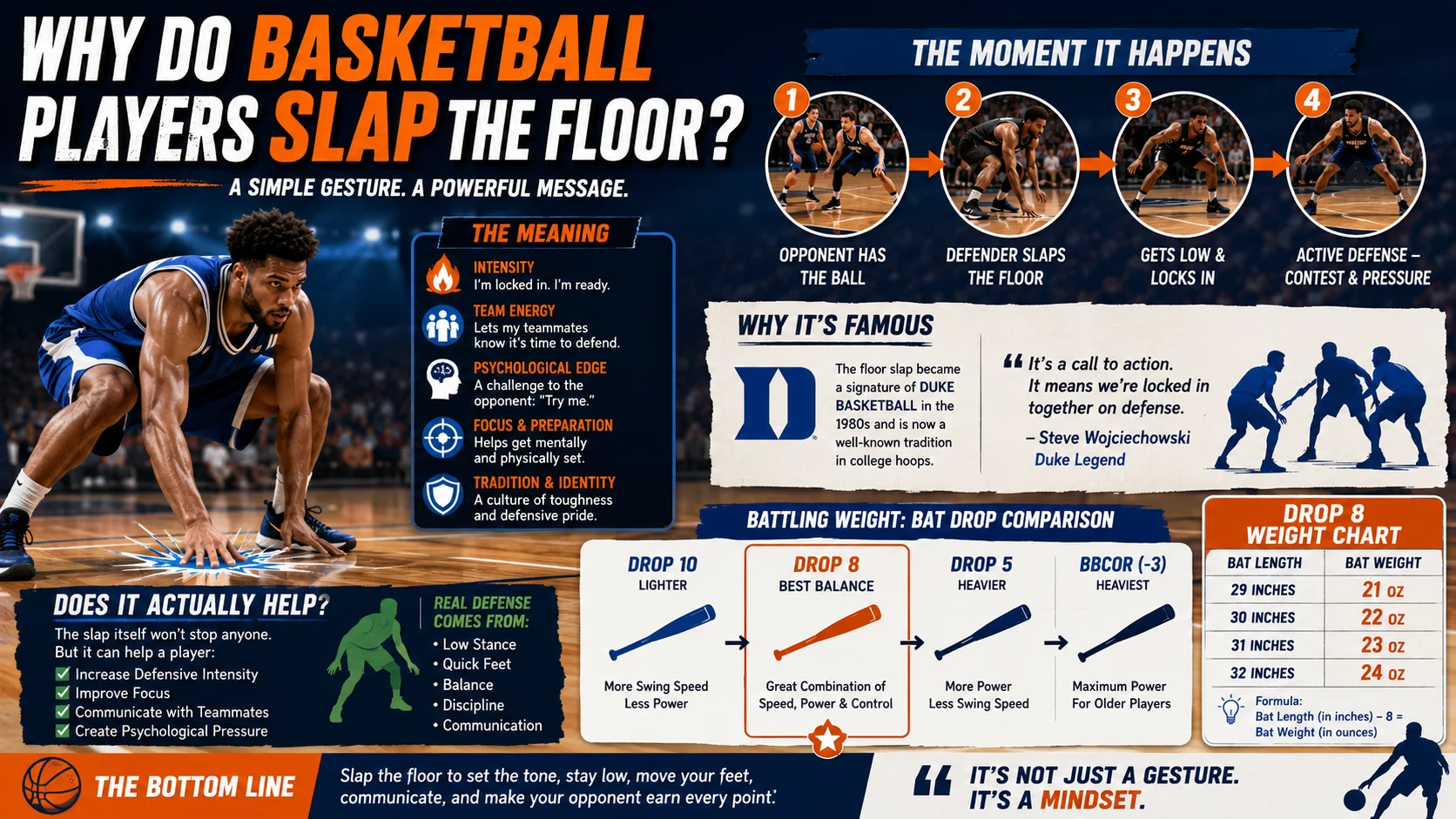
Basketball players slap the floor as a defensive rallying gesture that signals intensity, focus, and readiness to stop the opponent. It is usually meant to fire up the defender, communicate defensive energy to teammates, and sometimes intimidate the ball-handler. The move is especially associated with college basketball and Duke, where it became a recognizable team tradition.
When a basketball player slaps the floor, they’re essentially saying:
“I’m locked in. This possession is mine. Let’s get a stop.”
It is not a basketball rule, required technique, or official signal. Instead, it’s a combination of mental preparation, team communication, defensive intensity, and psychological pressure.
The gesture is most often seen when a defender is matched up one-on-one and wants to make the defensive possession feel like a challenge.
What Does Slapping the Floor Mean in Basketball?
A floor slap is primarily a defensive statement.
The player gets low, places a hand or sometimes both hands near the court and slaps the floor before settling into a defensive stance.
The message can have several layers:
| Reason | What It Communicates |
|---|---|
| Intensity | “I’m ready to defend.” |
| Motivation | Gets the player mentally fired up |
| Team Energy | Encourages teammates to lock in |
| Intimidation | Challenges the offensive player |
| Communication | Signals a defensive push or rally |
| Tradition | Represents team culture and identity |
The exact meaning depends on the situation and the team.
For some players, it’s a personal ritual. For others, especially in college basketball, it can become a collective defensive statement.
Why Do Basketball Players Slap the Floor on Defense?
1. It Fires Up the Defender
Defense requires concentration, effort, and quick reactions. A floor slap can act like a physical reset button.
The player is essentially switching from:
“We’re about to defend.”
to:
“I’m ready right now.”
That small physical action can help create an aggressive mindset before the possession begins.
This is particularly useful during important moments when one defensive stop can change the momentum of a game.
2. It Can Motivate the Entire Team
A floor slap isn’t always directed at the opponent.
Sometimes it’s directed at your own teammates.
When one player makes the gesture, teammates may respond by becoming more vocal, lowering into their defensive stances, or increasing their energy.
This is one reason the gesture became so recognizable in college basketball.
Duke has historically used the floor slap as a collective call to defensive action, with the tradition tracing back to players in the 1980s. Former Duke player Steve Wojciechowski described its roots as a “call to action.”
So when several defenders slap the floor together, the message becomes much bigger:
“Five defenders. One possession. Get the stop.”
3. It’s a Form of Psychological Pressure
Basketball is physical, but it’s also mental.
A defender who slaps the floor and gets into a low stance is deliberately showing the offensive player that they’re ready for the challenge.
It’s a nonverbal form of communication.
The defender doesn’t need to say:
“Try to get past me.”
The gesture says it for them.
This is one reason the floor slap can feel intimidating, particularly during a loud college basketball game.
However, intimidation is only part of the story. The main purpose is defensive intensity and motivation.
4. It Reinforces the Defensive Stance
There’s also a practical connection between the floor slap and defensive positioning.
When a player reaches toward the court, they naturally have to bend their knees and lower their hips.
That is close to the body position coaches want when teaching defensive stance.
The Jr. NBA even incorporates floor slapping directly into a defensive drill: players slap the floor, get into a defensive stance, then slide laterally in response to cues.
That doesn’t mean slapping the floor makes someone a better defender by itself.
It means the gesture is closely connected to the physical posture and mindset of defensive basketball.
Does Slapping the Floor Actually Help Defense?
Not directly.
A floor slap doesn’t magically make a player faster, stronger, or better at staying in front of a ball-handler.
The actual defensive skills are:
- Proper stance
- Lateral footwork
- Balance
- Reaction speed
- Hand positioning
- Anticipation
- Communication
- Staying disciplined
The slap is more of a mental and communicative tool than a mechanical advantage.
In fact, if a player becomes so focused on the gesture that they lose their defensive position, it can backfire.
There have even been famous examples where a defender slapped the floor and the offensive player immediately attacked the opening.
That’s why good defense ultimately matters much more than the theatrics.
Why Do Basketball Players Slap the Floor Before Facing a Ball-Handler?
This is probably the version most viewers notice.
The offensive player brings the ball up.
The defender gets low.
SLAP.
Then the defender locks eyes with the ball-handler.
This creates a small psychological confrontation.
The defender is communicating:
“You’re not getting by me easily.”
It can also help the defender mentally focus on the possession rather than the crowd, scoreboard, or previous play.
In one-on-one situations, that symbolic challenge can make the gesture particularly dramatic.
Why Is the Floor Slap Associated With Duke Basketball?
If you’ve watched college basketball for long enough, you’ve probably noticed Duke players associated with the tradition.
The practice became strongly connected with Duke basketball through players including Tommy Amaker and later Steve Wojciechowski, with the tradition developing in the 1980s.
Over time, the floor slap became more than an individual player’s habit.
It became part of Duke’s defensive identity.
That helped turn a simple gesture into one of the most recognizable rituals in college basketball.
The tradition has also spread beyond Duke. Other college programs have adopted variations of the floor slap, while opponents have occasionally used it themselves sometimes playfully to reference Duke’s reputation.
Do NBA Players Slap the Floor?
Yes, but it is much less common in the NBA than in college basketball.
NBA players have used the gesture, but it isn’t as strongly associated with the professional game.
Kevin Garnett, for example, was famously known for his defensive intensity and was photographed crouching to slap the floor while guarding Steve Nash.
The gesture has also appeared in other NBA moments, including a well-known 2019 sequence involving Luka Dončić and Kelly Oubre Jr. NBA.com described the floor slap as something not usually seen in the NBA or European basketball.
So if you see it in the NBA, it’s usually a player-specific or situational gesture, rather than a universal NBA defensive tradition.
Is Slapping the Floor a Basketball Rule?
No.
There is no basketball rule requiring a player to slap the floor.
A defender can play perfect defense without ever touching the court.
The official rules focus on things such as legal guarding position, movement, contact, and fouls not whether a player performs a floor slap.
So the floor slap is:
Tradition + mentality + communication not a rule.
Why Don’t All Basketball Players Do It?
Because it isn’t necessary.
Some players prefer to communicate through:
- Talking
- Pointing
- Calling defensive assignments
- Eye contact
- Physical positioning
- Simply getting into their stance
Others don’t like drawing attention to themselves.
And there’s an important downside: if the gesture becomes showboating, it can distract from the actual job defending.
A defender’s first responsibility is to stop the ball, not perform for the crowd.
Is Slapping the Floor Intimidation or Motivation?
It can be both.
Motivation
The player may be trying to fire themselves up and create defensive intensity.
Team Motivation
The gesture can encourage teammates to increase their defensive focus.
Intimidation
The defender may also be sending the offensive player a psychological message.
Tradition
For certain teams, it represents a shared defensive identity.
That’s why there isn’t one single meaning behind every floor slap.
What Happens After a Floor Slap?
Ideally, the player immediately gets into a strong defensive position.
The sequence should look something like:
Slap → Low stance → Eyes on the ball → Active feet → Stay in front → Contest
The slap itself isn’t the important part.
What happens next is.
A player can slap the floor as dramatically as possible, but if they can’t move their feet, the offensive player will simply go around them.
That’s why coaches emphasize defensive fundamentals over gestures.
Why Do Some Teams Slap the Floor Together?
When an entire team does it, the gesture becomes a rallying cry.
Instead of one defender saying:
“I’m ready.”
Five defenders are effectively saying:
“We’re ready.”
This is especially powerful during:
- Close games
- Tournament games
- Late-game possessions
- Defensive stands
- Home-court momentum swings
The visual impact also energizes the crowd, creating a feedback loop between the team and fans.
Does Slapping the Floor Make a Player a Better Defender?
No not by itself.
If anything, it’s useful to think of the floor slap as the symbol, while defensive fundamentals are the substance.
A great defender needs:
- Low center of gravity
- Quick lateral movement
- Discipline
- Strong anticipation
- Good communication
- Proper hand placement
- Awareness of screens and help defense
The floor slap doesn’t replace any of these.
The Jr. NBA’s use of the gesture in defensive drills illustrates the same idea: the slap is paired with getting into stance and moving on defensive cues.
Why Does the Floor Slap Look So Intense?
There’s a reason the gesture looks dramatic on television.
The player is usually:
- Bent low
- Focused on the opponent
- Moving aggressively
- Making a sudden physical gesture
- Surrounded by crowd noise
That combination creates a powerful visual.
And when an entire team does it together, it becomes even more noticeable.
It’s one of those basketball moments where body language becomes part of the competition.
Floor Slap vs. Normal Defensive Stance
| Floor Slap | Defensive Stance |
|---|---|
| Optional gesture | Fundamental skill |
| Mental trigger | Physical technique |
| Can motivate | Helps actually defend |
| Can intimidate | Improves positioning |
| Team tradition | Required defensive foundation |
| Psychological | Mechanical |
The key takeaway is simple:
The slap is optional. The stance isn’t.
Frequently Asked Questions
Why do basketball players slap the floor?
Basketball players slap the floor mainly to show defensive intensity, motivate themselves and teammates, and psychologically challenge the opponent. It is a tradition and communication gesture rather than an official basketball technique.
Is slapping the floor a defensive signal?
Sometimes. On some teams, a floor slap can serve as a rallying signal for increased defensive effort. However, it isn’t a universal or official signal used by every basketball team.
Why does Duke slap the floor?
Duke’s floor-slapping tradition developed in the 1980s and became closely associated with the program’s defensive identity. It has been described as a collective “call to action” for defensive intensity.
Do NBA players slap the floor?
Yes, but the gesture is less common in the NBA than in college basketball. Individual players, including Kevin Garnett, have famously used it as part of their defensive persona.
Does slapping the floor intimidate opponents?
It can. The gesture creates a visible psychological challenge, but its primary purpose is usually defensive motivation and intensity rather than intimidation alone.
Is there any rule against slapping the floor?
Generally, the gesture itself is not a basketball violation. It becomes an issue only if a player’s overall behavior violates another rule, such as through unsportsmanlike conduct.
Does slapping the floor improve defense?
Not mechanically. It doesn’t make a player faster or improve footwork. Its value is mainly psychological, motivational, and communicative.
Final Verdict
Basketball players slap the floor because it is a powerful way to show that they’re locked in defensively. The gesture can motivate the defender, energize teammates, communicate intensity, and put psychological pressure on the ball-handler.
But don’t mistake the dramatic slap for the actual defensive skill.
The real work starts after the hand leaves the floor when the defender drops into position, moves their feet, stays balanced, communicates, and refuses to give up an easy lane.
That’s why the best way to understand the floor slap is this:
It’s not the defense. It’s the declaration that the defense is about to begin.
And when five players slap the floor together, it’s no longer just a gesture. It’s a team saying, “We’re getting this stop.”

Emily Parker is a sports journalist at SportsOrbitX.com with a passion for covering cricket, tennis and major international sporting events. She is committed to producing clear, reliable and engaging content for sports enthusiasts worldwide.