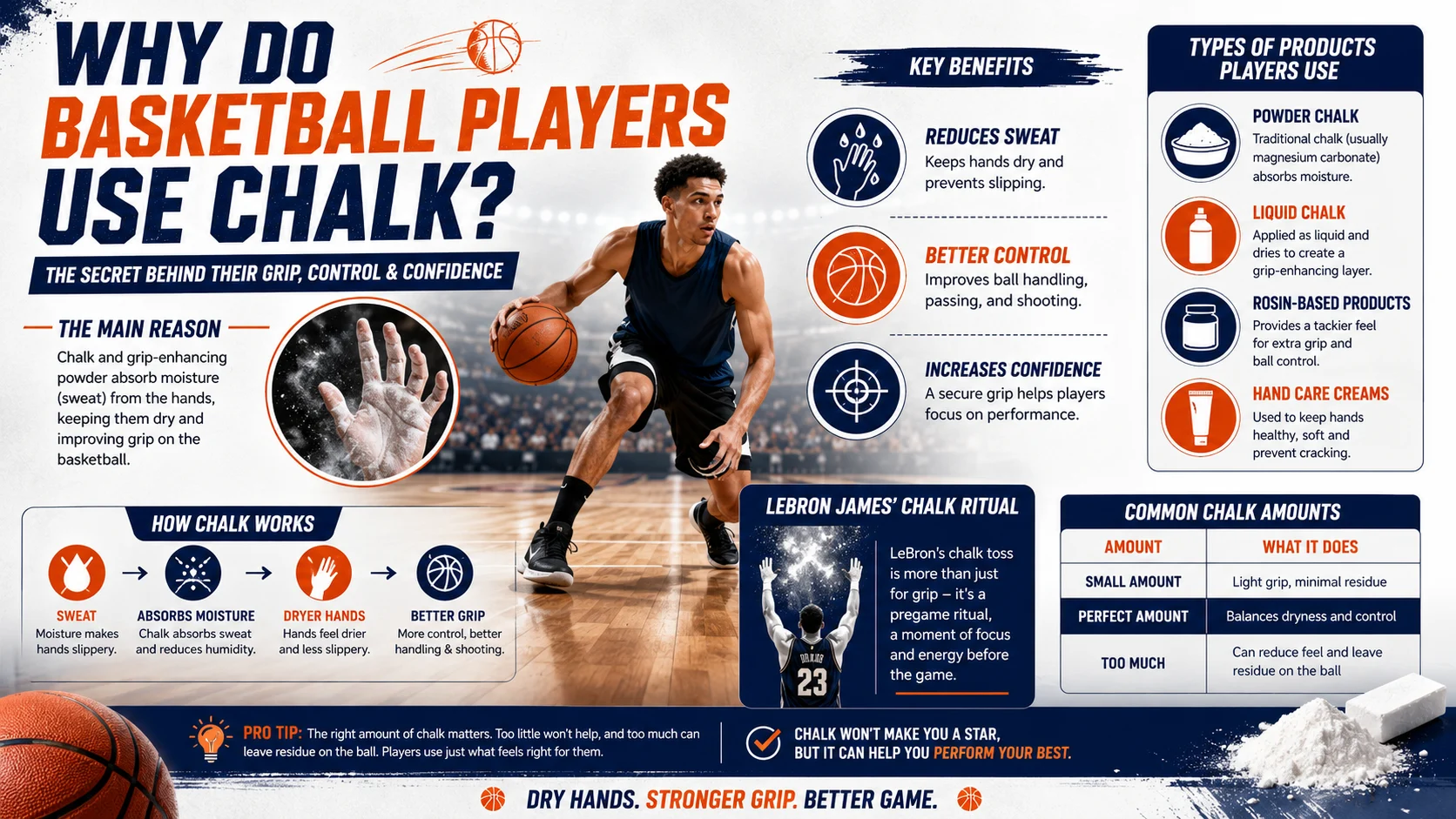
Basketball players use chalk or grip-enhancing powder mainly to reduce moisture on their hands and improve their grip on the basketball. Drier hands can make ball handling, catching, passing, and shooting feel more secure. Some NBA players also use chalk as part of a pregame routine or personal ritual, with LeBron James’ famous chalk toss being the best-known example.
Why Do Basketball Players Use Chalk?
Basketball players use chalk primarily because sweaty hands can make the ball harder to control. Chalk, commonly involving magnesium carbonate in athletic applications, helps absorb moisture and leaves the hands feeling drier, which can improve grip.
But there is an important distinction: not every white powder you see around an NBA player’s hands is traditional chalk. Players may use powdered chalk, rosin-based grip products, liquid grip products, or hand-care products depending on their preference. ESPN’s reporting on NBA players’ hand-care routines shows that modern players use several different products to manage how their hands feel on the ball.
What Does Chalk Do for Basketball Players?
Basketball is a game of fractions of a second.
A guard catches the ball, changes direction, crosses over, and releases a pass almost instantly. A center grabs a rebound with both hands while fighting through contact. A shooter needs a consistent feel when the ball leaves the fingertips.
In all of those situations, hand-to-ball contact matters.
Sweat can make the palms feel slick. Chalk or another appropriate grip product can reduce moisture and give the player a drier surface to work with.
That is why players may apply a small amount before a game or during a stoppage.
The basic process is simple:
Sweat → slippery hands → reduced grip
Chalk/grip product → less moisture → drier hands → more secure feel
The goal isn’t to make the basketball stick permanently to the hand. It’s to give the player a more predictable grip.
Does Basketball Chalk Actually Improve Grip?
It can, particularly when excess moisture is the problem.
Research on magnesium carbonate in other grip-dependent sports has found improved grip performance under certain conditions, although that research should not be interpreted as proof that chalk automatically improves basketball performance.
The practical reason is straightforward: when sweat accumulates on the palms, the skin can become slippery. A drying agent can change that surface condition.
For a basketball player, that may translate into a more comfortable feel when:
- Catching a pass
- Dribbling
- Palming or controlling the ball
- Passing
- Handling the ball under pressure
- Preparing for a shot
However, chalk is not a substitute for basketball skill. A player with excellent grip powder but poor ball-handling technique is still going to struggle.
What Kind of Chalk Do Basketball Players Use?
This is where the subject gets interesting.
When people say “basketball chalk,” they may actually be referring to several different products.
1. Powdered Chalk
Athletic chalk is commonly based on magnesium carbonate, which is also widely used in activities such as gymnastics, climbing, and weightlifting.
Its primary purpose is moisture management and grip.
2. Liquid Chalk
Liquid chalk is applied as a liquid and dries to leave a grip-enhancing layer on the hands.
One advantage is that it can be easier to apply in a controlled amount than loose powder.
3. Rosin-Based Grip Products
Some basketball players use products containing rosin, which can provide a tackier feel.
ESPN’s reporting on NBA hand care notes that players use both powder and rosin-based products, while others prefer creams designed to manage dry or rough hands.
Important: It’s Not Simply “Classroom Chalk”
The white substance used for athletic grip should not be confused with ordinary blackboard or sidewalk chalk.
Athletic chalk is generally associated with magnesium carbonate, whereas traditional chalk products can use different materials.
So if you’re wondering, “Do NBA players rub school chalk on their hands?” no, that’s not the right way to think about it.
Why Do NBA Players Put Chalk on Their Hands?
At the professional level, even small details can become part of a player’s preparation.
NBA players handle the basketball hundreds of times during practices and games. Their hands also become sweaty under intense physical activity.
For some players, grip products are simply practical equipment.
For others, they become part of a routine.
ESPN’s reporting describes a modern NBA culture around hand care that includes powder, rosin, creams, and other grip products. Players have different preferences depending on how their hands, the ball, and the environment feel.
That last point is important.
There isn’t one universal NBA chalk routine.
Some players like dry hands. Others prefer a slightly tackier feel. Some use products during games, while others barely use them at all.
Why Does LeBron James Throw Chalk in the Air?
If you’ve watched NBA basketball, you’ve probably seen LeBron James’ famous pregame chalk toss.
He puts powder on his hands, raises his arms, and releases it into the air before games. The moment became one of the most recognizable pregame rituals in basketball.
But is it purely for grip?
No. The chalk toss has also become a ritual and part of his connection with the crowd.
Sporting News reports that James has used the ritual for much of his NBA career and has spoken about fans embracing it. The tradition has also been linked to Michael Jordan, who had his own chalk-related pregame routine.
So there are really two stories behind the chalk:
Practical: Help manage moisture and prepare the hands.
Psychological/ritual: Create a familiar routine before competition.
That’s why simply saying “LeBron throws chalk because it improves his grip” doesn’t tell the whole story.
Does Chalk Make You Shoot Better?
Not directly.
This is one of the biggest misconceptions about basketball chalk.
Chalk doesn’t magically increase shooting accuracy, jumping ability, or ball-handling skill.
Instead, it can help create a more consistent hand surface when sweat is interfering with grip.
That may help a player feel more comfortable when handling or releasing the basketball.
Think of it this way:
Chalk doesn’t teach you how to shoot. It can help remove one small distraction from your hands.
For an elite player, that small detail can matter because consistency is valuable at the highest level.
Can Chalk Help With Dribbling?
It can help if sweaty hands are causing the player to lose control.
Dribbling depends heavily on fingertip control and the player’s ability to repeatedly contact the ball with precision.
If the palms are excessively sweaty, the player may feel less secure when changing direction or controlling the ball.
A drying or grip-enhancing product can therefore make the ball feel more manageable.
But again, the effect depends on the individual player.
Someone with naturally dry hands may notice very little difference.
Why Do Basketball Players Need Grip So Much?
Basketball isn’t like baseball, where the ball is primarily held briefly before a pitch.
Basketball players interact with the ball constantly.
They:
- Dribble with one or both hands.
- Catch fast passes.
- Pass around defenders.
- Grab rebounds.
- Shoot from different distances.
- Control the ball while moving at speed.
A small loss of grip can turn into a bad pass, fumbled dribble, or missed opportunity.
That’s why professional players pay surprising attention to their hands.
ESPN’s reporting describes hand maintenance as a significant part of NBA player routines because the hands are involved in virtually every basketball action.
Does More Chalk Mean More Grip?
No. More isn’t necessarily better.
Applying excessive powder can create problems.
Too much product can:
- Leave residue on the ball.
- Change the way the ball feels.
- Make the hands feel overly dry.
- Create unnecessary dust.
- Become counterproductive if the surface becomes too coated.
The goal is usually the right amount for the player’s hands, not covering the palms in a thick layer.
This is also why professional players have individual preferences.
Chalk vs. Baby Powder: Are They the Same?
No.
This distinction is important.
Baby powder is generally designed to reduce friction or absorb moisture for personal-care purposes. Athletic grip chalk is designed specifically for managing moisture and improving grip.
A player looking for better basketball grip shouldn’t automatically assume that any white powder will work the same way.
The product’s composition and how it interacts with the player’s hands and the basketball matter.
Does Weather Affect Basketball Chalk?
Absolutely.
Humidity can make sweaty hands feel even more difficult to manage, while cold, dry conditions can create an entirely different hand-care problem.
NBA players interviewed by ESPN have described adjusting their hand products depending on the climate and how their hands feel.
This explains why a product that feels perfect in one arena may not feel the same in another.
Basketball players aren’t just managing the ball.
They’re managing their hands, the environment, and the feel of the basketball.
Why Don’t All Basketball Players Use Chalk?
Because not everyone needs it.
Some players naturally have relatively dry hands and don’t experience significant grip problems.
Others prefer rosin, liquid grip, hand creams, or simply wiping their hands.
In fact, modern NBA hand care has become surprisingly varied. ESPN has documented players using powder, rosin-based products, creams, and other grip solutions.
So chalk is an option, not a requirement.
Is Basketball Chalk Allowed?
The answer can depend on the competition, facility, and specific product.
Professional basketball environments may regulate what players can apply to their hands or equipment, particularly if excessive residue could affect the basketball or court.
Players should follow the rules of their league, school, tournament, or facility rather than assuming that every grip product is acceptable.
For recreational players, it’s also smart to use products specifically intended for athletic grip rather than experimenting with household powders.
Chalk Isn’t the Secret to NBA Ball Handling
This is probably the most important takeaway.
When fans see an NBA superstar covering their hands with powder, it’s tempting to think they’ve discovered some secret performance trick.
They haven’t.
Chalk can help with moisture and grip, but elite ball handling comes from years of:
- Practice
- Coordination
- Strength
- Timing
- Technique
- Repetition
- Game experience
The powder may help the hands feel right.
The player still has to do the work.
Frequently Asked Questions
Why do basketball players use chalk?
Basketball players use chalk or grip-enhancing products primarily to reduce moisture on their hands and create a more secure, consistent grip on the basketball.
What is basketball chalk made of?
Athletic chalk is commonly made with magnesium carbonate. However, NBA players may use other grip products, including rosin-based powders, liquid grip products, and hand-care creams.
Does chalk improve basketball grip?
It can improve the feel of grip when sweaty hands are the problem. Research in other grip-dependent sports supports the usefulness of magnesium carbonate for reducing moisture and improving grip under certain conditions.
Why does LeBron James throw chalk before games?
LeBron James’ chalk toss is both a practical hand-preparation routine and a famous pregame ritual. He has performed it for much of his NBA career, and fans have come to associate it strongly with him.
Do NBA players use regular chalk?
Not usually. Athletic grip products commonly use materials such as magnesium carbonate or rosin rather than ordinary classroom chalk.
Does chalk make you a better basketball player?
No. Chalk can help manage sweaty hands and improve grip, but it cannot replace proper basketball technique, practice, or conditioning.
Can you use chalk while playing basketball?
It depends on the league, facility, and product. Players should check their competition’s rules and avoid excessive application that could leave residue on the basketball or court.
Final Verdict
So, why do basketball players use chalk?
The simple answer is grip.
When basketball players sweat, their hands can become slippery. Athletic chalk and other grip-enhancing products can help manage moisture and give players a more predictable feel when catching, passing, dribbling, and shooting.
But there’s a bigger story behind the white powder.
For some players, it’s practical equipment. For others, it’s part of their pregame routine. And for LeBron James, the chalk toss became an iconic ritual recognized by basketball fans around the world.
The important distinction is that chalk doesn’t create basketball skill. It simply helps some players optimize one small but important part of performance: how their hands feel when they touch the ball.
And in a sport where one bad grip can turn a clean possession into a turnover, that small detail can be worth paying attention to.

Daniel Brooks is a sports writer at SportsOrbitX.com, specializing in football, basketball and global sports news. He focuses on delivering accurate reporting, match analysis and timely updates that keep fans informed.