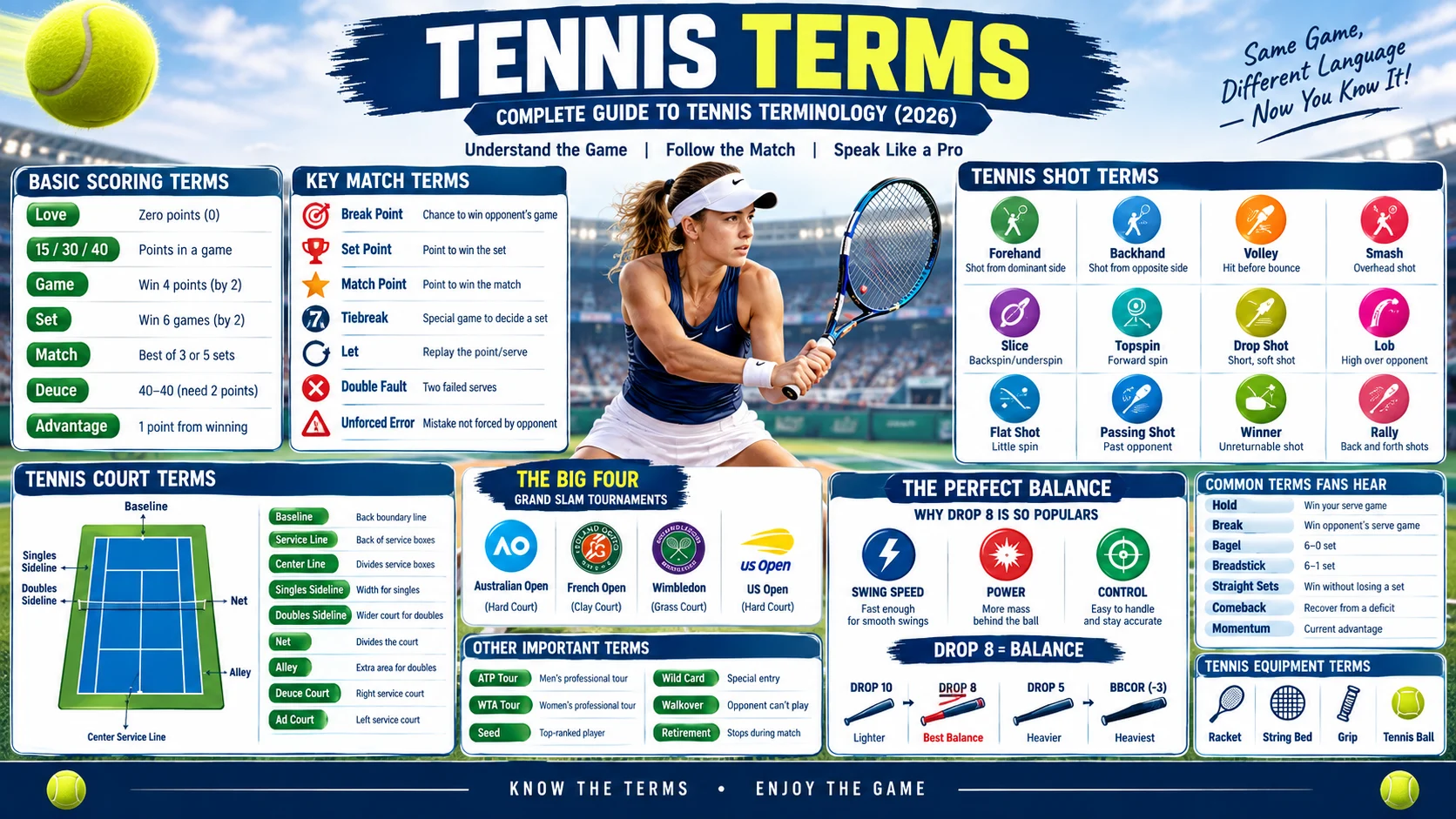
Learn the most important tennis terms, from love, deuce, ace, break point and rally to tiebreak, let, advantage, volley and Grand Slam. This beginner-friendly tennis glossary explains what each term means in simple language, with examples.
What Are Tennis Terms?
Tennis terms are the words and phrases used to describe scoring, shots, court positions, rules, strategies, players, matches and tournaments. Understanding terms such as love, deuce, ace, break point, rally, volley, baseline, and tiebreak makes it much easier to follow a tennis match.
Tennis Terms at a Glance
| Tennis Term | Simple Meaning |
|---|---|
| Ace | Legal serve the opponent does not touch |
| Love | Zero points |
| Deuce | 40–40 in a game |
| Advantage | One point away from winning after deuce |
| Break Point | Chance for receiver to win the game |
| Rally | Series of shots hit back and forth |
| Volley | Shot hit before the ball bounces |
| Baseline | Back boundary line of the court |
| Let | Point or serve stopped and replayed |
| Tiebreak | Special game used to decide a tied set |
| Double Fault | Two consecutive service faults |
| Unforced Error | Mistake not directly forced by opponent |
| Winner | Shot opponent cannot return |
| Grand Slam | One of tennis’s four major tournaments |
Basic Tennis Terms Every Beginner Should Know
Love
Love means zero in tennis scoring.
For example, a score of 15–love means the first player has won one point while the opponent has won none.
The word is unique to tennis and is one of the first terms beginners encounter.
Point
A point is the smallest scoring unit in tennis. Players compete for individual points to win games, games to win sets, and sets to win matches.
Game
A game consists of points. Under standard scoring, the sequence is:
Love → 15 → 30 → 40 → Game
A player normally needs to win at least four points and lead by two points to win a game.
Set
A set is made up of games. In traditional scoring, a player generally needs to win six games with a two-game advantage to take a set.
For example:
- 6–3 = set won
- 6–4 = set won
- 7–5 = set won
If the set reaches 6–6, a tiebreak may be used depending on the competition rules.
Match
A match is the complete contest between players or teams.
Depending on the tournament, matches may be best of three sets or best of five sets.
Important Tennis Scoring Terms
Deuce
Deuce means the score is tied at 40–40.
A player must then win two consecutive points to win the game.
The scoring sequence after deuce is:
Deuce → Advantage → Game
If the player with advantage loses the next point, the score returns to deuce.
Advantage
Advantage is the point immediately after deuce that gives one player the lead.
It is often displayed as:
- Ad-In — server has advantage
- Ad-Out — receiver has advantage
The player must win the next point to close out the game.
Break Point
A break point occurs when the receiver is one point away from winning the server’s game.
For example, if the server is losing 30–40, the receiver has break point.
Winning that point produces a break of serve.
Set Point
A set point is a point that can win the set.
For example, if a player leads 5–4 and 40–30, that player has set point.
Match Point
A match point is a point that can win the entire match.
It is one of the most important scoring situations in tennis.
Championship Point
A championship point is essentially a match point in a final or title-deciding situation. The term is commonly used when winning the point would secure the tournament championship.
Tiebreak
A tiebreak is a special scoring format used to decide a tied set.
The exact format can vary by competition, but a standard tiebreak is commonly played to 7 points with a two-point margin.
Major competitions can also use specific final-set tiebreak rules, so tournament regulations matter.
Tennis Serve Terms
Serve
The serve starts every point. The server hits the ball diagonally into the opponent’s service box.
Ace
An ace is a legal serve that the receiver fails to touch.
Aces are usually powerful weapons because the server wins the point immediately.
Service Winner
A service winner is a serve that the opponent touches but cannot return effectively.
Unlike an ace, the receiver makes contact with the ball.
First Serve
The first serve is the player’s initial attempt to start the point.
Players can often hit it with greater pace because they have a second opportunity if it becomes a fault.
Second Serve
The second serve is the player’s final opportunity after the first serve is missed.
Players often use more spin and margin over the net on second serves to reduce the risk of a double fault.
Double Fault
A double fault occurs when a player misses both service attempts.
The receiver automatically wins the point.
Service Fault
A service fault occurs when a serve does not legally land in the correct service box or violates another serving requirement.
The server normally receives another attempt unless it is already a second serve.
Service Break
A service break, commonly called a break, occurs when the receiver wins the game being served by the opponent.
Breaking serve is particularly important because serving is generally considered an advantage in tennis.
Tennis Shot Terms
Forehand
The forehand is a groundstroke normally hit from the player’s dominant side.
For many players, it becomes a primary attacking weapon.
Backhand
The backhand is a groundstroke hit on the opposite side of the body from the player’s forehand.
It can be performed with one hand or two hands.
Groundstroke
A groundstroke is a forehand or backhand hit after the ball has bounced.
Volley
A volley is a shot hit before the ball bounces.
Players commonly use volleys near the net.
Half-Volley
A half-volley is hit immediately after the ball bounces, usually very close to the ground.
It requires excellent timing and control.
Smash
An overhead smash is a powerful overhead shot, often used against a high defensive ball or lob.
Lob
A lob sends the ball high over an opponent, often when that player is positioned near the net.
Drop Shot
A drop shot is a soft shot designed to land short on the opponent’s side.
Its effectiveness comes from changing pace and forcing the opponent forward.
Slice
A slice is a shot hit with backspin or underspin. It generally travels lower and can stay close to the court surface after bouncing.
Topspin
Topspin causes the ball to rotate forward.
It helps players hit with height and depth while bringing the ball down into the court.
Flat Shot
A flat shot is hit with relatively little topspin or slice. It can travel quickly and directly through the court.
Passing Shot
A passing shot is hit past an opponent who has moved toward the net.
It may travel beside the player or over them.
Winner
A winner is a shot that lands legally and cannot be returned successfully by the opponent.
Tennis Court Terms
Baseline
The baseline is the back boundary line at each end of the court.
Baseline players typically spend much of the rally behind or near this area.
Service Line
The service line marks the back boundary of the service boxes.
Center Service Line
The center service line divides the two service boxes on each side of the net.
Singles Sideline
The singles sideline marks the width of the court used for singles matches.
Doubles Sideline
The doubles sideline is farther outside and creates the wider court used in doubles.
Net
The net divides the two sides of the court.
A tennis ball must generally travel over the net and land within the appropriate court area during play.
Alley
The alley is the extra court area between the singles and doubles sidelines.
It is used in doubles but not singles.
Deuce Court
The deuce court is the server’s right-hand service court.
Ad Court
The ad court is the server’s left-hand service court.
Tennis Rule Terms
Let
A let means play is stopped and the point or serve is replayed according to the applicable rule.
A common example is a serve that touches the net but still lands correctly in the service box.
Foot Fault
A foot fault occurs when the server violates the required positioning during the serve, such as stepping on or beyond the baseline before making contact.
Out
A ball is out when it lands outside the boundaries that apply to the current type of play.
In
A ball is in when it lands within the legal boundaries.
Unforced Error
An unforced error is a mistake that occurs without the opponent clearly forcing the error.
Examples include hitting an easy ball into the net or beyond the baseline.
Forced Error
A forced error occurs when an opponent’s shot creates enough pressure that the player makes a mistake.
The distinction between forced and unforced errors can sometimes involve judgment.
Challenge
A challenge is a player’s request to review a line call using the competition’s electronic review system when available.
Modern professional tennis increasingly uses electronic line-calling technology, but exact review procedures depend on the tournament.
Tennis Strategy Terms
Rally
A rally is the sequence of shots exchanged between players during a point.
A rally can last only a few shots or continue for dozens of exchanges.
Rally Ball
A rally ball is a reliable shot used to keep the point going rather than immediately attempting a winner.
Approach Shot
An approach shot is used to move toward the net, often followed by a volley.
Serve-and-Volley
Serve-and-volley is an aggressive style in which the player serves and immediately moves toward the net.
Baseline Player
A baseline player builds points primarily from the back of the court using groundstrokes.
All-Court Player
An all-court player can comfortably use baseline play, net play, attacking shots and defensive techniques.
Counterpuncher
A counterpuncher absorbs an opponent’s pace and redirects it, often using consistency and court coverage to turn defense into offense.
Unforced Error Rate
This describes how frequently a player makes errors without being directly forced by the opponent.
It can be useful when analyzing consistency and match performance.
Tennis Tournament Terms
Grand Slam
The Grand Slam tournaments are the four most prominent annual events in professional tennis:
- Australian Open
- French Open
- Wimbledon
- US Open
Winning all four major singles tournaments in the same calendar year is called a Calendar Grand Slam.
Australian Open
Played in Melbourne, the Australian Open is the first Grand Slam tournament of the calendar year and is played on hard courts.
French Open
Also known as Roland-Garros, the French Open is played on clay in Paris.
Wimbledon
Wimbledon is the historic grass-court Grand Slam tournament held in London.
US Open
The US Open is the final Grand Slam tournament of the traditional annual Grand Slam calendar and is played on hard courts in New York.
ATP Tour
The ATP Tour is the main professional men’s tennis tour.
WTA Tour
The WTA Tour is the major professional women’s tennis tour.
Qualifying
Qualifying is the preliminary stage through which players compete for places in the main tournament draw.
Main Draw
The main draw is the primary tournament field where players compete for the title.
Seed
A seed is a player placed in a favorable position within the tournament draw based on ranking and tournament rules.
Wild Card
A wild card is a tournament entry awarded outside the normal qualification route.
Walkover
A walkover occurs when a player advances because the opponent cannot compete before the match begins.
It is different from a retirement during a match.
Retirement
A retirement occurs when a player stops competing during a match, often because of injury or another circumstance.
Tennis Doubles Terms
Doubles
Doubles is played with four players, with two players on each team.
Mixed Doubles
Mixed doubles features one male and one female player on each team under the competition’s applicable rules.
Poaching
In doubles, poaching occurs when a player moves across the court to intercept a ball intended for their partner’s side.
Australian Formation
An Australian formation is a doubles serving formation where the server and partner initially position themselves on the same side of the court.
Tennis Equipment Terms
Tennis Racket
The racket is the primary piece of equipment used to hit the tennis ball.
String Bed
The string bed is the network of strings inside the racket head.
Grip
The grip is the handle area where the player holds the racket. It can also refer to different ways of holding the racket.
Overgrip
An overgrip is a thin layer wrapped around the racket’s existing grip to improve comfort, traction and moisture management.
Sweet Spot
The sweet spot is the area of the string bed where contact generally feels cleaner and produces efficient energy transfer.
Tennis Ball
A tennis ball is a pressurized or pressureless ball designed according to the specifications of the governing rules.
Common Tennis Terms Fans Hear During Matches
| Term | Meaning |
|---|---|
| Hold | Server wins their service game |
| Break | Receiver wins the opponent’s service game |
| Hold to Love | Server wins without losing a point |
| Bagel | Winning a set 6–0 |
| Breadstick | Winning a set 6–1 |
| Straight Sets | Winning a match without losing a set |
| Comeback | Recovering from a significant deficit |
| Rally | Exchange of shots |
| Break Back | Winning a break immediately after losing serve |
| Momentum | Competitive advantage created by a player’s recent performance |
| Unreturned Serve | Serve that the opponent cannot return effectively |
FAQs
What does love mean in tennis?
Love means zero. For example, 30–love means one player has 30 points and the opponent has zero.
What does deuce mean in tennis?
Deuce means the game is tied at 40–40. A player must then win two consecutive points to take the game under standard advantage scoring.
What is an ace in tennis?
An ace is a legal serve that the opponent fails to touch, giving the server the point immediately.
What is a break point?
Break point is a situation where the receiver can win the opponent’s service game by winning the next point.
What is a tiebreak in tennis?
A tiebreak is a special scoring format used to decide a tied set according to the competition’s rules.
What is a volley in tennis?
A volley is a shot hit before the ball bounces, usually near the net.
What is a tennis winner?
A winner is a legal shot that the opponent cannot successfully return.
What is a double fault?
A double fault occurs when a player fails to make a legal serve on both serving attempts, resulting in a lost point.
Final Thoughts
Tennis becomes much easier to understand once its terminology clicks. The most important terms to learn first are love, deuce, advantage, ace, break point, rally, baseline, volley, winner, unforced error, tiebreak and Grand Slam.
Whether you are watching a Grand Slam final, learning to play, or simply trying to understand the scoreboard, knowing these tennis terms helps you follow what happened, why the point mattered, and how the match is developing.

Emily Parker is a sports journalist at SportsOrbitX.com with a passion for covering cricket, tennis and major international sporting events. She is committed to producing clear, reliable and engaging content for sports enthusiasts worldwide.