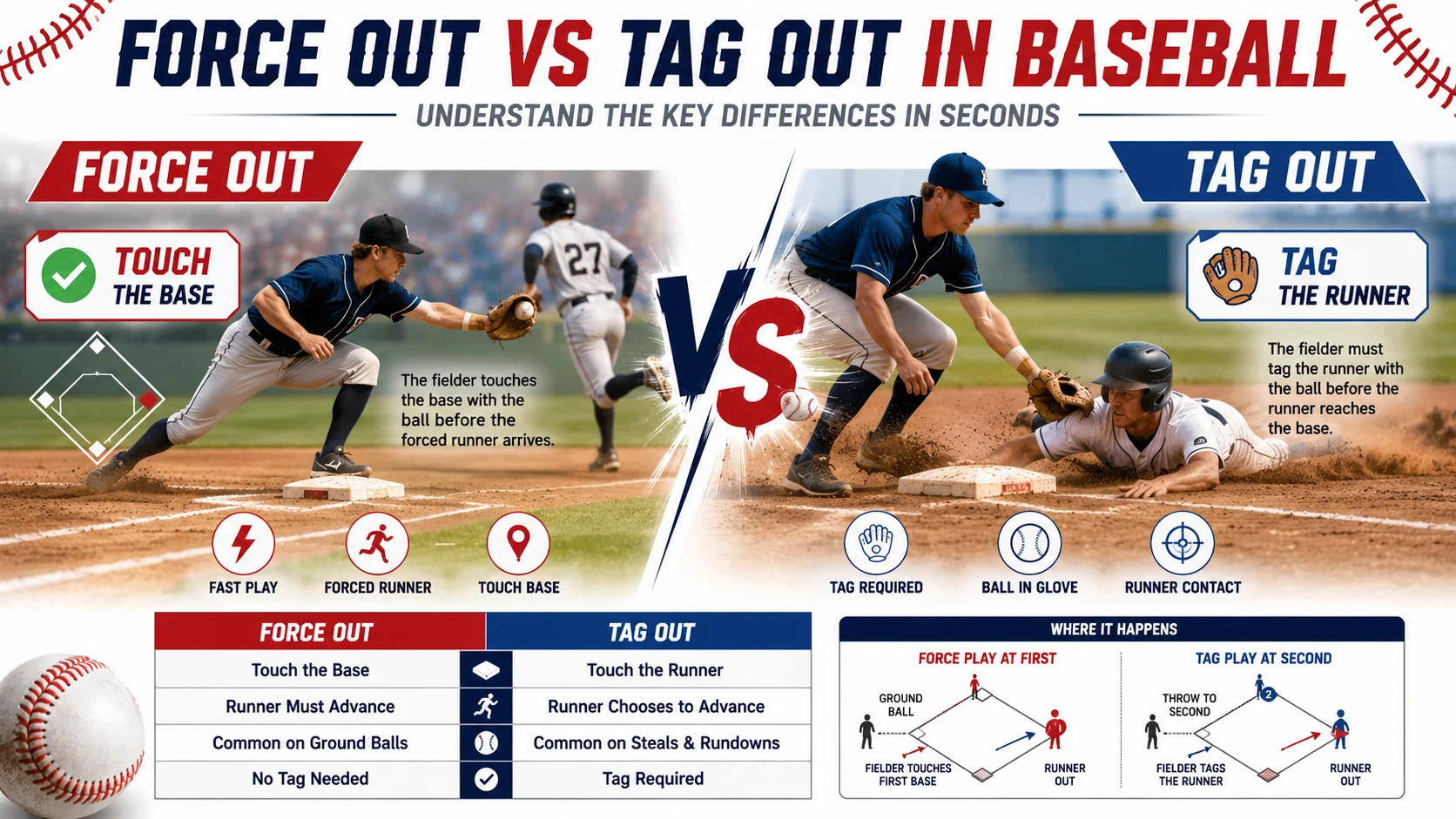
A force out occurs when a defensive player records an out by touching the base before a forced runner arrives. A tag out happens when a defensive player touches a runner with the ball or glove while holding the ball before the runner reaches a base. Understanding the difference is essential because each rule applies in different game situations and can change how defensive plays are executed.
The main difference is simple:
- Force Out: The fielder only needs to touch the base while holding the ball before the forced runner arrives.
- Tag Out: The fielder must physically tag the runner with the ball or glove holding the ball before the runner reaches a base.
Think of it this way:
Force Out = Touch the Base
Tag Out = Touch the Runner
Quick Comparison Table
| Feature | Force Out | Tag Out |
|---|---|---|
| How the Out Is Made | Touch the base | Tag the runner |
| Runner Forced to Advance? | Yes | No |
| Need to Touch Runner? | No | Yes |
| Most Common At | First base | Second, third, or home |
| Speed Required | Fast throw to base | Quick tag on runner |
| Common Situation | Ground balls | Steals, rundowns, pickoffs |
| Appeal Needed | No | No |
Why Understanding These Two Rules Matters
If you’ve ever watched a baseball game and wondered why a fielder simply stepped on first base instead of tagging the runner or why another play required chasing and tagging the runner you’ve encountered the difference between a force out and a tag out.
These are two of the most fundamental defensive plays in baseball. Players, parents, coaches, and new fans often confuse them because both result in an out, but the rules behind them are completely different.
Knowing when each type of out applies helps you:
- Better understand game strategy.
- Follow close defensive plays.
- Learn baseball rules more quickly.
- Appreciate smart defensive decisions.
- Avoid common rule misconceptions.
Whether you’re a beginner learning the game or a parent watching youth baseball, mastering these concepts will make every inning easier to follow.
What Is a Force Out in Baseball?
A force out happens when a runner is required to advance because the batter has become a runner and is taking first base.
Instead of tagging the runner, the defense only needs to:
- Secure possession of the baseball.
- Touch the correct base.
- Do so before the forced runner arrives.
If those conditions are met, the runner is out.
The runner doesn’t need to be tagged because the rules already require them to advance.
Simple Example of a Force Out
Imagine this situation:
- Runner on first base.
- The batter hits a ground ball to the shortstop.
Since the batter is running to first, the runner on first must advance to second.
The shortstop throws the ball to the second baseman.
If the second baseman steps on second base before the runner arrives:
It’s a force out.
No tag is needed.
Why Is It Called a “Force” Out?
The word force refers to the runner being forced to leave their current base.
The runner has no choice.
Because the batter is legally entitled to first base after putting the ball in play, every runner behind them may be forced to advance.
For example:
- Batter becomes runner.
- Runner on first must go to second.
- Runner on second may have to go to third.
- Runner on third may be forced home.
Whenever a runner is forced to advance, a force play becomes possible.
Common Force Out Situations
Force outs happen frequently during ground balls.
Some examples include:
Ground Ball to the Shortstop
Runner on first.
The shortstop fields the ball and throws to second.
The second baseman touches the bag before the runner arrives.
Result:
Force Out.
Double Play
Runner on first.
Ground ball to the second baseman.
The second baseman steps on second for the force out.
Then throws to first before the batter arrives.
Result:
Double Play.
This is one of baseball’s most common force-out combinations.
Bases Loaded
Bases loaded.
Ground ball to the third baseman.
The third baseman throws home.
The catcher steps on home plate before the runner arrives.
Result:
Force Out at Home.
No tag is required because the runner from third is forced to score.
What Is a Tag Out in Baseball?
A tag out occurs when a defensive player touches a runner with the ball or with the glove holding the ball before the runner reaches a safe base.
Unlike a force out, the defense must tag the runner.
Simply touching the base does not count unless the runner is forced to advance.
Simple Example of a Tag Out
Imagine this play:
A runner hits a single.
They decide to stretch it into a double.
The outfielder throws the ball to the second baseman.
Before the runner reaches second base, the second baseman tags the runner.
Result:
Tag Out.
Stepping on the base alone would not record the out because the runner wasn’t forced to advance.
Why Is a Tag Necessary?
A tag is required whenever the runner has the option to stay on their current base or return to it.
Since the runner isn’t forced to move, the defense must physically touch them to record the out.
This is why tag outs often happen during:
- Stolen base attempts.
- Pickoff plays.
- Rundowns.
- Extra-base hit attempts.
- Returning to a base after a fly ball.
Common Tag Out Situations
Stolen Base Attempt
A runner tries to steal second.
The catcher throws to the second baseman.
The second baseman catches the ball and tags the sliding runner.
Result:
Tag Out.
Pickoff Attempt
The pitcher notices the runner taking a large lead.
He throws to first.
The first baseman tags the runner before they dive back.
Result:
Tag Out.
Rundown
A runner gets caught between second and third base.
The fielders throw the ball back and forth.
Eventually, one player tags the runner.
Result:
Tag Out.
Trying for an Extra Base
A batter hits the ball into the gap.
They attempt to turn a double into a triple.
The throw beats them.
The third baseman tags them before touching the base.
Result:
Tag Out.
Force Out vs Tag Out: Side-by-Side Comparison
Understanding the differences becomes much easier when you compare them directly.
| Category | Force Out | Tag Out |
|---|---|---|
| Runner Forced to Advance | Yes | No |
| Must Touch Runner | No | Yes |
| Must Touch Base | Yes | Sometimes |
| Most Common Play | Ground balls | Steals and rundowns |
| Speed Needed | Quick throw | Quick tag |
| Can Happen at First Base | Very Often | Rarely |
| Requires Runner Contact | No | Yes |
How to Know Which Rule Applies
A simple question can help you determine whether the defense needs a force out or a tag out:
Is the runner required to advance because of the batter?
- Yes → A force out is possible.
- No → The defense must tag the runner.
This quick rule works in most game situations and is one of the easiest ways for beginners to identify the correct type of play.
Common Mistakes Beginners Make
New baseball fans often misunderstand these rules. Here are a few common misconceptions:
Mistake #1: Every Out at a Base Is a Force Out
Not true. If the runner is not forced to advance, the defense must tag the runner even if they’re very close to the base.
Mistake #2: Touching the Base Always Counts
Only when a force play exists. Otherwise, touching the base alone does not record the out.
Mistake #3: Force Outs and Tag Outs Are Interchangeable
They both result in an out, but they are governed by different rules and apply in different situations.
When Does a Force Out Become a Tag Out?
One of the most confusing baseball rules for beginners is knowing when a force play no longer exists.
A force out only exists while the runner is required to advance. If that obligation disappears, the defense must tag the runner instead of simply touching the base.
This often happens after another runner is retired or when a runner returns to their original base.
Example
Imagine there are runners on first and second with one out.
The batter hits a ground ball to the shortstop.
The shortstop throws to second base, recording the force out on the runner coming from first.
At that moment, the force on the runner from second is removed.
If that runner hesitates or tries to return to second, the third baseman must tag the runner. Simply stepping on third base is no longer enough.
Rule to remember:
Once the force is removed, the next play usually becomes a tag play.
Force Out Examples at Every Base
- Force plays can happen at any base when runners are required to advance.
Force Out at First Base
This is the most common force play in baseball.
The batter hits a ground ball.
The first baseman catches the throw and touches first base before the batter-runner arrives.
Result: Force Out.
No tag is necessary because the batter is forced to run to first.
Force Out at Second Base
Runner on first.
The batter hits a ground ball.
The second baseman steps on second before the runner arrives.
Result: Force Out.
This play frequently starts a double play.
Force Out at Third Base
Runners on first and second.
Ground ball to the infield.
The third baseman touches third before the runner from second arrives.
Result: Force Out.
Force Out at Home Plate
Bases loaded.
Ground ball to the pitcher.
The pitcher throws home.
The catcher steps on home plate before the runner arrives.
Result: Force Out.
Since the runner from third is forced to score, touching home plate is enough.
Common Tag Out Examples
Tag plays occur when runners are not forced to advance.
Stealing Second Base
The catcher throws to second.
The shortstop catches the ball and tags the sliding runner.
Result: Tag Out.
Runner Tries for Third
The batter hits a single.
The runner attempts to stretch it into a triple.
The throw arrives before the runner.
The third baseman tags the runner.
Result: Tag Out.
Pickoff Attempt
The pitcher throws to first.
The first baseman tags the runner before they dive back.
Result: Tag Out.
Rundown
A runner gets trapped between two bases.
Fielders exchange throws until one tags the runner.
Result: Tag Out.
Real Game Scenario: Force Out vs. Tag Out
Let’s compare two nearly identical plays.
Scenario 1: Force Out
- Runner on first.
- Ground ball to shortstop.
- Throw to second.
- Second baseman steps on the bag.
Result: Force Out.
The runner had to advance.
Scenario 2: Tag Out
- Runner on second.
- Fly ball is caught.
- Runner attempts to advance to third.
The third baseman receives the throw.
If they only step on third base, the runner is safe.
The runner wasn’t forced to advance.
The third baseman must tag the runner.
Result: Tag Out.
Why the Difference Matters
Understanding the distinction between force outs and tag outs affects more than just learning the rules.
It influences:
- Defensive positioning.
- Throwing decisions.
- Double-play strategy.
- Runner awareness.
- Umpire decisions.
- Coaching tactics.
Experienced players instinctively recognize whether a force exists before making a throw.
How Infielders Decide Which Play to Make
Infielders make split-second decisions based on the game situation.
Before every pitch, they mentally ask:
- How many outs are there?
- Where are the runners?
- Is there a force at any base?
- Which out is easiest?
- Can we turn two?
This preparation helps them react quickly once the ball is hit.
For example, with a runner on first and less than two outs, middle infielders often anticipate a potential double play and position themselves accordingly.
Force Outs and Double Plays
Most double plays begin with a force out.
A classic example is the 6-4-3 Double Play:
- The shortstop (6) fields the ground ball.
- Throws to the second baseman (4) for the force out.
- The second baseman throws to the first baseman (3).
- The first baseman records another force out.
Result:
Two outs on one play.
This is one of the most common defensive plays in baseball.
Can a Tag Out Also Start a Double Play?
Yes.
Although less common, tag plays can also lead to double plays.
Example:
A runner attempts to steal.
The catcher throws to second.
The runner is tagged out.
Another runner attempts to advance during the play.
The defense quickly throws to another base to record a second out.
These situations require excellent awareness and quick decision-making.
Umpire Signals for Force Outs and Tag Outs
Regardless of whether the out is a force or a tag play, the umpire uses the same general signal:
- A firm fist raised into the air while calling “Out!”
However, umpires carefully watch different actions depending on the play.
On Force Plays
The umpire watches:
- Was the fielder in possession of the ball?
- Did they touch the correct base?
- Did it happen before the runner arrived?
On Tag Plays
The umpire watches:
- Did the fielder maintain control of the ball?
- Was the runner actually tagged?
- Did the tag occur before the runner reached the base?
Because tag plays often happen in close, high-speed situations, they can be among the most challenging calls in baseball.
Tips for Players
Whether you’re just starting baseball or looking to improve your game, these tips can help.
For Infielders
- Always know where the force play is before each pitch.
- Secure the ball before attempting the out.
- Use quick, accurate footwork around the bases.
- Communicate clearly with teammates during double-play opportunities.
For Base Runners
- Understand whether you’re forced to advance.
- Run hard on every force play.
- Slide legally on close tag plays when appropriate.
- Watch your base coach for guidance.
Frequently Asked Questions
Is first base always a force out?
No. While most outs at first are force plays involving the batter-runner, there are situations such as pickoff attempts on a runner returning to first where a tag is required.
Can you tag a runner on a force play?
Yes. A defensive player may tag the runner instead of touching the base. However, touching the base is usually faster and easier.
Can a runner go back on a force play?
Generally, no. A forced runner must advance because the batter has become a runner. Once the force is removed, the runner may have different options depending on the play.
What is easier: a force out or a tag out?
Most players consider a force out easier because the defense only needs to touch the base while holding the ball. Tag plays require accurate timing and direct contact with the runner.
Can home plate have a force out?
Yes. With the bases loaded, the runner from third is forced to advance home. The catcher can record the out by touching home plate before the runner arrives.
Why doesn’t the defense always tag the runner?
When a force exists, touching the base is usually quicker and reduces the chance of a missed tag. That’s why infielders typically choose the force play whenever possible.
Expert Tips
Experienced coaches often teach young players one simple rule:
Know the force before the pitch.
By checking the number of outs, the runners on base, and where a force play exists, players can react more confidently and make faster defensive decisions.
Another important lesson is to avoid assuming every play is a force. Baseball situations change rapidly, and recognizing when the force has been removed is a key defensive skill.
Final Verdict
Understanding the difference between a force out and a tag out is one of the most important steps in learning baseball. While both result in an out, they apply under different circumstances and require different defensive actions.
A force out occurs when a runner is required to advance, allowing the defense to record the out simply by touching the appropriate base with the ball before the runner arrives. In contrast, a tag out is necessary when a runner is not forced to advance, requiring the fielder to physically tag the runner with the ball or glove holding the ball.
Recognizing when a force exists and when it no longer applies helps players make smarter decisions, improves defensive execution, and gives fans a clearer understanding of the game. Whether you’re a beginner, parent, coach, or player, mastering these two concepts will make every baseball game easier to follow and enjoy.

Emily Parker is a sports journalist at SportsOrbitX.com with a passion for covering cricket, tennis and major international sporting events. She is committed to producing clear, reliable and engaging content for sports enthusiasts worldwide.