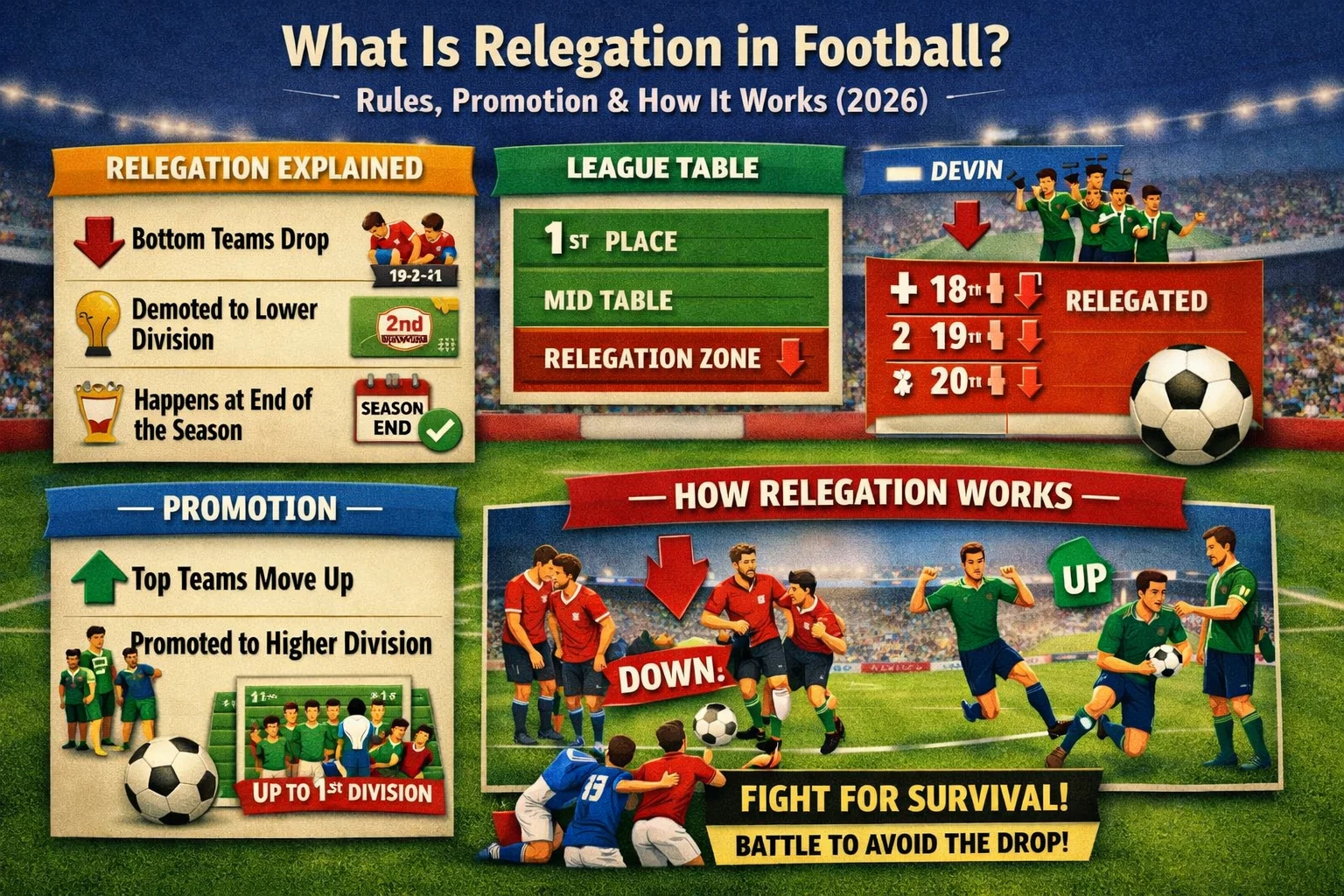
Relegation in football is the process of moving the lowest-performing teams from a higher league to a lower division at the end of a season. It works alongside promotion, allowing the best teams from lower divisions to replace those that performed poorly, keeping leagues competitive and rewarding success on the field.
What Is Relegation in Football
Why Relegation Is One of Football’s Most Unique Features
Unlike many professional sports leagues around the world, football uses a system where clubs can move up or down between divisions based entirely on their performance during the season. This system is known as promotion and relegation, and it is one of the defining characteristics of football.
For millions of fans, the excitement of avoiding relegation can be just as intense as winning a league title. While top clubs battle for championships and qualification for international competitions, teams near the bottom fight for something equally important survival.
Every point earned throughout the season can determine whether a club remains in the top division or drops to a lower league.
Why New Football Fans Often Find It Confusing
If you’re new to football, relegation can seem unusual.
Questions such as these are common:
- Why do teams move to another league?
- What happens after a club is relegated?
- Can they return the following season?
- Why don’t all sports use this system?
These questions arise because many sports, particularly in North America, operate using a franchise model where teams remain in the same league regardless of their results.
Football follows a different philosophy. Success must be earned every season, and poor performances have real consequences.
What This Guide Covers
In this complete guide, you’ll learn:
- What relegation means in football.
- How the promotion and relegation system works.
- Which teams are relegated.
- Why leagues use relegation.
- How promotion is connected to relegation.
- What happens when a club is relegated.
You’ll also discover expert insights, real-world examples, and common misconceptions later in the article.
What Is Relegation in Football?
Simple Definition
Relegation is the process where one or more of the lowest-ranked teams in a football league are moved down to a lower division at the end of the season.
At the same time, the best-performing clubs from the lower division are promoted to replace them.
This creates a continuous system where clubs must earn their place every year through their performances on the pitch.
What Does “Relegated” Mean?
When a team is relegated, it means the club has finished in one of the league’s lowest positions and will compete in a lower division during the following season.
For example:
A club finishing in the bottom places of the Premier League moves down to the EFL Championship for the next campaign.
Although relegation is disappointing, it does not remove a club from professional football. Instead, it provides an opportunity to rebuild, compete at a lower level, and potentially earn promotion back to the top division.
Why Is It Called Relegation?
The word relegation means being moved to a lower rank, position, or category.
In football, the term accurately describes what happens when a club drops from one league to another because of poor performance.
The opposite process is called promotion, where successful clubs move upward into a higher division.
Together, promotion and relegation form the foundation of football’s league pyramid.
How Relegation Differs From Being Eliminated
Many beginners confuse relegation with elimination, but they are completely different concepts.
Relegation happens in league competitions after a full season.
Elimination happens in knockout tournaments after losing a match or two-legged tie.
For example:
- A Premier League club finishing in the bottom three is relegated.
- A team losing an FA Cup match is eliminated from that competition but continues playing league matches.
Understanding this difference helps explain why league football and cup competitions operate under different rules.
Why Does Relegation Exist?
Promotion and relegation have existed in organized football for more than a century because they create a fair and competitive league system.
Rather than guaranteeing clubs a permanent place in the top division, every team must continually prove it belongs there.
Keeping Football Competitive
One of the biggest reasons relegation exists is to maintain competitiveness throughout the season.
Without relegation, clubs near the bottom of the table might have little motivation to improve once they can no longer challenge for trophies.
Instead, every point matters.
A single victory late in the season can determine whether a club survives or drops to a lower division.
This creates dramatic matches that remain meaningful until the final weeks of the campaign.
Rewarding Successful Clubs
Promotion gives ambitious clubs from lower divisions the opportunity to compete against stronger opponents.
Instead of remaining permanently separated, football allows teams to climb the pyramid through sporting merit.
This system rewards:
- Excellent coaching.
- Smart recruitment.
- Long-term planning.
- Consistent performances.
Even relatively small clubs can eventually reach the highest level if they perform well enough.
Punishing Poor Performance
Just as success is rewarded, poor performance has consequences.
Teams that consistently lose matches, concede goals, and collect too few points eventually fall into the relegation places.
Rather than relying on financial power or historical reputation, football demands results on the field.
This accountability is one of the reasons many supporters consider football’s league system fair.
Protecting League Quality
Relegation also helps maintain the overall quality of the competition.
Every season:
- Strong clubs move up.
- Weak-performing clubs move down.
This constant movement keeps leagues fresh, competitive, and unpredictable.
Supporters never know which newly promoted club might become the next success story.
How Does Relegation Work?
Although league rules differ slightly across countries, the basic promotion and relegation process is remarkably similar worldwide.
League Table Determines Final Positions
Throughout the season, clubs compete to earn points.
After every match, teams are ranked in the league table according to their results.
Generally:
- Win = 3 points
- Draw = 1 point
- Loss = 0 points
The clubs with the highest point totals finish near the top.
Those with the fewest points finish near the bottom.
Points Decide Who Stays Up
At the end of the season, the league table determines each club’s final position.
The lowest-ranked teams enter the relegation zone.
These clubs move down to the next division.
Meanwhile, promoted clubs replace them.
Although the exact number of relegated teams varies between competitions, the principle remains the same.
Goal Difference and Other Tiebreakers
Sometimes two or more teams finish with the same number of points.
When this happens, leagues apply tiebreakers.
The most common include:
- Goal difference
- Goals scored
- Head-to-head record (in some competitions)
- Fair play record (rarely used)
Goal difference is calculated by subtracting goals conceded from goals scored.
For example:
- Goals Scored: 60
- Goals Conceded: 45
Goal Difference: +15
A better goal difference can determine whether a club survives or is relegated.
When Relegation Is Officially Confirmed
A club is officially relegated once it becomes mathematically impossible to finish above the relegation zone.
This can happen:
- Several weeks before the season ends.
- On the final matchday.
- Occasionally after complex tiebreakers.
When relegation is confirmed, the club begins preparing for life in the lower division.
What Is Promotion in Football?
Promotion is the opposite of relegation.
Instead of moving downward, successful clubs move upward into a higher league.
Promotion and relegation always work together.
Without promotion, relegation would have little purpose.
Simple Definition
Promotion is the process where the highest-performing teams from a lower division advance to the next higher league for the following season.
Promotion rewards clubs that consistently perform well throughout the campaign.
How Promotion Works
Most leagues automatically promote the top teams in the standings.
Others also use promotion playoffs to determine the final promoted club.
Regardless of the format, promoted teams earn the opportunity to compete at a higher level against stronger opposition.
For many clubs, promotion represents years of careful planning and development.
Promotion vs Relegation
Although they are opposite outcomes, promotion and relegation are closely connected.
| Promotion | Relegation |
|---|---|
| Moves clubs to a higher division | Moves clubs to a lower division |
| Rewards strong performance | Results from poor performance |
| Creates new opportunities | Requires rebuilding |
| Celebrated by supporters | Often emotionally difficult |
Both systems ensure football remains dynamic and merit-based.
Why Both Systems Work Together
Promotion and relegation create a balanced football pyramid where every club has something to play for.
Top teams chase championships.
Mid-table teams aim for improvement.
Lower-ranked teams fight for survival.
Meanwhile, ambitious clubs in lower divisions compete for promotion.
This interconnected structure keeps matches meaningful throughout the season and gives clubs at every level realistic ambitions.
Which Teams Get Relegated?
Not every struggling club is relegated.
Instead, leagues clearly define how many teams move down each season.
Bottom Teams in the League Table
In most football leagues, the clubs finishing in the lowest positions are relegated.
The exact number depends on competition rules, but the principle remains consistent.
Teams that earn the fewest points over the season occupy the relegation places.
Number of Relegated Clubs
Some leagues relegate:
- Two clubs.
- Three clubs.
- Four clubs.
Others combine automatic relegation with relegation playoffs.
The number varies, but every league publishes its rules before the season begins.
Different Rules in Different Countries
Although promotion and relegation are common worldwide, each country’s football association sets its own regulations.
Differences may include:
- Number of promoted clubs.
- Number of relegated clubs.
- Playoff formats.
- Tiebreaking procedures.
Despite these variations, the core principle remains unchanged:
Strong performances lead to promotion, while poor performances can result in relegation.
Which Football Leagues Use Relegation?
Promotion and relegation are used by most professional football leagues around the world. Although the exact rules vary by country, the basic principle remains the same: teams that perform poorly move down a division, while successful clubs from lower leagues move up.
This open league structure is one of the reasons football is considered the world’s most competitive sport.
English Football Pyramid
England has one of the largest and most famous football league systems in the world.
The pyramid includes multiple interconnected divisions, including:
- Premier League
- EFL Championship
- League One
- League Two
- National League
At the end of each season:
- The lowest Premier League clubs are relegated to the Championship.
- The best Championship clubs earn promotion to the Premier League.
The same promotion and relegation system continues throughout the lower divisions.
Because every level is connected, even small community clubs can theoretically climb to the Premier League through long-term success.
Spanish Football (La Liga)
Spain also uses promotion and relegation.
At the end of the season:
- The lowest-ranked La Liga clubs move down to the Segunda División.
- The strongest Segunda División teams are promoted to La Liga.
This system has allowed several clubs to establish themselves in Spain’s top flight after years of development.
Italian Football (Serie A)
Italy follows a similar model.
Serie A clubs that finish in the relegation zone drop to Serie B, while the top Serie B teams move up.
Italian football is known for fierce battles at both ends of the table, with survival often decided during the final weeks of the season.
German Football (Bundesliga)
Germany combines automatic promotion with playoff opportunities.
Depending on league positions:
- Some clubs earn automatic promotion.
- Others compete in promotion/relegation playoffs.
These playoff matches often produce some of the most dramatic moments of the football calendar.
French Football (Ligue 1)
France also operates a promotion and relegation system.
The number of promoted and relegated clubs may change occasionally as league structures evolve, but the principle remains identical.
Strong performances are rewarded with promotion, while struggling teams face relegation.
Other European Leagues
Most European football associations use similar systems, including:
- Netherlands
- Portugal
- Belgium
- Scotland
- Turkey
- Switzerland
- Austria
Although formats differ slightly, promotion and relegation remain central to league competition.
Which Leagues Do Not Use Relegation?
Not every football league follows the promotion and relegation model.
Some countries operate closed leagues where teams remain permanent members.
Major League Soccer (MLS)
Major League Soccer (MLS) in the United States and Canada does not currently use promotion or relegation.
Instead, clubs remain in the league regardless of their league position.
New clubs usually enter through league expansion rather than promotion from lower divisions.
Franchise Sports Systems
Several North American professional sports use franchise models.
These include:
- NFL
- NBA
- MLB
- NHL
In these competitions:
- Teams cannot be relegated.
- League membership remains fixed.
- Expansion is controlled by league ownership.
This approach differs significantly from traditional football structures.
Why Some Countries Avoid Relegation
Supporters of franchise systems argue that permanent league membership provides:
- Financial stability
- Long-term investment security
- Predictable commercial planning
However, critics believe the absence of relegation reduces competitive pressure because struggling teams face fewer sporting consequences.
What Happens After a Team Is Relegated?
Relegation affects nearly every part of a football club.
Its impact extends far beyond simply playing in a different division.
Moving to a Lower Division
The most immediate consequence is moving into the league below.
This means facing:
- Different opponents
- New stadiums
- Different fixture schedules
- New competitive challenges
While the overall objective remains the same, the level of competition changes.
Financial Losses
Relegation usually reduces a club’s income.
Common financial effects include:
- Lower broadcasting revenue
- Reduced sponsorship income
- Smaller commercial deals
- Lower prize money
For many clubs, careful financial planning becomes essential after relegation.
Sponsorship Challenges
Sponsors often prefer clubs competing in top divisions because they receive greater television exposure.
After relegation:
- Existing sponsorship agreements may decrease in value.
- Some partnerships may end.
- Clubs may need to negotiate new commercial contracts.
This can significantly affect long-term budgeting.
Television Revenue
Broadcast income is one of the largest revenue sources for professional football clubs.
Top divisions usually receive much larger television contracts than lower leagues.
As a result, relegated clubs often experience one of their biggest financial reductions through lower broadcasting payments.
Player Transfers
Relegation frequently changes squad planning.
Some players:
- Request transfers.
- Receive offers from top-division clubs.
- Have release clauses linked to relegation.
Meanwhile, clubs may recruit younger or more affordable players to suit the financial realities of the lower division.
Managerial Changes
Football managers often face intense pressure after relegation.
Some clubs:
- Appoint new coaches.
- Restructure technical staff.
- Introduce long-term rebuilding plans.
Others keep the same manager if they believe continuity offers the best chance of immediate promotion.
Fan Reactions
Supporters experience a wide range of emotions after relegation.
Common reactions include:
- Disappointment
- Frustration
- Hope for promotion
- Increased loyalty
Many fans continue supporting their clubs regardless of division, demonstrating the strong connection between football clubs and their communities.
Financial Impact of Relegation
For many clubs, relegation is not only a sporting setback but also a significant financial challenge.
Top-flight football generates substantially greater revenue than lower divisions.
Broadcast Revenue Decline
Television rights often provide the largest share of club income.
Moving to a lower league generally results in:
- Reduced broadcast payments.
- Fewer televised matches.
- Lower international exposure.
Some leagues provide temporary financial support, often referred to as “parachute payments,” to help eligible clubs adjust to the loss of revenue.
Reduced Commercial Income
Commercial income may also decline.
Businesses generally invest more in clubs competing at the highest level because of greater visibility and larger audiences.
Relegation can therefore reduce:
- Shirt sponsorships.
- Advertising partnerships.
- Corporate hospitality income.
Lower Ticket Sales
Although loyal supporters usually remain committed, attendance may decrease after relegation.
Factors include:
- Lower-profile opponents.
- Reduced media attention.
- Changing supporter expectations.
However, some clubs continue attracting large crowds despite competing outside the top division.
Wage Management
Top-flight salaries can become difficult to sustain after relegation.
Many clubs respond by:
- Selling high-earning players.
- Renegotiating contracts.
- Promoting academy graduates.
Responsible wage management often determines whether a club can recover quickly.
Rebuilding the Squad
Successful clubs treat relegation as an opportunity to rebuild.
Long-term recovery usually focuses on:
- Youth development.
- Smart recruitment.
- Financial sustainability.
- Strong coaching.
Several clubs have returned stronger after following disciplined rebuilding strategies.
Can Relegated Teams Return?
Absolutely.
Relegation does not permanently remove a club from top-level football.
Many teams earn promotion after only one season.
Automatic Promotion
Most leagues automatically promote the highest-finishing clubs in the lower division.
Winning promotion immediately is often the primary objective for recently relegated teams.
Promotion Playoffs
Some competitions award additional promotion places through playoffs.
These knockout matches create opportunities for clubs that narrowly missed automatic promotion.
Playoff finals are often among the most valuable matches in football because promotion can transform a club’s future.
Immediate Comebacks
Several clubs have bounced back to the top division at the first attempt.
Immediate promotion usually depends on:
- Retaining key players.
- Strong leadership.
- Effective recruitment.
- Maintaining confidence after relegation.
Long-Term Rebuilding
Not every club returns quickly.
Some require several seasons to rebuild financially and competitively.
Others spend many years outside the top division before eventually returning.
Patience and careful planning are often essential.
Relegation Playoffs Explained
Not every league decides promotion and relegation solely through league positions.
Some competitions also use playoffs.
What Are Relegation Playoffs?
Relegation playoffs are additional matches used to determine whether a team remains in its current division or moves down.
Depending on the competition, playoffs may involve:
- Teams from the bottom of the higher league.
- High-finishing clubs from the lower division.
Which Countries Use Them?
Several football associations include promotion and relegation playoffs in their league structures.
The format varies, but the objective remains the same: deciding the final promotion or relegation place through head-to-head competition.
How Playoffs Work
Although rules differ, a typical playoff involves:
- Teams qualify based on league position.
- Clubs play one or two knockout matches.
- The winner competes in the higher division next season.
These matches often attract enormous attention because an entire season can depend on one result.
Why Playoffs Create Drama
Promotion and relegation playoffs combine months of league competition with the intensity of knockout football.
Players face immense pressure knowing that one goal can determine:
- Promotion.
- Relegation.
- Financial rewards.
- Club planning for the following season.
This makes playoff fixtures some of the most exciting matches in football.
Biggest Relegations in Football History
Relegation has affected some of the world’s biggest football clubs. While many fans associate it with smaller teams, history shows that even league champions, European giants, and clubs with massive fan bases can suffer relegation after poor performances or extraordinary circumstances.
These examples demonstrate that no club is completely immune from the pressure of survival.
Leeds United
Leeds United were one of England’s strongest clubs during the late 1990s and early 2000s, regularly competing in European competitions.
However, financial difficulties, player departures, and declining league performances eventually led to relegation from the Premier League.
The club spent many years rebuilding before earning promotion back to England’s top division.
Juventus
Juventus experienced one of football’s most unusual relegations.
Unlike most clubs that are relegated because of league position, Juventus were moved to Serie B following the Calciopoli match-fixing scandal in 2006.
Despite the setback, the club quickly returned to Serie A and later enjoyed one of the most successful periods in its history.
This remains one of football’s most famous examples of recovery after relegation.
Hamburger SV
For decades, Hamburger SV proudly held the distinction of never being relegated from Germany’s Bundesliga.
That remarkable record eventually ended when the club was relegated after struggling near the bottom of the table.
Their relegation surprised football fans across Europe and highlighted how difficult it is to remain competitive year after year.
Schalke 04
Schalke 04 is one of Germany’s largest and most passionately supported clubs.
After years of competing in European tournaments, poor league performances eventually resulted in relegation.
The club later reorganized its squad and returned to the Bundesliga, showing that relegation does not have to define a club’s future.
Sunderland
Sunderland experienced consecutive relegations after struggling in the Premier League.
Their decline demonstrated how quickly fortunes can change in professional football and how important long-term planning is for sustained success.
Leicester City
Just a few years after producing one of football’s greatest underdog stories by winning the Premier League title, Leicester City were relegated following an inconsistent season.
Their journey reminded fans that past achievements do not guarantee future survival.
Clubs That Became Stronger After Relegation
Although relegation is disappointing, it can also become the beginning of a successful rebuilding process.
Several clubs have used relegation as an opportunity to restructure, develop young players, and return stronger.
Learning From Failure
Relegation often forces clubs to evaluate every aspect of their organization.
This may include:
- Recruitment strategy
- Coaching structure
- Youth development
- Financial planning
- Sports science
Many clubs emerge with a clearer long-term vision after making these changes.
Successful Rebuilding Projects
Some clubs respond to relegation by focusing on sustainable growth instead of seeking immediate short-term success.
Successful rebuilding usually involves:
- Investing in talented young players.
- Hiring experienced coaching staff.
- Improving club infrastructure.
- Managing finances responsibly.
These decisions often create stronger foundations for future success.
Winning Promotion Again
Returning to the top division is one of football’s greatest achievements.
Promotion rewards clubs that:
- Maintain squad unity.
- Adapt to new challenges.
- Perform consistently throughout the season.
For supporters, celebrating promotion after relegation often feels even more rewarding because of the difficult journey involved.
How Teams Avoid Relegation
Every season, clubs near the bottom of the table look for ways to improve their chances of survival.
Modern football combines tactical planning, data analysis, recruitment, and sports science to reduce relegation risk.
Strong Defensive Organization
Teams battling relegation often prioritize defensive stability.
Improving defensive organization helps clubs:
- Concede fewer goals.
- Earn valuable draws.
- Protect narrow leads.
Even small defensive improvements can make a significant difference over a full season.
Smart January Transfers
The January transfer window allows clubs to strengthen their squads midway through the season.
Successful relegation battles often involve signing players who:
- Address weak positions.
- Add experience.
- Improve squad depth.
Well-planned recruitment can completely change a team’s fortunes.
Hiring New Managers
Some clubs appoint new managers in the hope of improving results.
A new coach may introduce:
- Fresh tactics.
- Greater motivation.
- Improved training methods.
- Better team organization.
While managerial changes do not always guarantee success, they sometimes provide the momentum needed to escape relegation.
Youth Academy Development
Academy graduates can become valuable assets during difficult periods.
Young players often provide:
- Energy
- Enthusiasm
- Tactical flexibility
- Long-term value
Many clubs successfully combine experienced professionals with emerging academy talent.
Sports Science and Analytics
Modern football increasingly relies on technology.
Clubs analyze:
- Player fitness
- Injury prevention
- Running data
- Passing patterns
- Opposition strengths
- Tactical trends
These insights help coaches make better decisions throughout the season.
How Relegation Affects Players
Relegation changes a player’s professional career in several ways.
The impact extends beyond simply competing in a different league.
Contracts
Some player contracts include clauses that become active after relegation.
These may involve:
- Salary reductions.
- Release clauses.
- Performance-related bonuses.
Such clauses help clubs manage finances if they move into a lower division.
Salary Reductions
Lower league revenue often means clubs cannot maintain top-flight wages.
As a result:
- Some players accept reduced salaries.
- Others move to different clubs.
Financial planning becomes an important part of rebuilding.
Transfer Requests
High-performing players may attract interest from clubs competing in higher divisions.
Transfers can benefit both parties by:
- Helping clubs reduce wage costs.
- Allowing players to continue competing at the highest level.
International Careers
Playing in a lower division may reduce a player’s visibility for international selection.
However, exceptional performances can still earn national team opportunities in many countries.
How Relegation Affects Fans
Supporters often experience relegation more emotionally than anyone else.
Unlike players and managers, fans remain connected to their clubs for life.
Emotional Impact
Common emotions include:
- Disappointment
- Frustration
- Sadness
- Hope
Despite difficult results, loyal supporters continue backing their teams.
Club Loyalty
Many clubs maintain strong attendances after relegation.
This loyalty demonstrates that football is about far more than winning trophies.
Supporters continue attending matches because of their connection to the club and community.
Attendance Changes
Some clubs experience lower attendances after relegation.
Others continue attracting impressive crowds due to passionate local support.
The response often depends on club history, expectations, and long-term optimism.
Community Support
Football clubs frequently represent entire cities or regions.
Even after relegation, supporters continue:
- Purchasing season tickets.
- Attending matches.
- Supporting community initiatives.
This relationship between clubs and communities is one of football’s greatest strengths.
Expert Insights and Interesting Facts About Football Relegation
Relegation is far more than a change in league position. It influences finances, player recruitment, coaching decisions, and the long-term future of football clubs. These insights highlight why promotion and relegation remain central to the sport.
Relegation Can Cost Clubs Millions
Dropping into a lower division often results in a substantial reduction in broadcasting income, sponsorship value, commercial partnerships, and matchday revenue.
For many clubs, financial planning begins months before the season ends in case relegation becomes a possibility.
Survival Is Sometimes More Valuable Than Winning a Trophy
Remaining in a top division can provide financial stability and long-term growth opportunities that exceed the value of some domestic cup victories.
This is why clubs fighting relegation often treat survival as their primary objective.
Newly Promoted Teams Often Face Immediate Relegation
Promotion brings excitement, but competing against stronger opponents is a major challenge.
Newly promoted clubs often need to strengthen their squads quickly to remain competitive.
Relegation Battles Produce Some of Football’s Most Dramatic Matches
While title races receive global attention, survival battles often create equal or even greater tension.
One late goal can determine whether a club stays in the top division or drops to a lower league.
Modern Clubs Use Analytics to Predict Relegation Risk
Many professional clubs monitor advanced data throughout the season, including:
- Expected Goals (xG)
- Defensive efficiency
- Injury trends
- Squad depth
- Fixture difficulty
These insights help coaches identify weaknesses before they become costly.
Big Clubs Can Be Relegated Too
History has shown that reputation alone offers no protection.
Every club must earn enough points to remain in its league, regardless of its size, history, or financial resources.
Promotion Is Often Harder Than Fans Expect
Winning promotion requires consistency across an entire season.
Many recently relegated clubs discover that returning immediately is more difficult than anticipated because lower divisions are highly competitive.
Football’s Pyramid Makes Every Match Matter
Promotion and relegation ensure meaningful competition throughout the league table.
Championship contenders chase trophies.
Mid-table clubs pursue improvement.
Lower-ranked teams battle for survival.
This structure creates excitement from the opening matchday until the final whistle of the season.
Common Myths About Relegation
Football fans often misunderstand how relegation works.
Let’s examine some common myths.
Myth 1: The Worst Team Always Finishes Last
False.
League position depends on points earned over an entire season.
Even strong squads can struggle because of injuries, poor form, or managerial changes.
Myth 2: Big Clubs Cannot Be Relegated
False.
Several famous clubs have experienced relegation despite their history and success.
Myth 3: Relegation Means the Club Is Finished
False.
Many clubs return stronger after rebuilding their squads and improving long-term planning.
Myth 4: Every Country Uses Promotion and Relegation
False.
Some leagues, including Major League Soccer, operate without relegation.
Myth 5: Teams Can Refuse Relegation
False.
League rules apply equally to every club.
Teams cannot choose to remain in a higher division after finishing in relegation positions.
Myth 6: Promotion Happens Automatically Everywhere
False.
Many competitions use promotion playoffs to decide the final promoted club.
Frequently Asked Questions
What is relegation in football?
Relegation is the process of moving the lowest-ranked teams from one league to a lower division at the end of the season.
Why are teams relegated?
Teams are relegated because they finish in the league’s relegation positions after earning too few points during the season.
How many teams are relegated each season?
The number depends on the competition. Some leagues relegate two clubs, while others relegate three or more.
Can a relegated team return to the top division?
Yes. Many clubs earn promotion the following season through automatic promotion or promotion playoffs.
Which leagues do not use relegation?
Major League Soccer (MLS) and several North American franchise-based leagues do not currently use promotion and relegation.
What is the difference between promotion and relegation?
Promotion moves successful clubs to a higher division, while relegation moves struggling clubs to a lower division.
What are relegation playoffs?
Relegation playoffs are additional matches used in some leagues to determine the final promotion or relegation place.
Has a famous football club ever been relegated?
Yes. Clubs such as Juventus, Leeds United, Hamburger SV, Schalke 04, and Leicester City have all experienced relegation.
Can goal difference decide relegation?
Yes. If teams finish level on points, goal difference is one of the most common tiebreakers.
Why is relegation important?
Relegation keeps football competitive by rewarding successful clubs with promotion while ensuring poor performances have meaningful consequences.
Conclusion
Relegation is one of football’s most distinctive and competitive features. Rather than guaranteeing clubs a permanent place in the top division, the promotion and relegation system rewards consistent success and holds every team accountable for its performances throughout the season.
Although relegation can be financially and emotionally challenging, it also creates opportunities for rebuilding, developing young talent, and returning stronger. Combined with promotion, it forms the foundation of football’s league pyramid, ensuring that every match, every point, and every season truly matters.
Whether you’re a new fan learning the basics or a lifelong supporter following your club’s survival battle, understanding relegation helps you appreciate why football remains one of the world’s most compelling and unpredictable sports.

Emily Parker is a sports journalist at SportsOrbitX.com with a passion for covering cricket, tennis and major international sporting events. She is committed to producing clear, reliable and engaging content for sports enthusiasts worldwide.