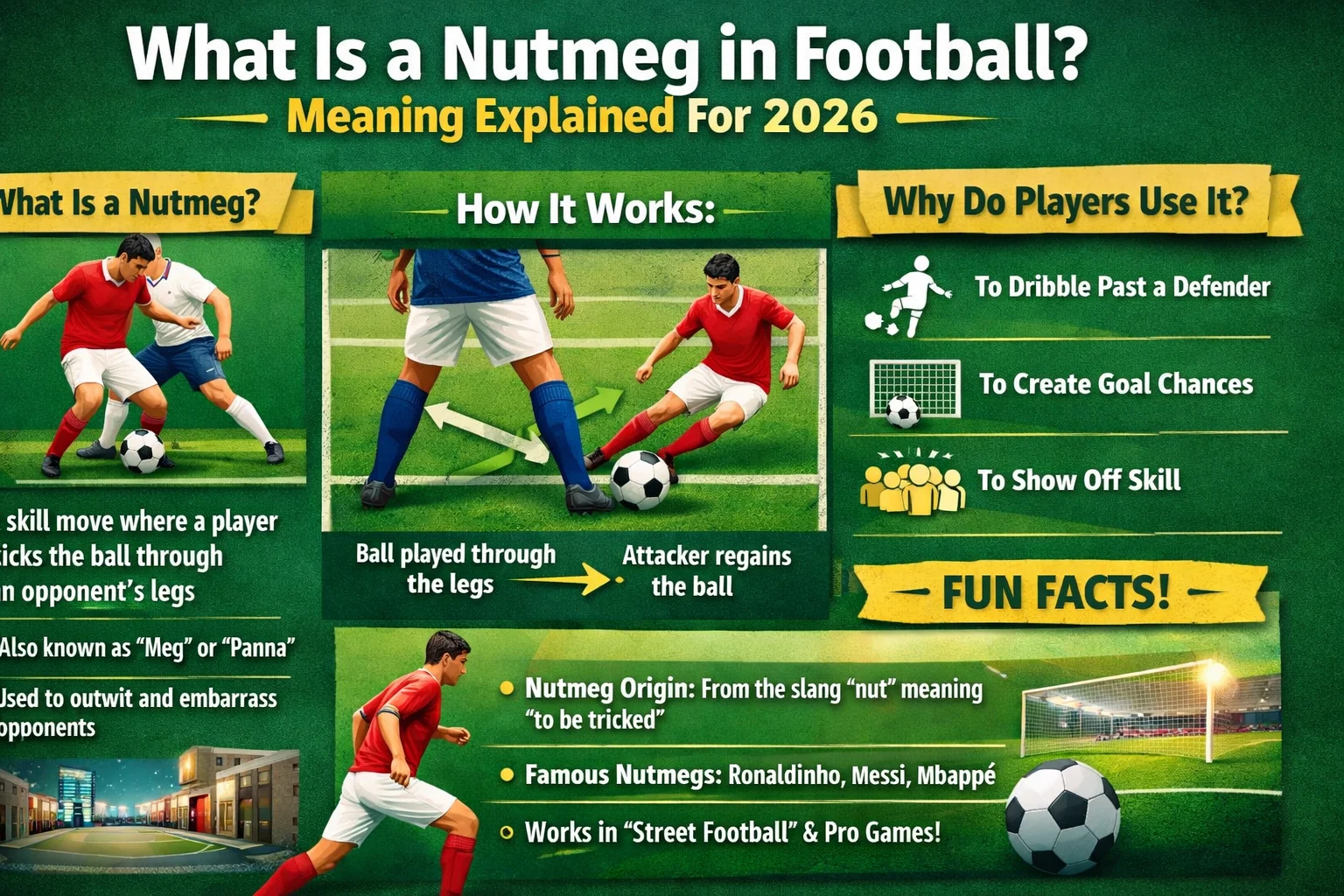
Quick Answer: A nutmeg in football is a skill move where a player passes, dribbles, or shoots the ball directly through an opponent’s legs, then collects it on the other side, widely considered one of the sport’s most embarrassing moments for the defender involved.
Few moments in football humiliate a defender quite as visibly, or delight a crowd quite as instantly, as watching the ball slide clean through their legs before an attacker collects it on the other side. It’s a skill move that needs no commentary to understand, celebrated across stadiums in every language, yet the strange, food-related name behind it has genuinely puzzled fans for generations, prompting endless debate among football historians and linguists alike.
This guide explains exactly what is a nutmeg in football, where the unusual term actually comes from, the technique behind pulling one off, and some of the players most closely associated with the move throughout football history and modern highlight culture.
What Exactly Counts as a Nutmeg?
For a nutmeg to count, the ball must travel directly between an opponent’s legs, not simply past them to one side or around their body entirely. Most commonly, it’s performed as part of a dribbling move, where an attacker deliberately pushes the ball through a defender’s legs and runs around them to reclaim possession on the far side. It can also happen through a pass to a teammate, or occasionally even as part of a shot on goal, provided the ball clearly threads between the defender’s legs rather than around their body during the attempt.
Where Does the Term “Nutmeg” Actually Come From?
The exact origin of the word remains genuinely disputed, with several competing theories circulating among football historians and linguists.
The Cockney Rhyming Slang Theory
One popular explanation suggests “nutmegs” became rhyming slang for “legs,” eventually shortening into football slang used to describe the ball passing between an opponent’s legs.
The 19th-Century Export-Trade Theory
Another theory traces back to the nutmeg spice trade itself. According to this account, unscrupulous 19th-century traders would occasionally mix real nutmeg pods with cheaper wooden replicas to deceive buyers, meaning to be “nutmegged” meant to be fooled or tricked in a transaction, a meaning that later transferred into football to describe a defender being deceived.
The Oxford English Dictionary Connection
Regardless of which origin story is accurate, the phrase “nutmegging” appears in English usage dating back to the 1800s, defined broadly as being tricked or deceived in a way that makes the victim look foolish, a meaning that fits naturally with how the term is used on a football pitch today.
How to Perform a Nutmeg: Common Techniques
Several distinct techniques are commonly used to execute a nutmeg during a match:
- The push-through — Using the inside of the foot to push the ball forward through the defender’s open legs at close range, then running around to collect it
- The chip nutmeg — Lifting the ball over a defender’s outstretched leg so it drops through the gap between their legs
- The body-feint nutmeg — Showing the ball to one side to encourage the defender to shift their stance, then pushing it through the legs in the other direction
- The pass-and-go nutmeg — Threading the ball through an opponent’s legs directly to a teammate, then continuing the run to receive a return pass
Is a Nutmeg Only Used in Football?
No, the term and the skill itself appear in several other sports as well. Basketball, ice hockey, and field hockey all use variations of the same concept, describing a ball or puck passed between an opponent’s legs. Football, however, remains by far the most culturally significant home for the term, given how visually dramatic and widely celebrated the moment becomes when it happens during a high-profile match.
Famous Players Known for Nutmegging Opponents
Certain players have built part of their footballing reputation specifically around their frequent, skillful use of nutmegs during matches. Luis Suárez became particularly well known for the move, inspiring the widely repeated football phrase suggesting he could “nutmeg a mermaid,” reflecting just how routinely he embarrassed defenders with the skill throughout his career. Other players closely associated with the move include Ronaldinho, Neymar, Juan Román Riquelme, and Lionel Messi, all celebrated for their close control and dribbling ability in tight spaces where nutmegs are most commonly attempted.
Why Is a Nutmeg Considered So Embarrassing for Defenders?
Beyond the immediate loss of possession, a nutmeg carries a distinct social and psychological sting within football culture that goes well beyond its tactical impact on a match. Because the ball passes so visibly and specifically through the defender’s own legs, it’s widely perceived as a more personal, humiliating failure compared to simply being dribbled past to one side. This cultural weight has turned nutmegs into a genuinely celebrated highlight moment in their own right, frequently compiled into standalone video montages independent of the goals or match results they may have contributed to.
Nutmeg Culture in the Social Media Era
The rise of social media and short-form video content has arguably amplified the cultural significance of the nutmeg beyond what it enjoyed in earlier decades of football coverage. Highlight clips specifically dedicated to nutmegs now regularly circulate across platforms, often generating engagement independent of the broader match result or context, since the moment itself is instantly understandable and shareable even to casual viewers with limited football knowledge. This has led some analysts to describe the nutmeg as one of football’s most “meme-able” moments, a skill that translates across language and cultural barriers in a way that few other football terms manage as effectively.
Do Data Providers Track Nutmegs as a Statistic?
While nutmegs have never been an official IFAB-recognized statistic, several modern football data and analytics companies have begun informally tracking them in recent years, reflecting growing interest in quantifying skill moves beyond traditional metrics like goals, assists, and tackles. Some broadcasters and statistical platforms now display live nutmeg counts during matches featuring players particularly well known for the skill, treating it as a genuine point of fan engagement rather than a purely tactical statistic. This growing, informal tracking reflects football’s broader trend toward capturing more granular, entertainment-focused data points that resonate with modern audiences increasingly interested in skill and flair alongside traditional performance metrics.
Nutmegs in Youth Development and Street Football
The nutmeg holds a particularly significant place within street football and futsal culture, where tight spaces and close control are placed at an even greater premium than in traditional 11-a-side football. Many young players first learn and attempt nutmegs in informal, small-sided games long before playing organized matches, given how naturally the skill emerges from close-quarters dribbling situations common in street football settings. Some youth coaches specifically incorporate nutmeg-focused drills into technical training sessions, recognizing that the confidence and close control required to successfully nutmeg an opponent under pressure often translates into broader technical improvement across a young player’s overall game.
Frequently Asked Questions
What is a nutmeg in football? A nutmeg is a skill move where a player passes or dribbles the ball directly through an opponent’s legs, then collects it on the other side.
Where does the word “nutmeg” come from in football? The exact origin is disputed, with theories ranging from Cockney rhyming slang for “legs” to a 19th-century nutmeg spice trade deception, though the term “nutmegging” dates back to the 1800s in English usage.
Does a nutmeg have to happen during a dribble? No, a nutmeg can occur through a pass to a teammate or occasionally a shot on goal, as long as the ball clearly travels between the opponent’s legs.
Is nutmegging used in other sports besides football? Yes, similar concepts appear in basketball, ice hockey, and field hockey, though football remains the sport most culturally associated with the term.
Which player is most famous for nutmegging opponents? Luis Suárez is particularly well known for the move, alongside players like Ronaldinho, Neymar, and Lionel Messi, all celebrated for their close control in tight spaces.
Is a nutmeg an official football statistic? No, nutmegs are not an officially tracked statistic under IFAB’s Laws of the Game, though some modern data providers have begun informally tracking them for analytical and highlight purposes.
Are nutmegs more common in street football than professional matches? Yes, tight spaces and close-quarters dribbling in street football and futsal make nutmeg opportunities significantly more frequent than in traditional 11-a-side matches with more open space.
Why have nutmegs become more culturally prominent in recent years? The rise of social media highlight culture has amplified the nutmeg’s visibility, since the moment is instantly understandable and shareable across language and cultural barriers, unlike more tactically nuanced football moments.
Conclusion
So, what is a nutmeg in football? At its core, it’s a simple, visually unmistakable moment: the ball threading between a defender’s legs before being collected on the other side. Despite its disputed linguistic origins, the term has become one of football’s most universally understood pieces of slang, carrying a cultural weight far beyond its actual tactical impact on a match, now amplified further by social media’s appetite for instantly shareable skill moments. Want to explore more football terminology? Check out our guide on What Is an Assist in Football for another key concept every fan should understand.

Daniel Brooks is a sports writer at SportsOrbitX.com, specializing in football, basketball and global sports news. He focuses on delivering accurate reporting, match analysis and timely updates that keep fans informed.