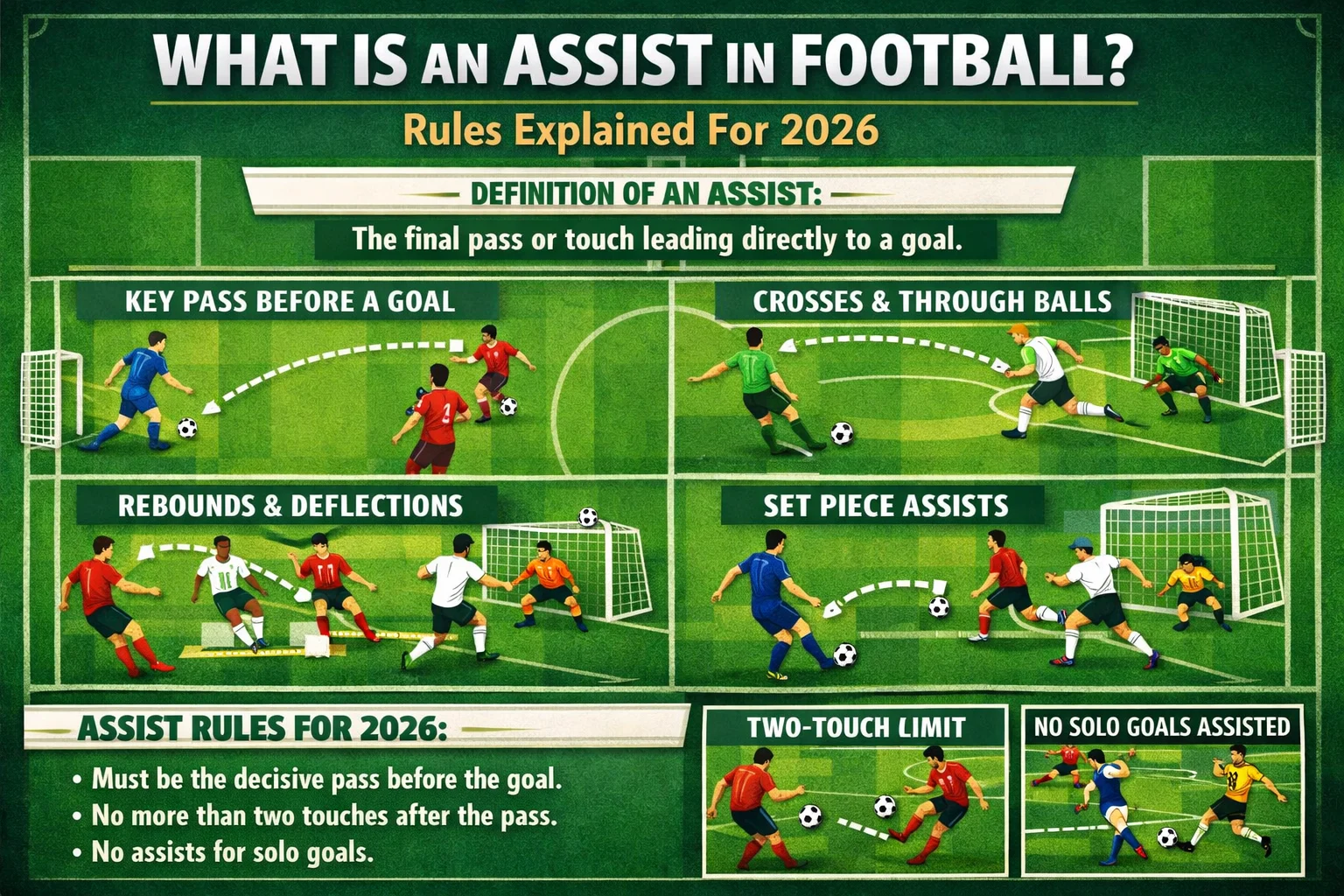
Quick Answer: An assist in football is awarded to the player whose pass, cross, or other direct action immediately leads to a teammate scoring a goal, provided no significant intervening action, like a defensive clearance or a long dribble, breaks the connection between the two events.
Goals get the headlines, the replays, and the wild celebrations, but ask any manager what actually wins matches and they’ll usually point to the pass that came before it. An assist rarely draws the same roar from the crowd, yet it’s often the moment of vision and precision that made the goal possible in the first place, and modern football has increasingly come to recognize just how much creative weight that single statistic carries in evaluating a player’s true attacking output.
This guide explains exactly what is an assist in football, how it’s determined in edge cases like deflections and penalties, and which players hold the sport’s most impressive all-time assist records across club and international competitions.
The Basic Definition of an Assist
An assist is credited to the player who delivers the final pass, cross, or touch that directly sets up a goal for a teammate. While assists aren’t an official IFAB law-book concept in the way goals or fouls are, they’re tracked consistently across virtually every major competition and statistical database, including Opta, StatsBomb, and official league records, using a broadly consistent set of criteria applied match after match throughout a season.
How Assists Are Determined: The Core Rules
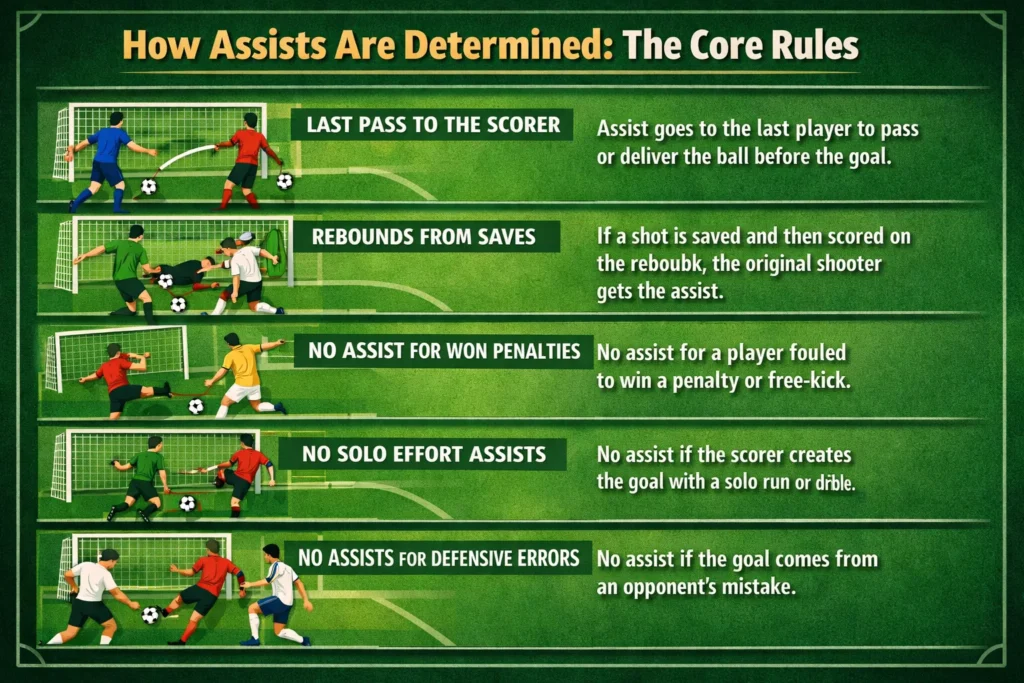
Several consistent principles govern how an assist is awarded across most competitions and data providers:
- The assist goes to the last player to pass, cross, or otherwise deliver the ball to the goal scorer, provided the goal follows without a significant interruption
- If a shot is saved or parried by the goalkeeper and another player scores the rebound, the original shot-taker is typically credited with the assist
- If a goal is scored directly from a penalty or free-kick, the player who was fouled to win that penalty or free-kick is not automatically given an assist under most standard statistical conventions, though fantasy football platforms often handle this differently
- If the goal scorer creates their own opportunity through a solo dribble or run, no assist is awarded to anyone
- If a goal results from an opponent’s misplaced pass or defensive error rather than a genuine attacking action, no assist is typically credited
What About Deflected Passes?
Deflections create some of the trickiest assist decisions for statisticians tasked with reviewing match footage after the final whistle. If a pass takes a minor touch off a defender before reaching a teammate who scores, it generally still counts as an assist, since the original delivery was clearly on course to reach its intended target regardless of the slight deflection. However, if the deflection significantly changes the ball’s direction in a way that makes the outcome essentially accidental, statistical providers may withhold the assist entirely, treating the goal as unassisted instead of crediting the original passer.
Do Goalkeepers Ever Get Credited With Assists?
Yes, goalkeepers can receive assists, though it happens far less frequently than for outfield players given their position and typical role during attacking phases of play. A long throw, a quick distribution, or a well-placed goal kick that leads directly to a goal without significant intervening play can be credited as a goalkeeper assist. Modern goalkeepers known for strong distribution, such as those trained extensively in build-up play under possession-focused coaching systems, have occasionally posted assist numbers that surprise fans more accustomed to associating the position purely with shot-stopping.
Assists vs. Key Passes: What’s the Difference?
These two terms are often confused by newer fans, but they measure different things entirely. An assist is the final pass that directly results in a goal being scored. A key pass, by contrast, is any pass that creates a genuine scoring opportunity for a teammate, regardless of whether the resulting shot actually finds the net. This means a player can record several key passes in a match without registering a single assist, simply because their teammates failed to convert the resulting chances.
Assist Rules: Quick Reference Table
| Situation | Assist Awarded? |
|---|---|
| Pass directly leads to a goal with no interruption | Yes |
| Shot saved, rebound scored by another player | Yes, to the original shot-taker |
| Player wins a penalty that a teammate converts | No, under most standard conventions |
| Goal scorer creates the chance through a solo run | No assist to anyone |
| Pass takes a minor deflection but still reaches the intended target | Yes |
| Goal results from an opponent’s significant defensive error | Typically no |
The All-Time Assist Leaders in Football
Several players have built legendary reputations specifically around their playmaking ability rather than pure goal-scoring output alone. Lionel Messi holds the record for most assists in top-flight football history, with a career total exceeding 300 assists across club and international competitions, reflecting his dual threat as both a scorer and a creator throughout his lengthy and decorated career. Other players frequently cited among the greatest playmakers include Cristiano Ronaldo and Ángel Di María, both of whom have accumulated well over 200 career assists at the highest level, alongside historic Premier League figures like Ryan Giggs, who holds the competition’s all-time assist record from his two-decade career at Manchester United.
Why Assists Matter Beyond the Statistic
Assists have become an increasingly important metric for evaluating a player’s overall offensive contribution, particularly for attacking midfielders and wingers whose value often extends well beyond their personal goal tally alone. Combined goal-and-assist statistics, commonly abbreviated as “G/A” in modern football coverage, are now widely used by analysts, scouts, and fantasy football platforms to assess a player’s complete attacking output, recognizing that creating a goal often requires just as much skill, vision, and decision-making as finishing one under pressure.
A Brief History of Tracking Assists in Football
Unlike goals, which have been recorded since football’s earliest formalized matches, assists were not consistently tracked as an official statistic for much of the sport’s history. The concept gained significant momentum through the 1990s and 2000s as television broadcasting, data analytics, and fantasy football platforms all began placing greater emphasis on quantifying a player’s creative contribution rather than focusing exclusively on goals scored. Statistical companies like Opta, founded in the 1990s, played a major role in standardizing how assists were tracked across English football, eventually influencing how leagues and competitions worldwide approached the statistic. Today, virtually every major professional league maintains detailed, publicly accessible assist records, a level of tracking that would have been considered unusual just a few decades earlier in the sport’s history.
How Fantasy Football Handles Assists Differently
It’s worth noting that fantasy football platforms frequently apply more generous assist criteria than official statistical providers use for real-world match records. In many fantasy football formats, winning a penalty or free-kick that a teammate subsequently converts is awarded as an assist, unlike the stricter standard used by most official statistics services. Similarly, some fantasy platforms credit an assist when a player’s shot is saved and the rebound is scored, treating it identically to official conventions in this specific case, but diverging on other edge cases like deflections and set-piece situations. This distinction matters for fans who follow fantasy football closely, since a player’s fantasy assist total can occasionally differ meaningfully from their officially recorded real-world statistic for the same match.
Assist Records Across Major Tournaments
Beyond domestic league competitions, assist records at major international tournaments carry their own significance and historical weight. FIFA World Cup assist statistics have become an increasingly discussed topic among analysts and fans, with specific rules governing edge cases like rebounds and penalty-related goals applied consistently across the tournament. Players who combine strong goal-scoring with high assist totals at major tournaments are often regarded as the most complete attacking performers of their generation, since major tournament football typically features tighter, more tactically disciplined defenses that make both goals and genuine assists considerably harder to produce compared to a typical domestic league match.
Notable Assist Moments in Football History
Certain assists have become just as iconic as the goals they created, remembered specifically for the vision or technical skill involved in the pass itself. Some of the most celebrated assists in football history involve moments of individual brilliance, such as a defense-splitting through ball threading multiple defenders, or a perfectly weighted cross delivered under intense pressure during a high-stakes match. Award ceremonies and end-of-season highlight reels increasingly dedicate specific attention to standout assists, reflecting a broader cultural shift within football toward recognizing playmaking as an art form deserving of the same appreciation traditionally reserved for spectacular finishing.
Expert Insights and Interesting Facts About Football Assists
An assist is more than just the final pass before a goal. At the highest levels of football, assists measure creativity, vision, teamwork, and decision-making. Coaches, analysts, and scouts often use assist data to evaluate a player’s ability to create goal-scoring opportunities rather than simply finish them.
Lionel Messi Holds the Record for the Most Official Career Assists
Lionel Messi is widely recognized as the player with the most official career assists in professional football history, recording more than 380 official assists across club and international competitions.
His combination of vision, passing accuracy, close control, and playmaking has allowed him to create hundreds of goals over nearly two decades.
Expert Insight: Messi is unique because he ranks among football’s all-time leaders in both goals and assists, demonstrating elite finishing and chance creation throughout his career.
Cristiano Ronaldo Is Also Among Football’s Greatest Assist Providers
Although best known for scoring goals, Cristiano Ronaldo has also recorded well over 250 official career assists.
His crossing ability, movement, quick passing, and decision-making have helped teammates score consistently in the Premier League, La Liga, Serie A, and international football.
This proves that elite goalscorers often contribute significantly as creators as well.
Kevin De Bruyne Is Considered One of the Greatest Modern Playmakers
Few midfielders have matched Kevin De Bruyne’s consistency in creating chances.
His strengths include:
- Through balls
- Early crosses
- Long-range passing
- Set-piece delivery
- Vision under pressure
Football analysts regularly rank him among the best assist providers of the modern era because he combines technical precision with exceptional game intelligence.
The Premier League Assist Record Belongs to Ryan Giggs
Ryan Giggs holds the record for the most Premier League assists, finishing his career with 162 assists.
Remarkably, he maintained this level of creativity over more than two decades while adapting to different managers, teammates, and tactical systems.
An Assist Requires More Than Technical Skill
The best assist providers excel because they consistently demonstrate:
- Exceptional vision
- Spatial awareness
- Intelligent movement
- Quick decision-making
- Accurate timing
- Strong communication with teammates
Many elite coaches believe anticipation is just as important as passing ability.
Assists Are Recorded Differently Across Competitions
Not every football competition follows identical assist criteria.
Different leagues and statistical organizations may disagree on whether an action qualifies as an assist, particularly in situations involving:
- Deflections
- Rebounds
- Own goals
- Penalties won
- Multiple touches before the goal
As a result, a player’s assist total may vary slightly depending on the data provider.
Expected Assists (xA) Reveal Hidden Creativity
Modern football analytics use a statistic called Expected Assists (xA).
Unlike traditional assists, xA measures the quality of a chance created rather than whether the teammate actually scores.
For example:
A player may deliver five excellent passes that should produce goals, but if teammates miss every opportunity, the player records zero assists while still earning a high Expected Assists (xA) value.
For this reason, many clubs consider xA a more accurate indicator of creative performance than assists alone.
Midfielders Usually Lead Assist Charts
Although forwards and wingers also provide assists, attacking midfielders often dominate assist rankings because they:
- Spend more time in creative areas.
- Control attacking transitions.
- Deliver key passes into dangerous spaces.
- Frequently take corners and free kicks.
Players such as Kevin De Bruyne, Mesut Özil, Cesc Fàbregas, Xavi, and Andrés Iniesta built their reputations on consistently creating chances for teammates.
Some of Football’s Greatest Players Had Nearly as Many Assists as Goals
The world’s best playmakers don’t simply score they create.
Legends like Lionel Messi, Xavi, Andrés Iniesta, Luka Modrić, Kevin De Bruyne, and Mesut Özil are remembered not only for trophies but also for their ability to unlock defenses with a single pass.
Their careers demonstrate that creating goals can be just as valuable as scoring them.
Football Is Becoming More Data-Driven Than Ever
Professional clubs now track dozens of creative metrics beyond traditional assists, including:
- Key passes
- Expected assists (xA)
- Progressive passes
- Through balls
- Shot-creating actions
- Final-third passes
- Cross accuracy
These advanced statistics help coaches identify players whose creative influence extends far beyond the basic assist column.
Expert Takeaway: While assists remain one of football’s most celebrated statistics, modern analysis shows they represent only part of a player’s creative impact. Elite playmakers consistently influence matches through intelligent movement, vision, and chance creation even when those opportunities don’t always result in official assists.
Frequently Asked Questions
What is an assist in football? An assist is awarded to the player whose pass, cross, or direct action immediately leads to a teammate scoring a goal, without a significant interruption in play.
Does winning a penalty count as an assist? Under most standard statistical conventions, winning a penalty does not count as an assist for the fouled player, though fantasy football platforms sometimes apply different, more generous rules.
Can a goalkeeper get an assist? Yes, a goalkeeper can be credited with an assist if their throw, pass, or distribution leads directly to a goal without significant intervening play.
What is the difference between an assist and a key pass? An assist is the final pass that directly results in a goal, while a key pass is any pass that creates a genuine scoring opportunity, regardless of whether it’s actually converted into a goal.
Who holds the record for most assists in football history? Lionel Messi holds the record for most assists in top-flight football history, with a career total exceeding 300 assists across club and international competitions.
Do deflected passes still count as assists? Generally yes, if the deflection is minor and the pass was clearly on course to reach the intended teammate; significant deflections that change the outcome may result in no assist being awarded.
Does fantasy football use the same assist rules as official statistics? Not always. Fantasy football platforms often apply more generous criteria, such as crediting an assist for winning a penalty that a teammate converts, which differs from most official statistical conventions.
Are assists tracked officially by FIFA? While FIFA doesn’t maintain assists as an official law-book statistic in the way goals are recorded, most competitions, including FIFA tournaments, track assists using broadly consistent criteria applied by data providers and official competition statisticians.
Conclusion
So, what is an assist in football? At its core, it’s a recognition of the pass, cross, or moment of vision that directly creates a goal, a statistic that has grown from a footnote into one of the sport’s most closely tracked measures of creative impact since data providers like Opta began standardizing the process in the 1990s. From deflected passes to goalkeeper distributions, understanding the specific edge cases behind how assists are awarded makes it much easier to appreciate the players whose contributions often go unnoticed compared to the goal-scorers they set up. Want to explore more football terminology? Check out our guide on What Is an Own Goal in Football for another key statistical concept every fan should understand.

Emily Parker is a sports journalist at SportsOrbitX.com with a passion for covering cricket, tennis and major international sporting events. She is committed to producing clear, reliable and engaging content for sports enthusiasts worldwide.