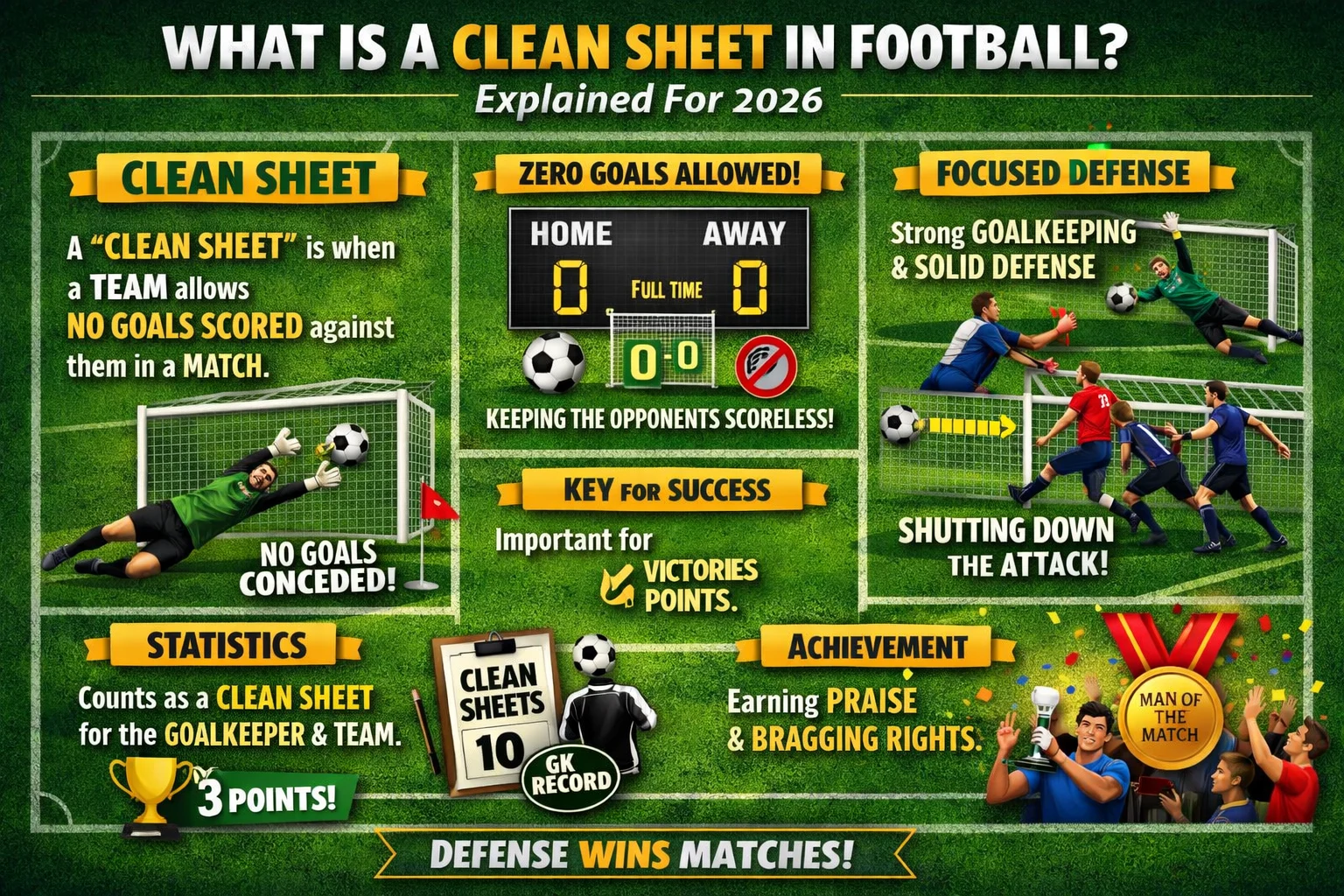
Quick Answer: A clean sheet in football occurs when a team, and specifically its goalkeeper, prevents the opposing side from scoring any goals during a match, resulting in a scoreline where the opponent finishes with zero goals recorded.
Some of football’s biggest achievements never involve the ball crossing a line at all. A goalkeeper punching clear a dangerous cross in the 89th minute, a center-back winning one final header, a defensive line holding firm through 90 minutes of relentless pressure none of it shows up on a scoreboard, yet it all builds toward one of the sport’s quietly prestigious accomplishments.
This guide explains exactly what is a clean sheet in football, how it’s officially credited, why the term exists, and why it remains one of the most respected individual and team achievements across every level of the sport.
What Exactly Is a Clean Sheet?
A clean sheet is recorded whenever a team finishes a match without conceding a single goal to their opponent, regardless of how the match itself unfolds. If a team wins 2-0, 1-0, or draws 0-0, they’ve kept a clean sheet, regardless of how many goals they themselves scored. The term applies specifically to preventing goals against, not to a team’s own attacking output, meaning a high-scoring 5-0 win and a tense 1-0 win are both equally valid clean sheets from a defensive standpoint.
Where Does the Term “Clean Sheet” Come From?
The phrase originates from football’s earlier record-keeping days, when match officials and scorers tracked goals on a physical sheet of paper during every fixture. If a team’s opponent failed to score, that team’s section of the sheet remained blank, or “clean,” giving rise to the terminology still used universally across the sport today, even though scorekeeping has long since moved to digital systems and real-time statistical databases.
Who Gets Credit for a Clean Sheet?
While keeping a clean sheet is genuinely a full-team defensive effort involving every position on the pitch, official statistics primarily credit the goalkeeper, since clean sheets are most commonly used as a goalkeeping performance metric. That said, individual defenders and even defensive midfielders are widely recognized within the sport as directly contributing to a clean sheet, even if the formal statistic itself is recorded under the goalkeeper’s name in most official record-keeping systems used by leagues worldwide.
Clean Sheet Rules and Edge Cases
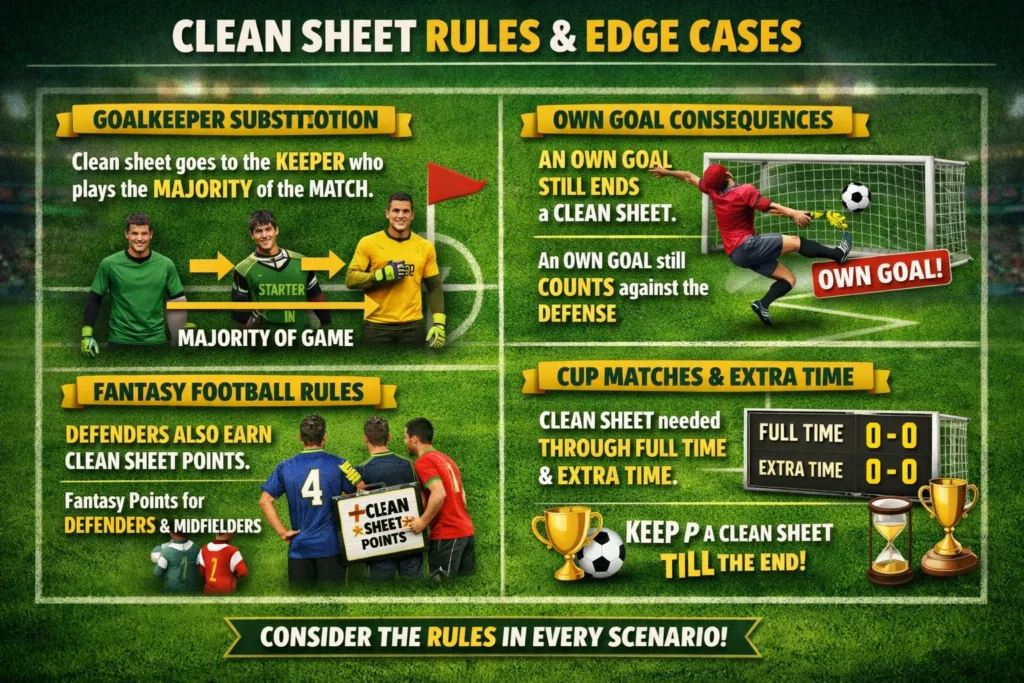
Several specific situations affect how a clean sheet is recorded across different competitions and statistical systems:
- If a goalkeeper is substituted mid-match, most competitions and data providers credit the clean sheet to whichever goalkeeper played the majority of the match, though conventions can vary slightly by league
- An own goal still counts as a goal conceded, meaning a clean sheet is lost even if the opposing team never had a shot on target themselves
- In fantasy football formats, defenders and sometimes defensive midfielders can also earn clean sheet points, differing from official real-world statistical conventions that credit the goalkeeper first
- A clean sheet in a cup competition typically requires preventing goals through full-time and any extra time played, though rules can vary depending on the specific tournament
Why Clean Sheets Matter So Much
Clean sheets carry significant weight in football for reasons that go beyond simple record-keeping and statistical tracking. A team that avoids conceding only needs a single goal to win the match, fundamentally shifting the pressure dynamic compared to a high-scoring, back-and-forth contest. Clean sheets are also widely regarded within coaching circles as a strong indicator of overall team organization and defensive discipline, since keeping the opposition off the scoresheet requires consistent effort from every outfield player, not just the goalkeeper and central defenders positioned closest to their own goal.
The Golden Glove: Football’s Clean Sheet Award
Just as the Golden Boot recognizes a competition’s top goal-scorer, the Golden Glove (sometimes called the Golden Gloves) is awarded to the goalkeeper with the most clean sheets across a season or tournament. This award has become an increasingly prominent storyline in competitions like the Premier League and major international tournaments, giving goalkeepers a specific, trackable accolade that parallels the recognition strikers receive for scoring goals throughout a long competitive season.
Clean Sheets and Team Success: Is There a Real Link?
Statistical analysis across professional football consistently shows a strong correlation between clean sheet totals and overall league success, reflecting the old coaching axiom that “defense wins championships” across virtually every major footballing nation. Teams competing at the top of major leagues typically post significantly higher clean sheet counts than teams in relegation battles, since consistent defensive solidity tends to translate directly into accumulated points over a full season, even when a team’s attacking output is comparatively modest.
Famous Goalkeepers Known for Clean Sheets
Certain goalkeepers have become particularly associated with clean sheet records throughout football history and continue to serve as benchmarks for the current generation. Petr Čech holds the Premier League’s all-time clean sheet record, having recorded over 200 across his career with Chelsea and Arsenal. Gianluigi Buffon became widely recognized as one of the first goalkeepers in modern football to surpass 500 career clean sheets, a milestone reflecting both individual quality and the defensive systems he played behind throughout a lengthy professional career at the highest level of European football.
Clean Sheets in Football Betting
Beyond its role as a performance statistic, “clean sheet” has also become a common term in football betting markets, where fans can wager specifically on whether a team will avoid conceding during a given match. A “clean sheet bet” is typically a straightforward yes/no market, separate from other outcomes like the final score or overall match winner, meaning a team can lose the wager for their fans while still technically keeping a clean sheet, or vice versa, if the betting slip was tied to a different team’s defensive performance. It’s worth noting that a “win to nil” bet is a distinct, related market requiring both a clean sheet and a victory, which carries different odds and requirements compared to a standalone clean sheet wager.
How Coaches Build Teams Around Clean Sheets
Defensive-minded coaches often structure their entire tactical philosophy around minimizing goals conceded rather than maximizing goals scored, reflecting a long-standing belief across football coaching circles worldwide that defensive consistency wins more points over a season than attacking flair alone. This approach typically involves disciplined defensive shape, coordinated pressing triggers to prevent opponents from building dangerous attacks, and clear communication systems between the goalkeeper and outfield defenders. Some of football’s most historically successful teams, including several Serie A sides renowned for their “catenaccio” defensive systems, built sustained periods of dominance specifically around exceptional clean sheet records rather than high-scoring attacking football.
Clean Sheets vs. Other Defensive Statistics
While clean sheets remain one of the most recognized defensive statistics in football, analysts increasingly supplement this metric with additional data points for a fuller, more nuanced picture of defensive performance. Expected goals against (xGA), saves made per match, and duels won percentage are commonly used alongside clean sheet totals, since a goalkeeper with fewer clean sheets but a significantly higher save percentage may be performing better individually than raw clean sheet numbers alone would suggest, particularly if playing behind a weaker defensive structure that concedes more scoring opportunities overall.
Clean Sheets in International and World Cup Football
Clean sheets take on added significance in knockout international tournaments like the FIFA World Cup, where a single defensive lapse can eliminate a team from the competition entirely and end a nation’s tournament hopes. Teams that progress deep into major tournaments frequently do so on the back of exceptional defensive records, with several World Cup-winning squads throughout history built around goalkeepers and defenses that conceded remarkably few goals across the entire tournament. At the ongoing 2026 FIFA World Cup, clean sheet records have again become a significant storyline heading into the knockout stages, with pundits and analysts closely tracking which national teams have managed to keep their defenses most consistently organized through the group stage and beyond, given how tightly contested modern international tournaments have become.
Clean Sheets at the Youth and Amateur Level
While clean sheets are most prominently discussed in professional and international football, the concept holds real developmental value at youth and amateur levels of the sport as well. Coaches working with younger players often use clean sheets as an accessible, easy to understand goal for developing defenders and goalkeepers, helping instill principles of positioning, communication, and defensive discipline before players are ready to fully grasp more complex tactical concepts. Encouraging young goalkeepers and defenders to take pride in clean sheets, rather than solely celebrating goals scored by teammates, is frequently cited by youth coaching resources as a valuable way to build a well-rounded understanding of the sport from an early age.
Frequently Asked Questions
What is a clean sheet in football? A clean sheet is when a team prevents their opponent from scoring any goals during a match, regardless of how many goals that team scores themselves.
Who gets credit for a clean sheet, the goalkeeper or the whole team? Official statistics primarily credit the goalkeeper, though a clean sheet is widely recognized as a full-team defensive achievement involving defenders and midfielders as well.
Does a 0-0 draw count as a clean sheet for both teams? Yes, in a 0-0 draw, both teams keep a clean sheet since neither side conceded a goal during the match.
Does an own goal affect a clean sheet? Yes, an own goal still counts as a goal conceded, meaning the clean sheet is lost even though the opposing team didn’t directly score.
What is the Golden Glove award in football? The Golden Glove is awarded to the goalkeeper with the most clean sheets across a season or tournament, serving as the goalkeeping equivalent of the Golden Boot.
Who holds the record for most clean sheets in Premier League history? Petr Čech holds the Premier League’s all-time clean sheet record, with over 200 recorded during his career at Chelsea and Arsenal.
What is the difference between a clean sheet bet and a win to nil bet? A clean sheet bet only requires a team to avoid conceding, while a win to nil bet requires both a clean sheet and an outright victory for the wager to succeed.
Do defensive midfielders get credit for clean sheets? In official statistics, clean sheets are primarily credited to goalkeepers, though defensive midfielders and defenders are widely recognized as contributing significantly to the achievement, and some fantasy football platforms award them clean sheet points directly.
Conclusion
So, what is a clean sheet in football? At its simplest, it’s a team finishing a match without conceding a goal but as this guide shows, it represents far more than a blank line on a scoresheet. From its origins in literal paper record-keeping to its modern recognition through awards like the Golden Glove, and its role in both professional coaching philosophy and football betting markets, the clean sheet remains one of football’s clearest indicators of genuine defensive quality, earned through the combined effort of a goalkeeper and every outfield player in front of them. Want to explore more football terminology? Check out our guide on What Does CDM Mean in Football to see how midfield positioning directly contributes to defensive solidity.

Daniel Brooks is a sports writer at SportsOrbitX.com, specializing in football, basketball and global sports news. He focuses on delivering accurate reporting, match analysis and timely updates that keep fans informed.