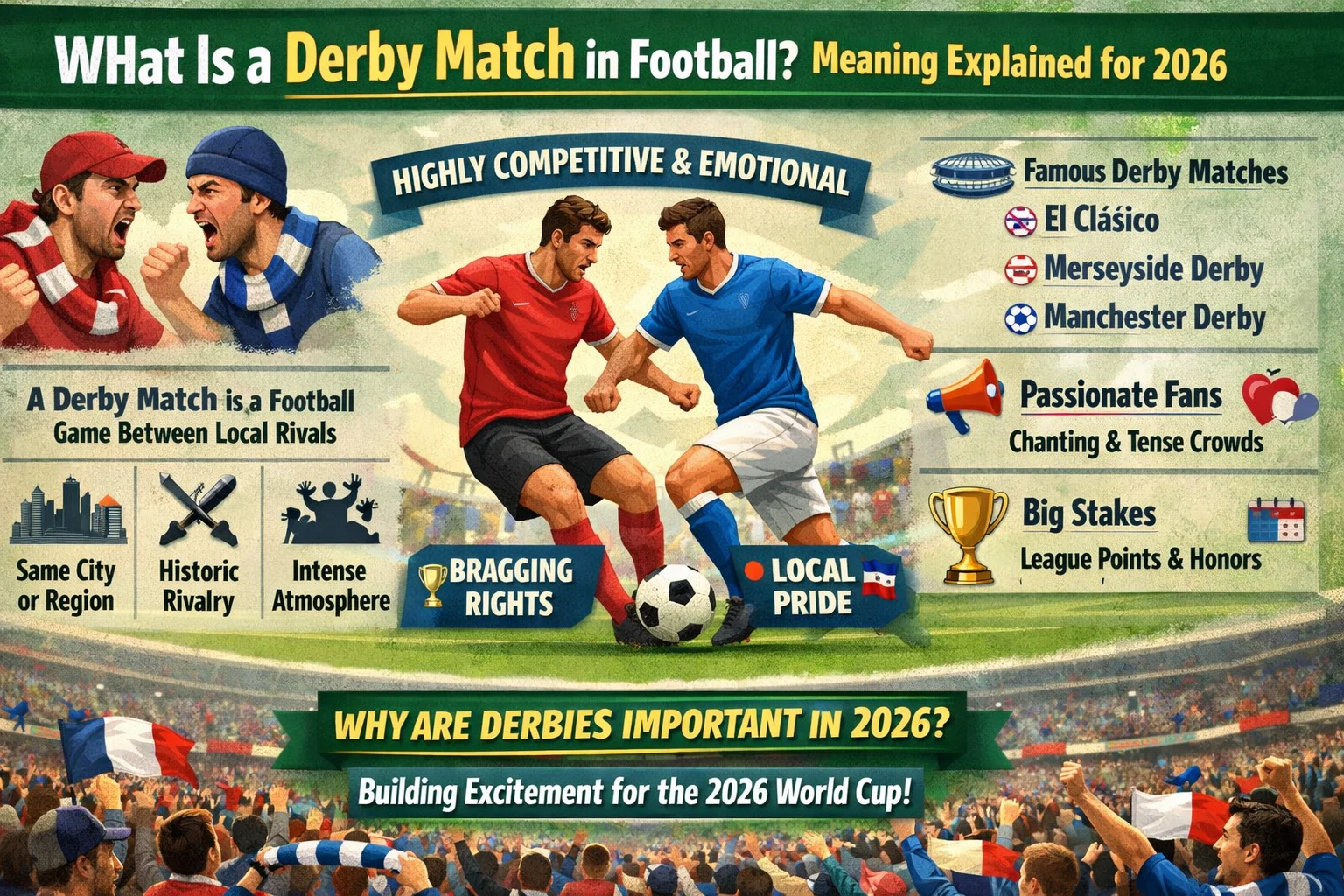
Quick Answer: A derby match in football refers to a fixture between two clubs that share a strong local, regional, or historical rivalry, most commonly clubs based in the same city, though the term is also used more broadly for any fixture carrying intense, long-standing significance beyond a typical league game.
League position stops mattering the moment a derby kicks off. A last-place team can beat a title contender, form goes out the window, and for ninety minutes, bragging rights over the entire city are genuinely on the line. Few words in football carry as much emotional weight packed into so few letters as “derby,” yet the term’s own origin has nothing to do with football at all, tracing back instead to a completely different sport entirely.
This guide explains exactly what is a derby match in football, where the unusual term actually comes from, the different categories of derbies that exist, and some of the most intense local rivalries the sport has ever produced across different countries and footballing cultures.
What Exactly Makes a Match a “Derby”?
At its core, a derby is defined by geographic and historical proximity rather than by any official competition rule or governing body classification. Most commonly, it describes a match between two clubs based in the same city or metropolitan area, such as Liverpool versus Everton or Inter Milan versus AC Milan. However, the term has expanded over time to include regional rivalries between clubs from nearby but distinct towns or cities, and occasionally even rivalries rooted more in historical or political tension than strict geography, blurring the line between a traditional derby and a broader footballing rivalry.
Where Does the Word “Derby” Actually Come From?
Despite its deep association with football, the term didn’t originate on a football pitch at all. It traces back to the Derby, a famous annual horse race first run in 1780 at Epsom Downs in England, named after Edward Smith-Stanley, the 12th Earl of Derby, who helped establish the event alongside fellow racing enthusiasts of the era. Over time, “Derby Day” became shorthand in British culture for any major, highly anticipated sporting occasion drawing significant public attention. By the late 1800s and early 1900s, the term had been adopted into football specifically to describe intensely anticipated local rivalry matches, eventually becoming the standard term used across English-speaking football and, later, much of the football world more broadly through translation and cultural adoption.
Types of Football Derbies
Not all derbies are structured the same way, and football fans generally recognize several distinct categories, each with its own defining characteristics beyond simple geographic proximity:
City Derbies
The most classic form, involving two clubs based in the same city, such as the Manchester Derby (Manchester United vs. Manchester City) or the Merseyside Derby (Liverpool vs. Everton).
Regional Derbies
Matches between clubs from nearby towns or a shared geographic region, even without sharing the exact same city, such as various derbies across northern England or Spain’s Basque region.
Political or Historical Derbies
Rivalries shaped less by pure geography and more by deep political, religious, or historical tension, such as the Old Firm derby between Celtic and Rangers in Glasgow, closely tied to religious and cultural divides in Scotland.
National Derbies (Clásicos)
Matches between a country’s two most historically dominant clubs, regardless of geographic distance, such as El Clásico between Real Madrid and Barcelona, sometimes referred to separately from a traditional “derby” due to the larger geographic gap involved.
Derby vs. Rivalry: Is There a Difference?
While the terms are often used interchangeably in everyday football conversation, there’s a subtle distinction worth noting for accuracy. “Derby” typically implies a geographic connection, whether a shared city, region, or country. “Rivalry” is a broader term that can apply to any two clubs with a significant history of competition, tension, or repeated high-stakes meetings, even without any geographic proximity at all separating them. Every derby is technically a rivalry, but not every rivalry qualifies as a derby in the strictest, geographically grounded sense of the term.
Why Are Derbies So Intensely Emotional?
Derbies carry a unique emotional weight compared to standard league fixtures, largely because the stakes extend well beyond typical league standings or points accumulated over a season. For fans, a derby often represents a direct, personal contest for local identity and pride, with the result determining bragging rights among friends, family, and coworkers who may support the opposing club for years afterward. This heightened emotional investment frequently translates into matches played at a significantly higher intensity than usual, with players themselves often citing derbies as some of the most physically and mentally demanding fixtures of an entire season, regardless of either club’s broader form or league position at the time of kickoff.
Derby Matches: Quick Reference Table
The table below summarizes how different derby categories are typically classified within football culture.
| Derby Type | Example | Defining Factor |
|---|---|---|
| City Derby | Manchester United vs. Manchester City | Same city |
| Regional Derby | Athletic Bilbao vs. Real Sociedad | Shared region |
| Political/Historical Derby | Celtic vs. Rangers (Old Firm) | Religious/cultural divide |
| National Derby (Clásico) | Real Madrid vs. Barcelona | National dominance, not geography |
Some of the World’s Most Intense Derbies
Football has produced no shortage of legendary rivalries across different continents and footballing cultures, each carrying its own distinct history and character:
- Old Firm Derby (Scotland) — Celtic vs. Rangers, deeply rooted in religious and political divisions within Glasgow and broader Scottish society for over a century.
- Superclásico (Argentina) — Boca Juniors vs. River Plate, widely regarded as one of the most passionate derbies anywhere in world football, drawing intense national attention.
- Merseyside Derby (England) — Liverpool vs. Everton, historically known for a relatively family-friendly atmosphere despite the intensity, given the number of mixed-support households in the city.
- Milan Derby (Italy) — AC Milan vs. Inter Milan, two clubs sharing the same stadium, adding a unique layer to their fierce, decades-long rivalry.
- Eternal Derby (Serbia) — Red Star Belgrade vs. Partizan Belgrade, one of several rivalries across Eastern Europe and the Balkans informally referred to using the “Eternal Derby” naming convention.
How Clubs and Cities Prepare for Derby Day
Derby matches require significantly more logistical and security planning than a typical fixture, given the heightened emotional intensity among supporters on both sides. Police forces in cities with historically intense derbies often coordinate closely with both clubs well in advance, managing segregated supporter sections, adjusted policing levels, and, in some particularly volatile rivalries, restrictions on away supporter attendance entirely. Local businesses, particularly pubs and restaurants near the stadiums, frequently see derby day as one of the busiest and most commercially significant days of the entire football calendar, reflecting how deeply embedded these fixtures become in a city’s broader social and economic rhythm well beyond the football-specific audience.
Derbies at the Youth and Academy Level
The intensity associated with derby matches isn’t confined to first-team football alone. Youth academy fixtures between historic rivals often carry a surprising amount of the same emotional weight, with young players growing up acutely aware of a rivalry’s significance well before they ever play in a first-team derby themselves. Coaches at academy level sometimes specifically use these early exposure matches as a development tool, helping young players build composure under the heightened pressure and atmosphere that derby fixtures create, recognizing that the ability to perform under this specific kind of intensity is a skill that transfers directly to first-team football later in a player’s career.
How Derbies Shape Club Identity and Fan Culture
Beyond the 90 minutes on the pitch, derby rivalries play a significant role in shaping a club’s broader identity, matchday traditions, and supporter culture over generations. Chants, banners, and specific matchday rituals often develop specifically around derby fixtures, becoming as much a part of a club’s cultural identity as its official crest or colors. For many supporters, their first derby experience, whether attending in person or watching with family, becomes a formative memory in their relationship with the club, reinforcing derbies as generational touchpoints that extend the rivalry’s significance well beyond any single result or season.
How Derbies Influence Transfer Decisions
The intensity surrounding derby rivalries occasionally extends into the transfer market itself, with players sometimes facing significant scrutiny or backlash from supporters when moving directly between two fierce local rivals. Such transfers, while relatively rare, tend to generate substantial media attention and fan controversy, given how directly they challenge the loyalty and identity typically associated with supporting one side of a historic rivalry. Clubs are often acutely aware of this dynamic when negotiating transfers involving a direct rival, sometimes factoring in the potential fan reaction alongside purely footballing and financial considerations before finalizing a deal that could see a player switch allegiances within the same fiercely contested local rivalry.
Frequently Asked Questions
The following questions cover the most common points of curiosity fans have about derby matches and their cultural significance.
What is a derby match in football? A derby match is a fixture between two clubs sharing a strong local, regional, or historical rivalry, most commonly clubs based in the same city or metropolitan area.
Where does the term “derby” come from? The term originated from the Derby horse race first run in 1780 at Epsom Downs, later adopted into football to describe major, highly anticipated rivalry matches worldwide.
Is El Clásico considered a derby? El Clásico is sometimes classified separately as a “national derby” or clásico, since it involves two clubs from different, distant cities rather than sharing the same immediate geographic area.
What is the difference between a derby and a rivalry? A derby typically implies geographic proximity, while a rivalry is a broader term that can apply to any two clubs with significant tension, regardless of physical location.
Why are derby matches considered unpredictable? Derbies are widely considered unpredictable because emotional intensity and local pride often outweigh current league form, frequently producing results that defy expectations based purely on league standing.
What is the Old Firm derby? The Old Firm derby refers to matches between Celtic and Rangers in Glasgow, Scotland, one of football’s most intense rivalries due to deep religious and political divisions.
Do derby matches require extra security compared to normal fixtures? Yes, cities with historically intense derbies often coordinate closely with police forces for enhanced security planning, segregated supporter sections, and, in some cases, restrictions on away supporter attendance.
Are derby rivalries present at youth academy level too? Yes, youth fixtures between historic rivals often carry significant emotional weight, with academies sometimes using these matches specifically to help young players develop composure under heightened pressure.
Conclusion
So, what is a derby match in football? At its simplest, it’s a fixture defined by proximity and history rather than league position, carrying an emotional weight that regularly turns routine matches into some of the most unpredictable, passionately contested games in the sport, shaping club identity and fan culture across generations. From Manchester to Glasgow to Buenos Aires, derbies remain a reminder that football, at its core, is often less about tactics and more about identity, pride, and community. Want to explore more football terminology? Check out our guide on What Is a Clásico in Football for a deeper look at one of the sport’s most historically significant rivalries.

Daniel Brooks is a sports writer at SportsOrbitX.com, specializing in football, basketball and global sports news. He focuses on delivering accurate reporting, match analysis and timely updates that keep fans informed.