Quick Answer: The 2026 World Cup featured 12 groups of four teams in the group stage, followed by a five-round knockout stage (Round of 32, Round of 16, Quarterfinals, Semifinals, Final). Spain won the tournament, beating France 2-0 in the semifinal and Argentina 1-0 in the final, while England defeated France 6-4 in the third-place playoff.
Forty-eight teams, twelve groups, and a month and a half of football later, only two nations were left standing at MetLife Stadium. Getting there meant surviving a group stage unlike any before it, followed by an extra knockout round never previously used at a World Cup. Here’s exactly how every team was grouped, and how the tournament’s business end unfolded from the Round of 32 through to the final whistle in New Jersey.
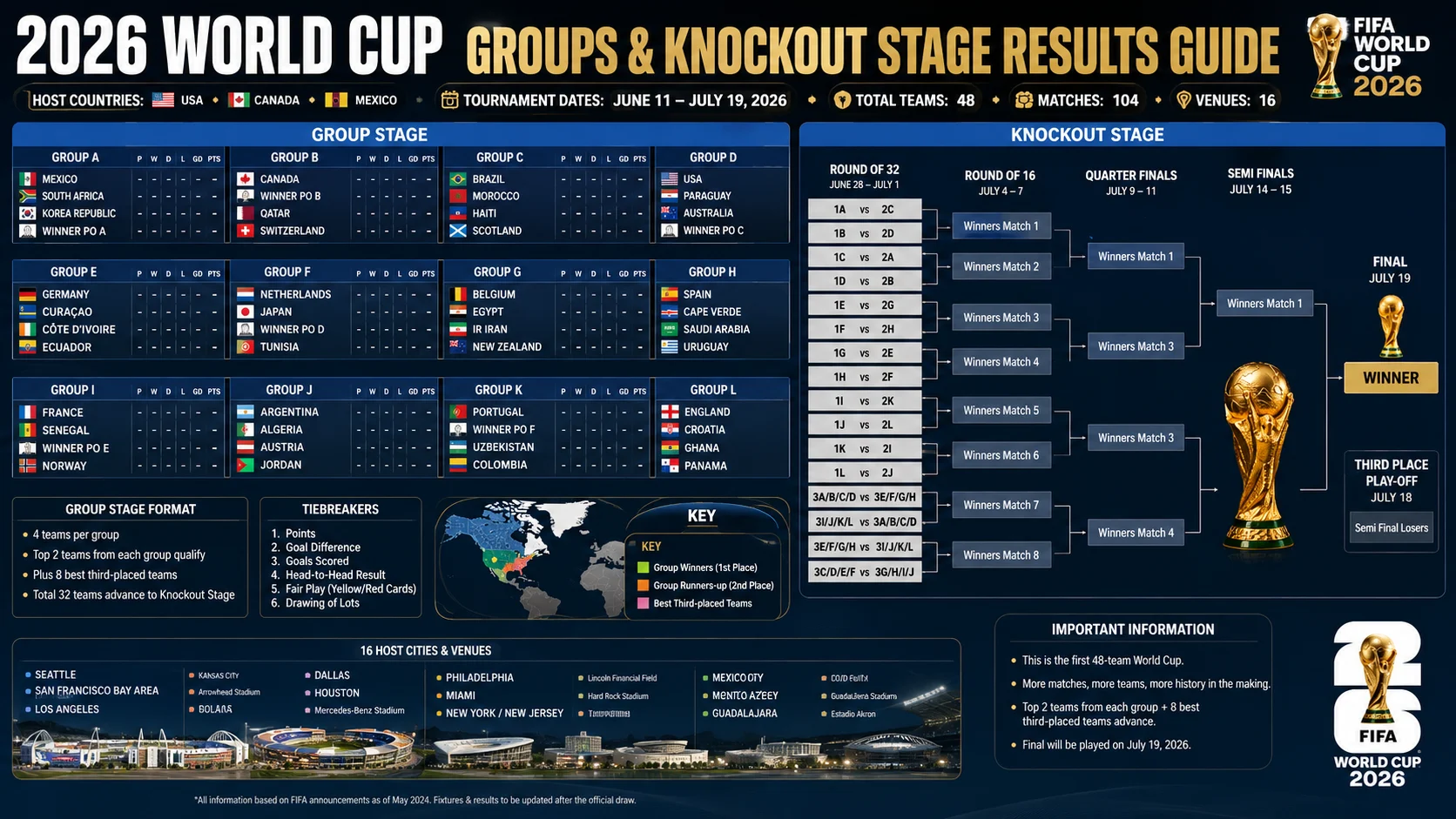
This guide covers the complete group stage draw for the 2026 FIFA World Cup, followed by a full breakdown of the knockout stage results, from the newly introduced Round of 32 through to the final in New Jersey.
The 2026 World Cup Groups: Full Breakdown
The 48 qualified teams were drawn into 12 groups of four at the Kennedy Center in Washington, D.C. on December 5, 2025. Each team played three group matches, with the top two finishers from every group advancing automatically to the Round of 32, joined by the eight best third-place teams to complete the 32-team knockout field.
| Group | Teams |
|---|---|
| Group A | Mexico, South Africa, South Korea, Czechia |
| Group B | Canada, Switzerland, Qatar, Bosnia and Herzegovina |
| Group C | Brazil, Morocco, Scotland, Haiti |
| Group D | United States, Paraguay, Australia, Turkey |
| Group E | Germany, Curaçao, Ivory Coast, Ecuador |
| Group F | Netherlands, Japan, Tunisia, Sweden |
| Group G | Belgium, Egypt, Iran, New Zealand |
| Group H | Spain, Cabo Verde, Saudi Arabia, Uruguay |
| Group I | France, Senegal, Norway, Iraq |
| Group J | Argentina, Algeria, Austria, Jordan |
| Group K | Portugal, Colombia, Uzbekistan, DR Congo |
| Group L | England, Croatia, Ghana, Panama |
Mexico opened the tournament on June 11 at Estadio Azteca, hosting South Africa in Group A’s opening fixture, 16 years to the day after Mexico’s opener against the same opponent at the 2010 World Cup.
Notable Group Stage Storylines
The expanded format produced several standout narratives before the knockout stage even began. Argentina cruised through Group J with wins over Algeria (3-0), Austria (2-0), and Jordan (3-1), while Cabo Verde’s run through Group H captured global attention as one of the tournament’s clearest underdog stories, given the island nation’s population of roughly 500,000. Both Brazil and Portugal, two of the sport’s traditional powerhouses, suffered notable setbacks during the tournament, with Brazil losing to Norway and Portugal eventually eliminated by Spain, results that reshaped the perceived favorites heading into the knockout rounds.
Round of 32: The Newly Introduced Round
For the first time in World Cup history, the knockout stage began with a Round of 32 rather than a Round of 16, a direct result of the tournament’s expansion to 48 teams. Running from June 28 to July 3, this new round matched group winners and runners-up against third-place qualifiers and each other across the tournament’s 16 host cities. Confirmed Round of 32 fixtures included Argentina defeating Cabo Verde, Egypt eliminating Australia on penalties, Switzerland beating Algeria, Portugal defeating Croatia, and Canada progressing past South Africa, among the round’s 16 total matches that trimmed the field to the final 16 teams.
Round of 16: Setting Up the Quarterfinals
The Round of 16, played from July 4 to July 7, further narrowed the field, with several results directly shaping the shortened path to the final. Belgium eliminated co-host nation the United States with a 4-1 victory, ending the American side’s tournament run in front of home supporters. Morocco continued their strong run by defeating Canada, setting up a quarterfinal meeting with France, a rematch of the two nations’ 2022 semifinal encounter.
Quarterfinals: Four Results, Four Semifinalists
The quarterfinals, played July 9 to July 11, delivered some of the tournament’s most dramatic moments, with two matches requiring extra time to separate the sides:
- France 2-0 Morocco — France secured their spot in the last four with a comfortable victory over Morocco, avenging their tight 2022 semifinal meeting between the two nations.
- Spain 2-1 Belgium — A late substitute contribution in the 88th minute proved decisive as Spain’s defense, the tournament’s stingiest, held firm to advance.
- England 2-1 Norway (after extra time) — Jude Bellingham scored twice, including a decisive extra-time goal, to send England through in a genuine thriller.
- Argentina 2-1 Switzerland (after extra time) — Julián Álvarez and Lautaro Martínez scored in extra time to complete a dramatic Argentine comeback after Switzerland had equalized in the second half.
Semifinals: Spain and Argentina Book Their Final Spot
Played on July 14 and 15, the semifinals produced two contrasting results that set up the tournament’s championship match:
Spain 2-0 France (AT&T Stadium, Arlington, July 14) — Spain delivered a commanding performance, built on early goals in each half and the tournament’s best defensive record, denying France a third consecutive World Cup final appearance.
Argentina 2-1 England (Mercedes-Benz Stadium, Atlanta, July 15) — England led 1-0 deep into the match before Argentina scored twice in the final minutes, with Lautaro Martínez netting the winner to complete another dramatic comeback for the defending champions.
Third-Place Playoff: England 6-4 France
Played on July 18 in Miami Gardens, the third-place match delivered ten combined goals in a genuinely wild finish. Bukayo Saka scored a hat-trick for England, with Jude Bellingham sealing the win in stoppage time. Kylian Mbappé scored twice for France in the defeat, a result that nonetheless confirmed him as the World Cup’s all-time leading scorer across his three tournament appearances.
The Final: Spain 1-0 Argentina
Spain completed their tournament with a 1-0 extra-time victory over Argentina at MetLife Stadium on July 19, with Ferran Torres scoring the only goal of the match in the 106th minute. The result secured Spain’s second World Cup title and denied Argentina the chance to become the first repeat champion since Brazil in 1962.
2026 World Cup: Knockout Stage Results Summary
| Round | Dates | Key Result |
|---|---|---|
| Round of 32 | June 28 – July 3 | Argentina, Egypt, Switzerland, Portugal, Canada advance among others |
| Round of 16 | July 4 – July 7 | Belgium 4-1 USA; Morocco def. Canada |
| Quarterfinals | July 9 – July 11 | France 2-0 Morocco; Spain 2-1 Belgium; England 2-1 Norway (AET); Argentina 2-1 Switzerland (AET) |
| Semifinals | July 14 – July 15 | Spain 2-0 France; Argentina 2-1 England |
| Third-Place Playoff | July 18 | England 6-4 France |
| Final | July 19 | Spain 1-0 Argentina (AET) |
How the Expanded Knockout Format Changed the Tournament
Prior to 2026, the World Cup’s knockout stage had begun with a Round of 16 since the tournament expanded to 32 teams in 1998. The introduction of a Round of 32 meant the eventual champion had to win one additional match compared to every previous 32-team World Cup, a change that tested squad depth and fitness management more significantly than any prior tournament. Coaches were forced to balance rotation across the longer competition with maintaining momentum heading into the business end of the knockout rounds, with several teams citing fatigue management as a key factor in their late-tournament performances, particularly during matches that required extra time.
Individual Performances That Defined the Knockout Stage
Beyond the team results themselves, several individual performances stood out across the knockout rounds. Jude Bellingham’s extra-time goal against Norway in the quarterfinal, following an earlier equalizer just before halftime, highlighted his growing reputation as one of England’s most important players on the biggest stage. Lautaro Martínez’s late winners in both the quarterfinal against Switzerland and the semifinal against England cemented his status as Argentina’s most reliable source of goals during the tournament’s most pressurized moments. Kylian Mbappé’s two goals in the third-place playoff, meanwhile, secured his place as the World Cup’s all-time leading scorer, a fitting personal milestone even in a match that ended in defeat for France.
Why the Round of 32 Draw Mattered So Much
With 32 teams reaching the knockout stage, the specific pairings determined by group finishing position carried significant weight in shaping each team’s path toward the final. Group winners were generally positioned to face third-place qualifiers or runners-up from other groups in the Round of 32, theoretically offering a smoother opening knockout match compared to facing another group winner. This bracket structure meant that strong group-stage performances didn’t just secure qualification, but also meaningfully influenced the difficulty of a team’s route through the remainder of the tournament, rewarding consistency across all three group matches rather than simply squeezing through to the next round.
Frequently Asked Questions
How many groups were in the 2026 World Cup? The 2026 World Cup featured 12 groups of four teams each, labeled A through L, with the top two from every group advancing automatically to the Round of 32.
Which group was Argentina in at the 2026 World Cup? Argentina competed in Group J alongside Algeria, Austria, and Jordan, winning all three of their group matches to top the group.
What was the score of the 2026 World Cup final? Spain defeated Argentina 1-0 after extra time in the final, with Ferran Torres scoring the winning goal in the 106th minute.
Who did England lose to in the semifinals? England lost 2-1 to Argentina in the semifinal, having led 1-0 before Argentina scored twice in the final minutes of the match.
What was the score of the third-place playoff? England defeated France 6-4 in the third-place playoff, with Bukayo Saka scoring a hat-trick and Kylian Mbappé scoring twice for France.
Why did the 2026 World Cup have a Round of 32? The Round of 32 was introduced for the first time due to the tournament’s expansion to 48 teams, adding an extra knockout round compared to previous editions.
How did group finishing position affect a team’s knockout path? Group winners were generally positioned to face third-place qualifiers or runners-up from other groups in the Round of 32, meaning strong group-stage performances often led to a theoretically smoother opening knockout match.
Which teams provided the biggest upsets during the knockout stage? Belgium’s 4-1 win over co-host United States and Norway pushing England to extra time in the quarterfinal were among the tournament’s most talked-about knockout stage results.
Conclusion
From twelve groups spanning three host nations to a Round of 32 never previously seen at a World Cup, the 2026 tournament’s path to the final tested every team more thoroughly than any prior edition. Spain’s run through this expanded field, capped by a commanding semifinal win over France and a hard-fought final victory over Argentina, stands as a fitting champion’s story for the biggest World Cup ever held, one shaped as much by the tournament’s new format as by the players themselves. Want the complete overview of the tournament? Check out our guide on 2026 FIFA World Cup: The Complete Tournament Guide for the full picture.

Emily Parker is a sports journalist at SportsOrbitX.com with a passion for covering cricket, tennis and major international sporting events. She is committed to producing clear, reliable and engaging content for sports enthusiasts worldwide.