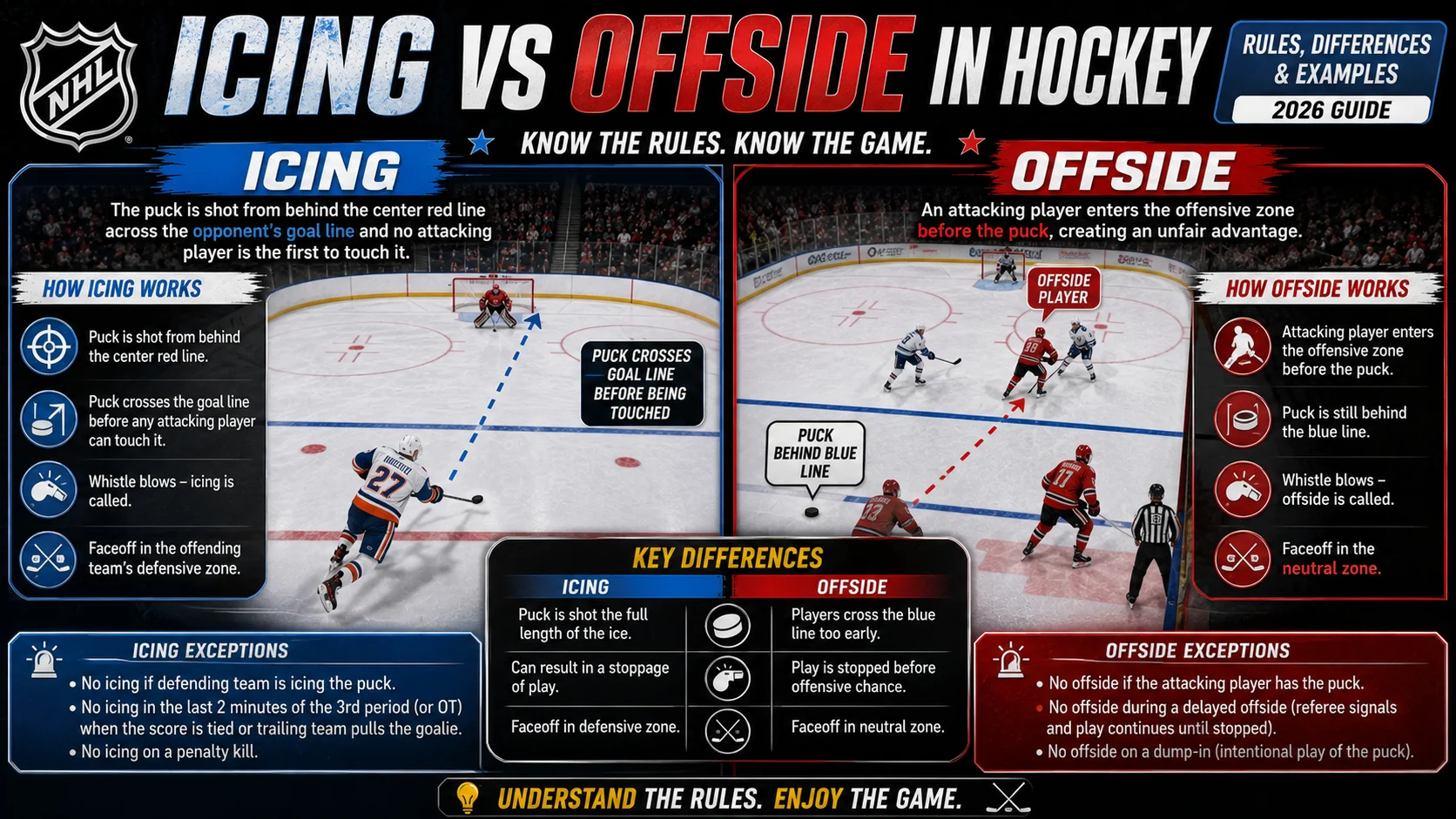
Icing stops an illegal long-distance puck shot, while offside happens when an attacking player enters the offensive zone before the puck.
Icing vs Offside
The easiest way to remember the difference is this:
Icing = where the puck is shot.
Offside = when the player enters the offensive zone.
Icing generally occurs when a team shoots the puck from its own half of the ice all the way past the opponent’s goal line without another player touching it. Offside occurs when an attacking player precedes the puck into the offensive zone.
So, if you’re watching hockey and wondering why the official stopped play, look at the puck’s journey for icing and the blue line for offside.
Icing vs Offside at a Glance
| Rule | Icing | Offside |
|---|---|---|
| Main issue | Puck is sent too far down the ice | Player enters offensive zone too early |
| Key area | Center red line and goal line | Blue line |
| What causes it? | Puck crosses the opponent’s goal line from the team’s half | Attacking player precedes the puck into the zone |
| Main purpose | Prevent teams from simply dumping the puck away to escape pressure | Keep attacking play fair and prevent players from cherry-picking |
| Typical result | Play stops and faceoff follows | Play stops or becomes delayed, depending on the situation |
| Easy memory trick | Long puck | Early player |
What Is Icing in Hockey?
Icing is a rule designed to prevent a team from simply firing the puck the length of the ice to escape pressure.
In the NHL, a team at equal or greater numerical strength cannot shoot, bat, or deflect the puck from its own half of the ice beyond the opponent’s goal line without the play being stopped, subject to the rule’s exceptions.
In practical terms, imagine a defenseman is under heavy pressure in his own zone. Instead of making a controlled pass, he launches the puck all the way down the rink.
If the puck crosses the opposing goal line untouched, the officials can call icing.
The result is a stoppage and a faceoff back in the offending team’s defensive end.
Why Does Hockey Have an Icing Rule?
Without icing, a team under pressure could repeatedly shoot the puck 150 feet down the ice whenever it wanted a break.
That would make defensive play too easy.
Icing encourages teams to find legitimate ways to move the puck out of trouble rather than simply launching it as far as possible.
It also creates an important tactical decision: clear the zone safely, or try to make a controlled play?
What Is Offside in Hockey?
Offside is about the relationship between the attacking player and the puck as the puck enters the offensive zone.
The basic idea is simple:
The puck must enter the attacking zone before the attacking player does.
The blue line is the critical boundary.
If an attacking player crosses into the offensive zone ahead of the puck and is still involved in the play, the officials can call offside.
The NHL’s current rulebook also recognizes possession and control situations. For example, a player who is actually controlling the puck can cross the line ahead of the puck without being considered offside, provided the player had possession and control before the skates crossed the leading edge of the blue line.
The Simplest Way to Understand Offside
Picture a forward skating toward the opponent’s net.
The forward crosses the blue line.
But the puck is still outside the offensive zone.
That’s the problem.
The player has entered the zone before the puck.
Offside.
Now reverse the sequence:
The puck crosses the blue line first.
The forward enters immediately afterward.
Onside.
This is why hockey fans often watch the puck and the player’s skates at the blue line when determining whether a play is legal.
Icing vs Offside: The Biggest Difference
The difference comes down to what caused the stoppage.
Icing Is About Distance
The puck is sent from one half of the rink all the way beyond the opponent’s goal line.
Think:
Defense → long shot → opponent’s goal line → icing
Offside Is About Timing and Position
The attacking player enters the offensive zone before the puck.
Think:
Player enters → puck hasn’t entered yet → offside
That’s the distinction worth remembering.
Icing is primarily a puck-travel rule. Offside is primarily a zone-entry rule.
Icing Example
A defenseman has the puck near his own blue line.
He is under pressure and shoots it down the entire length of the ice.
Nobody touches the puck.
It crosses the opponent’s goal line.
If the applicable icing conditions are met, the linesman stops play for icing.
The attacking team then gets a faceoff in the offending team’s end zone.
Under NHL rules, the attacking team has a choice of which end-zone faceoff dot to use following an icing.
Offside Example
A winger is skating toward the attacking blue line.
The puck carrier is slightly behind.
The winger crosses the blue line first.
The puck crosses the line a moment later.
If the attacking player was ahead of the puck when entering the zone and the applicable conditions for offside are present, the play is offside.
The important detail is that the puck must establish the zone entry before the attacking players do.
What Is Delayed Offside?
This is where hockey can become confusing.
A team can sometimes enter the offensive zone while technically offside, but the officials do not immediately stop play.
Instead, the team can tag up by having its attacking players leave the offensive zone.
If they completely clear the zone and then re-enter legally, play can continue.
This is known as delayed offside.
The NHL’s official video rulebook specifically includes separate explanations for offside and delayed offside.
Simple Delayed Offside Example
A forward enters the attacking zone before the puck.
The linesman signals delayed offside.
Instead of playing the puck, the attacking players skate back across the blue line.
Once they have cleared the zone, the team can re-enter with the puck legally.
This gives the attacking team a chance to correct the positioning without immediately stopping play.
Can a Goal Be Disallowed for Offside?
Yes.
This is one reason offside reviews can become so important.
If a goal is scored and video review conclusively shows that an attacking player entered the zone before the puck, the goal can be overturned.
Recent NHL Situation Room decisions continue to demonstrate this. In October 2026, several goals were overturned after video review determined that attacking players preceded the puck into the offensive zone.
The NHL’s review standard is demanding: the original call is overturned only when the review provides conclusive and irrefutable evidence that the call was incorrect.
Can Icing Be Called on a Power Play?
This is an important exception.
Under NHL rules, icing is generally not called against a team that is shorthanded because of a penalty. The numerical-strength provisions of Rule 81 specifically address when icing does and does not apply.
That’s why you may see a penalty-killing team fire the puck down the ice without receiving an icing call.
However, the exact situation matters, so the official rule should be consulted for unusual circumstances.
What Happens After an Icing Call?
An icing violation results in a faceoff.
The defending team is placed under additional pressure because the puck comes back into its defensive zone rather than giving the team a chance to reset at center ice.
Another important consequence is that an NHL team that commits icing generally cannot make a normal player substitution before the ensuing faceoff, with specific exceptions.
That makes icing more than just a stoppage.
It can become a strategic penalty without being a traditional minor penalty.
A tired defensive unit may be forced to remain on the ice against a fresh group of attackers.
What Happens After an Offside Call?
After an offside stoppage, the faceoff location depends on the circumstances and the applicable NHL rules.
The key difference from icing is that offside does not necessarily punish a team for sending the puck too far.
Instead, it stops an attacking play that entered the offensive zone illegally.
Icing vs Offside: Which Is More Serious?
Neither is simply “more serious” in every situation.
Both are violations that stop or affect play, but their strategic consequences can differ.
Icing can be especially costly late in a shift because the offending team may be unable to change its players before the faceoff.
Offside can be especially costly when a team is attacking, particularly if it interrupts a dangerous scoring opportunity.
And when an offside violation is discovered during review after a goal, the consequence can be even bigger: the goal can be disallowed.
Icing vs Offside vs Penalty
Another common misunderstanding is assuming icing and offside are penalties in the same sense as tripping, hooking, or slashing.
They aren’t.
| Situation | What It Is | Typical Consequence |
|---|---|---|
| Icing | Game-flow violation | Stoppage + defensive-zone faceoff |
| Offside | Game-flow violation | Stoppage/delayed play + faceoff |
| Tripping | Penalty | Player may serve penalty time |
| Hooking | Penalty | Player may serve penalty time |
| High-sticking | Can be a penalty depending on circumstances | Possible penalty |
Icing and offside are primarily game-flow rules, while penalties generally involve prohibited physical or equipment-related actions.
How to Remember Icing and Offside
Here’s the easiest memory trick:
Icing = Ice Length
Think about the puck traveling the length of the ice.
If a team simply sends the puck from its half all the way past the opponent’s goal line, think icing.
Offside = Offensive Zone
Think about the offensive blue line.
If an attacking player enters before the puck, think offside.
One-Line Memory Trick
Icing is about the puck going too far; offside is about the player going in too early.
That one sentence solves most beginner confusion.
Icing vs Offside: Real-Game Decision Guide
When you’re watching a hockey game, ask these questions:
Did the puck travel from the team’s own half all the way beyond the opponent’s goal line?
If yes, check for icing.
Did an attacking player enter the offensive zone before the puck?
If yes, check for offside.
Did the attacking players enter early but then completely clear the zone?
That may be delayed offside, allowing play to continue if the team properly tags up.
Frequently Asked Questions
What is the difference between icing and offside in hockey?
Icing concerns a puck being shot from a team’s own half beyond the opponent’s goal line without a qualifying touch. Offside concerns an attacking player entering the offensive zone before the puck.
Is icing worse than offside?
Not necessarily. Both stop attacking momentum, but icing can be particularly costly because the team that iced the puck may be unable to make a normal line change before the faceoff.
Why do hockey players shoot the puck down the ice?
Players may dump the puck to relieve pressure, create a forechecking opportunity, or change the location of play. If the puck is sent all the way beyond the opposing goal line under circumstances covered by the icing rule, it can result in an icing call.
Why isn’t icing called every time the puck crosses the goal line?
There are exceptions to the icing rule. For example, certain deflections by an opponent can nullify icing, and the NHL rules contain specific provisions concerning short-handed teams, goalkeepers, and whether an opposing player could reasonably have played the puck.
Can offside be reviewed in the NHL?
Yes. Offside plays involving a goal can be subject to video review under the NHL’s review procedures. Recent NHL games have shown goals overturned when video conclusively established that an attacking player preceded the puck into the zone.
What line determines offside?
The blue line determines whether a player has legally entered the attacking zone.
What line matters for icing?
The center red line is important in determining whether the puck was propelled from the team’s own half, while the opposing goal line determines whether the puck has traveled far enough for icing to potentially apply.
What is delayed offside?
Delayed offside occurs when attacking players have entered the offensive zone before the puck, but the play is allowed to continue while they have an opportunity to clear the zone and tag up.
Final Verdict
Icing and offside may both stop hockey games, but they solve completely different problems.
Icing controls how far a team can send the puck from its own half, while offside controls how players enter the attacking zone.
If you remember only two things, remember this:
Icing = puck travels too far.
Offside = player enters too early.
Once you understand the center red line, goal line, blue line, and the basic order in which players and the puck enter each zone, these calls become much easier to recognize.
And that’s why the next time a linesman blows the whistle, you can look at the play and immediately ask the right question: Was it the puck’s journey—or the player’s position—that caused the stoppage?

Emily Parker is a sports journalist at SportsOrbitX.com with a passion for covering cricket, tennis and major international sporting events. She is committed to producing clear, reliable and engaging content for sports enthusiasts worldwide.