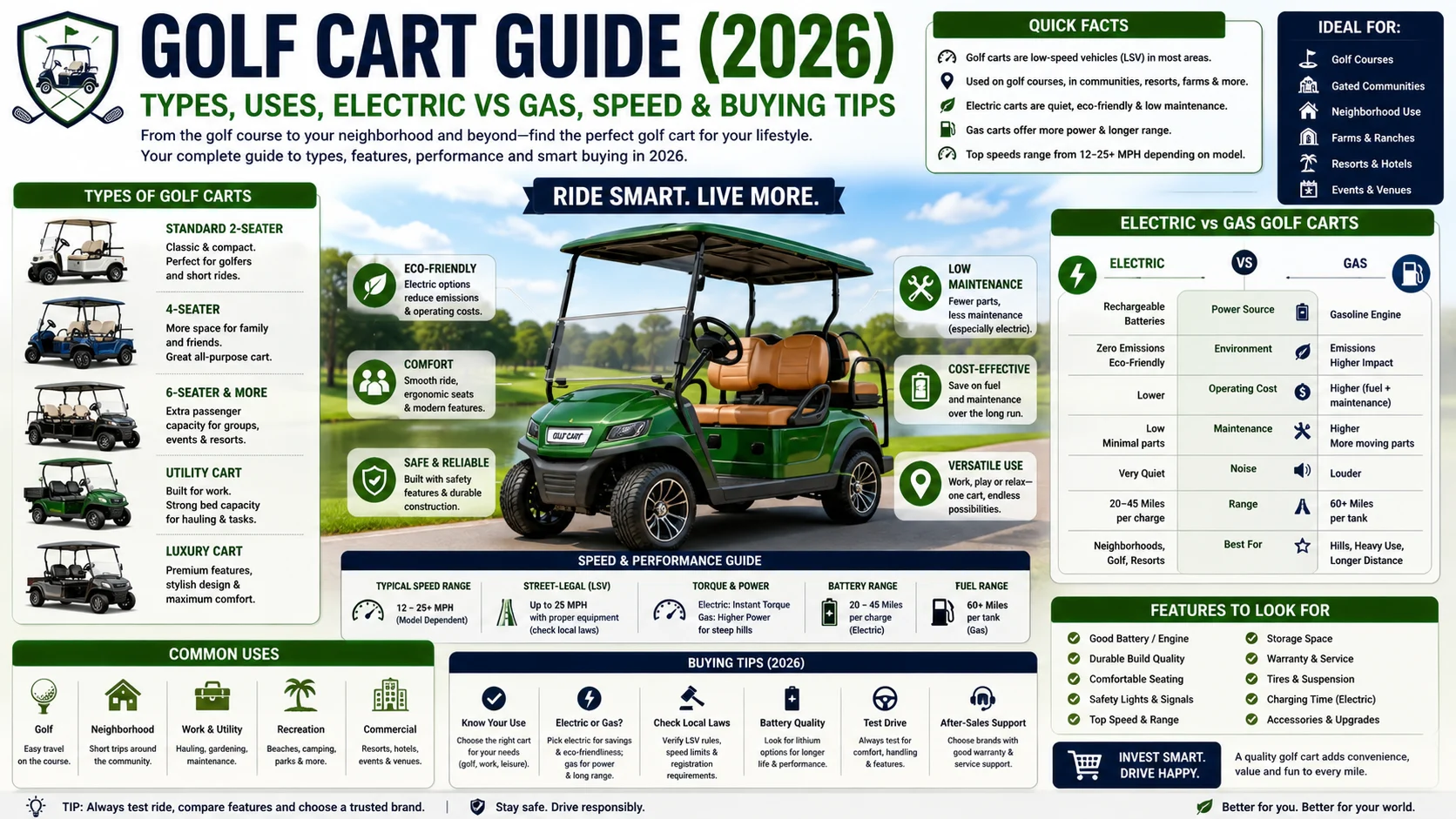
A golf cart is a compact, low-speed vehicle designed mainly to carry golfers and equipment, but modern models are also used in neighborhoods, resorts, farms, campuses, and private properties. Today’s golf carts come in electric and gas versions, with 2-, 4-, 5-, and 6-passenger configurations.
What Is a Golf Cart?
A golf cart is a small motorized vehicle originally designed to transport golfers, clubs, and other equipment around a golf course. Its compact size, tight turning radius, simple controls, and low-speed operation make it practical for short-distance transportation.
Modern golf carts have moved far beyond the fairway. Depending on the model, they can be used for neighborhood transportation, resorts, large properties, events, campuses, farms, warehouses, and utility work.
Manufacturers such as Yamaha offer golf cars in different passenger capacities and with either gasoline or electric powertrains, while Club Car offers personal, utility, and street-oriented models.
The important distinction is that a conventional golf cart is not automatically a street-legal vehicle. A cart designed for golf-course or private-property use may have very different equipment and legal requirements from a low-speed vehicle intended for public roads.
Quick Golf Cart Facts
| Feature | Typical Golf Cart Information |
|---|---|
| Main purpose | Golf courses and short-distance transportation |
| Power options | Electric or gasoline |
| Common seating | 2, 4, 5 or 6 passengers |
| Typical environment | Golf courses, private property, resorts, communities |
| Controls | Steering wheel, accelerator and brake pedal |
| Drive type | Usually rear-wheel drive |
| Main advantage | Simple, compact and convenient transportation |
| Street legality | Depends on vehicle specification and local law |
How Does a Golf Cart Work?
Although a golf cart looks simple, several systems work together to move and stop the vehicle.
An electric golf cart uses a battery pack, electric motor, controller, charger, accelerator system, brakes, and drivetrain. When you press the accelerator, the controller regulates electrical power sent to the motor.
A gas golf cart uses a small gasoline engine, fuel system, transmission or transaxle, starter system, and drivetrain.
Modern electric models can also use lithium-ion batteries rather than traditional lead-acid batteries. Yamaha, for example, has introduced golf cars using lithium-ion technology and AC motors designed to provide controlled acceleration and efficient operation.
The basic experience is simple:
Press accelerator → motor/engine produces power → drivetrain turns the wheels → cart moves
Electric vs Gas Golf Cart
One of the biggest decisions when buying a golf cart is choosing between electric and gas power.
| Feature | Electric Golf Cart | Gas Golf Cart |
|---|---|---|
| Power source | Battery | Gasoline |
| Noise | Very quiet | Louder |
| Local emissions | No tailpipe emissions | Produces exhaust |
| Refueling | Recharge battery | Fill fuel tank |
| Maintenance | Generally simpler drivetrain | Engine maintenance required |
| Best for | Neighborhoods, courses, short trips | Heavy use and longer operating periods |
| Driving feel | Smooth and quiet | Familiar engine-powered feel |
| Long-term considerations | Battery condition/replacement | Fuel and engine maintenance |
Neither powertrain is automatically right for every buyer.
For quiet neighborhood driving or golf-course use, an electric cart can be appealing. For applications where rapid refueling and sustained engine operation matter, gasoline may make more sense.
Current manufacturers offer both choices. Club Car’s personal golf-cart lineup, for example, includes gas, flooded lead-acid electric, and lithium-ion options.
How Fast Does a Golf Cart Go?
A conventional golf cart is generally built for low-speed operation rather than highway travel.
The exact speed depends on the manufacturer, model, controller, motor or engine, gearing, load, terrain, tires, and modifications.
Some modern personal golf carts are designed around speeds near 19 mph, while certain personal transportation versions can be configured differently. Yamaha’s current examples show models with different operating speeds depending on the configuration.
Golf Cart vs Low-Speed Vehicle
This distinction matters if you plan to drive on public roads.
In the United States, NHTSA defines a low-speed vehicle (LSV) as a four-wheeled motor vehicle with a speed capability of more than 20 mph but not more than 25 mph on a paved level surface, subject to the applicable federal definition and requirements. LSVs require specific safety equipment such as headlamps, stop lamps, turn signals, tail lamps, reflectors, parking brake, appropriate windshield glazing, mirrors, seat belts and a VIN.
That means you should never assume that adding lights or a windshield automatically makes an ordinary golf cart street legal.
Always check your local and state requirements before operating a golf cart on public roads.
Types of Golf Carts
Golf carts now come in several configurations.
2-Passenger Golf Cart
The traditional two-seat layout is ideal for:
- Golfers
- Couples
- Personal transportation
- Small properties
- Resorts
- Short-distance trips
A two-passenger model is usually easier to maneuver and park than larger carts.
4-Passenger Golf Cart
A four-passenger cart provides additional seating without becoming as large as some six-passenger configurations.
It works well for:
- Families
- Neighborhood transportation
- Golfing groups
- Resorts
- Private communities
- Property owners
5-Passenger Golf Cart
Five-seat golf cars are particularly useful when passenger capacity is important. Yamaha offers five-passenger configurations designed for golf-course and transportation applications.
6-Passenger Golf Cart
A six-passenger golf cart is designed for larger groups and family transportation.
The trade-off is size. A larger cart generally requires more space to store, maneuver, and turn.
Utility Golf Carts
Not every golf cart is designed to carry golfers.
Utility versions can include:
- Cargo beds
- Tool storage
- Heavy-duty suspension
- Work-focused tires
- Increased ground clearance
- Additional carrying capacity
These carts are useful on farms, campuses, resorts, maintenance properties, warehouses, and construction or landscaping sites.
Yamaha’s utility golf-car lineup, for example, includes cargo-bed designs intended to move tools, equipment, supplies, and other materials.
What Are Golf Carts Used For?
Golf remains the most obvious use, but it is no longer the only one.
Golf Courses
Golf carts reduce the walking distance between holes and allow players to carry clubs and other equipment efficiently. Manufacturers design course models around maneuverability, reliability, passenger comfort, and repeated daily use.
Neighborhoods
In communities where local regulations allow it, golf carts can be convenient for short trips.
They may be used for:
- Visiting neighbors
- Local shopping
- Community events
- Moving around large residential areas
- Traveling between nearby facilities
Resorts and Hotels
Resorts often use golf carts to transport guests, staff, luggage, and supplies across large properties.
Farms and Large Properties
A utility golf cart can make short-distance work easier when a full-size truck would be excessive.
Campuses and Events
Golf carts can also be used to move people and equipment around campuses, event venues, sports facilities, and private sites.
Are Golf Carts Street Legal?
Sometimes but not automatically.
Street legality depends on the vehicle’s classification and the laws where you live.
A standard golf cart intended for golf-course or private-property use may not meet the equipment requirements for public-road operation. A vehicle specifically manufactured or converted to meet applicable low-speed-vehicle requirements may have additional equipment.
In the U.S., NHTSA treats LSVs as a distinct category, and states or local governments can impose additional rules governing registration, licensing, insurance, road access, and operation.
Before buying a cart for road use, check:
- Local speed requirements
- Registration rules
- Driver-license requirements
- Insurance requirements
- Required lights and signals
- Seat-belt requirements
- Allowed roads and speed limits
- Whether the vehicle is actually classified as an LSV
What Should You Look for When Buying a Golf Cart?
Buying a golf cart is easier when you decide how you will actually use it first.
1. Choose the Powertrain
Decide between electric and gas based on your typical driving distance, charging access, maintenance preferences, noise requirements, and intended workload.
2. Pick the Right Seating Capacity
Do not buy a six-passenger cart if you normally travel alone or with one other person simply because it looks bigger.
Choose based on real passenger needs.
3. Check Battery Technology
For an electric cart, battery condition is one of the most important ownership factors.
If buying used, ask:
- How old is the battery?
- Is it lead-acid or lithium?
- How long does a full charge last?
- Has the battery been regularly maintained?
- Is the charger included?
- Does the cart show any charging problems?
4. Inspect the Frame and Suspension
Look underneath the cart.
Check for:
- Rust
- Cracks
- Bent components
- Worn bushings
- Damaged suspension
- Loose steering components
- Uneven tire wear
A shiny body cannot compensate for a neglected chassis.
5. Test the Brakes
The cart should stop smoothly and predictably.
Do not overlook the parking brake either.
6. Check Tires and Wheels
Look for cracking, uneven wear, damaged sidewalls, and incorrect tire sizes.
Oversized or modified wheels can also change handling and braking characteristics.
7. Consider the Terrain
Flat golf-course paths require different capabilities from steep, uneven property.
If your property has hills, ask about:
- Motor output
- Torque
- Gear ratio
- Battery capacity
- Braking performance
- Ground clearance
8. Think About Storage
Measure your garage, shed, trailer, or storage area before purchasing.
A six-passenger lifted cart may look impressive but can become frustrating if it does not fit where you intend to keep it.
New vs Used Golf Cart
Both can make sense.
A new golf cart typically offers newer technology, current features, fewer unknowns, and manufacturer/dealer support.
A used golf cart can provide value, particularly when the previous owner maintained it properly.
However, the condition of a used cart matters more than its appearance.
A used cart with a beautiful custom body but an aging battery, worn suspension, poor brakes, and neglected drivetrain may become more expensive than expected.
The smartest inspection is mechanical first, cosmetic second.
Golf Cart Maintenance Checklist
Regular maintenance can help prevent small problems from becoming expensive repairs.
Electric Golf Cart
Check:
- Battery condition
- Battery connections
- Charger operation
- Tire pressure
- Brake system
- Steering
- Suspension
- Electrical connections
- Water level if using applicable flooded lead-acid batteries
Gas Golf Cart
Also inspect:
- Engine oil
- Air filter
- Spark plug
- Fuel system
- Fuel lines
- Drive belt
- Engine cooling
- Battery
- Brakes and suspension
Always follow the maintenance schedule provided for your specific model.
Golf Cart Safety Tips
Golf carts may feel slow, but they are still motorized vehicles and can cause serious injuries in crashes or rollovers.
Follow these basic practices:
- Keep all passengers seated.
- Do not overload the cart.
- Use seat belts when equipped and required.
- Keep hands and feet inside the vehicle.
- Drive at a controlled speed.
- Slow down before turns.
- Avoid steep slopes when the cart is not designed for them.
- Never carry more passengers than the seating system allows.
- Keep children away from the controls unless they are legally permitted and properly trained to operate the vehicle.
- Do not modify the speed system without understanding the safety and legal consequences.
NHTSA has specifically noted that increasing the speed capability of a conventional golf cart can change how the vehicle is regulated and treated under federal motor-vehicle requirements.
Golf Cart Accessories Worth Considering
Depending on how you use your cart, useful accessories may include:
- Windshield
- Weather enclosure
- Rear seat
- Roof extension
- Side mirrors
- Headlights
- Turn signals
- Seat belts
- Storage compartments
- Golf bag holders
- USB charging ports
- Backup camera
- Utility cargo box
- All-terrain tires
The key is to buy accessories that solve a real problem rather than simply adding weight and complexity.
Frequently Asked Questions
What is a golf cart?
A golf cart is a small, low-speed motorized vehicle primarily designed to transport golfers and equipment. Modern golf carts are also widely used for personal, recreational, utility, resort, and property transportation.
How much does a golf cart cost?
The price varies significantly depending on the brand, seating capacity, powertrain, battery technology, features, customization, and whether the cart is new or used. Current new personal models from major manufacturers can range from the lower five figures upward, while used carts vary widely by age and condition. For example, Club Car currently lists personal models starting above $10,000 in the U.S. market.
Are electric golf carts better than gas golf carts?
It depends on the application. Electric carts offer quiet operation and can be convenient where charging is readily available. Gas carts can be useful where quick refueling and sustained operation are priorities.
How many people can ride in a golf cart?
Golf carts are available in several configurations, commonly including two-, four-, five-, and six-passenger models. Seating capacity should always match the manufacturer’s intended configuration.
Can you drive a golf cart on the road?
Sometimes. Public-road use depends on the vehicle’s classification and local laws. A conventional golf cart should not automatically be assumed to be street legal.
How long do golf cart batteries last?
Battery life depends on battery type, usage, charging habits, maintenance, climate, and storage conditions. Lithium and lead-acid batteries also have different maintenance requirements and replacement economics.
What is the difference between a golf cart and an LSV?
A conventional golf cart is generally designed for low-speed, off-road or golf-course use. An LSV is a specific motor-vehicle category with defined speed and equipment requirements. In the U.S., federal LSV rules include a speed capability above 20 mph and up to 25 mph, along with required safety equipment.
Final Thoughts
A golf cart is much more than a vehicle for getting from the first tee to the 18th green. Modern models have become versatile transportation machines for golf courses, neighborhoods, resorts, farms, campuses, and private properties.
The right cart depends on what you actually need: electric or gas, two or six seats, standard or utility configuration, golf-course use or road use.
Before buying, focus on the fundamentals powertrain, battery or engine condition, seating capacity, brakes, suspension, terrain, storage, and legal requirements. A cart that fits your lifestyle and environment will be far more useful than one chosen simply because it looks impressive.
For road use especially, verify the vehicle’s classification and local requirements before driving it on public streets. A golf cart and a street-legal low-speed vehicle may look similar, but they are not necessarily subject to the same requirements.

Daniel Brooks is a sports writer at SportsOrbitX.com, specializing in football, basketball and global sports news. He focuses on delivering accurate reporting, match analysis and timely updates that keep fans informed.