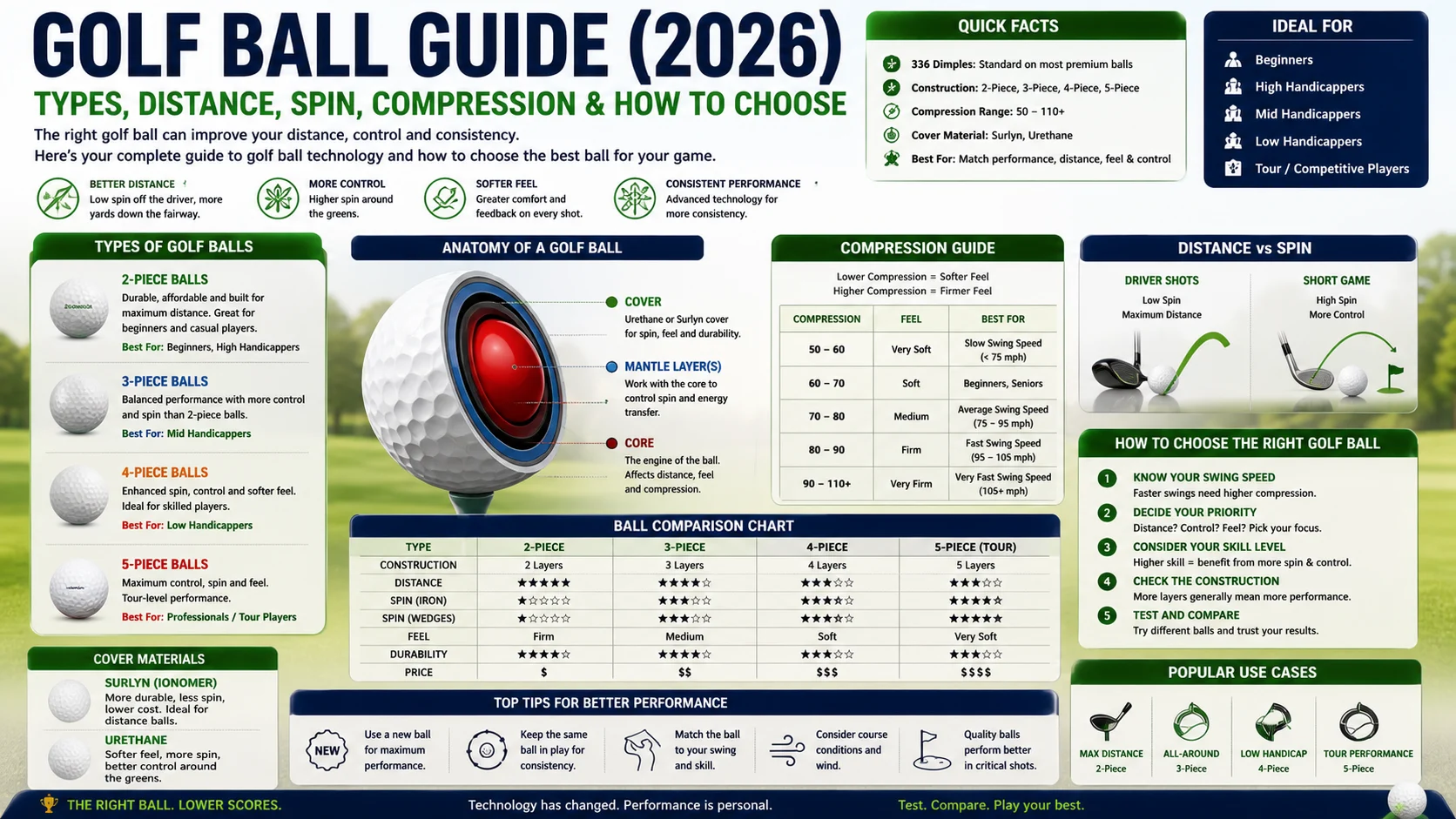
A golf ball is engineered to balance distance, speed, spin, feel, and control through its core, cover, compression, and dimple pattern. The right golf ball depends on your swing speed, skill level, short-game needs, and the type of performance you want from the tee to the green.
What Is a Golf Ball?
A golf ball is much more than a small white ball with dimples.
Modern golf balls are carefully engineered pieces of equipment designed to convert energy from the clubface into a controlled combination of ball speed, launch, spin, carry, and roll.
The construction of a golf ball can influence how it feels off the club, how quickly it leaves the driver, how much it spins with wedges, and how it behaves around the green.
That is why two golf balls that look almost identical can produce noticeably different results.
For most golfers, the biggest mistake is choosing a ball based only on brand or price. Your swing speed, ball flight, and short-game preferences matter much more.
Golf Ball Quick Facts
| Feature | Golf Ball Fact |
|---|---|
| Minimum diameter | 1.680 inches / 42.67 mm |
| Maximum legal weight | 1.620 oz / 45.93 g |
| Main purpose of dimples | Control aerodynamic flight |
| Common covers | Surlyn/ionomer and urethane |
| Common construction | 2-piece, 3-piece, 4-piece and multi-layer |
| Main performance factors | Distance, spin, feel, control |
| Best ball | Depends on the player’s swing and priorities |
Under the Rules of Golf, a conforming ball cannot weigh more than 1.620 ounces (45.93 g) and must have a diameter of at least 1.680 inches (42.67 mm).
How Does a Golf Ball Work?
When the clubface strikes the ball, an enormous amount of energy is transferred in a fraction of a second.
The golf ball then reacts through several interacting components:
Clubface → Ball compression → Ball speed → Launch → Spin → Aerodynamic flight → Carry and roll
The core provides much of the ball’s energy response. The mantle or intermediate layers help manage energy and spin, while the cover influences durability, feel, and short-game performance.
The dimples then help the ball fly efficiently through the air.
This is why golf-ball design is essentially a balance between speed and control.
What Are the Main Parts of a Golf Ball?
Core
The core is the engine of the golf ball.
It is generally made from a synthetic rubber compound and is designed to deform during impact before rapidly recovering its shape.
A softer or firmer core can change how the ball feels and responds at different swing speeds.
Mantle Layers
Multi-layer golf balls may contain one or more mantle layers between the core and cover.
These layers help engineers separate different performance characteristics for example, maintaining driver speed while producing more useful wedge spin.
Cover
The cover is the outer shell that directly interacts with the clubface.
The two major cover categories are:
- Surlyn or ionomer: generally durable and often associated with lower-cost distance-oriented balls.
- Urethane: commonly used in premium balls because it can provide a softer feel and more precise greenside spin.
Neither cover is automatically “better” for every golfer. The choice depends on what you need from the ball.
Dimples
Those small depressions covering the surface are one of the most important parts of the design.
Without dimples, a golf ball would experience dramatically different aerodynamic behavior and would not fly efficiently.
Dimple patterns are engineered to influence lift, drag, trajectory, stability, and overall flight.
Why Do Golf Balls Have Dimples?
Golf balls have dimples because dimples help the ball maintain a more efficient aerodynamic flight.
When a smooth ball travels through the air, airflow separates from its surface in a way that creates substantial drag. Dimples modify the airflow around the ball, reducing drag and helping generate aerodynamic lift.
The result is a ball that can travel significantly farther than a comparable smooth sphere.
So when you see hundreds of tiny dimples on a golf ball, they aren’t decorative.
They are part of the ball’s flight technology.
What Is Golf Ball Compression?
Compression describes how much the golf ball deforms when struck.
You will often see golf balls described as low-, mid-, or high-compression.
In general:
- Low compression: often feels softer and can suit players who prefer a softer response.
- Mid compression: aims for a versatile balance of feel and speed.
- High compression: generally produces a firmer feel and can suit golfers with higher swing speeds who prefer that response.
However, compression numbers should not be treated as a universal industry measurement.
Different manufacturers can use different testing methods, so a “70” from one brand does not necessarily feel identical to a “70” from another.
Does Swing Speed Matter?
Yes but it should not be the only factor.
A golfer’s driver swing speed can help narrow down suitable golf balls, but launch conditions, spin, contact quality, feel, and short-game performance also matter.
A ball that produces excellent driver distance but feels difficult to control around the green may not be the right overall fit.
Golf Ball Types
2-Piece Golf Balls
Two-piece balls typically combine a large core with a durable outer cover.
They are commonly designed around:
- Distance
- Durability
- Straight flight
- Affordability
They can be particularly appealing to beginners, high-disability golfers, and players who frequently lose balls.
3-Piece Golf Balls
Three-piece construction usually adds an intermediate layer between the core and cover.
This allows manufacturers to tune the ball more precisely for a combination of:
- Driver distance
- Mid-iron performance
- Wedge spin
- Feel
4-Piece and Multi-Layer Golf Balls
Multi-layer designs provide additional opportunities to control performance at different club speeds and impact conditions.
For example, a manufacturer can engineer the inner layers for speed while using outer layers to influence spin and feel.
These balls are often targeted at experienced players who can take advantage of more precise performance characteristics.
Urethane vs Surlyn Golf Balls
| Feature | Urethane | Surlyn/Ionomer |
|---|---|---|
| Feel | Softer/premium feel | Firmer feel |
| Greenside spin | Typically higher | Typically lower |
| Durability | Good but can mark more easily | Excellent |
| Price | Usually higher | Usually lower |
| Typical user | Experienced golfers | Beginners/recreational golfers |
| Main advantage | Control and feel | Distance, durability and value |
The exact performance depends on the complete ball design, not simply the cover material.
Distance vs Spin: What Should You Choose?
This is where golf-ball selection becomes interesting.
Many golfers assume that the longest golf ball is automatically the best ball.
But golf is not played only from the tee.
A ball must also perform on approach shots, chips, pitches, and putts.
A distance-focused player may prioritize:
Low driver spin + high ball speed + stable flight
A player focused on shot-making may prioritize:
Controlled driver spin + iron control + wedge spin + soft feel
The ideal combination depends on your game.
Does a More Expensive Golf Ball Go Farther?
Not necessarily.
A premium golf ball can offer more sophisticated performance characteristics, particularly around the green, but price alone does not determine distance.
A golfer who struggles with consistency may get more practical benefit from a durable, affordable ball that performs predictably than from an expensive tour-style ball that does not match their swing.
Price is not a substitute for ball fitting.
How to Choose the Right Golf Ball
1. Know Your Swing Speed
Swing speed provides useful information about how the ball may respond at impact.
If you know your driver speed from a launch monitor, use it as one factor when comparing balls.
2. Decide What Matters Most
Ask yourself:
- Do I want maximum driver distance?
- Do I need more greenside spin?
- Do I prefer a soft or firm feel?
- Do I lose many balls?
- Do I need a more penetrating ball flight?
- Am I playing competitively?
Your answers can quickly narrow the field.
3. Consider Your Short Game
Do not choose a ball exclusively based on driver numbers.
Hit several balls with:
- Wedges
- Pitch shots
- Chips
- Putts
Notice the difference in stopping power, sound, feel, and distance control.
4. Test on the Course
Launch-monitor testing is useful, but actual golf matters too.
A ball that looks excellent on a simulator should still produce predictable results during real rounds.
Test it in different situations before committing to a full-season supply.
Golf Ball for Beginners
Beginners generally benefit from simplicity.
A durable two-piece or value-oriented golf ball can be practical because beginners often lose balls and may not yet generate consistent contact.
Look for:
- Durable cover
- Predictable distance
- Straight, stable flight
- Reasonable price
- Comfortable putting feel
There is little reason to spend premium-ball money simply because a professional uses the same category of ball.
Golf Ball for High Disability pers
High disability pers should focus on consistency rather than marketing claims.
A ball that gives you predictable launch, acceptable distance, durability, and confidence around the green may be more useful than a tour-level ball chosen purely for prestige.
The right ball should fit the golfer not the other way around.
How Long Does a Golf Ball Last?
A golf ball can remain playable for a long time if its cover is not significantly damaged.
Replace a ball when you notice:
- Deep cuts
- Cracks
- Severe scuffing
- Major cover damage
- Unusual flight
A minor cosmetic mark does not automatically mean a ball is unusable, but significant cover damage can affect performance.
Can You Reuse Old Golf Balls?
Yes, provided they remain in good condition.
Used golf balls can be a practical option for recreational players, especially when cost matters.
However, balls that have been heavily scuffed, cut, or exposed to damaging conditions may not perform like a new ball.
For competitive play, make sure the ball is permitted under the applicable Rules of Golf and competition requirements.
What Is a Conforming Golf Ball?
A conforming golf ball meets the equipment specifications established by the governing bodies.
The R&A and USGA rules cover characteristics including:
- Weight
- Size
- Spherical symmetry
- Initial velocity
- Overall distance
- General construction requirements
The maximum permitted ball weight is 1.620 ounces, while the minimum diameter is 1.680 inches.
If you are playing an organized competition, checking the applicable conforming-ball list is important.
Golf Ball Distance Rules: What Changes in 2026?
Golf-ball distance regulation is an important topic for 2026.
The USGA and The R&A announced changes to the testing conditions used for the Overall Distance Standard, but the implementation timeline has been under review.
In June 2026, the governing bodies said there would be no change to the Overall Distance Standard testing approach until January 2030 while alternative options are evaluated.
This follows earlier plans for revised testing conditions beginning with the 2028 cycle. The governing bodies had previously said recreational golfers could continue using previously conforming balls through 2030.
For golfers buying balls in 2026, the practical takeaway is simple:
Check the current competition requirements if you play tournament golf; recreational golfers should not assume that every golf ball is suddenly becoming shorter in 2026.
Common Golf Ball Mistakes
Choosing Only by Price
Cheap does not always mean bad, and expensive does not automatically mean better.
Copying a Tour Professional
Professional golfers have completely different swing speeds, launch conditions, practice routines, and short-game skills.
Their ball choice may not translate directly to your game.
Ignoring Feel
If a ball feels unpleasant off your putter or wedges, confidence can suffer.
Changing Balls Every Round
Constantly switching between different constructions makes it harder to understand your own performance.
Once you find a ball that fits, consistency is valuable.
Focusing Only on Driver Distance
Golf is played from tee to green.
A ball that gives you slightly more driver distance but makes your wedge and putting performance less predictable may not improve your overall scoring.
FAQs
What is the best golf ball?
There is no single golf ball that is best for every player. The appropriate choice depends on swing speed, launch, spin, feel, skill level, and playing goals.
What golf ball should a beginner use?
A durable, affordable two-piece ball is often a practical starting point because beginners generally benefit from predictable distance and durability.
Are expensive golf balls worth it?
They can be worth it for golfers who can take advantage of their additional spin, feel, and control characteristics. For other players, a less expensive ball may provide all the performance they need.
Do golf balls really make a difference?
Yes. Construction, cover material, compression characteristics, and dimple design can influence launch, spin, feel, and flight.
How many dimples are on a golf ball?
There is no single required dimple count. Different golf balls use different dimple numbers and patterns because manufacturers tune their aerodynamic designs for specific performance goals.
Does a harder golf ball go farther?
Not automatically. Distance depends on the interaction between the ball and the club, including impact speed, launch, spin, construction, and aerodynamic behavior.
Should high disability pers use Pro V1-type balls?
A high disability per can use a premium urethane ball, but the key question is whether its performance characteristics actually benefit the player’s game. Disability alone does not determine the correct ball.
How often should you replace a golf ball?
Replace it when the cover is significantly damaged or its flight becomes inconsistent. A ball in good condition can remain playable for many rounds.
Final Thoughts
A golf ball is one of the most important pieces of equipment in your bag and one of the easiest to overlook.
The right ball can influence distance, launch, spin, feel, control and confidence, but the most expensive option is not automatically the right one.
Start with your swing, identify what your current ball does well and where it falls short, then compare balls based on real performance rather than packaging claims.
For beginners, durability and consistency may matter most. For experienced players, the difference may come down to launch, wedge spin, feel, and precise control.
The best golf ball for your game is the one that gives you predictable performance from the tee box all the way to the putting green.

Daniel Brooks is a sports writer at SportsOrbitX.com, specializing in football, basketball and global sports news. He focuses on delivering accurate reporting, match analysis and timely updates that keep fans informed.