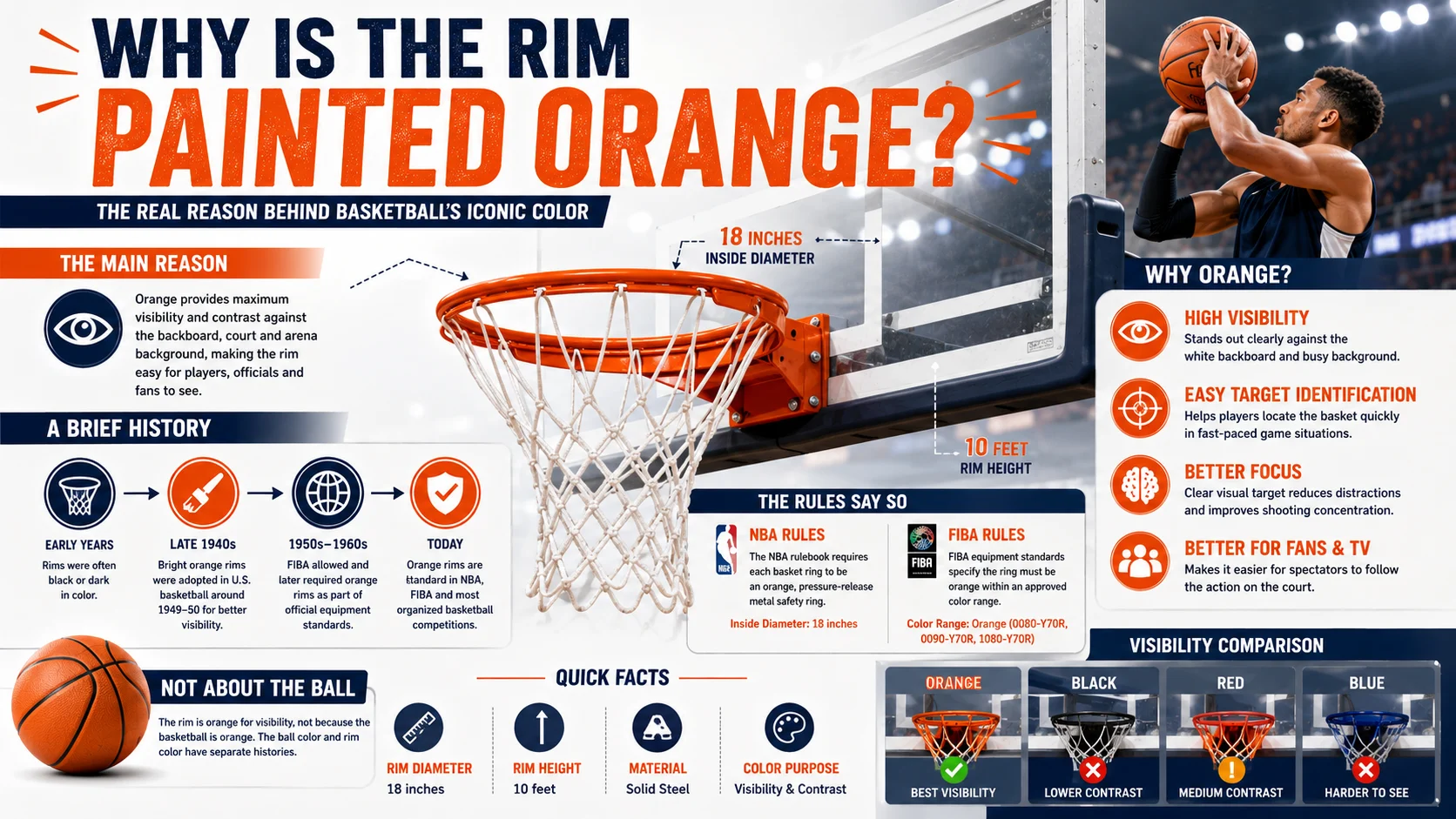
The basketball rim is painted orange primarily because the color provides strong visual contrast and makes the rim easier for players, officials, and spectators to see against the backboard, court, and arena background. Orange also became standardized through basketball’s equipment rules, turning a practical visibility choice into one of the sport’s most recognizable visual features.
Why is the basketball rim orange?
The main reason is visibility. Bright orange stands out clearly against the usually white backboard, hardwood court, and surrounding arena, helping players judge the target quickly when shooting.
It is not simply a decorative tradition. Orange is part of the standardized equipment design used at major levels of basketball. The current NBA rules specifically require the basket ring to be painted orange, while FIBA’s equipment specifications also define an approved orange color range for the ring.
| Question | Short Answer |
|---|---|
| Why is a basketball rim orange? | For strong visibility and contrast |
| Is orange required? | Yes, under major basketball equipment standards |
| Is it because basketballs are orange? | No, the rim and ball colors have separate histories |
| When did orange become established? | Orange rim use was adopted in U.S. basketball by the late 1940s and standardized internationally afterward |
| Does orange affect shooting? | It helps make the target visually distinct, but it does not change the rim’s physical performance |
| Is every basketball rim orange? | No, recreational or decorative hoops may use other colors |
Why Is the Basketball Rim Orange?
Look at almost any basketball court and one feature immediately catches your eye: the bright orange ring hanging beneath the backboard.
It looks so normal that most people never question it.
But there is actually a practical reason behind the color.
Orange makes the rim easy to see.
A basketball court contains a lot of visual information. There is the wooden floor, painted lines, a transparent or white-marked backboard, players moving at high speed, spectators in the background, arena lighting, and sometimes advertising surrounding the court.
The rim needs to remain visually obvious through all of that.
A bright orange ring creates a strong visual boundary around the target. For a player approaching the basket, that instant recognition matters.
The color does not make the hoop easier to score on mechanically. Instead, it makes the target easier to identify visually.
That distinction is important.
Orange Was a Visibility Choice, Not Just a Style Choice
The history of basketball equipment shows that color was treated as a practical issue.
Research into basketball visibility had been taking place for decades. Historical records from basketball rule materials indicate that studies beginning in the 1930s examined which ball colors were easiest for players to see. By the late 1950s, bright yellow and orange had emerged as particularly visible colors. The same historical record notes that bright orange rim color was accepted in U.S. basketball around the 1949–50 period, after earlier experimentation with ring colors.
That history helps explain why orange eventually became much more than an attractive color.
It became part of basketball’s visual identity.
When Did Basketball Rims Become Orange?
The change was not a single worldwide event on one exact day.
Different basketball organizations adopted equipment standards at different times.
Historical FIBA rule material records that orange-painted rings were permitted with transparent backboards in the early 1950s. Later FIBA rules required iron rings to be painted orange, with black no longer permitted in the relevant rule period.
This is an important detail because you will sometimes see claims that the rim suddenly changed from black to orange in one particular year everywhere.
The actual history is more gradual.
Orange was experimented with, accepted, and eventually standardized as basketball equipment evolved.
Why Orange Instead of Black?
At first glance, black might seem like an obvious choice.
Black is highly visible in many situations. So why did basketball settle on orange?
The answer comes down to contrast and the environment in which basketball is played.
A basketball backboard is commonly transparent or light-colored. The surrounding court is usually a light wood tone. The basketball itself is traditionally orange.
Against these backgrounds, a bright orange rim creates a recognizable target.
Black can provide contrast too, but orange became closely associated with the equipment standard and the broader visual language of the sport.
In other words, the choice wasn’t about finding a color that looked fashionable.
It was about creating an unmistakable visual target.
Does the Orange Rim Help Players Shoot Better?
Not directly.
The orange paint doesn’t change:
- Rim diameter
- Rim height
- Rim stiffness
- Ball rebound
- Shooting angle
- Basket mechanics
But visibility can influence how quickly a player identifies and focuses on the target.
A shooter doesn’t consciously think:
“I need to locate the orange color.”
The brain simply recognizes the target.
That’s particularly useful during fast-paced play, when players may have only a fraction of a second to locate the basket before releasing a shot.
So the orange rim doesn’t make the shot easier in a mechanical sense.
It makes the visual target clearer.
Why Is the Rim Orange Even With a Transparent Backboard?
This is actually one of the best reasons to use a strong contrasting color.
A transparent backboard allows players to see through it toward the arena. Depending on lighting and what is behind the basket, a rim with a low-contrast color could visually blend into the background.
Orange helps separate the ring from that environment.
FIBA’s equipment guidance emphasizes this broader principle: basket support equipment should contrast with its background so that it remains visible to players.
So the orange rim fits a larger equipment philosophy:
Basketball equipment should be visually clear enough for players to identify quickly.
Is the Orange Rim Required by the NBA?
Yes.
The NBA’s 2025–26 Official Playing Rules specify that each basket ring is an NBA-approved pressure-release metal safety ring with an inside diameter of 18 inches, and that the ring shall be painted orange.
That means orange isn’t merely an NBA tradition.
It is part of the league’s equipment specification.
The rule also establishes other important characteristics of the basket, including its height, attachment, and dimensions.
Does FIBA Also Require an Orange Rim?
Yes.
FIBA’s official basketball equipment specifications define the ring as a solid-steel structure and specify an approved orange color range for the ring. The listed Natural Colour System references include 0080-Y70R, 0090-Y70R, and 1080-Y70R.
That is a fascinating detail because it shows just how standardized the seemingly simple orange rim actually is.
It’s not merely:
“Paint it whatever orange looks good.”
At the elite level, equipment specifications can define the acceptable appearance and construction.
Is the Orange Rim Related to the Orange Basketball?
They are related visually, but the rim was not painted orange simply because basketballs are orange.
The ball itself went through its own color history.
Historical NCAA rules show that an orange ball became permitted in the late 1950s, after earlier rules had specified natural tan or yellow colors.
Meanwhile, historical basketball equipment records document the adoption of orange-painted rings earlier, beginning around the late 1940s in U.S. basketball and later becoming part of FIBA’s standards.
So the two orange elements developed through related but distinct equipment histories.
Why Does the Rim Look So Bright on TV?
Television has made the orange rim even more recognizable.
A basketball broadcast needs viewers to understand what is happening almost instantly.
When a player shoots, the audience needs to follow:
Player → Ball → Rim → Net
The bright ring acts as a visual anchor.
Modern cameras, high-definition displays, arena lighting, and broadcast graphics make this easier than it was decades ago, but the basic principle remains the same: a clearly defined basket helps viewers follow the action.
This is particularly valuable when the ball is moving quickly or when several players are crowded around the paint.
Does Every Basketball Hoop Have to Be Orange?
No.
This is where recreational basketball and regulated competition differ.
A driveway hoop, school playground, training hoop, or decorative basketball goal may use different colors.
Professional and organized competitions, however, follow their own equipment standards.
For example, the NBA explicitly requires an orange ring, while FIBA specifies an approved orange range for its competition equipment.
So if you see a black, red, or another colored rim at a neighborhood court, that doesn’t necessarily mean anything is wrong.
It may simply be a non-professional or non-standardized basketball goal.
Why Is the Rim Not Painted the Same Color as the Backboard?
Because the two pieces serve different visual purposes.
The backboard provides a large visual reference area and contains the shooting target rectangle.
The rim is the actual scoring opening.
Giving the rim a strong contrasting color helps players distinguish the precise location of the basket from the rest of the backboard.
This is especially important during:
- Layups
- Bank shots
- Rebounds
- Putbacks
- Close-range finishes
- Fast-break situations
The eye needs to identify the scoring target quickly.
Orange helps accomplish that.
Does Rim Color Affect Shooting Accuracy?
There is no special “orange-rim advantage” that automatically improves shooting percentage.
A player’s shooting accuracy depends on much more important factors:
- Shooting mechanics
- Release point
- Footwork
- Balance
- Arc
- Strength
- Distance
- Practice
- Defensive pressure
- Visual focus
However, a clearly visible target is obviously useful.
Think of an archery target.
You don’t expect the target color to make someone a better archer. But a clearly defined target makes it easier to aim.
The orange basketball rim serves a similar visual function.
Why Is Orange Now So Iconic in Basketball?
This is where function turned into tradition.
Once orange became standardized, fans began associating the color with basketball itself.
Today, an orange circle can immediately suggest:
- A basketball hoop
- A basketball court
- A shot attempt
- A dunk
- Basketball culture
The color has effectively become part of the sport’s visual vocabulary.
Interestingly, even the NCAA has used an orange circle representing a basketball rim in major event branding, showing how strongly the color and circular shape are associated with the sport.
What Makes Orange Easy to Notice?
The important concept is contrast.
Your visual system is constantly separating objects from their surroundings.
A high-contrast object is easier to identify quickly.
On a basketball court, the rim needs to remain distinguishable from:
- The backboard
- The arena
- The court
- Players
- Lighting
- Spectators
Orange provides a distinctive visual signal.
This is why the explanation “the rim is orange because it looks good” misses the bigger picture.
The color serves a functional purpose first. Tradition came afterward.
Quick Facts About the Orange Basketball Rim
| Fact | Answer |
|---|---|
| Primary reason for orange | Visibility and contrast |
| NBA rim color | Orange |
| NBA rim inside diameter | 18 inches |
| NBA rim height | 10 feet at the upper edge |
| FIBA rim color | Approved orange range |
| Is orange purely decorative? | No |
| Does orange change rim performance? | No |
| Can recreational hoops use other colors? | Yes |
| Is rim color connected to basketball history? | Yes |
Frequently Asked Questions
Why are basketball rims painted orange?
Basketball rims are painted orange primarily because the bright color provides strong visual contrast, making the scoring target easier for players and spectators to identify.
When did basketball rims become orange?
Orange rim adoption developed gradually. Historical records indicate that bright orange ring color was accepted in U.S. basketball around 1949–50, while FIBA later incorporated orange rings into its official equipment standards.
Is an orange rim required in the NBA?
Yes. The NBA’s 2025–26 rules specify that the basket ring shall be painted orange.
Is the basketball rim orange because the basketball is orange?
Not exactly. The rim and ball have separate equipment histories, although both eventually became strongly associated with orange for visibility and standardization.
Does an orange rim make shooting easier?
It does not mechanically make a shot easier. Its main benefit is visual: the contrasting color makes the target easier to identify.
Can a basketball rim be another color?
Recreational hoops can be painted different colors, but official competitions follow their governing body’s equipment rules. NBA and FIBA competition equipment specifies orange rings.
Final Verdict
The orange basketball rim is one of those details that seems purely cosmetic until you look at its history.
It isn’t orange by accident.
The color was chosen because visibility matters.
Basketball happens quickly. A player may receive a pass, attack the basket, rise for a jumper, or release a shot while moving at full speed. The rim needs to stand out immediately, and a bright orange ring provides a clear visual target against the backboard and arena environment.
Over time, that practical choice became standardized. The NBA’s current rules require orange basket rings, while FIBA’s equipment specifications define an approved orange range.
So the next time you see an orange rim, remember that you’re looking at more than a familiar basketball color.
You’re looking at a small piece of equipment design shaped by visibility, standardization, history, and the way humans visually track a fast-moving sport.
And that’s why the basketball rim is orange.