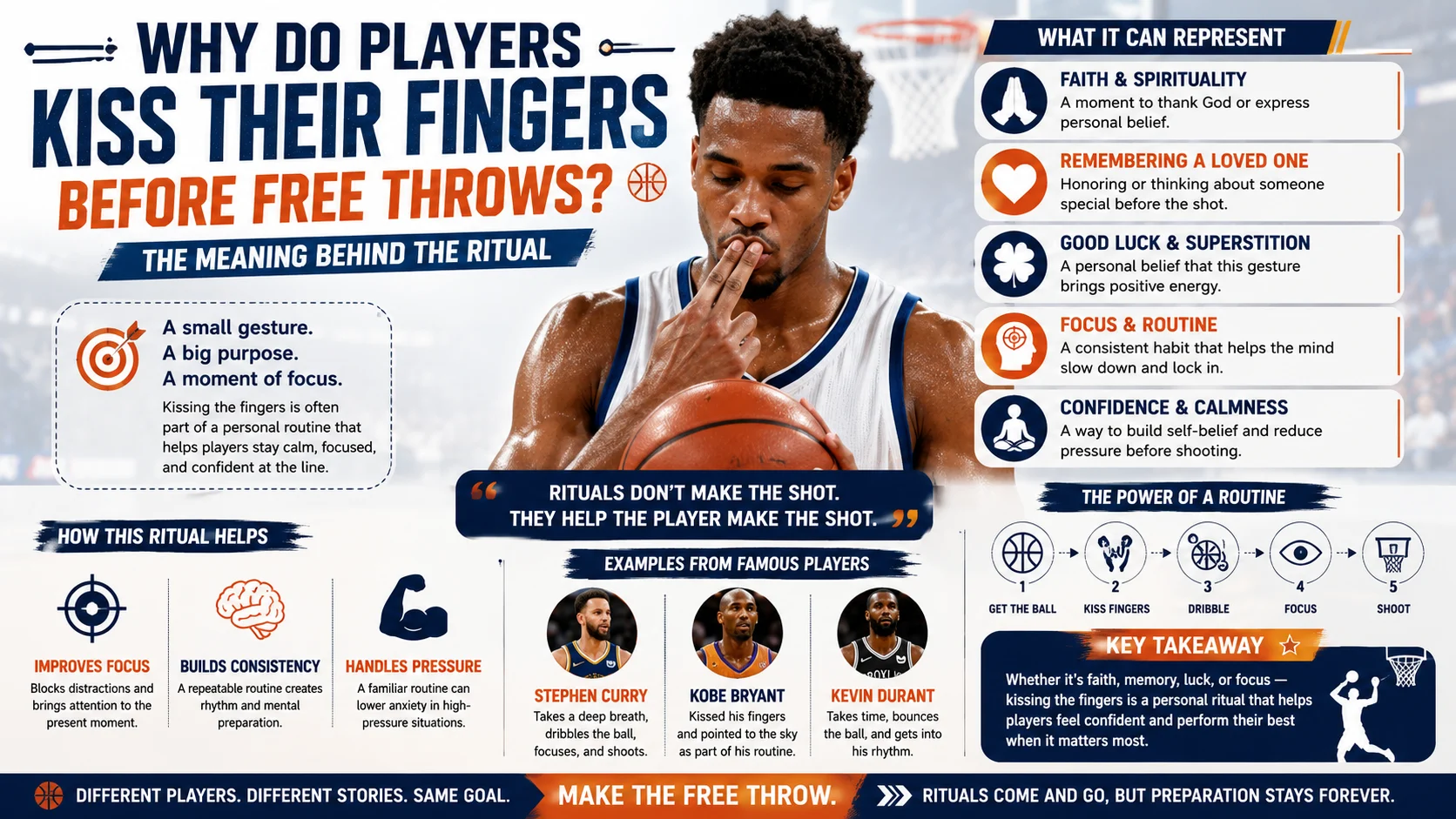
Some basketball players kiss their fingers before a free throw as part of a personal pre-shot routine or ritual. The gesture may symbolize faith, remembrance of a loved one, good luck, confidence, or mental focus. There is no universal meaning; its significance depends on the individual player and their personal beliefs or routine.
Players kiss their fingers before free throws mainly because it is part of a personal ritual or routine. For some, the gesture has a religious or emotional meaning; for others, it is simply a familiar action that helps them slow down, focus, and repeat the same shooting process.
Free throws are unusual in basketball because the player gets a moment without a defender actively contesting the shot. That quiet moment creates room for routines dribbles, breaths, spins, hand movements, finger kisses, or other personal habits.
Research on basketball free-throw rituals has found that players commonly use highly patterned behaviors before shooting. The important factor may be the consistency and rhythm of the routine, rather than one particular gesture.
What Does Kissing Your Fingers Before a Free Throw Mean?
There isn’t one official meaning.
When a player kisses their fingers before shooting, the gesture may mean something different depending on the person.
Common reasons include:
| Reason | What It Can Represent |
|---|---|
| Focus | A cue to mentally reset before shooting |
| Routine | A familiar step repeated before every attempt |
| Faith | A private expression of religious belief |
| Loved One | Remembering or honoring someone important |
| Good Luck | A personal superstition or confidence cue |
| Calmness | Helping the player slow down under pressure |
| Habit | Something repeated so often it becomes automatic |
The important point is that kissing the fingers does not have a single basketball-wide definition.
One player may be thinking about a family member. Another may be expressing faith. A third may simply be following the same routine they have used since childhood.
That is why it’s risky to look at the gesture and assume you know exactly what it means.
Why Are Free Throws So Full of Rituals?
A free throw looks simple: stand behind the line, aim at the basket, and shoot.
But psychologically, it can be one of the strangest moments in basketball.
The game stops.
The crowd watches.
The player is alone at the line.
There is no defender directly contesting the shot.
And everyone knows that a missed free throw can matter enormously in a close game.
That combination creates pressure.
Players therefore develop routines that give the moment some structure.
One player might bounce the ball three times. Another might spin it. Another takes a deep breath. Another touches their shorts or shoes. Some may kiss their fingers or the basketball.
Research has specifically documented these types of pre-shot behaviors, including actions such as spinning or bouncing the ball, touching equipment, and kissing the ball.
The routine essentially tells the player’s brain:
“This is the part where I shoot.”
Is Kissing the Fingers a Superstition?
Sometimes but not always.
A ritual and a superstition are slightly different.
A ritual is a repeated sequence of actions that helps an athlete prepare.
A superstition involves the belief that an action has some connection to the outcome, even when there is no obvious physical reason for it.
For example:
A player may kiss their fingers because it reminds them to focus.
That’s primarily a routine.
But:
A player believes the free throw will go in only if they kiss their fingers first.
That is closer to superstition.
In real basketball, the two can overlap.
Players may not even think of their behavior as a “ritual.” They may simply say, “That’s just what I do before I shoot.”
Research has found that athletes often perform these actions without necessarily viewing them as rituals themselves.
Does Kissing Your Fingers Actually Help Make Free Throws?
Not directly.
Kissing your fingers doesn’t physically make the basketball enter the hoop.
The shot is still determined by factors such as:
- Shooting mechanics
- Release angle
- Release speed
- Balance
- Alignment
- Touch
- Concentration
- Practice
The interesting part is what happens before the ball leaves the player’s hands.
A consistent routine can help an athlete create a repeatable mental and physical sequence.
Studies of free-throw rituals have found that the rhythm and relative timing of a player’s routine can matter more than simply making the routine longer or shorter.
In other words, the benefit isn’t necessarily:
“Kiss fingers = make shot.”
It’s more like:
“Repeat familiar sequence → settle down → focus → execute.”
That distinction is important.
The Psychology Behind a Free-Throw Routine
Imagine you’re shooting two free throws with 10 seconds left in a close game.
The crowd is loud.
Your teammates are watching.
The opposing team wants you to miss.
Your heart rate may increase, and your attention can shift toward the consequences of the shot rather than the mechanics of shooting it.
A familiar routine can provide something the player can control.
For example:
- Receive the ball.
- Take a breath.
- Kiss fingers.
- Dribble twice.
- Look at the target.
- Shoot.
The exact sequence doesn’t matter as much as making it consistent and repeatable.
This is one reason professional players can look almost robotic at the free-throw line. They are not necessarily trying to look superstitious.
They’re trying to make an important moment feel familiar.
Why Do Players Kiss Their Fingers and Then Point Up?
You may sometimes see a player perform a finger kiss followed by a gesture toward the sky.
This can have a deeply personal meaning.
For some athletes, gestures directed upward can represent:
- Faith
- Gratitude
- A prayer
- Remembering someone who has died
- Thanking God
- A personal connection to family
But there is no universal translation for the gesture.
Two players can make almost identical movements while attaching completely different meanings to them.
This is particularly important when discussing athletes’ religious beliefs or personal relationships. Unless the player has publicly explained the gesture, it is better to describe the possible meaning rather than claim to know their private intention.
Why Do Players Have Different Free-Throw Routines?
Because free-throw shooting is highly individual.
One player may need three dribbles.
Another may need one.
Another may bounce the ball five times.
Some players barely move before shooting.
Others perform a sequence that takes several seconds.
The NBA itself has highlighted how different players develop their own routines. For example, former Washington Wizards guard Gilbert Arenas described his free-throw routine as something that became a habit, while emphasizing the importance of repeating the same technique and staying confident.
The Sacramento Kings have similarly documented players describing simple routines such as a set number of dribbles or a deep breath, with players explaining that the routine helps them focus.
So when you see someone kiss their fingers, you’re seeing one version of a much bigger basketball tradition.
Does the Ritual Improve Free-Throw Percentage?
The answer is more complicated than a simple yes or no.
Research does not show that kissing your fingers itself magically improves shooting accuracy.
Older research examining free-throw rituals found no significant overall difference in free-throw success between ritual and non-ritual conditions in the study’s participants. However, the researchers did find relationships between characteristics of the ritual and successful attempts.
Later research emphasized the importance of maintaining the relative timing or rhythm of the routine.
There is also broader evidence that rituals can influence how effective an action feels to people. A study using basketball free-throw scenarios found that ritualized pre-shot behaviors increased observers’ perceptions of shooting efficacy, even when the action itself had no obvious mechanical connection to scoring.
So the strongest takeaway is:
The value may come from the player’s mental preparation and consistency not from the finger kiss itself.
Why Routines Matter More When the Game Is Tight
Free throws become particularly important when pressure increases.
A player who has made the same sequence hundreds or thousands of times doesn’t have to invent a new process when the scoreboard is close.
They can fall back on something familiar.
That can reduce the feeling that every shot is a completely new event.
Interestingly, recent research has also found evidence that teammate physical support can matter under free-throw pressure. In a study of NCAA women’s basketball games, teammate touch between free throws was associated with improved success on the second attempt after a missed first free throw.
This reinforces a broader point:
Free throws are not purely mechanical. Mental and social factors can influence how athletes perform under pressure.
Is Kissing the Fingers a Religious Gesture?
It can be, but it isn’t automatically religious.
A finger kiss may be:
- A sign of faith
- A tribute to someone
- A personal good-luck gesture
- A confidence routine
- A simple habit
The safest interpretation is to consider the player’s own explanation.
If an athlete has publicly stated that the gesture represents their faith or a loved one, that explanation is the strongest evidence.
Otherwise, it should be treated as a personal ritual rather than assigned a specific religious meaning.
Why Do Basketball Players Repeat the Same Routine?
Because consistency is valuable at the free-throw line.
A good routine can create a predictable sequence before the actual shooting motion.
Think about it like a batter’s pre-pitch routine in baseball.
The player might adjust their gloves, tap the plate, breathe, and reset before every pitch.
The actions don’t hit the ball.
They prepare the player to hit the ball.
Free-throw rituals work similarly.
The kiss, dribbles, breath, spin, or other movement is often the preparation, while the actual shooting technique remains the important physical skill.
What Should Young Players Learn From These Rituals?
Young basketball players sometimes copy professional players’ routines because they look cool.
That’s fine but copying the gesture isn’t the important part.
The useful lesson is consistency.
A young player can develop a simple routine such as:
Breathe → dribble twice → focus → shoot.
Or:
Breathe → one dribble → focus → shoot.
The routine should be:
- Short
- Comfortable
- Repeatable
- Legal
- Easy to remember
- The same during practice and games
Players should avoid making the routine so complicated that it becomes another source of pressure.
What If a Player Misses After Doing Their Ritual?
This is where superstition can become a problem.
If a player believes:
“I missed because I didn’t kiss my fingers correctly,”
they can become trapped in a cycle of anxiety.
A healthier approach is:
“The routine helps me prepare, but my technique makes the shot.”
That mindset keeps the ritual useful without giving it magical power.
A missed free throw doesn’t mean the routine failed.
It means the next shot is another opportunity to execute.
FAQs
Why do basketball players kiss their fingers before shooting?
Usually, it’s part of a personal pre-shot routine. It may represent focus, faith, remembrance, confidence, superstition, or simply habit.
Is kissing your fingers before a free throw a religious tradition?
Not necessarily. Some players may use the gesture for religious or personal reasons, but there is no universal religious meaning attached to it.
Does kissing your fingers help you make free throws?
Not directly. The gesture does not mechanically improve the shot. Its potential benefit comes from helping the player establish a consistent mental routine before shooting.
Why do NBA players have free-throw rituals?
Free throws happen under pressure, so players often develop repeatable routines to help maintain focus, rhythm, and confidence.
Are free-throw rituals actually proven to work?
Research suggests that consistent pre-shot routines and their timing can be associated with performance, but there is no evidence that one specific gesture such as kissing your fingers is universally effective.
Can young basketball players create their own free-throw routine?
Absolutely. A simple routine involving a breath, a consistent number of dribbles, and a visual focus point can help make free throws more repeatable.
Final Thoughts
So, why do players kiss their fingers before free throws?
The short answer is: because it means something to the player or helps them get into the right mental state before the shot.
For one athlete, it might be a quiet moment of faith. For another, it could be a tribute to someone they love. For someone else, it may simply be a habit they’ve repeated so many times that stepping to the free-throw line without it feels strange.
And that’s what makes basketball rituals fascinating.
The finger kiss doesn’t make the ball go through the hoop. The player’s skill does. But the ritual can help create the calm, familiar, repeatable moment in which that skill can be performed.
At the free-throw line, sometimes the most important thing a player can control isn’t the crowd, the scoreboard, or the pressure.
It’s the next breath, the next routine, and the next shot.

Emily Parker is a sports journalist at SportsOrbitX.com with a passion for covering cricket, tennis and major international sporting events. She is committed to producing clear, reliable and engaging content for sports enthusiasts worldwide.