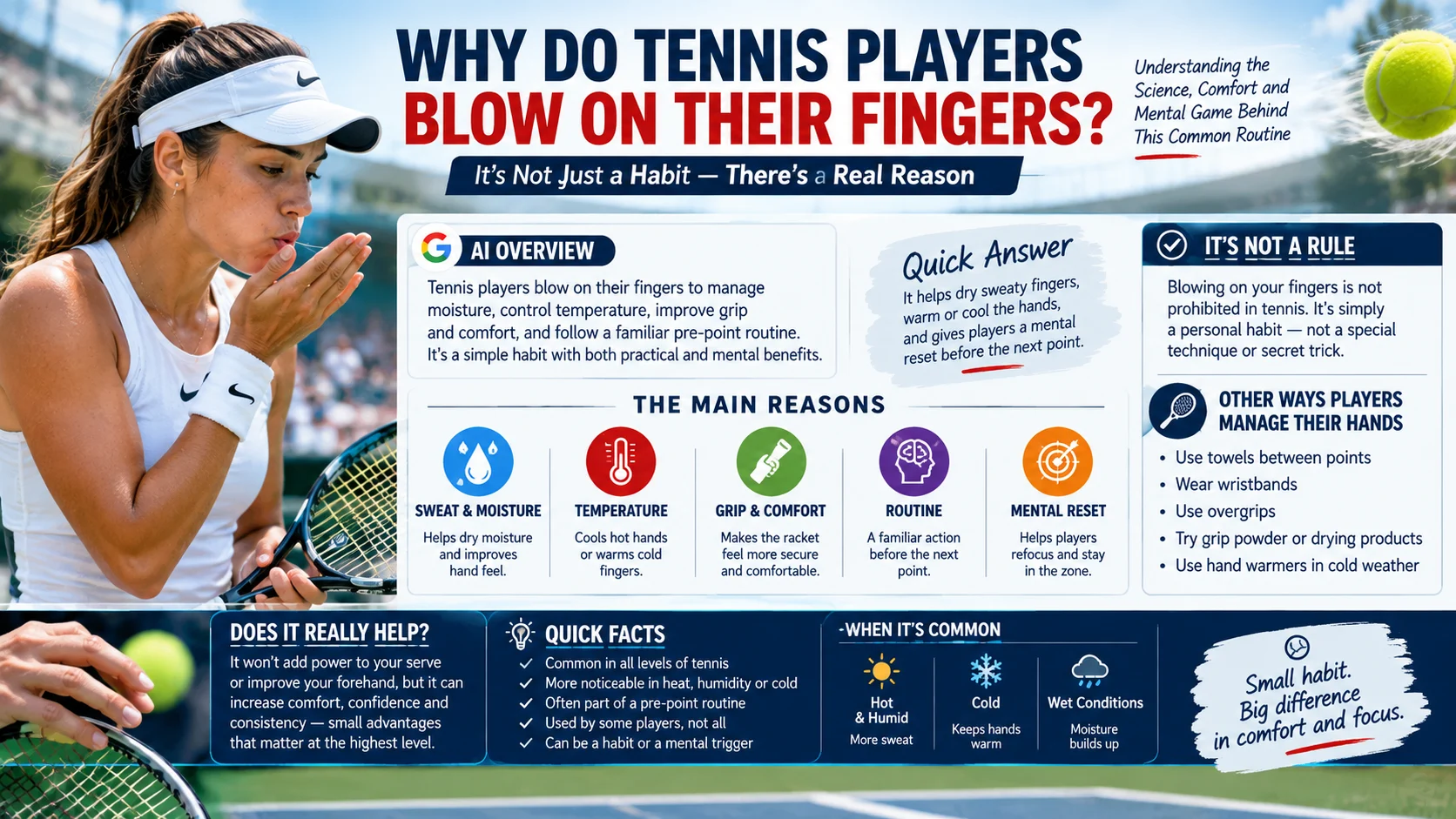
Tennis players blow on their fingers mainly to manage moisture, temperature, grip, and comfort during a match. Blowing can briefly cool sweaty fingers, dry moisture, or warm cold hands depending on the conditions. For some players, it also becomes a familiar routine that helps them reset mentally before the next point.
If you’ve watched professional tennis closely, you’ve probably noticed a player blow on their fingers before serving, returning, or preparing for the next point.
So, why do tennis players blow on their fingers?
Usually, it’s because they want to control how their fingers feel before the next shot. Blowing can help with sweat and moisture, provide a quick temperature adjustment, and give players a small psychological reset.
It isn’t a special tennis rule or a secret technique. In many cases, it’s simply a practical habit that has become part of a player’s pre-point routine.
| Reason | Why It Helps |
|---|---|
| Sweat | Can help dry moisture on the fingers |
| Heat | May provide a brief cooling sensation |
| Cold weather | Warm breath can make fingers feel more comfortable |
| Grip | Helps players feel more confident holding the racket |
| Routine | Creates a familiar pre-point action |
| Mental reset | Helps refocus between points |
What Does Blowing on Your Fingers Do?
The effect depends on the player’s situation.
If a player’s fingers are sweaty, blowing air across them can help moisture evaporate and make the skin feel temporarily drier.
If the player’s hands are cold, warm breath can provide a small amount of heat and make the fingers feel more comfortable.
There’s also another factor that is easy to overlook: touch perception.
Tennis requires extremely precise control. Players constantly adjust their racket grip, finger pressure, and wrist position. A small change in how the fingers feel can become noticeable, particularly during a tense point.
Blowing on the fingers can therefore become a quick way of saying, in effect, “reset and get ready.”
Do Tennis Players Blow on Their Fingers to Dry Sweat?
Yes, this can be one reason.
During a competitive match, players can sweat heavily, particularly in hot and humid conditions. Sweat doesn’t just affect the forehead or clothing—it can also accumulate on the hands.
A wet hand can change how a player perceives the racket handle.
Blowing may help remove or evaporate a small amount of surface moisture. However, it isn’t a substitute for a towel, wristband, grip change, or other sweat-management techniques.
For players who sweat heavily, overgrips, towels, wristbands, and appropriate racket grips are generally much more practical tools.
Why Grip Matters So Much in Tennis
The racket is the player’s connection to the ball.
A tennis player needs to control:
- Grip pressure
- Racket angle
- Wrist position
- Swing path
- Contact point
- Racket-face direction
Even a small change in grip can affect the feel of a shot.
That’s why professional players are extremely particular about their grips and hands.
A player preparing to serve may want the racket to feel completely secure in their hand. Someone returning a fast serve may similarly want maximum confidence in their grip.
Blowing on the fingers can be a tiny part of that preparation.
Is Blowing on Fingers a Mental Routine?
Absolutely, and this is one of the most interesting parts of the habit.
Tennis is an unusual sport because players spend long periods competing without a teammate physically taking over when momentum changes. Between points, they have a short amount of time to recover physically and mentally.
That creates opportunities for routines.
A player might:
- Walk to the back of the court.
- Adjust their strings.
- Bounce the ball.
- Touch their racket.
- Blow on their fingers.
- Take a breath.
- Prepare for the next point.
These actions can become highly familiar.
The important thing isn’t necessarily the physical benefit of blowing. The routine itself can help a player feel settled and prepared.
Blowing on Fingers as a Pre-Point Reset
Imagine losing a long rally by two inches.
The next point starts almost immediately.
A professional player can’t spend several minutes thinking about the previous mistake. They need to mentally close that point and prepare for the next one.
A small repeated action can help create that transition.
Blowing on the fingers may become part of that personal reset:
Point finished → routine → refocus → next point.
This doesn’t mean every player consciously uses it as a psychological technique. Sometimes a habit simply develops through repetition.
Do Tennis Players Blow on Their Fingers When They Are Cold?
Yes.
Cold weather can make the hands and fingers feel stiff or uncomfortable. Tennis players need their hands to remain responsive because precise racket control is essential.
Warm breath can temporarily make the fingers feel warmer.
However, blowing isn’t a powerful heating method. A player in genuinely cold conditions will generally rely on more effective methods such as:
- Warm clothing
- Gloves between points
- Hand warmers
- Keeping the body moving
- Maintaining circulation
The breath provides only a brief local effect.
Why Do Players Blow on Their Fingers After Touching the Court?
Sometimes you’ll see a player touch the court, adjust something, or make contact with a surface before blowing on their fingers.
This can be related to moisture, dirt, or tactile comfort.
Players may be very sensitive to anything that changes the feel of their racket hand. A quick blow can help remove loose moisture or simply restore the familiar sensation of the fingers.
Again, there isn’t one universal explanation for every player.
Context matters.
Is Blowing on Your Fingers a Tennis Rule?
No.
There is no tennis rule that requires players to blow on their fingers.
It’s simply an individual action.
Players are subject to rules concerning time between points, conduct, equipment, and other aspects of match play, but blowing on the fingers itself isn’t a regulated tennis technique.
That’s why you’ll see some players do it frequently while others never do it.
Does Blowing on Fingers Improve Tennis Performance?
Not directly in the way that better footwork, technique, fitness, or racket preparation does.
Blowing on the fingers doesn’t suddenly increase:
- Serve speed
- Forehand power
- Backhand accuracy
- Spin
- Reaction time
Its potential benefit is much smaller.
It may help a player feel:
- More comfortable
- Less distracted by sweat
- More prepared
- More focused
- More familiar with their routine
In elite sport, however, even small comfort improvements can matter when players are operating under intense pressure.
Why Professional Tennis Players Have So Many Routines
If you watch professional tennis, you’ll notice that players repeat actions constantly.
Some bounce the ball several times before serving. Others adjust their strings, clothing, racket, or hair. Some carefully position themselves before every serve.
These routines aren’t necessarily superstitions.
Often, they’re behavioral anchors.
A repeated action gives the player something familiar to focus on while transitioning from one point to the next.
Blowing on the fingers can serve a similar purpose.
Is It a Superstition or a Habit?
It can be either.
For one player, blowing on the fingers may have a practical purpose: their hands feel sweaty.
For another, it may simply be something they’ve done for years.
For another, it may become part of a mental routine.
And sometimes the player may not even think about it consciously.
Sports habits often begin with a practical action and eventually become automatic.
That’s why it’s difficult to assign one explanation to every tennis player who blows on their fingers.
Why You Don’t See Every Tennis Player Doing It
The simple answer is that players have different bodies, conditions, equipment, and routines.
Some athletes sweat more than others.
Some prefer very dry hands.
Some like a particular grip texture.
Some play primarily in warm conditions.
Others compete in colder environments.
And some players simply don’t have the habit.
Professional tennis doesn’t require a specific hand routine, so players naturally develop their own preferences.
Does Humidity Affect the Habit?
Yes.
Weather can significantly influence how a player’s hands feel.
Hot and Humid Conditions
Humidity can make sweat evaporation more difficult. Players may therefore notice moisture on their hands more often.
Hot and Dry Conditions
Players may sweat heavily, but moisture can evaporate more readily.
Cold Conditions
The main concern may shift from sweat management to keeping the fingers warm and flexible.
This is why the same player may use different routines depending on the tournament environment.
What Do Tennis Players Use Instead of Blowing on Their Fingers?
Players have several more effective ways to manage their hands during competition.
Towels
Players frequently use towels between points to remove sweat from their face, arms, and hands.
Wristbands
Wristbands can help absorb sweat before it reaches the hands.
Overgrips
A fresh overgrip can restore traction and improve the feel of the racket handle.
Grip Powder or Drying Products
Some players use products designed to manage moisture, depending on the rules and their personal preferences.
Hand Warmers
In cold conditions, players may use hand warmers between points or during changeovers.
Blowing is therefore only one small part of overall hand management.
Does Blowing on Fingers Affect Racket Grip?
Potentially, but only temporarily and indirectly.
The grip itself isn’t becoming dramatically different because a player blows on their fingers.
Instead, the player may experience a short-lived change in how the fingers feel.
That perception can be important.
Tennis players make constant micro-adjustments to their grip. They need enough pressure to control the racket without squeezing excessively.
If their fingers feel wet, cold, sticky, or uncomfortable, they may become distracted.
A quick routine can help them regain confidence in the grip.
The Real Reason: It’s Usually a Combination
The most accurate answer isn’t simply “tennis players blow on their fingers because they are sweaty.
The habit can involve several factors at once:
Physical comfort + moisture management + temperature + grip awareness + routine.
And the importance of each factor varies from player to player.
That’s why you’ll sometimes see a player blow on their fingers even when there doesn’t appear to be an obvious reason.
The action may have become an automatic part of their preparation.
Frequently Asked Questions
Why do tennis players blow on their fingers?
Tennis players may blow on their fingers to manage moisture, cool or warm their hands slightly, improve comfort, or follow a familiar pre-point routine.
Does blowing on your fingers help with sweat?
It can help dry a small amount of surface moisture through evaporation, but it is not as effective as a towel or changing to a dry grip.
Why do tennis players blow on their fingers before serving?
For some players, it is part of their pre-serve routine. It can help them refocus, settle their hands, and prepare mentally for the next point.
Do tennis players blow on their fingers when they’re cold?
Yes. Warm breath can temporarily make cold fingers feel more comfortable, although players generally use more effective methods to stay warm.
Is blowing on your fingers a tennis superstition?
It can be. For some players it’s a practical habit, while for others it may become part of a psychological or pre-point routine.
Is blowing on your fingers allowed in tennis?
Yes. Blowing on your fingers is not prohibited by the standard rules of tennis.
Does blowing on fingers improve grip?
It may temporarily change how the fingers feel, but it doesn’t fundamentally improve the racket grip. Players normally rely on proper grip selection, fresh overgrips, towels, and sweat-management techniques.
Why do some tennis players do it and others don’t?
Players have different sweat levels, preferences, weather conditions, equipment, and mental routines. There is no requirement for players to blow on their fingers.
Final Verdict
So, why do tennis players blow on their fingers?
There isn’t just one answer.
For some players, it helps manage sweat or moisture. For others, it provides a little warmth or cooling. And for many, it has simply become part of a familiar pre-point routine that helps them reset and concentrate.
The important thing to understand is that blowing on the fingers isn’t a secret performance trick. It won’t add power to a serve or magically improve a forehand. Its value is much more subtle: comfort, confidence, and routine.
And that’s what makes the habit interesting.
In a sport where a single point can turn a match around, professional players develop tiny routines that help them feel ready for what comes next. Blowing on the fingers is one of those small behaviors that looks strange when you first notice it but makes much more sense once you understand the physical and psychological demands of tennis.
Key Takeaway
Tennis players blow on their fingers mainly to manage moisture, temperature, finger comfort, and pre-point focus. The habit varies by player and conditions, and it is often as much about routine and mental preparation as it is about physical comfort.

Daniel Brooks is a sports writer at SportsOrbitX.com, specializing in football, basketball and global sports news. He focuses on delivering accurate reporting, match analysis and timely updates that keep fans informed.