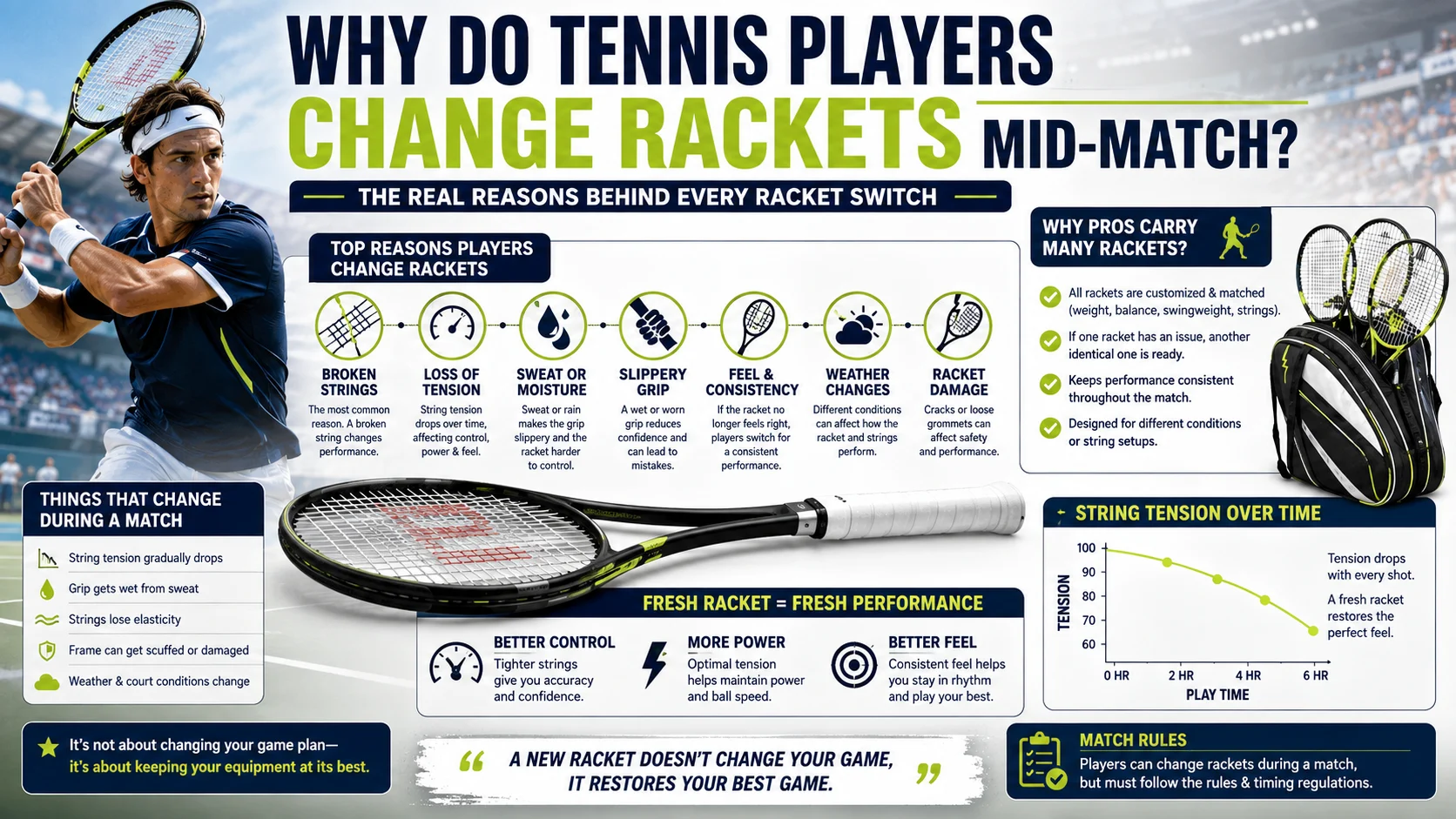
Tennis players change rackets mid-match mainly because of broken strings, changing string tension, sweat, weather conditions, or a racket that no longer feels right. Professional players often carry several identically customized rackets so they can switch without changing their playing setup.
A fresh racket can restore the intended power, control, spin, and feel, especially during long or high-pressure matches. In most cases, players are not changing rackets because they want a completely different racket they are replacing or adjusting the same setup to maintain consistent performance.
Why do tennis players change rackets mid-match?
The most common reasons are:
- The strings break
- String tension has changed
- The racket becomes wet from sweat or rain
- The grip becomes slippery
- The racket feels different after extended play
- The frame is damaged
- Weather conditions change
- A player wants a fresh, more predictable setup
- A racket has become uncomfortable or unstable
For professional players, changing rackets is usually about maintaining consistency, not making a dramatic tactical equipment change.
What Happens to a Tennis Racket During a Match?
A tennis racket does not remain exactly the same from the first point to the final point.
Every time the ball hits the strings, the string bed experiences impact and movement. Over hundreds of shots, the strings can gradually lose tension and elasticity.
That matters because the strings are responsible for much of the racket’s playing response.
A racket that feels crisp and controlled early in a match may feel noticeably softer later.
For a recreational player, the difference may be difficult to notice.
For a professional who repeatedly hits the ball at extremely high speeds and relies on precise timing, even a small change can matter.
That is why professional players often prepare multiple rackets before a match.
The Biggest Reason: Broken Strings
One of the most obvious reasons a tennis player changes rackets is a broken string.
When a string snaps, the racket’s string bed becomes uneven and can no longer produce the same response.
The player cannot simply continue using it normally.
Instead, they take another prepared racket from their bag.
Why Do Tennis Strings Break?
Strings can break because of:
- Repeated high-speed impacts
- Heavy topspin
- Hard hitting
- String material
- String tension
- Off-center contact
- Normal wear and tear
Players who generate extreme topspin can put particularly high stress on their strings.
This is one reason professional players may travel with many rackets that look identical.
The goal is simple: if one racket fails, another is ready immediately.
Do Tennis Players Change Rackets Because the Strings Lose Tension?
Yes.
This is a less obvious reason, but it can be extremely important.
Tennis strings gradually lose tension after being installed. They can also change during play because of repeated ball impacts.
As tension changes, the racket can feel different.
A lower-tension string bed generally feels more powerful and can provide a different level of comfort and ball pocketing, while higher tension generally produces a firmer response and can emphasize control.
The exact effect depends on the string type, racket, player, and setup.
For a professional player, predictability is extremely valuable.
If a player is accustomed to a particular string tension and response, a fresh racket can restore that familiar feel.
Why Do Pros Carry So Many Tennis Rackets?
Watch a professional match and you may notice players have a large bag filled with rackets.
This is not because they expect to use a different racket for every point.
Instead, they usually carry several rackets with closely matched specifications.
Professional rackets may be customized for:
- Weight
- Balance
- Swingweight
- String type
- String tension
- Grip size
- Handle shape
This means two rackets that appear identical to spectators can be carefully matched to provide nearly the same playing characteristics.
The Goal Is Consistency
A professional player doesn’t want to think:
“This racket feels completely different.”
They want to pick up another racket and continue playing almost as if nothing happened.
That consistency is especially important during a close match.
What If the Racket Gets Wet?
Sweat and moisture can also affect equipment.
Tennis players can sweat heavily during long matches, particularly in hot and humid conditions.
Moisture can make:
- The grip slippery
- The racket harder to control
- The player’s hand less secure
- The grip feel different
A player may simply replace the racket with another one that has a fresh, dry grip.
This is one reason professional players often have multiple prepared rackets available courtside.
Can Rain Cause Players to Change Rackets?
Rain can create even more equipment problems.
Wet conditions can affect the grip, strings, balls, and court surface.
If play continues in damp conditions, players may become more concerned about maintaining a secure grip and predictable racket response.
However, professional tennis matches are generally subject to tournament and umpire procedures concerning weather and court conditions, so players do not simply continue playing through unsafe conditions.
Does a New Racket Give a Player More Power?
Not necessarily.
A fresh racket does not automatically make a player hit harder.
The more important factor is consistency of performance.
A fresh string bed may feel more responsive compared with a racket whose strings have experienced substantial tension loss.
The player may therefore feel that the ball is coming off the racket differently.
For professionals, this difference can affect:
- Timing
- Depth
- Spin
- Control
- Confidence
The objective is usually not “more power.”
It’s the right response at the right moment.
Why Do Tennis Players Sometimes Change Rackets Even When Nothing Is Broken?
This is where professional equipment preparation becomes interesting.
A racket can still be usable even when the strings have not broken.
However, a player may prefer another racket because the current one no longer feels exactly right.
During a long match, a player might notice:
- Reduced string tension
- A softer string-bed response
- A wet grip
- Increased vibration
- A different feel on contact
- General equipment fatigue
If the player has several prepared rackets, there is little reason to tolerate an equipment problem that could affect performance.
Do Tennis Players Use Different Rackets for Different Shots?
Usually, no.
Professional players generally do not use one racket for serving and another for forehands.
Instead, they typically use multiple rackets built to essentially the same specification.
This is important because switching to a dramatically different racket during a match could interfere with timing and feel.
The rackets in a player’s bag are often intended to be interchangeable.
Why Do Players Change Rackets After a Long Rally?
There is no rule requiring a player to change rackets after a certain number of shots or rallies.
A player can continue using the same racket if it is performing properly.
However, if the strings have broken or the racket has become unsuitable for some reason, the player may change it at the next appropriate opportunity.
The decision is primarily practical.
Do Tennis Rules Allow Players to Change Rackets?
Yes, players are generally allowed to change rackets during a match, provided they follow the applicable rules and procedures.
A racket change is not automatically a penalty.
However, players cannot simply create unnecessary delays whenever they want.
The change needs to occur within the rules governing the match, including timing and changeover procedures.
What About Changing Rackets During a Point?
A player cannot normally stop play simply because they suddenly want a different racket.
Equipment changes are handled according to the rules and circumstances of the match.
If a string breaks during a point, the situation is treated differently from a player voluntarily deciding that they prefer another racket.
What Is the Difference Between a Fresh Racket and a Fresh String Job?
These two ideas are closely connected.
When a player changes to another racket during a match, the replacement racket may have:
- Fresh strings
- A specific tension
- A prepared grip
- Matching weight and balance
Professional players and their teams can prepare rackets specifically for competition.
A fresh racket therefore represents a known equipment setup, rather than simply grabbing any racket from a bag.
Why Is String Tension So Important?
String tension influences how the racket responds when the ball hits the string bed.
A player’s preferred tension depends on their:
- Playing style
- Swing speed
- String type
- Racket design
- Desired control
- Desired power
- Comfort preferences
There is no single “best” tennis string tension for everyone.
A professional may spend significant time testing equipment to find a setup that provides the desired combination of power, control, spin, and feel.
Once that setup is established, maintaining it becomes extremely important.
Do Different Weather Conditions Affect Racket Choice?
Weather can influence how equipment feels and performs.
Temperature, humidity, altitude, and court conditions can all affect tennis equipment and the ball.
For example, a player competing in a hot environment may experience much more sweat, while conditions at higher altitude can change how the ball travels.
Players and equipment teams may therefore prepare equipment with the expected conditions in mind.
However, the racket itself is only one part of the equation.
Ball behavior, court conditions, strings, and player adaptation all work together.
Why Do Professional Players Have Their Rackets Customized?
A professional racket is often very different from an ordinary retail racket sitting on a store shelf.
Players may have their rackets customized to closely match a preferred setup.
Customization can involve:
- Adding weight
- Adjusting balance
- Matching swingweight
- Customizing the handle
- Adjusting grip shape
- Selecting specific strings
- Selecting specific string tension
This is another reason professionals don’t simply buy one racket and use it for an entire tournament.
They need multiple rackets that behave consistently.
How Many Rackets Does a Tennis Player Carry?
There is no universal number.
Some professional players may carry a large collection of rackets during tournaments, particularly because stringing and equipment preparation are part of professional match routines.
The number can depend on:
- Player preference
- String durability
- Match length
- Playing conditions
- Tournament level
- String setup
A player who frequently breaks strings may need more backup rackets than someone whose strings are more durable.
Do Tennis Players Change Rackets to Change Their Strategy?
Occasionally, equipment choices can support a strategic preference, but this should not be confused with changing rackets simply because one is “better.”
Most professional players establish their racket and string setup long before a match.
During the match, consistency is usually more valuable than experimentation.
A player isn’t normally thinking:
“I need a more powerful racket for this game.”
They are more likely thinking:
“I need the same predictable feel I had when I started.”
That distinction explains why racket changes often go unnoticed by casual viewers.
Why Do Some Players Change Rackets More Often Than Others?
String durability is a major factor.
A player who hits with heavy topspin and high racket-head speed can place significant stress on the strings.
Another player may use a setup that lasts longer.
Therefore, racket changes can vary considerably between players.
Playing style matters.
String material matters.
Tension matters.
Match conditions matter.
There is no universal schedule such as “change your racket every two games.”
What Happens to a Tennis Racket After the Match?
After a professional match, rackets may be inspected and restrung.
Stringers can check:
- Broken strings
- String tension
- Grip condition
- Frame condition
- General wear
The player and equipment team can then prepare the rackets for the next practice session or match.
This behind-the-scenes preparation is an important part of professional tennis that spectators rarely see.
Frequently Asked Questions
Why do tennis players change rackets mid-match?
The most common reasons are broken strings, changing string tension, wet grips, equipment damage, or the need for a fresh and predictable string bed.
Do tennis players change rackets when the strings break?
Yes. A broken string changes the racket’s response significantly, so players normally switch to another prepared racket.
Why do tennis players have so many rackets?
Professional players carry multiple rackets as backups and because their rackets may be customized and strung to closely matched specifications.
Do tennis players use a different racket for serving?
Usually not. Professional players generally use multiple rackets with matching or very similar specifications for all shots.
Does changing rackets give a player an advantage?
It can help restore a familiar feel and consistent response, particularly when strings have broken or the racket has become wet or otherwise unsuitable. It does not automatically make a player more powerful.
Can a tennis player change rackets whenever they want?
Players can change rackets, but they must do so according to the applicable match rules and timing procedures. They cannot simply stop play whenever they want to switch equipment.
Do professional tennis players use different string tensions?
Players have individual preferences, and their rackets may be prepared at specific tensions. Some may also adjust equipment based on conditions or personal preference.
Why does string tension matter so much?
String tension influences the feel and response of the racket, including the balance between power, control, comfort, and spin. Changes in tension can therefore be noticeable to high-level players.
Do tennis players change rackets because they are tired?
Not usually because the racket itself makes them tired. However, a fresh grip or a racket with a familiar string response can make equipment easier to control during a long match.
How many rackets does a professional tennis player need?
There is no fixed number. Professionals often carry multiple prepared rackets because strings can break and equipment can become wet, damaged, or otherwise unsuitable during competition.
Final Verdict
So, why do tennis players change rackets mid-match?
The answer is much more practical than it looks.
Professional tennis players change rackets to maintain consistency and protect performance. A string can break, tension can change, a grip can become soaked with sweat, or the racket can simply stop feeling the way the player expects.
That is why the rackets sitting in a professional player’s bag are not just backups. They are part of the player’s competition setup.
A top player may have several rackets that look almost identical, but each can be carefully prepared with matching weight, balance, strings, tension, and grip specifications. When one racket stops providing the expected response, the player can pick up another and continue with minimal disruption.
The key takeaway is simple:
Professional players don’t usually change rackets because they suddenly want a “better” racket. They change because they want the same reliable performance they’ve already built their game around.
That small equipment change can be especially important when a match becomes long, physical, and high-pressure when even a subtle difference in feel can matter.

Emily Parker is a sports journalist at SportsOrbitX.com with a passion for covering cricket, tennis and major international sporting events. She is committed to producing clear, reliable and engaging content for sports enthusiasts worldwide.