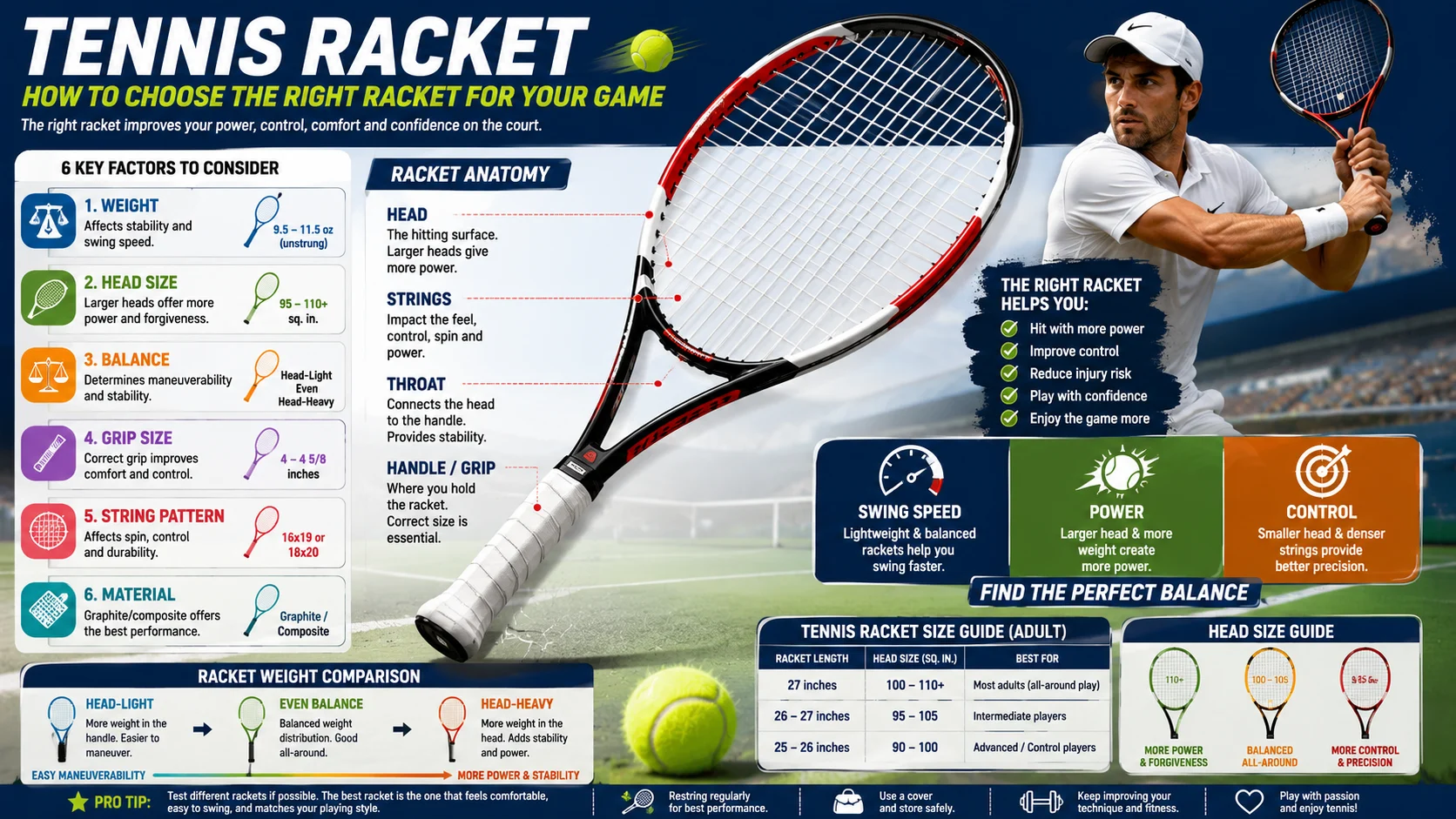
A tennis racket is the main piece of equipment used to hit the ball over the net, and choosing the right one can directly affect power, control, comfort, and swing speed. The best tennis racket depends on your playing level, racket weight, head size, balance, grip size, string pattern, and playing style.
For most beginners, a lightweight or mid-weight racket with a larger head provides easier power and forgiveness. More experienced players often prefer heavier, head-light rackets that offer greater stability and control.
What Is a Tennis Racket?
A tennis racket is a lightweight frame with a stringed hitting surface used to strike a tennis ball. Modern rackets are usually made from graphite or graphite-based composite materials and come in different weights, head sizes, grip sizes, balances, and string patterns.
The right racket should feel comfortable, stable, and easy to control rather than simply being the most powerful or expensive model.
Tennis Racket at a Glance
| Feature | What It Affects | Beginner-Friendly Choice |
|---|---|---|
| Weight | Power, stability, swing speed | Around 9.5–10.5 oz unstrung |
| Head Size | Power and forgiveness | 100–110 sq. in. |
| Balance | Maneuverability vs stability | Even to slightly head-light |
| Grip Size | Comfort and control | Properly fitted to hand |
| String Pattern | Spin, control, durability | 16×19 |
| Material | Feel and performance | Graphite/composite |
| Length | Reach and leverage | 27 inches for most adults |
Why Choosing the Right Tennis Racket Matters
A tennis racket is not just something you hold while playing. It becomes part of your swing.
The wrong racket can make a player work harder than necessary. A racket that is too heavy may slow the swing, while one that is too light may feel unstable against fast shots. A very small head can reward precision but punish off-center contact.
The right racket, on the other hand, can make the game feel noticeably easier.
It can help with:
- Better ball control
- Easier power generation
- Faster swing speed
- Improved stability
- More comfortable contact
- Greater confidence
- Better consistency
This is why choosing a racket based only on brand or appearance is usually a mistake.
How to Choose a Tennis Racket
The best tennis racket depends on who is using it and how they play.
Before buying one, look at these six specifications:
- Racket weight
- Head size
- Balance
- Grip size
- String pattern
- Playing level
Let’s break down each one.
Tennis Racket Weight
Weight is one of the most important specifications.
A lighter racket is generally easier to maneuver and swing quickly. A heavier racket usually provides greater stability and can produce more plow-through when the player has enough strength and technique to control it.
Lightweight Tennis Rackets
Generally around 9–10 ounces unstrung, lightweight rackets can be useful for:
- Beginners
- Juniors moving into adult rackets
- Players who value maneuverability
- People who struggle with heavier equipment
The main advantage is easy handling.
Mid-Weight Tennis Rackets
Rackets around 10–11 ounces unstrung are popular because they offer a useful balance between maneuverability, stability, and power.
For many recreational adult players, this range is an excellent starting point.
Heavy Tennis Rackets
Heavier rackets can provide:
- More stability
- Greater plow-through
- Better performance against heavy incoming shots
- More control for advanced players
However, they require stronger and more efficient swing mechanics.
Important: A heavier racket is not automatically a better racket.
If you cannot swing it comfortably, its extra weight becomes a disadvantage.
Tennis Racket Head Size
Head size refers to the surface area of the racket head, usually measured in square inches.
The larger the head, the larger the potential sweet spot.
| Head Size | General Character | Best Suited For |
|---|---|---|
| Under 95 sq. in. | Precise, demanding | Advanced players |
| 95–100 sq. in. | Control and versatility | Intermediate/advanced |
| 100–105 sq. in. | Balanced | Most players |
| 106–110+ sq. in. | Forgiving and powerful | Beginners/recreational |
Why Larger Tennis Racket Heads Help Beginners
Beginners rarely hit the exact center of the strings on every shot.
A larger racket head provides more forgiveness when contact is slightly off-center.
That can make it easier to:
- Get the ball over the net
- Generate depth
- Maintain consistency
- Learn proper technique
This is why a beginner usually benefits more from forgiveness than from an extremely control-oriented racket.
What Is the Sweet Spot on a Tennis Racket?
The sweet spot is the area of the string bed where contact generally feels cleanest and most efficient.
When the ball strikes near this area, the racket usually produces:
- Less unwanted vibration
- Better energy transfer
- More comfortable impact
- More predictable ball response
A larger head size generally provides a larger forgiving hitting area, although sweet-spot behavior also depends on frame construction, string setup, and weight distribution.
Tennis Racket Balance Explained
Racket balance describes where the weight is distributed along the frame.
There are three basic categories.
Head-Light Tennis Racket
More weight is positioned toward the handle.
Advantages:
- Easier maneuverability
- Quick preparation
- Good for volleys
- Comfortable for fast swings
Advanced players often appreciate this setup because they generate their own power and want maneuverability.
Head-Heavy Tennis Racket
More weight is positioned toward the racket head.
Advantages:
- More stability
- Easier power for some players
- Stronger feel through contact
However, head-heavy rackets can feel slower during quick exchanges.
Even-Balance Tennis Racket
Weight is distributed more evenly.
This provides a compromise between:
Power + Stability + Maneuverability
For recreational players who aren’t sure what balance they prefer, an even or slightly head-light racket can be a sensible starting point.
Tennis Racket Grip Size
Grip size is frequently overlooked, but it can have a major effect on comfort and control.
A grip that is too small may encourage excessive squeezing of the handle. A grip that is too large can make it harder to change grip positions and may feel cumbersome.
For adult players, common grip sizes include approximately:
- 4 inches
- 4 1/8 inches
- 4 1/4 inches
- 4 3/8 inches
- 4 1/2 inches
- 4 5/8 inches
Sizing conventions can vary by region and manufacturer.
Simple Grip-Fit Check
When holding the racket normally, there should generally be a small amount of space between the fingertips and the palm area of the hand.
If you’re between sizes, many players prefer starting with the smaller grip because an overgrip can increase the handle size slightly.
For a serious player, getting measured at a tennis shop or by a coach is even better.
Tennis Racket String Pattern
String pattern affects how the racket interacts with the ball.
The two common patterns are:
16×19
18×20
16×19 String Pattern
A 16×19 pattern generally provides:
- Easier access to spin
- More open string movement
- A lively response
- Good all-around performance
It is a popular choice for recreational and competitive players.
18×20 String Pattern
An 18×20 pattern has more strings and is generally denser.
It can provide:
- More predictable response
- Strong control
- A firmer feel
- Potentially greater string durability
Players who prioritize precision may prefer this type of setup.
Tennis Racket Length
A standard adult tennis racket is generally around 27 inches long.
Longer rackets can provide additional reach and leverage, but they may be more difficult to maneuver.
For most adult recreational players, a standard-length racket is the easiest place to start.
Junior players need specially sized rackets based on height and age rather than simply choosing an adult model.
Best Tennis Racket for Beginners
If you’re buying your first tennis racket, don’t overcomplicate the decision.
Look for:
- Moderate weight
- Larger head size
- Comfortable grip
- Forgiving string pattern
- Easy maneuverability
- Durable construction
A racket around 100–110 sq. in. with a manageable weight is often a practical starting point for an adult beginner.
The goal is to make learning easier not to buy professional-level equipment before developing the skills to use it.
Best Tennis Racket for Intermediate Players
Once your technique becomes more consistent, you may start noticing what your current racket lacks.
An intermediate player might want:
- More stability
- Better directional control
- Greater spin potential
- More precise feedback
- A slightly heavier frame
At this stage, racket selection becomes more personal.
Two intermediate players can prefer completely different rackets because their strokes and playing styles are different.
Best Tennis Racket for Advanced Players
Advanced players typically generate substantial racket-head speed themselves.
They may therefore prioritize:
- Stability
- Control
- Feel
- Precision
- Swing weight
- Customization potential
A heavier, more control-oriented racket can be excellent in the hands of a strong and technically proficient player.
But advanced equipment isn’t automatically better for everyone.
Power vs. Control: Which Tennis Racket Should You Choose?
This is one of the most important decisions when selecting a racket.
Choose a More Powerful Racket If:
- You struggle to generate depth.
- Your swing is relatively slow.
- You’re a beginner.
- You want more help from the racket.
- You prefer a larger sweet spot.
Choose a More Control-Oriented Racket If:
- You already generate plenty of pace.
- Your shots frequently sail long.
- You have developed consistent technique.
- You want more predictable response.
- You can comfortably handle additional racket weight.
The ideal racket sits somewhere between these characteristics for many players.
Tennis Racket for Spin
If topspin is a major part of your game, look for a combination of:
- Open string pattern
- Appropriate head size
- Spin-friendly string setup
- Manageable swing weight
- Fast racket-head speed
But remember: the racket does not create spin by itself.
Technique, racket-head speed, contact point, swing path, and strings all contribute.
Tennis Racket for Beginners vs. Professionals
| Feature | Beginner | Intermediate | Advanced |
|---|---|---|---|
| Head Size | Larger | Medium | Smaller/medium |
| Weight | Lighter | Moderate | Moderate/heavy |
| Forgiveness | High | Medium-high | Lower |
| Power Assistance | High | Moderate | Player-generated |
| Control | Moderate | High | Very high |
| Maneuverability | High | Balanced | Player-dependent |
The biggest difference is not that professional rackets are magically superior.
They are simply designed around players who already possess the strength and technique to take advantage of their characteristics.
How Much Does a Good Tennis Racket Cost?
Tennis rackets are available across a wide price range.
You can find:
- Entry-level rackets
- Recreational rackets
- Intermediate performance rackets
- Premium tournament rackets
Price often increases with advanced materials, construction, technology, and brand positioning.
However, spending more doesn’t guarantee better results.
For a beginner, investing in the right specifications is usually more valuable than buying the most expensive racket available.
How Often Should You Replace a Tennis Racket?
There is no fixed replacement schedule.
A racket may last for years if it is properly maintained and doesn’t suffer structural damage.
Consider replacing it when:
- The frame becomes cracked.
- The racket is visibly damaged.
- The grommets are severely worn.
- The racket no longer feels consistent.
- You have significantly changed your playing level.
- Your current specifications no longer suit your game.
Strings, meanwhile, generally need attention much more frequently than the racket frame itself.
Tennis Racket vs. Tennis Racquet
Tennis racket and tennis racquet mean the same thing.
“Racket” is the more common spelling in general English, while “racquet” is also widely used in tennis terminology and branding.
For search purposes, both terms are worth understanding.
Common Tennis Racket Buying Mistakes
Buying Too Heavy
Players sometimes assume heavier automatically means more powerful.
If you cannot maintain racket-head speed, the extra weight can work against you.
Choosing Based Only on Brand
A famous professional’s racket isn’t necessarily right for your game.
Ignoring Grip Size
An uncomfortable grip can affect your entire swing.
Choosing Too Small a Head
Control-oriented rackets can be demanding for beginners.
Forgetting Strings
The racket frame is only part of the equation. String type, tension, and condition can significantly change how a racket plays.
Tennis Racket Buying Checklist
Before purchasing, ask:
What is my playing level?
Beginner, intermediate, or advanced?
What do I need most?
Power, control, spin, comfort, or maneuverability?
Can I comfortably swing the racket?
If not, look for something lighter or better balanced.
Is the grip size correct?
Don’t ignore hand comfort.
What head size do I need?
Larger usually means more forgiveness; smaller can offer more precision.
Does it match my playing style?
Your racket should complement your game not force you to change it.
Frequently Asked Questions
What is the best tennis racket for beginners?
For most adult beginners, a manageable racket with a larger head size, comfortable grip, and moderate weight is a good starting point. These characteristics provide forgiveness without making the racket difficult to control.
What racket weight should a beginner use?
Many adult beginners do well with a racket in the lighter-to-midweight range, but the correct weight depends on strength, fitness, swing speed, and comfort. The racket should feel easy to control throughout a full session.
Is a heavier tennis racket better?
Not necessarily. Heavier rackets can offer greater stability and plow-through, but they require more strength and swing speed. A racket that is too heavy can reduce maneuverability and cause fatigue.
What tennis racket size is best?
For most adult players, a standard 27-inch racket is a practical choice. Head size should be selected according to playing level and desired balance between forgiveness, power, and control.
What head size is best for beginners?
A racket around 100–110 square inches is commonly a comfortable starting range because it provides a useful combination of power and forgiveness.
What is the difference between 16×19 and 18×20?
16×19 is an open string pattern that generally offers easier access to spin and a livelier response. 18×20 is denser and often emphasizes control and predictable response.
How long does a tennis racket last?
A quality racket can last for several years or longer if it is maintained properly. Its lifespan depends on frequency of play, storage, impact damage, stringing, and overall care.
Should beginners use professional tennis rackets?
Usually, beginners benefit more from forgiving and easy-to-swing equipment than from demanding professional-oriented frames. Advanced rackets make more sense once a player has developed the technique and strength to use them effectively.
Final Verdict
The best tennis racket isn’t necessarily the lightest, heaviest, most expensive, or most popular model. It is the racket that matches your game.
For beginners, forgiveness and easy handling are usually more important than maximum control. Intermediate players can start fine-tuning weight, balance, head size, and string pattern according to their style. Advanced players can benefit from heavier and more precise frames when their technique and physical strength allow them to control the additional demands.
If you’re buying a racket for the first time, start with the fundamentals: comfortable weight, correct grip size, appropriate head size, suitable balance, and the right certification/specifications for your needs. Once those basics are right, the racket becomes an asset rather than another variable you have to fight.
The perfect tennis racket should make you think about your next shot not the racket in your hand.
Key Takeaways
- A tennis racket affects power, control, spin, stability, and comfort.
- Beginners generally benefit from forgiving, manageable rackets.
- Racket weight should match your strength and swing speed.
- Larger heads usually provide greater forgiveness.
- Grip size is important for comfort and control.
- Head-light rackets are generally easier to maneuver.
- Open string patterns such as 16×19 can help players access spin.
- More expensive does not automatically mean better.
- Your playing style should ultimately determine your racket choice.

Daniel Brooks is a sports writer at SportsOrbitX.com, specializing in football, basketball and global sports news. He focuses on delivering accurate reporting, match analysis and timely updates that keep fans informed.