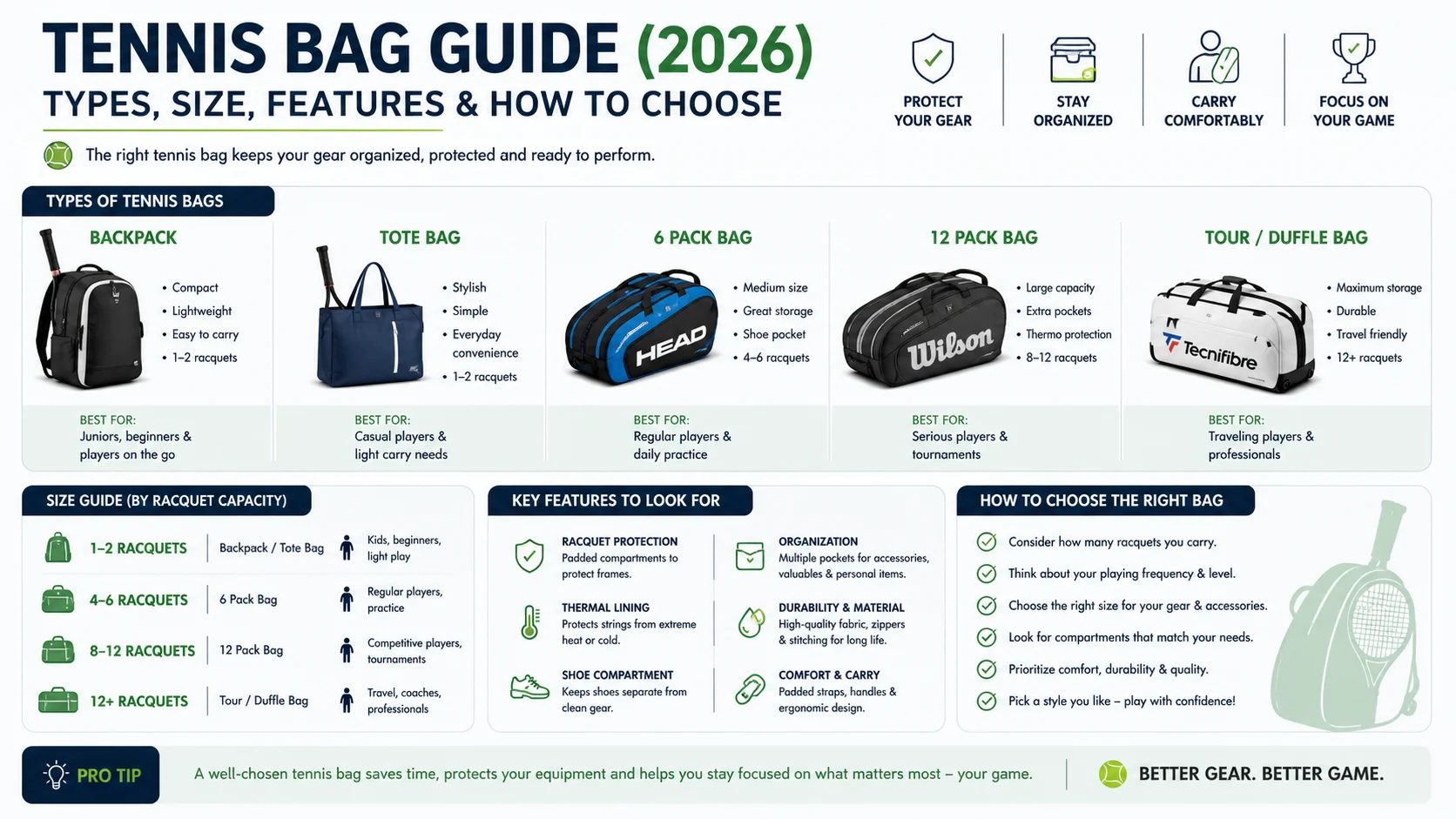
The right tennis bag protects rackets and organizes gear.
A tennis bag is more than something you carry your racket in. The right bag protects your equipment, keeps your shoes and clothes separate, holds tennis balls and accessories, and makes it much easier to move from home to the court.
Whether you play tennis casually on weekends, practice several times a week, or compete regularly, choosing the right tennis bag comes down to three things: how much gear you carry, how many rackets you need, and how you prefer to transport it.
From compact racket bags and tennis backpacks to large tournament bags, there is a style for almost every player.
What Is a Tennis Bag?
A tennis bag is a purpose-built bag designed to carry and protect tennis equipment and personal gear.
Most tennis bags have dedicated or padded compartments for rackets, while larger models can include separate spaces for:
- Tennis shoes
- Tennis balls
- Clothing
- Towels
- Water bottles
- Grips and overgrips
- Wristbands
- Phone and keys
- Tennis accessories
Unlike an ordinary backpack or gym bag, a tennis bag is designed around the unusual shape and protection needs of tennis rackets.
Why Do You Need a Tennis Bag?
You can technically carry a racket in almost any large bag, but a dedicated tennis bag offers several important advantages.
Racket Protection
A good tennis bag helps protect your racket from scratches, impacts and unnecessary exposure to the elements.
Padded racket compartments are especially useful when you carry more than one racket.
Better Organization
Instead of throwing your racket, shoes, towel and clothes into one large compartment, a tennis bag allows you to separate your equipment.
This is particularly helpful when you play frequently.
Easy Transportation
Tennis bags are designed to be carried comfortably. Depending on the style, you may get backpack straps, shoulder straps or handles.
Separation of Shoes and Clothing
Some larger bags include a dedicated shoe compartment. This keeps dirty court shoes away from clean clothing and other equipment.
Types of Tennis Bags
There is no single “best” tennis bag for every player. The ideal type depends on your playing frequency and how much equipment you normally carry.
Tennis Backpack
A tennis backpack is one of the most convenient options for casual and recreational players.
It typically has room for one or two rackets along with smaller accessories, clothing and personal items.
Best for:
- Casual players
- Commuters
- Students
- Players who use public transportation
- People who prefer hands-free carrying
A backpack is especially practical when you don’t want to carry a large tournament-style bag.
Tennis Racket Bag
A traditional racket bag is designed primarily around racket storage.
Depending on the size, it may hold anywhere from a couple of rackets to several rackets plus clothing and accessories.
Best for:
- Regular players
- Club players
- Players who carry multiple rackets
- Training sessions
Tennis Duffel Bag
A tennis duffel combines the capacity of a sports duffel with racket-friendly storage.
It can be a good middle ground for players who need more room than a backpack but don’t want a large tournament bag.
Tennis 3-Racket Bag
A 3-racket bag is useful for players who regularly carry multiple rackets but don’t need a huge amount of additional equipment.
It gives you enough racket capacity for a primary racket plus backups without becoming unnecessarily bulky.
Tennis 6-Racket Bag
A 6-racket bag provides considerably more capacity and is often suitable for competitive players.
It can accommodate several rackets while leaving space for clothing, balls, towels and accessories.
Tennis 9- or 12-Racket Bag
Large racket bags are designed for serious competitors, coaches and players who carry extensive equipment.
These bags can include multiple racket compartments and specialized storage for shoes, clothing and accessories.
If you only carry one racket and a water bottle, however, a bag this large may be unnecessary.
Tennis Bag Size Guide
The right size depends mainly on how much equipment you carry.
| Tennis Bag Type | Typical Capacity | Best For |
|---|---|---|
| Tennis Backpack | 1–2 rackets | Casual players |
| 3-Racket Bag | Up to 3 rackets | Regular players |
| 6-Racket Bag | Up to 6 rackets | Competitive players |
| 9-Racket Bag | Up to 9 rackets | Tournament players |
| 12-Racket Bag | Up to 12 rackets | Serious competitors/coaches |
Remember that racket capacity is not the same as total storage capacity. A bag advertised as holding six rackets may also have additional compartments for clothing, shoes and accessories.
How Many Rackets Should Your Tennis Bag Hold?
For many recreational players, a 1- or 2-racket bag is enough.
If you play competitively, carrying at least one backup racket can be useful. A broken string during a match can turn a minor equipment problem into a major inconvenience.
Players who routinely travel to tournaments may prefer a larger bag because they need room for multiple rackets, clothing, towels, shoes, balls and other essentials.
One Racket
Best for:
- Beginners
- Casual players
- Occasional court sessions
Two to Three Rackets
Best for:
- Regular club players
- Intermediate players
- Players who want a backup racket
Six or More Rackets
Best for:
- Competitive players
- Tournament players
- Coaches
- Players carrying different racket setups
What Should You Look for in a Tennis Bag?
The number of rackets is only the beginning. A quality tennis bag should also make your equipment easy to access and protect it during transportation.
Padded Racket Compartments
Look for dedicated compartments with padding, especially if you frequently travel with expensive rackets.
Shoe Compartment
A ventilated shoe compartment is one of the most useful features in a larger tennis bag.
It keeps sweaty or dusty tennis shoes away from rackets, clothes and other gear.
Accessory Pockets
Small pockets are useful for items that are easy to lose inside a large compartment.
These can include:
- Keys
- Wallet
- Phone
- Sunglasses
- Grips
- Strings
- Dampeners
Water Bottle Storage
A dedicated bottle pocket makes hydration easier during long practices and matches.
Comfortable Straps
If you regularly walk or cycle to the court, strap design becomes especially important.
A backpack-style carrying system can distribute weight more comfortably than a single shoulder strap.
Durable Material
A tennis bag should be able to handle regular transportation, court surfaces and changing weather conditions.
Look for strong fabric, quality stitching and reliable zippers.
Tennis Bag vs. Tennis Backpack
Both can be excellent choices, but they serve different needs.
| Feature | Tennis Bag | Tennis Backpack |
|---|---|---|
| Racket Capacity | Usually higher | Usually lower |
| Storage | Large | Moderate |
| Portability | Good | Excellent |
| Tournament Use | Excellent | Good |
| Everyday Carry | Good | Excellent |
| Multiple Rackets | Better | Limited |
A tennis backpack is usually the better choice for someone who wants convenience and portability.
A traditional tennis bag is better if you carry several rackets and a lot of equipment.
What Should You Pack in a Tennis Bag?
A well-packed tennis bag can save you from scrambling before a match.
Essential Tennis Gear
At minimum, consider carrying:
- Tennis racket
- Backup racket if needed
- Tennis balls
- Water bottle
- Towel
- Tennis shoes
- Extra shirt
- Extra socks
- Grips or overgrips
Useful Accessories
Depending on how often you play, you may also want:
- Wristbands
- Hat or visor
- Sunscreen
- Phone
- Small first-aid supplies
- Energy snacks
- Ball dampeners
- Stringing accessories
Competitive players generally need more equipment than recreational players, so their bags naturally become larger.
Can You Use a Tennis Bag as a Gym Bag?
Yes, particularly if the tennis bag has a large main compartment.
However, tennis bags are optimized around racket storage, while gym bags are generally designed for clothing, shoes and workout equipment.
If tennis is your primary activity, a tennis bag offers more practical organization.
If you regularly combine tennis with gym sessions, choose a larger model with flexible storage.
How to Keep Your Tennis Bag Organized
A large bag can quickly become messy if everything is thrown into the same compartment.
Try organizing equipment by purpose:
Racket compartment:
Rackets and protective accessories.
Shoe compartment:
Tennis shoes and socks.
Main compartment:
Clothing, towels and larger items.
Small pockets:
Phone, keys, grips, dampeners and other accessories.
This simple system makes finding equipment much faster before and after matches.
How to Choose the Right Tennis Bag
The easiest way to choose is to answer five questions.
How Many Rackets Do You Carry?
This determines the minimum racket capacity you need.
Do You Carry Tennis Shoes?
If yes, prioritize a dedicated shoe compartment.
Do You Travel to Tournaments?
If you regularly travel, choose a larger and more protective bag.
Do You Walk or Cycle to the Court?
A tennis backpack may be more comfortable and practical.
How Much Extra Gear Do You Carry?
If you only carry a racket and a few accessories, don’t buy a huge bag simply because it has more capacity.
The best tennis bag is the smallest bag that comfortably carries everything you actually use.
Tennis Bag for Beginners
Beginners rarely need a massive tournament bag.
A compact tennis backpack or small racket bag is usually enough for:
- One racket
- Balls
- Water
- Towel
- Small accessories
- Change of clothes
As your playing frequency increases, you can upgrade to a larger bag.
Tennis Bag for Competitive Players
Competitive players often need considerably more storage.
A larger racket bag can provide space for:
- Multiple rackets
- Match clothing
- Practice clothing
- Tennis shoes
- Towels
- Balls
- Grips
- Accessories
- Food and hydration
For tournament players, organization becomes just as important as capacity.
How to Clean and Maintain a Tennis Bag
Your tennis bag will last longer if you take care of it properly.
Empty It Regularly
Remove old balls, wrappers, used towels and clothing after every session.
Let Damp Gear Dry
Don’t leave sweaty clothing or wet towels inside the bag overnight.
Clean the Interior
Occasionally empty the bag completely and wipe the interior according to the manufacturer’s care instructions.
Protect It From Extreme Conditions
Avoid leaving the bag in places where excessive heat, moisture or direct sunlight could damage the materials or equipment inside.
Frequently Asked Questions
What is the best type of tennis bag?
The best type depends on your needs. A tennis backpack is excellent for casual players, while larger racket bags are better for players carrying multiple rackets and tournament equipment.
How many rackets can a tennis bag hold?
Tennis bags range from compact models designed for one or two rackets to large tournament bags capable of holding six, nine, twelve or more rackets.
Do tennis bags have shoe compartments?
Many larger tennis bags include dedicated shoe compartments, although the exact design varies between models.
Is a tennis backpack better than a tennis bag?
Neither is universally better. A backpack offers excellent portability, while a traditional racket bag usually provides more capacity and better organization for multiple rackets.
What should I carry in my tennis bag?
A typical setup includes a racket, tennis balls, water, towel, shoes, extra clothing and essential accessories such as grips and dampeners.
Can a tennis bag protect my racket?
A properly designed tennis bag with padded racket compartments can help protect rackets during transportation and storage.
What size tennis bag do I need?
Choose based on the number of rackets and amount of equipment you carry. One-racket players can use a compact bag, while tournament players generally need substantially more capacity.
Final Verdict
A tennis bag should make playing tennis easier, not give you another piece of equipment to worry about. The right choice protects your rackets, separates your shoes and clothing, keeps accessories organized and gives you enough space without unnecessary bulk.
For a casual player, a compact tennis backpack or small racket bag is usually enough. Regular players may benefit from a 3- or 6-racket bag, while competitive and tournament players often need larger bags with multiple racket compartments and dedicated storage.
Don’t choose a tennis bag simply because it looks impressive or holds the maximum number of rackets. Think about what you actually take to the court. Capacity, racket protection, comfort, organization and durability matter far more than having the biggest bag.
Ultimately, the best tennis bag is the one that fits your game, your equipment and your routine.