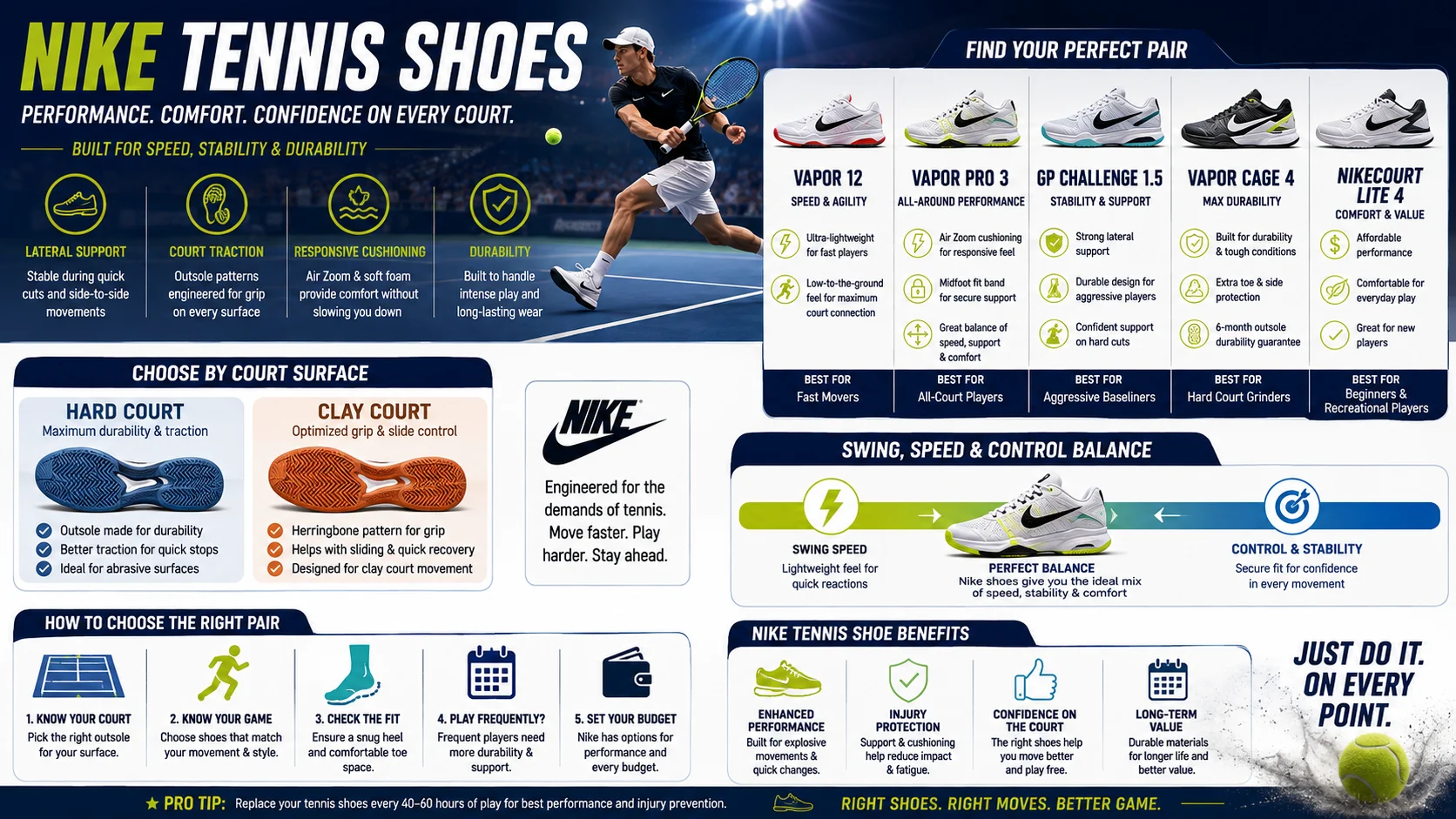
Nike tennis shoes are designed around the demands of tennis, including rapid lateral movement, sudden stops, explosive push-offs, and repeated court impact. In 2026, Nike’s lineup includes options such as the Vapor 12, Vapor Pro 3, GP Challenge 1.5, Vapor Cage 4, and NikeCourt Lite 4, giving players choices for speed, stability, durability, cushioning, and value.
For most players, the right Nike tennis shoe depends less on the brand name and more on your court surface, playing style, foot shape, movement pattern, and how much support or durability you need.
Are Nike Tennis Shoes Good?
Yes. Nike makes some of the most recognizable tennis shoes because its tennis range is built specifically for the movements that happen on a court not simply adapted from running shoes.
The biggest advantage is variety. A fast player who constantly moves forward and backward needs a different shoe from a hard-court grinder who destroys the outsole or a recreational player who mainly wants comfort.
Quick Comparison
| Nike Tennis Shoe | Best For | Main Strength |
|---|---|---|
| Nike Vapor 12 | Fast, aggressive movers | Speed and court feel |
| Nike Vapor Pro 3 | All-around competitive play | Speed + cushioning |
| Nike GP Challenge 1.5 | Aggressive baseline players | Stability and support |
| Nike Vapor Cage 4 | Hard-court grinders | Durability |
| NikeCourt Lite 4 | Recreational players | Value and everyday comfort |
Nike’s current tennis collection includes both premium performance models and more accessible options, so you don’t necessarily need the most expensive shoe to get a tennis-specific setup.
What Makes Nike Tennis Shoes Different?
Tennis places unusual demands on footwear.
A player can sprint toward a ball, stop suddenly, push sideways, recover toward the center, and repeat the movement dozens of times in a single rally.
That’s why a proper tennis shoe needs to provide more than soft cushioning.
Lateral Stability
Running shoes are primarily designed for forward motion. Tennis shoes have to handle movement in multiple directions.
Nike’s performance tennis models are designed around side-to-side cuts, quick stops, and aggressive changes of direction. The Vapor Pro 3, for example, uses a full midfoot fit band to help create a secure feel during sharper cuts.
Court Traction
The outsole is arguably one of the most important parts of a tennis shoe.
Too little traction can make movement feel unstable. Too much uncontrolled grip can interfere with natural movement.
Nike’s tennis shoes use court-specific outsole designs, with models available for hard and clay courts.
Cushioning Without Losing Responsiveness
Tennis players need impact protection, but excessive softness can make quick movement feel sluggish.
Nike uses Air Zoom cushioning in several tennis models to provide responsive cushioning during movement and push-off.
Best Nike Tennis Shoes in 2026
Nike Vapor 12
The Nike Vapor 12 is aimed at players who prioritize fast movement and a performance-oriented feel.
It sits in Nike’s premium tennis lineup and is available in both men’s and women’s versions.
Best For
- Fast movers
- Aggressive all-court players
- Players who value responsiveness
- Competitive tennis
If your game is built around reaching difficult balls quickly and recovering into position, the Vapor family is worth considering.
Nike Vapor Pro 3
The Nike Vapor Pro 3 is one of the most versatile choices in Nike’s current tennis lineup.
Nike says the shoe is designed to provide bounce and responsiveness during side-to-side movement and scrambles to the net. Its Air Zoom cushioning is paired with a lighter rubber compound, while the outsole is designed to help players decelerate, plant, and recover.
Why It Stands Out
- Responsive cushioning
- Lightweight feel
- Strong lateral movement
- Secure midfoot fit
- Hard-court and clay-court versions
- Good option for all-court players
For someone searching for a Nike tennis shoe that can handle a wide range of playing situations, the Vapor Pro 3 is one of the easiest models to recommend.
Nike GP Challenge 1.5
The Nike GP Challenge 1.5 is another performance-focused option in Nike’s lineup and is particularly interesting for players who want stability during aggressive movement. Nike currently offers men’s and women’s versions, including court-specific models.
Best For
- Baseline players
- Aggressive hitters
- Players who load heavily into their cuts
- Those wanting a more supportive performance shoe
This is the type of shoe to consider if your priority is controlled movement rather than simply having the lightest shoe possible.
NikeCourt Air Zoom Vapor Cage 4
If durability is your biggest concern, the NikeCourt Air Zoom Vapor Cage 4 deserves serious attention.
Nike describes it as its most durable Vapor shoe and uses additional high-wear protection, including outsole tread that extends onto the upper. The design also hides the laces within the upper to help protect them during sliding.
Best For
- Hard-court players
- Frequent competitors
- Aggressive movers
- Players who slide frequently
- People who destroy tennis shoe outsoles quickly
The Vapor Cage 4 isn’t necessarily the first choice for someone who wants an ultra-light shoe. Its appeal is durability, stability, and protection.
NikeCourt Lite 4
The NikeCourt Lite 4 is a more accessible option for players who don’t need a premium performance shoe.
Nike currently lists men’s and women’s versions, as well as hard-court and clay-court options.
Best For
- Recreational players
- Beginners
- Occasional tennis
- Players looking for a lower-cost Nike option
If you play once or twice a week and aren’t putting extreme demands on your footwear, spending significantly more on a top-tier performance model may not provide much additional value.
Nike Tennis Shoes by Playing Style
The best Nike tennis shoe isn’t the same for everyone.
Best Nike Tennis Shoes for Fast Players
Look toward the Vapor family.
Players who constantly move around the court generally benefit from a shoe that feels responsive and doesn’t unnecessarily weigh them down.
The Vapor Pro 3 is particularly compelling because Nike combines Air Zoom cushioning with a lighter outsole compound and a secure midfoot fit.
Best Nike Tennis Shoes for Aggressive Baseliners
Consider the GP Challenge 1.5.
A baseline player who repeatedly loads the outside of the foot during powerful groundstrokes needs stability as much as speed.
Best Nike Tennis Shoes for Durability
The Vapor Cage 4 is the obvious choice when outsole life and protection are priorities.
Its construction specifically targets high-wear areas, and Nike backs the outsole with a six-month durability guarantee.
Best Nike Tennis Shoes for Beginners
The NikeCourt Lite 4 is a sensible starting point.
Beginners generally don’t need to spend premium money immediately. A tennis-specific shoe with appropriate traction and support is more important than buying the most advanced model.
Nike Tennis Shoes for Hard Courts
Hard courts are unforgiving.
They create repeated impact and can wear through outsole rubber faster than softer surfaces.
If you primarily play hard-court tennis, look for:
- Durable outsole rubber
- Strong lateral support
- Forefoot protection
- Reliable traction
- Adequate cushioning
The Vapor Pro 3 is designed specifically for hard-court use in the listed model, while the Vapor Cage 4 emphasizes durability and protection.
Nike Tennis Shoes for Clay Courts
Clay requires a different outsole approach because players frequently slide and then need to recover quickly.
Don’t simply buy a hard-court tennis shoe because it looks similar.
Nike offers clay-court versions of several models, including the Vapor Pro 3 and NikeCourt Lite 4.
Why Clay-Court Shoes Matter
Clay-specific footwear is designed around:
- Sliding control
- Court grip
- Quick recovery
- Managing loose clay beneath the foot
If clay is your primary surface, choose a model specifically designated for clay rather than assuming any tennis shoe will perform equally well.
Are Nike Tennis Shoes Good for Wide Feet?
This is where you should be careful.
Nike tennis shoes don’t all fit identically, and a model that feels excellent on one foot can feel restrictive on another.
Instead of choosing based solely on the Nike name, pay attention to:
- Toe-box space
- Midfoot pressure
- Heel lockdown
- Overall shoe shape
- Your normal Nike size
Try the shoes on with the socks you normally wear for tennis and perform a few lateral movements before deciding.
A good tennis shoe should feel secure without creating pressure points.
How Should Nike Tennis Shoes Fit?
Your tennis shoe should feel secure, not squeezed.
There should be enough room for your toes to move naturally, while the heel should remain firmly contained during sudden stops.
Simple Fit Test
When trying on a Nike tennis shoe:
- Stand normally.
- Make sure your toes aren’t pressing against the front.
- Lace the shoe firmly.
- Perform a lateral shuffle.
- Stop suddenly.
- Check whether your heel moves excessively.
- Look for pressure or rubbing.
If the foot slides around inside the shoe, the problem isn’t something you should expect to “break in.”
Nike Tennis Shoes vs. Running Shoes
If you’re playing actual tennis, tennis shoes are usually the smarter choice.
Running shoes are designed primarily for forward movement. Tennis shoes are designed for lateral cuts, sudden braking, court traction, and repeated changes of direction.
That difference becomes increasingly important as your movement becomes more aggressive.
A running shoe may feel comfortable during a warm-up but behave very differently when you suddenly have to chase a wide ball.
How Long Do Nike Tennis Shoes Last?
There isn’t one universal lifespan.
A recreational player might get substantially more use from a pair than someone playing several competitive matches every week.
Durability depends on:
- Court surface
- Playing frequency
- Body weight
- Movement style
- Sliding habits
- Outsole construction
Hard-court players and aggressive movers should pay particular attention to outsole wear.
Replace tennis shoes when traction, cushioning, stability, or structural support has noticeably deteriorated even if the upper still looks acceptable.
Are Expensive Nike Tennis Shoes Worth It?
Sometimes but not for everyone.
A premium Nike tennis shoe can make sense if you:
- Play frequently
- Compete regularly
- Need advanced stability
- Put heavy stress on your footwear
- Want specialized performance features
For casual players, however, a less expensive NikeCourt model may provide everything necessary.
The smartest purchase isn’t the most expensive one. It’s the shoe whose characteristics match your actual game.
How to Choose the Right Nike Tennis Shoes
Before buying, answer these five questions:
What Court Do You Play On?
Hard court and clay court shoes aren’t interchangeable in every situation.
How Do You Move?
Fast movers may prefer a lighter, responsive shoe. Heavy sliders may prioritize durability.
Do You Need Stability?
If you make aggressive lateral cuts, stability should be high on your list.
How Often Do You Play?
Occasional players can often choose a simpler model, while frequent competitors may benefit from premium construction.
Where Does Your Current Shoe Fail?
This is one of the most useful questions.
If your current shoes wear out at the toe, prioritize durability.
If your heel moves, prioritize lockdown.
If your feet hurt after long matches, look more closely at cushioning and fit.
If you feel slow, consider a more responsive and lightweight design.
Frequently Asked Questions
Which Nike tennis shoe is best overall?
The Nike Vapor Pro 3 is one of the strongest all-around choices because it combines responsive cushioning, lateral support, flexibility, and a secure fit.
What are the best Nike tennis shoes for hard courts?
The Vapor Pro 3 and Vapor Cage 4 are strong choices, depending on whether you prioritize speed and responsiveness or durability and protection.
Are Nike tennis shoes good for beginners?
Yes. Beginners don’t necessarily need Nike’s most expensive performance model. A tennis-specific option such as the NikeCourt Lite 4 can be a practical starting point.
Can I use Nike running shoes for tennis?
It’s better to use tennis-specific shoes. Tennis involves significantly more lateral movement and sudden stopping than ordinary running.
Are Nike tennis shoes good for clay courts?
Yes, but choose a Nike model specifically offered in a clay-court version. Nike currently lists clay versions of models including the Vapor Pro 3 and NikeCourt Lite 4.
How do I know when to replace Nike tennis shoes?
Replace them when the outsole loses meaningful traction or when cushioning, stability, or structural support has noticeably declined. Visual appearance alone isn’t a reliable indicator.
What should I look for in Nike tennis shoes?
Focus on court surface, traction, lateral stability, cushioning, durability, fit, and your playing style. These factors matter more than color or brand popularity.
Final Verdict
Nike’s tennis lineup is broad enough that there isn’t one model that can honestly be called the best Nike tennis shoe for everyone.
For a fast, all-around performance option, the Vapor Pro 3 stands out for its combination of responsiveness, cushioning, lateral movement, and secure fit.
For players who prioritize durability, particularly on hard courts, the Vapor Cage 4 is the more compelling choice.
Aggressive baseline players should consider the GP Challenge 1.5, while recreational players and beginners may find better value in the NikeCourt Lite 4. Nike’s premium Vapor 12 is another option for players focused on speed and performance.
The important thing is not buying the shoe with the biggest name. Buy the shoe that solves the biggest problem in your current game. That’s what turns a tennis shoe from a piece of equipment into something that can actually help you move, compete, and play with confidence.