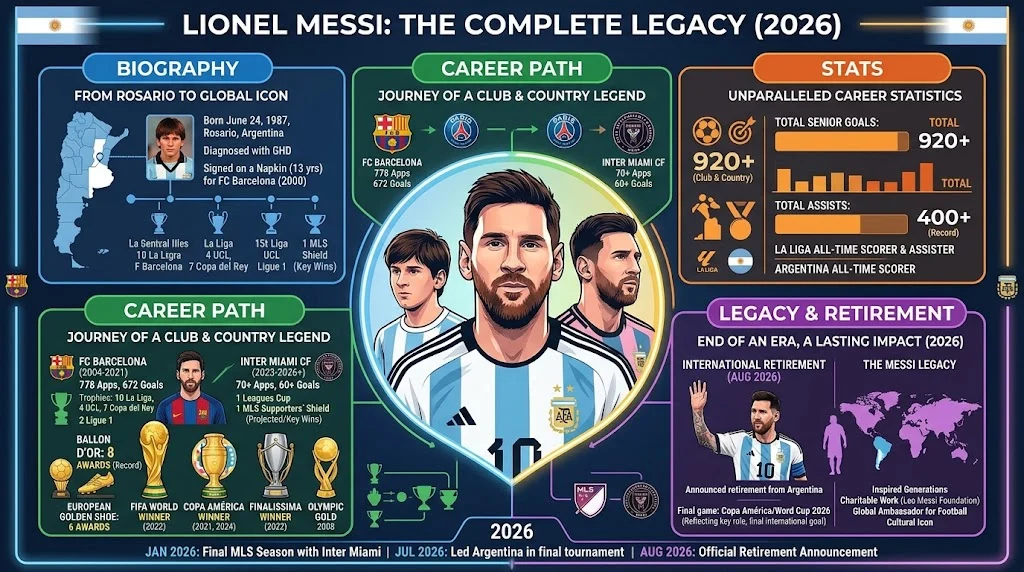
Lionel Messi is an Argentine football legend widely regarded as one of the greatest players in history. He won the 2022 FIFA World Cup, Copa América titles in 2021 and 2024, and a record eight Ballon d’Or awards. After reaching the 2026 World Cup final with Argentina, Messi announced his retirement from international football on August 31, 2026. He continues his club career with Inter Miami through the 2028 MLS season.
Lionel Messi Quick Facts
| Category | Details |
|---|---|
| Full Name | Lionel Andrés Messi |
| Known As | Lionel Messi, Leo Messi, La Pulga |
| Nationality | Argentine |
| Position | Forward / Attacking Playmaker |
| Famous Number | 10 |
| Current Club | Inter Miami |
| National Team | Argentina |
| World Cup Titles | 1 |
| Copa América Titles | 2 |
| Ballon d’Or | 8 |
| World Cup Appearances | 6 |
| 2026 World Cup Goals | 8 |
| 2026 World Cup Assists | 4 |
| Argentina Status | Retired from international football |
| Inter Miami Contract | Through 2028 MLS season |
The 2026 numbers are particularly remarkable because Messi was 39 years old during the tournament. He scored eight goals and recorded four assists at the 2026 World Cup, finishing second in the Golden Boot race behind Kylian Mbappé.
Who Is Lionel Messi?
Lionel Messi is an Argentine footballer whose career has combined extraordinary scoring ability, creativity, dribbling, passing, and longevity.
But describing Messi as simply a goal scorer misses what made him different.
He could create a goal from almost nothing.
A crowded penalty area, two defenders closing in, barely any space Messi could receive the ball, change direction in an instant, accelerate through the gap, and either finish himself or produce a pass that seemed impossible a second earlier.
That combination of vision, close control, balance, and decision-making made him one of the most influential footballers of his generation.
His career has taken him from Rosario, Argentina, to Barcelona, Paris Saint-Germain, Inter Miami, and the biggest stages in international football.
And by 2026, his story had reached another extraordinary chapter.
Lionel Messi’s Early Life
Messi was born in Rosario, Argentina, in 1987 and developed a passion for football at an extremely young age.
As a child, his talent quickly became obvious.
He joined Newell’s Old Boys and eventually moved to Spain as a youngster, where he entered FC Barcelona’s La Masia academy.
That move changed the direction of his life.
Barcelona didn’t simply develop Messi into a professional footballer. The club gave him an environment in which his technical ability could develop at the highest level.
His path wasn’t completely straightforward, however. Messi faced a medical challenge involving growth hormone deficiency during his youth, and his family’s decision to move to Spain became an important part of his development.
The small Argentine boy would eventually become Barcelona’s greatest scorer.
Lionel Messi at Barcelona
Messi’s Barcelona career is where his legend truly exploded.
He made his first-team debut in 2004 and spent 17 seasons with the club before leaving in 2021.
The numbers are extraordinary.
According to FC Barcelona, Messi finished his official Barcelona career with 778 appearances and 672 goals, along with 35 trophies.
Major Barcelona Achievements
With Barcelona, Messi won:
- 10 La Liga titles
- 4 UEFA Champions League titles
- 7 Copa del Rey titles
- 8 Spanish Super Cups
- 3 FIFA Club World Cups
- 3 UEFA Super Cups
One season stands out even among his incredible career.
During the 2011–12 season, Messi scored 73 goals in official competitions for Barcelona. FC Barcelona lists this as the club’s record for goals in a single season.
Then came 2012.
Messi scored 91 goals in the calendar year, establishing one of the most famous individual records in modern football.
Why Was Lionel Messi So Good?
Messi’s greatness wasn’t based on one skill.
It was the combination.
Dribbling
Messi’s low center of gravity allowed him to change direction incredibly quickly.
Instead of relying purely on straight-line speed, he used tiny movements to manipulate defenders.
One step left.
A sudden cut right.
A burst forward.
And suddenly the defender was behind him.
Ball Control
Messi’s first touch became one of his greatest weapons.
He could receive difficult passes while already preparing his next move.
That meant he often appeared to have more time than everyone else.
Passing and Vision
Messi eventually developed into much more than a winger or forward.
He became a playmaker capable of seeing passing lanes before they opened.
His assists became just as important as his goals.
Finishing
His left foot became legendary.
Messi could score:
- From outside the box
- From free kicks
- From tight angles
- In one-on-one situations
- With chips over goalkeepers
- From penalties
- After long dribbling runs
This versatility made defending him incredibly difficult.
Lionel Messi and Argentina
For much of Messi’s early international career, success with Argentina seemed strangely difficult.
He reached major finals but repeatedly came away disappointed.
Argentina lost the 2014 World Cup final to Germany and suffered Copa América final defeats in 2015 and 2016.
In 2016, Messi even announced his international retirement after the Copa América Centenario final defeat.
But he returned.
That decision ultimately changed the ending of his Argentina story.
Messi Finally Wins With Argentina
The breakthrough came at the 2021 Copa América.
Argentina defeated Brazil in the final at the Maracanã, giving Messi his first major senior international trophy with Argentina.
Then came the 2022 FIFA World Cup.
This was the trophy that had escaped him for years.
Messi scored twice in the final against France during a spectacular 3–3 match and converted his penalty in the shootout as Argentina won the World Cup.
FIFA notes that Messi scored in every knockout-round match at the 2022 tournament and won the Golden Ball as the tournament’s outstanding player.
For many fans, that victory settled the biggest argument surrounding his legacy.
He had finally won the World Cup.
Lionel Messi at the 2026 World Cup
Messi’s sixth World Cup became another historic chapter.
At 39, many expected his international career to be nearing its end.
Instead, he helped Argentina reach the 2026 World Cup final, making him only the second player to appear in three World Cup finals, matching Brazil legend Cafu’s achievement.
He also broke another major record.
Against Austria, Messi scored twice to reach 18 World Cup goals, surpassing Miroslav Klose and becoming the tournament’s all-time leading scorer.
By the end of the tournament, Messi had:
- 8 goals
- 4 assists
- 6 World Cup appearances
- 18 career World Cup goals
- 3 World Cup final appearances
Argentina ultimately lost the 2026 final 0–1 to Spain after extra time.
Messi’s final World Cup ended in disappointment, but his tournament performance at 39 added another layer to his extraordinary longevity.
Why Did Lionel Messi Retire From Argentina?
On August 31, 2026, Messi confirmed that he was ending his Argentina national-team career.
He explained that he felt he had given everything and believed younger players deserved the opportunity to take the team forward.
His international career therefore ended with an impressive collection of major achievements:
- 2021 Copa América champion
- 2022 World Cup champion
- 2024 Copa América champion
- 2026 World Cup finalist
- Argentina’s record appearance holder
- Argentina’s all-time leading scorer
The ending was emotional because Messi’s relationship with Argentina had included both extraordinary success and years of painful disappointment.
His final chapter wasn’t simply about trophies.
It was about refusing to quit when the trophies weren’t coming.
Lionel Messi at Inter Miami
In 2023, Messi moved to Inter Miami, creating one of the biggest moments in MLS history.
His arrival transformed the club’s global profile and immediately produced silverware.
Messi helped Inter Miami win the 2023 Leagues Cup, the club’s first major trophy.
He later helped the team win the 2024 MLS Supporters’ Shield and earned the 2024 MLS Landon Donovan MVP award.
In 2025, Messi won the MLS Golden Boot after scoring 29 regular-season goals.
And he’s still not finished.
Inter Miami has extended Messi’s contract through the 2028 MLS season, meaning fans can expect to see him continue playing in Miami for several more seasons.
Lionel Messi’s 2026 Inter Miami Form
Age hasn’t stopped Messi from producing remarkable performances.
On August 31, 2026, he scored four goals and added an assist in Inter Miami’s 7–1 victory over CF Montréal.
It was the first four-goal regular-season game of his MLS career.
The performance also made him the fastest player in MLS history to reach 20 regular-season multi-goal games, doing so in 72 matches.
That performance tells you something important about Messi’s evolution.
He doesn’t need to play exactly the way he did at 24.
The explosive runs may be less frequent, but his understanding of space, passing, positioning, and finishing remains elite.
How Many Ballon d’Or Awards Has Messi Won?
Lionel Messi has won the Ballon d’Or eight times, the most in the award’s history.
His winning years include:
- 2009
- 2010
- 2011
- 2012
- 2015
- 2019
- 2021
- 2023
France Football’s official winners list confirms Messi’s eight victories.
His 2023 award was particularly significant because it followed Argentina’s 2022 World Cup triumph.
Lionel Messi’s Greatest Achievements
| Achievement | Messi’s Record |
|---|---|
| Ballon d’Or | 8 |
| World Cup titles | 1 |
| Copa América titles | 2 |
| Barcelona goals | 672 |
| Barcelona appearances | 778 |
| World Cup goals | 18 |
| World Cup final appearances | 3 |
| Calendar-year goals record | 91 |
| Barcelona trophies | 35 |
| Inter Miami contract | Through 2028 |
The Barcelona figures come from the club’s official records, while the World Cup and 2026 international figures are confirmed by FIFA.
Is Lionel Messi the Greatest Footballer of All Time?
There is no mathematical formula that can definitively answer the GOAT debate.
Football fans will always compare Messi with legends such as Pelé, Diego Maradona and Cristiano Ronaldo.
But Messi’s case is unusually strong because he combined almost every elite attacking skill:
Goals + assists + dribbling + passing + vision + longevity + trophies + individual awards.
And unlike many great players, Messi successfully reinvented himself.
He began as a devastating dribbler.
He became a prolific scorer.
Then he evolved into a creative playmaker.
At Inter Miami, he has increasingly relied on intelligence, positioning and decision-making to remain decisive despite being in his late 30s.
That adaptability may ultimately become one of the most impressive parts of his legacy.
What Makes Lionel Messi Different?
Perhaps the simplest answer is this:
Messi makes difficult football look simple.
His most memorable moments rarely look complicated.
A touch.
A change of direction.
A pass between defenders.
A left-footed finish into the corner.
But behind that simplicity is an extraordinary understanding of timing, space, balance and decision-making.
That’s why Messi’s legacy isn’t based only on the number of goals he scored.
It’s based on how he changed the way people imagined football could be played.
Frequently Asked Questions About Lionel Messi
How old is Lionel Messi in 2026?
Lionel Messi is 39 years old in 2026.
What team does Messi play for in 2026?
Messi plays for Inter Miami CF in Major League Soccer. His current contract runs through the 2028 MLS season.
Did Messi retire from Argentina?
Yes. On August 31, 2026, Messi announced his retirement from Argentina’s national team.
How many World Cups has Messi won?
Messi has won one FIFA World Cup, with Argentina in 2022.
How many Ballon d’Or awards does Messi have?
Messi has won eight Ballon d’Or awards, the most in the history of the award.
How many goals did Messi score at the 2026 World Cup?
Messi scored eight goals at the 2026 World Cup and provided four assists.
How many World Cup goals does Messi have?
Messi finished his World Cup career with 18 goals, making him the competition’s all-time leading scorer.
Final Verdict
Lionel Messi’s career is no longer simply a story about one of football’s greatest players.
It is a story about talent, failure, persistence, reinvention and legacy.
From a young player leaving Argentina for Barcelona to a global superstar, World Cup champion and eight-time Ballon d’Or winner, Messi has continually found new ways to remain at the center of football’s biggest moments.
His 2026 chapter was particularly fitting: at 39, he reached another World Cup final, became the tournament’s all-time leading scorer, scored eight goals, and then closed his Argentina career.
He didn’t get the perfect ending Argentina lost the final to Spain.
But perhaps perfection isn’t what made Messi’s story special.
He kept coming back.
And that may be the most important part of the Lionel Messi legacy.

Daniel Brooks is a sports writer at SportsOrbitX.com, specializing in football, basketball and global sports news. He focuses on delivering accurate reporting, match analysis and timely updates that keep fans informed.