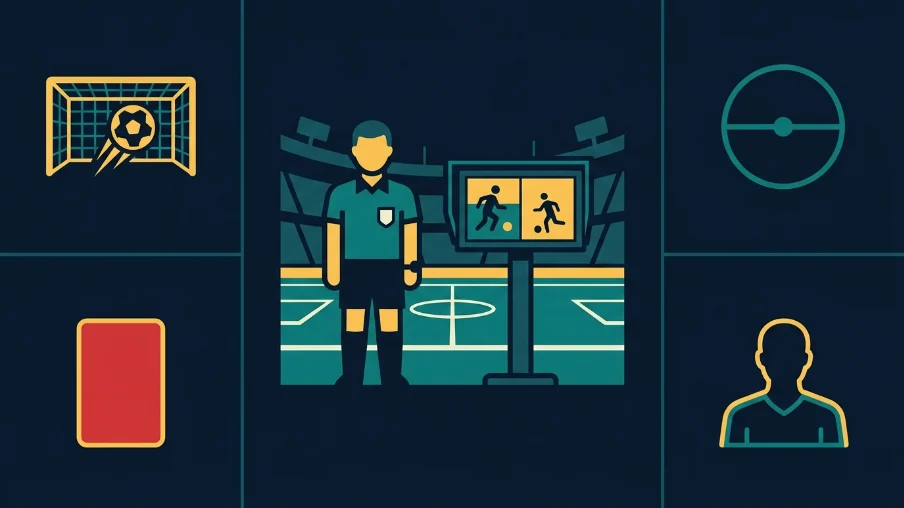
Quick Answer: VAR stands for Video Assistant Referee, a system that uses video replays to help the main referee review and correct clear, obvious errors on goals, penalties, red cards, and cases of mistaken identity.
A goal is scored, the stadium erupts and then everyone waits. Players stand with their hands on their hips, fans check their phones for replays, and the referee jogs toward the sideline to look at a small screen. That pause, now a familiar part of modern football, exists because of one piece of technology that has changed the sport more than almost anything else in the last decade, reshaping how goals are celebrated and how officiating decisions are made at every major competition.
This guide explains exactly what VAR stands for, how does VAR work in football, when was VAR introduced in football, and the biggest VAR controversies in football since its introduction cross-checked against official IFAB and FIFA documentation, so you’re getting accurate, source-backed information rather than fan speculation or repeated broadcast commentary.
What Does VAR Stand For in Football?
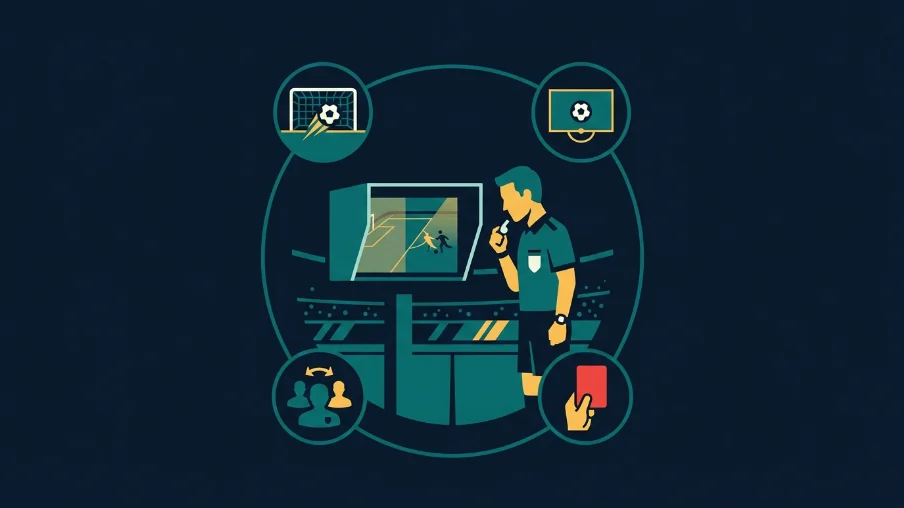
VAR stands for Video Assistant Referee. It refers both to the technology itself and to the team of officials operating it during a match. The VAR team sits in a separate video operations room, watching multiple camera angles of the game in real time, ready to alert the main, on-field referee if they spot a clear and obvious error in one of four specific categories: goals, penalty decisions, direct red card incidents, and cases of mistaken identity.
Despite the name, VAR does not replace the referee’s final authority. The on-field referee always makes the final decision VAR simply provides additional video evidence to help them get big decisions right, functioning as a safety net rather than an independent decision-making body within the match.
How Does VAR Work in Football?
Understanding how does VAR work in football requires breaking the process down into its actual steps, since the system operates quite differently from how many casual fans assume based on watching brief broadcast segments during a match.
Step 1: Continuous Monitoring
Unlike systems in sports like cricket or tennis, where a team must request a review, VAR operates continuously throughout the match. The video assistant referee and their support team monitor every phase of play without waiting for anyone to ask for a check, scanning for potential errors across all four reviewable categories in real time.
Step 2: Flagging a Potential Error
When the VAR team spots something that may be a clear and obvious mistake within the four reviewable categories, they alert the on-field referee via a radio earpiece.
Step 3: The Referee’s Decision
The on-field referee can either accept the VAR team’s recommendation directly, or walk to the pitch-side monitor to review the footage personally before making a final call. This walk to the “referee review area” has become one of the most visually recognizable parts of the VAR process for fans watching at home or in the stadium, often accompanied by a tense pause in play while the decision is finalized.
Step 4: Communicating the Outcome
Once a decision is made, referees in most top competitions now explain the outcome to the stadium via a public address announcement, a change introduced specifically to improve transparency after early criticism of the system.
When Was VAR Introduced in Football?
The question of when was VAR introduced in football has a more specific answer than most fans realize, since the technology went through several years of testing before ever appearing in a professional match. The concept originated with the Royal Netherlands Football Association (KNVB), which launched a project called “Refereeing 2.0” in 2013 to explore how video technology could reduce refereeing errors. Early trials began shortly after in Dutch football.
In 2016, the International Football Association Board (IFAB), which governs football’s official Laws of the Game, approved formal trials of the system. VAR was first used in a competitive match in September 2016, during a Dutch Cup fixture. From there, adoption accelerated quickly:
- 2017 VAR trials expanded into Italy’s Serie A, Germany’s Bundesliga, and several other top leagues.
- 2018 VAR made its first appearance at a FIFA World Cup, in Russia, marking its global debut on football’s biggest and most-watched stage.
- 2019 The Premier League introduced VAR for the 2019-20 season, following a vote by English top-flight clubs.
Since its introduction, oversight of VAR protocols has increasingly shifted toward FIFA, working closely alongside IFAB to refine how the system is applied consistently across different competitions worldwide.
VAR Controversies in Football
No discussion of VAR controversies in football would be complete without acknowledging that the system, despite its intended purpose of reducing errors, has remained one of the sport’s most debated topics since its introduction, with strong opinions on both sides of the argument among players, coaches, and fans alike.
Slowing Down the Game
One of the most consistent criticisms involves match flow. Reviews can take several minutes, interrupting the natural rhythm of a game and, in the eyes of many fans, undermining the spontaneous celebration that follows a goal.
Subjective Offside Calls
While VAR is highly effective at determining factual matters like whether the ball crossed a line, offside decisions often come down to millimeters, drawn using semi-automated lines across a player’s body. Critics argue this level of precision contradicts the original intent of only correcting “clear and obvious” errors, since a millimeter-level offside call rarely fits that original description.
Inconsistent Application
Different leagues and competitions have applied VAR with varying thresholds for what counts as a reviewable error, leading to accusations of inconsistency, particularly when comparing decisions across different tournaments or even different referees within the same league, season, or competition.
High-Profile Disputed Decisions
Several matches at major tournaments have featured VAR decisions that sparked significant public debate, with pundits, players, and fans disagreeing over whether the system’s ruling matched the spirit of the game, even when the letter of the law was technically followed correctly by the officiating team.
Semi-Automated Offside Technology: VAR’s Evolution
Since its initial rollout, VAR has continued to evolve well beyond its original 2016 framework. One of the most significant upgrades has been semi-automated offside technology, first used at the 2022 FIFA World Cup in Qatar. This system uses multiple tracking cameras and a sensor inside the match ball to detect the exact position of every player at the moment the ball is played, generating a 3D offside line far faster and more precisely than a human assistant referee could manage alone. By the 2026 World Cup, this technology has become standard at the tournament, further reducing the time needed for offside reviews while maintaining the millimeter-level precision that originally drew criticism when VAR was newer.
Notable VAR Moments at Major Tournaments
VAR’s presence at football’s biggest stages has produced some of the most talked-about officiating moments in recent tournament history:
- 2018 FIFA World Cup (Russia) VAR’s tournament debut included a controversial late penalty awarded to France in the final against Croatia, a decision that intensified early global debate about the system’s role in deciding major matches.
- 2022 FIFA World Cup (Qatar) Semi-automated offside technology was used for the first time at a World Cup, alongside several tightly contested offside calls that were decided by centimeters.
- UEFA Champions League Numerous VAR reviews involving handball decisions have sparked ongoing discussion about how subjective handball law remains, even with clear video evidence available.
How VAR Compares to Video Review in Other Sports
Football is far from the only sport using video review technology, though its approach differs meaningfully from other major sports. In cricket and tennis, players or team officials must actively request a review, and only a limited number of unsuccessful challenges are permitted per match or innings. VAR, by contrast, operates continuously and is triggered by the officiating team itself rather than by player request, meaning there’s no limit on how many times it can intervene during a single match. This structural difference is part of why some football pundits have proposed a player-challenge system as a potential reform, similar to models already used successfully in other sports.
VAR’s Impact on Football So Far
| Area | Before VAR | After VAR |
| Major refereeing errors | More frequent, no in-game correction | Significantly reduced on reviewable incidents |
| Match flow | Continuous, minimal stoppages | Occasional multi-minute reviews |
| Fan transparency | Referee explanations rare | Stadium announcements now common in top leagues |
| Offside accuracy | Judged by assistant referee’s eye alone | Semi-automated lines used in top competitions |
Frequently Asked Questions
What does VAR stand for in football? VAR stands for Video Assistant Referee, a system that reviews match footage to help the main referee correct clear and obvious errors.
How does VAR work in football exactly? VAR continuously monitors the match from a video operations room, alerting the on-field referee to potential clear errors in four categories: goals, penalties, red cards, and mistaken identity, with the referee making the final decision.
When was VAR introduced in football? VAR was first trialed in the Netherlands starting in 2013, used in a competitive match for the first time in 2016, and made its FIFA World Cup debut in 2018.
What are the main VAR controversies in football? The most common criticisms include disrupted match flow, overly precise offside calls, inconsistent application across leagues, and disputed high-profile decisions at major tournaments.
Can VAR overrule the referee completely? No. VAR only provides recommendations and video evidence; the on-field referee always retains final authority over every decision.
Is VAR used in every football league? No. While most top professional leagues and major international tournaments use VAR, many lower-division and amateur competitions still do not have access to the technology.
Why does VAR sometimes take so long? Reviews can take time because officials must examine multiple camera angles and, in some cases, the on-field referee personally reviews footage before making a final decision.
Has VAR reduced controversial decisions overall? Data on reviewable incidents like goals, penalties, and red cards suggests clear factual errors have dropped significantly, though subjective calls like handballs and marginal offsides continue to generate debate.
Does every football league use the same VAR technology? No. While the core video review concept is consistent, features like semi-automated offside technology are currently limited to top-tier competitions and major tournaments with the necessary camera infrastructure.
Conclusion
What does VAR stand for in football? At its core, it’s simply Video Assistant Referee but as this guide shows, the system’s real impact goes far beyond its name. From reducing major refereeing errors to sparking some of the sport’s most heated debates, VAR has reshaped how football is officiated at the highest level since its introduction in 2016, and continues to evolve through upgrades like semi-automated offside technology at the 2026 World Cup.
Whether fans see it as a necessary correction to human error or an unwelcome disruption to the game’s flow, understanding how does VAR work in football makes it much easier to follow the decisions shaping matches today. Want to understand more of the officiating side of the game? Check out our guide on What is a False 9 in Football? The 2026 World Cup Tactic Explained for the complete rules breakdown.