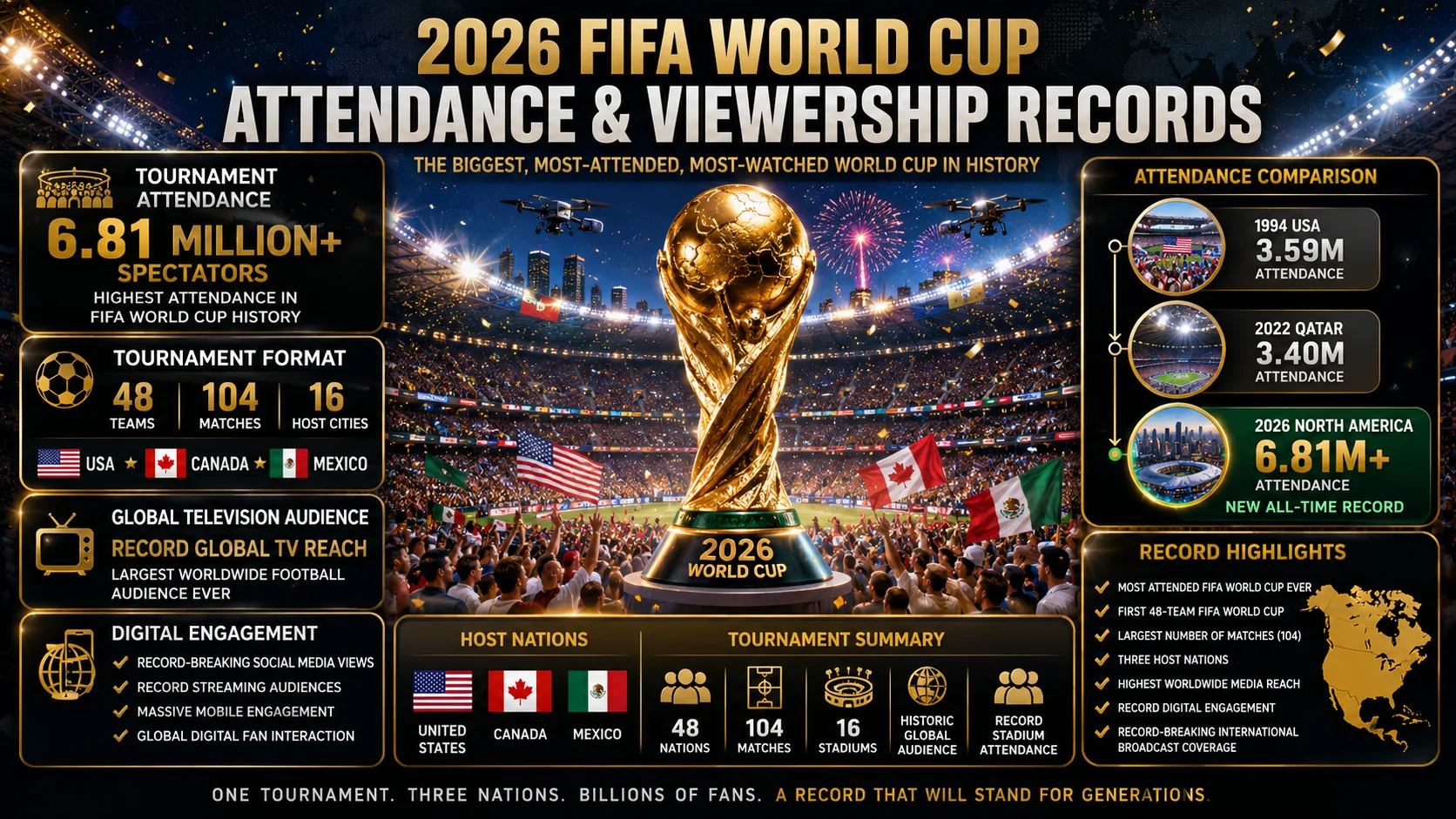
Quick Answer: The 2026 FIFA World Cup set the all-time attendance record with 6,810,966 fans across 104 matches, an average of 65,490 spectators per game at 99.7% stadium capacity, while global television audiences approached six billion viewers, with the United States-Belgium Round of 16 match becoming the most-watched soccer telecast in U.S. history.
Before the group stage had even finished, the 2026 World Cup had already broken a record that stood for 32 years. By the time Spain lifted the trophy in New Jersey, the tournament hadn’t just beaten the old attendance mark, it had left it in the distance, while television audiences on the other side of the world were doing much the same thing across dozens of markets simultaneously.
This guide breaks down the complete attendance and viewership records set at the 2026 World Cup, from the tournament’s historic stadium numbers to the television audiences that shattered previous benchmarks across multiple countries and broadcast platforms.
2026 World Cup: Attendance by the Numbers
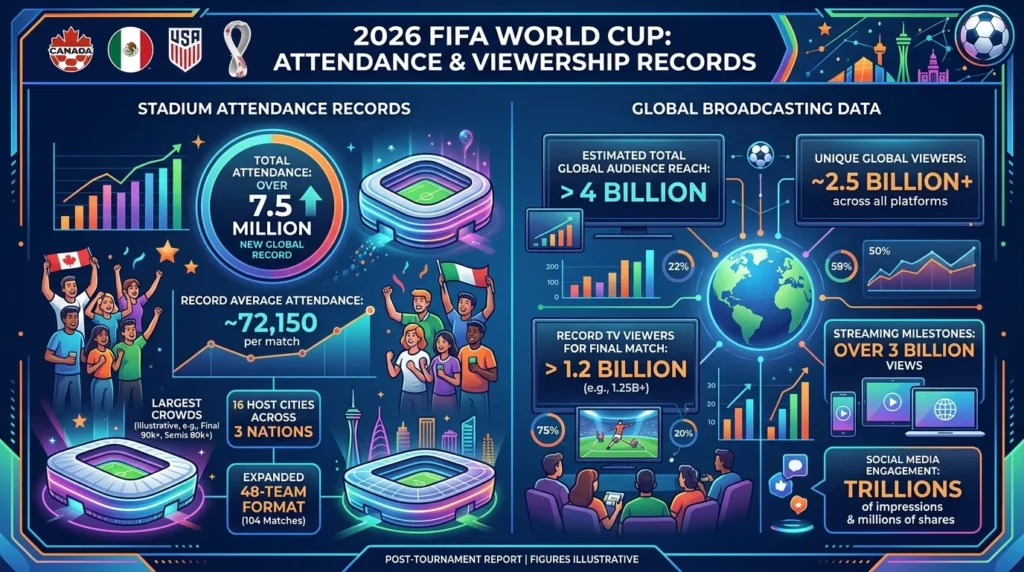
Here are the tournament’s headline attendance figures at a glance before diving into the full details below.
- Total attendance: 6,810,966 fans across all 104 matches
- Average attendance per match: 65,490 spectators
- Stadium occupancy rate: 99.7% of available capacity
- Previous record: 3,587,538, set at the 1994 World Cup in the United States
- Highest single-day attendance: 426,834 spectators on June 25
- Largest total crowd at one venue: Mexico City’s Estadio Azteca, with 404,120 fans across five matches
How the Old Attendance Record Fell So Quickly
The 1994 World Cup’s attendance record of 3,587,538 had stood for 32 years, widely considered one of the most durable benchmarks in the tournament’s history given the difficulty of matching the United States’ stadium infrastructure and market size at that time. Remarkably, the 2026 tournament had already surpassed this mark before the group stage had even concluded, according to FIFA’s own official tracking throughout the competition. By the time the competition reached the quarterfinal stage, total attendance had already crossed 6.25 million, with the final tally of 6,810,966 nearly doubling the previous record and comfortably exceeding the combined attendance of the 2018 and 2022 World Cups, despite those two tournaments featuring 128 total matches compared to 2026’s 104.
Why Attendance Grew So Dramatically
Several factors combined to drive the 2026 tournament’s unprecedented attendance figures to levels no previous edition had come close to achieving. The expansion to 48 teams meant 16 additional nations’ fanbases had a direct incentive to travel and attend matches compared to the previous 32-team format. Hosting across three countries with well-established stadium infrastructure, particularly large NFL venues repurposed for football, provided significantly greater seating capacity than several recent host nations offered in prior tournaments. The tournament also benefited from strong ticket demand across all three host countries, with stadiums running at 99.7% occupancy throughout the competition, reflecting sustained demand rather than a few standout marquee matches driving the overall average.
Television Viewership: Records Across Multiple Markets
Television audiences matched the tournament’s attendance figures for record-breaking scale across nearly every market that broadcast the competition. At a press conference during the tournament, officials cited a figure approaching six billion viewers globally, though FIFA had not released a fully detailed audience breakdown by the tournament’s conclusion. In the United States specifically, the group stage alone averaged nearly 5.1 million viewers across Fox, FS1, and Tubi, a 92% increase compared to the 2022 tournament, making it the most-watched FIFA World Cup group stage average in English-language U.S. television history to date.
The Most-Watched Match in U.S. Soccer History
The United States’ Round of 16 elimination at the hands of Belgium became a genuine television landmark, despite the disappointing result for the co-host nation and its passionate domestic fanbase. The July 6 match drew 30 million viewers on Fox, peaking near 32 million U.S. viewers at its broadcast height, making it the most-watched soccer telecast in American television history by a considerable margin. The same match also set a Spanish-language viewership record, with Telemundo recording a total audience delivery of 9.1 million viewers.
The Final: A Combined Audience Approaching 63 Million in the US Alone
The July 19 final between Spain and Argentina drew a combined U.S. audience of 62.8 million viewers across Fox, Telemundo, and Peacock, with the match alone accounting for 66.4 million viewers at its broadcast peak during the closing stages of extra time. This figure obliterated previous U.S. viewership benchmarks for a World Cup final, reflecting both the tournament’s North American hosting advantage, which placed most matches in convenient afternoon and evening time slots, and the sustained storyline of Lionel Messi’s likely final World Cup appearance drawing in casual viewers alongside dedicated football fans.
Attendance and Viewership Records: Quick Reference Table
The table below summarizes the key figures and benchmarks set during the 2026 FIFA World Cup.
| Record | Figure | Detail |
|---|---|---|
| Total tournament attendance | 6,810,966 | All-time record, surpassing 1994’s 3,587,538 |
| Average attendance per match | 65,490 | Across 104 total matches |
| Stadium occupancy rate | 99.7% | Consistent across the full tournament |
| Most-watched U.S. soccer telecast ever | 30M+ viewers | USA vs. Belgium, Round of 16 |
| Final combined U.S. audience | 62.8 million | Fox, Telemundo, and Peacock combined |
| Highest single-day attendance | 426,834 | June 25 |
Digital Engagement Beyond Traditional Attendance and TV
Beyond stadium attendance and broadcast television, the 2026 tournament also set records across digital platforms and social media channels. FIFA reported more than 20 billion video views across its own digital platforms during the competition, alongside viral moments like the “Viking Row” celebration, which attracted over 172 million views on TikTok alone. More than 7.7 million fans also gathered at FIFA Fan Festivals across the three host countries, providing an additional layer of engagement beyond those who purchased match tickets or watched via traditional broadcast television.
Attendance Breakdown Across Host Cities
With matches spread across 16 cities in three countries, attendance figures varied considerably by venue, largely influenced by stadium capacity and the specific matches hosted at each location throughout the competition. Mexico City’s Estadio Azteca led all venues in total attendance, aided by both its large capacity and the emotional significance of hosting matches at a stadium already steeped in World Cup history from both 1970 and 1986. Dallas also emerged as a notable milestone venue, with a capacity crowd of 70,649 pushing the all-time cumulative FIFA World Cup attendance figure, calculated across every tournament in the competition’s history, past the 50 million mark for the first time ever. This kind of historical bookkeeping underscores just how significant the 2026 tournament’s contribution was to the World Cup’s attendance totals across nearly a century of continuous competition.
What Record Attendance and Viewership Mean for FIFA’s Revenue
Beyond the raw attendance and viewership figures themselves, these records carry direct financial implications for FIFA and the broader football ecosystem as a whole. Larger attendance figures translate into increased ticketing revenue, while record-breaking television audiences strengthen the value of broadcast rights negotiations for future tournaments across every participating market. FIFA president Gianni Infantino specifically noted that the expanded format had contributed to projections of record tournament revenue and a correspondingly larger prize fund for competing nations, reflecting how attendance and viewership records extend well beyond simple bragging rights into the sport’s broader commercial and competitive structure moving forward.
How the Expanded Format Contributed to the Records
The expansion from 32 to 48 teams played a direct, measurable role in driving both attendance and viewership figures to unprecedented levels never previously seen at a World Cup. Simply put, more participating nations meant more fanbases with a direct incentive to travel to matches or tune in via television and streaming platforms throughout the tournament. This effect was compounded by the tournament’s location across three well-established football and sporting markets, each with existing large-capacity stadiums originally built for American football that could be adapted for the expanded competition without requiring extensive new construction, a contrast to some previous host nations that built stadiums specifically for the tournament from scratch.
What These Records Mean for Future World Cups
The scale of the 2026 tournament’s attendance and viewership figures sets a genuinely difficult benchmark for future editions to match, particularly as the next World Cup returns to a single-host or smaller multi-nation format without North America’s combination of stadium infrastructure and favorable broadcast time zones. FIFA officials have acknowledged that replicating this level of engagement will require careful planning around host selection, stadium capacity, and broadcast scheduling for tournaments held in regions with different market sizes and infrastructure. Nevertheless, the 2026 edition has firmly established that an expanded 48-team format, combined with the right hosting conditions, can produce engagement figures that meaningfully exceed anything the tournament has achieved in its near-century of history.
Frequently Asked Questions
The following questions cover the most common points of curiosity about the tournament’s record-breaking scale.
What was the total attendance for the 2026 World Cup? The 2026 World Cup recorded a total attendance of 6,810,966 fans across all 104 matches, the highest in tournament history.
How does 2026’s attendance compare to the previous record? The 2026 total nearly doubled the previous record of 3,587,538, set at the 1994 World Cup in the United States, a mark that had stood for 32 years.
What was the most-watched soccer match in U.S. television history? The United States’ Round of 16 loss to Belgium on July 6 became the most-watched soccer telecast in U.S. history, drawing 30 million viewers on Fox.
How many people watched the 2026 World Cup final? The final drew a combined U.S. television audience of 62.8 million viewers across Fox, Telemundo, and Peacock, with global viewership figures cited as approaching six billion.
What was the average stadium occupancy rate during the tournament? Stadiums operated at 99.7% of capacity on average throughout the entire 2026 World Cup, reflecting sustained high demand across all host cities.
Which stadium had the largest total attendance during the tournament? Mexico City’s Estadio Azteca recorded the largest total crowd figure, with 404,120 fans across its five hosted matches.
Did the 2026 World Cup surpass the combined attendance of the two previous tournaments? Yes, the 2026 total comfortably exceeded the combined attendance of the 2018 and 2022 World Cups, despite those two editions featuring 128 total matches compared to 2026’s 104.
How did the expanded 48-team format affect these records? The expansion to 48 teams meant more participating nations and fanbases with direct incentive to attend or watch, directly contributing to both the record attendance and viewership figures across the tournament.
Conclusion
The 2026 World Cup didn’t just crown a new champion it fundamentally reset what’s possible for the tournament’s scale, shattering a 32-year-old attendance record before the group stage had even concluded and drawing television audiences that dwarfed every previous edition. From packed NFL stadiums running at near-full capacity to a viral digital footprint spanning billions of views, this expanded 48-team tournament confirmed its place as the biggest World Cup ever held by virtually every measurable metric, setting a new benchmark that future editions will be measured against for years to come. Want to explore more about the tournament? Check out our guide on 2026 FIFA World Cup: The Complete Tournament Guide for the full story.

Daniel Brooks is a sports writer at SportsOrbitX.com, specializing in football, basketball and global sports news. He focuses on delivering accurate reporting, match analysis and timely updates that keep fans informed.