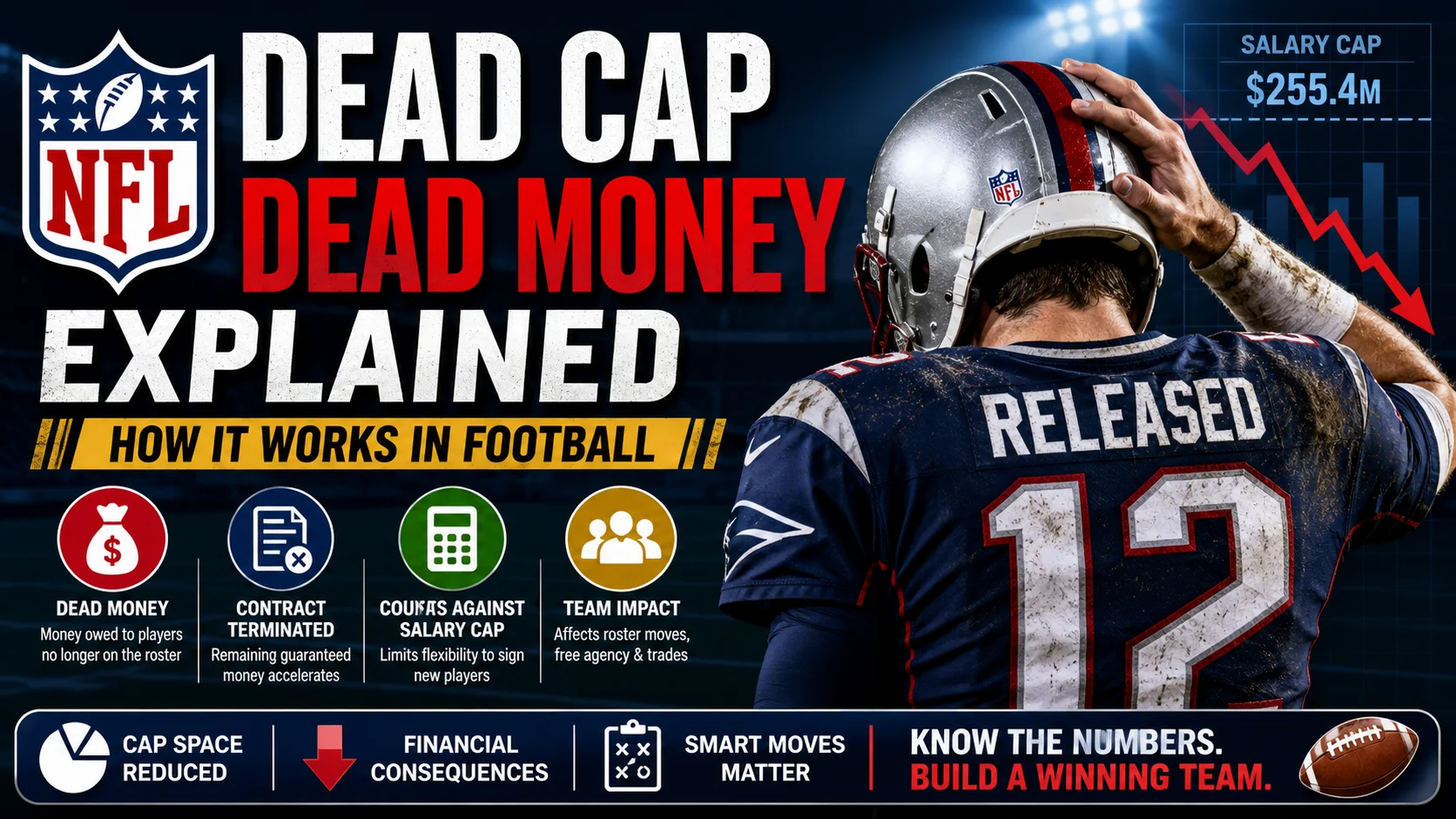
NFL dead cap, also called dead money, is salary cap space charged to a team for a player who is no longer on its roster. It usually comes from previously paid signing bonuses, guaranteed money, and other contract amounts that remain chargeable after a release or trade. Dead cap can limit a team’s ability to sign players, but it also allows teams to move on from expensive contracts.
Quick Answer: What Is Dead Cap in the NFL?
Dead cap is money a team must continue counting against its NFL salary cap even after a player leaves the team.
For example, imagine an NFL player receives a $20 million signing bonus spread across five contract years. The team initially accounts for $4 million per year in signing-bonus proration.
If the player is released after the second year, the remaining $12 million may accelerate onto the team’s salary cap, subject to the applicable contract and transaction rules.
The player is gone, but the remaining cap charge stays.
That’s why it’s called dead money: the team is paying a salary cap cost for a player who is no longer playing for it.
How Does NFL Dead Cap Work?
To understand dead money, you first need to understand how NFL contracts are structured.
NFL teams operate under a salary cap, which limits how much they can spend on player compensation during a league year. However, the amount a player receives in cash and the amount charged against the salary cap in a particular season are not always the same.
For example, a player might receive a large signing bonus immediately, but the team can spread its salary cap accounting across multiple contract years.
This process is called bonus proration.
Under NFL rules, signing bonuses can generally be prorated over a maximum of five contract years. If the player leaves before those years are completed, the remaining unaccounted amount can accelerate onto the team’s salary cap. NFL Football Operations+1
Understanding Signing Bonus Proration
Consider this example:
A team signs a player to a five-year contract with a $20 million signing bonus.
Instead of counting the entire $20 million against the first season’s salary cap, the team spreads it across five years.
| Contract Year | Signing Bonus Cap Charge |
|---|---|
| Year 1 | $4 million |
| Year 2 | $4 million |
| Year 3 | $4 million |
| Year 4 | $4 million |
| Year 5 | $4 million |
| Total | $20 million |
Now imagine the team releases the player after Year 2.
The team has already accounted for $8 million in signing-bonus charges. The remaining $12 million becomes accelerated dead cap, subject to applicable rules.
Example result
$8M
Already accounted for
$12M
Remaining dead cap
The team must account for that remaining $12 million even though the player is no longer on its roster.
What Causes Dead Money in the NFL?
Dead money doesn’t appear randomly. It usually comes from specific contract features that create salary cap charges before the contract is completed.
Here are the most common reasons.
1. Signing Bonuses
Signing bonuses are one of the biggest sources of NFL dead money.
Teams often pay these bonuses upfront while spreading their salary cap charges across multiple seasons.
When a player is released or traded, the remaining prorated amount can accelerate onto the original team’s cap.
2. Guaranteed Money
Guaranteed contracts can create dead cap when a player leaves the team.
For example, if a player has a guaranteed $10 million salary and is released without an applicable offset or other contractual reduction, the team may still have to account for that guaranteed compensation.
This is why cutting an expensive player doesn’t necessarily eliminate the team’s financial obligation.
3. Restructured Contracts
Contract restructures can create future dead-money problems.
Teams sometimes convert a player’s base salary into a signing bonus to create immediate salary cap space.
This reduces the current year’s cap charge but spreads the converted amount across future seasons.
If the player is later released or traded, the remaining prorated bonus can become dead money.
4. Option Bonuses
Some NFL contracts include option bonuses that are paid when a team exercises a contractual option.
Like signing bonuses, qualifying option bonuses can be prorated for salary cap purposes.
If the player leaves before the proration is completed, the remaining amount can contribute to dead cap.
5. Void Years
Void years are additional contract years that help teams spread bonus charges beyond the player’s intended playing contract.
These years may contain no actual expectation that the player will remain with the team.
However, they can leave significant salary cap charges behind when the contract voids.
Important: Dead cap does not always mean the team is sending the player another payment. It often represents previously paid money that still needs to be accounted for under salary cap rules. NFL Football Operations+1
Dead Cap vs. Salary Cap: What’s the Difference?
These terms are closely connected, but they don’t mean the same thing.
| Term | Meaning |
|---|---|
| Salary Cap | Maximum amount a team can spend on player compensation under league rules |
| Cap Hit | Amount of a player’s contract charged against the team’s cap in a season |
| Dead Cap | Cap charges associated with a player no longer on the roster |
| Cap Savings | Salary cap space a team gains after moving on from a player |
| Guaranteed Money | Contract compensation the player is entitled to receive under applicable guarantee terms |
For example, a player might have a $25 million salary cap hit.
If the team releases him and carries $8 million in dead cap, its potential cap savings would be approximately $17 million, assuming no other relevant adjustments.
This is why NFL general managers examine both dead money and cap savings before making roster decisions.
What Happens to Dead Cap When an NFL Player Is Released?
When a team releases a player, the financial consequences depend on the contract structure and timing of the transaction.
A typical release before June 1 can cause the remaining prorated signing bonus to accelerate onto the current year’s salary cap.
The team may also have to account for guaranteed compensation that remains payable.
However, the team generally removes the player’s remaining non-guaranteed base salary from its future cap obligations.
Example:
Imagine a player has:
- $15 million in remaining prorated signing bonus.
- $10 million in non-guaranteed base salary.
- $25 million total scheduled cap charge.
If the team releases him before June 1, the $15 million remaining bonus could become dead cap.
Assuming no other adjustments, the team would save approximately $10 million in cap space.
This illustrates an important NFL salary cap principle: a team can release a player and still carry a substantial cap charge for him.
What Is a Post-June 1 Release in the NFL?
A post-June 1 release is a roster move that allows an NFL team to spread certain remaining signing-bonus charges across two salary cap years instead of absorbing all of them immediately.
Normally, releasing a player before June 2 causes the remaining bonus proration to accelerate onto the current year’s cap.
With a post-June 1 release, the accounting is different:
- The current year’s remaining bonus proration stays on the current year’s cap.
- The future remaining bonus proration moves to the following year’s cap.
- Applicable guaranteed salary obligations still have to be accounted for.
The NFL also permits teams to designate up to two players for post-June 1 treatment before June 2, subject to league rules.
However, the cap savings from a designated release do not become available until June 2. This is an important distinction for teams planning free-agency spending. NFL Football Operations+1
Regular Release vs. Post-June 1 Release
| Feature | Regular Pre-June 1 Release | Post-June 1 Treatment |
|---|---|---|
| Current-year bonus proration | Accelerates | Remains in current year |
| Future bonus proration | Accelerates into current year | Moves to following year |
| Current-year cap relief | Generally immediate | Available June 2 |
| Future dead cap | Usually reduced | Can remain |
Important distinction: The special pre-June 1 designation applies to releases, not trades. An actual trade completed after June 1 can receive the applicable post-June 1 accounting treatment. CBS Sports+1
How Does Dead Cap Affect NFL Teams?
Dead money can dramatically change how an NFL team builds its roster.
Even when a franchise wants to move on from an underperforming player, a large dead-cap charge can make that decision financially difficult.
Here are five major ways dead cap affects teams.
1. Limits Free Agency Spending
Teams with significant dead money have less salary cap space available to sign new players.
This can force general managers to pursue cheaper free agents or rely more heavily on draft picks.
2. Makes Player Releases More Expensive
A team might want to release an aging quarterback or an expensive defensive player, but the remaining guaranteed money and bonus proration could make the move costly.
3. Creates Future Salary Cap Problems
Some teams restructure contracts to create immediate cap relief.
Although this helps in the short term, it can push financial obligations into future seasons.
4. Influences Trade Decisions
Dead cap can influence whether a team decides to trade a player instead of releasing him.
A trade may remove certain future salary obligations while leaving previously prorated bonuses with the original team.
5. Affects Long-Term Team Building
General managers must balance current performance with future financial flexibility.
A team that repeatedly pushes cap charges into future seasons can eventually face difficult roster decisions.
How Do NFL Teams Reduce Dead Cap?
NFL teams cannot simply erase existing dead money, but they can use different contract and roster strategies to manage its impact.
Restructuring Contracts
Teams can convert eligible base salary into signing bonuses to reduce current-year cap charges.
However, this can increase future dead-cap exposure.
Trading Players
Trading a player can transfer certain remaining salary obligations to another team.
However, previously prorated signing bonuses generally remain with the original team and can accelerate.
Using Post-June 1 Designations
Teams can use post-June 1 release designations to spread eligible bonus charges over two salary cap years.
This provides additional flexibility when managing expensive contracts.
Negotiating Contract Extensions
Extensions can sometimes spread compensation over additional contract years and create short-term cap relief.
However, guaranteed money and bonus proration must still be considered.
These strategies help teams manage their financial commitments, but none makes existing cap obligations disappear. NFL Football Operations+1
Real NFL Dead Money Examples
Dead cap isn’t just a theoretical accounting concept. It has played a major role in decisions involving some of the NFL’s biggest stars.
Tom Brady and the Tampa Bay Buccaneers
When Tom Brady retired, the Buccaneers faced a significant dead-money charge because of previously prorated signing bonuses.
According to the NFL’s free-agency explanation, Brady’s departure left Tampa Bay with approximately $35.1 million in dead money.
The example demonstrates how void years and signing-bonus proration can create cap obligations even after a player retires. NFL
Tua Tagovailoa and the Miami Dolphins
The 2026 offseason provided another example of how complicated NFL dead money can become.
Following Tua Tagovailoa’s release, CBS Sports reported that the quarterback’s contract created approximately $55.4 million in 2026 dead money, with additional charges scheduled for 2027.
The situation involved guaranteed base salary and previously structured bonus payments.
It demonstrates why releasing an expensive quarterback doesn’t necessarily create significant salary cap savings. CBS Sports
Dead Cap vs. Cap Savings: An NFL Example
Understanding these two terms together makes NFL contract decisions much easier to follow.
Imagine a team is considering releasing a veteran player with the following contract:
| Contract Detail | Amount |
|---|---|
| Current Cap Hit | $30 million |
| Remaining Dead Money | $12 million |
| Non-Guaranteed Salary Removed | $18 million |
| Potential Cap Savings | $18 million |
The calculation is:
Cap Savings = Current Cap Hit − Dead Cap
\[ \$30M-\$12M=\$18M \]
The team would save approximately $18 million in salary cap space, assuming no additional adjustments.
This is why a player with $12 million in dead money can still be released if the team believes the resulting cap savings are worth it.
Why Do NFL Teams Have Dead Money if Players Are Gone?
NFL teams have dead money because salary cap accounting doesn’t automatically disappear when a player leaves the roster.
For example, a team may pay a player a $20 million signing bonus but spread the cap charges across five seasons.
If the player leaves after two seasons, the remaining $12 million in bonus proration may accelerate onto the team’s cap.
The player is no longer part of the team, but the remaining accounting obligation still exists.
Frequently Asked Questions
What does dead cap mean in the NFL?
Dead cap refers to salary cap charges associated with a player who is no longer on a team’s roster. It usually comes from previously paid signing bonuses, guaranteed compensation, and other contract obligations.
What is dead money in football?
Dead money is another name for dead cap. It represents contract-related salary cap charges that remain after a player is released, traded, or retires.
Does dead cap mean a team is still paying a player?
Not necessarily. Much of dead cap comes from money already paid to a player but not yet fully accounted for against the salary cap. However, unpaid guaranteed compensation can still create actual payment obligations.
Why do NFL teams release players with dead money?
Teams release players to improve their roster, reduce future salary obligations, or create salary cap space. Sometimes accepting a dead-cap charge is better than keeping an expensive or underperforming player.
Does trading a player remove dead cap?
Not completely. A trade can transfer certain future salary obligations to the acquiring team, but the original team generally retains its remaining prorated signing-bonus charges.
What happens to dead cap after June 1?
With applicable post-June 1 treatment, the current year’s remaining bonus proration stays on the current cap, while future bonus proration moves to the following year’s cap.
What is a dead cap hit?
A dead cap hit is the amount charged against a team’s salary cap for a player who is no longer on its roster.
For example, if a released player leaves $10 million in remaining prorated bonus charges, the team may carry a $10 million dead-cap hit.
Can an NFL team have more dead cap than its salary cap savings?
Yes. A team can release a player and receive little or no cap savings if the remaining dead money and guaranteed obligations are close to or greater than the player’s current cap hit.
What is the difference between dead cap and guaranteed money?
Guaranteed money is compensation a player is contractually entitled to receive under the applicable guarantee terms. Dead cap is a salary cap accounting charge. Guaranteed money can contribute to dead cap, but the two terms are not interchangeable.
Do retired NFL players count against the salary cap?
They can. Retirement doesn’t automatically eliminate remaining salary cap obligations. Previously prorated bonuses and applicable guarantees can remain chargeable to the team.
Which NFL position can create the most dead money?
Quarterbacks can create particularly large dead-cap charges because of their expensive contracts, signing bonuses, and guaranteed compensation. However, any position can generate significant dead money depending on the contract.
Is dead cap bad for an NFL team?
Not always. Dead cap can be a necessary cost of moving on from an expensive player. The important question is whether the roster improvement and future cap flexibility justify absorbing that charge.
Final Verdict
NFL dead cap is one of the most important concepts in understanding how professional football teams manage their money. It explains why releasing a player doesn’t always eliminate his financial impact and why teams sometimes carry millions of dollars in salary cap charges for players who are no longer on their rosters.
Signing bonuses, guaranteed salaries, contract restructures, and void years can all create dead money. Although teams use strategies such as trades, contract extensions, and post-June 1 releases to manage these obligations, the underlying financial commitments don’t simply disappear.
For fans, understanding dead cap makes it easier to follow NFL free agency, blockbuster trades, roster cuts, and salary cap decisions.
For general managers, it’s a balancing act between winning today and maintaining financial flexibility for tomorrow.

Emily Parker is a sports journalist at SportsOrbitX.com with a passion for covering cricket, tennis and major international sporting events. She is committed to producing clear, reliable and engaging content for sports enthusiasts worldwide.