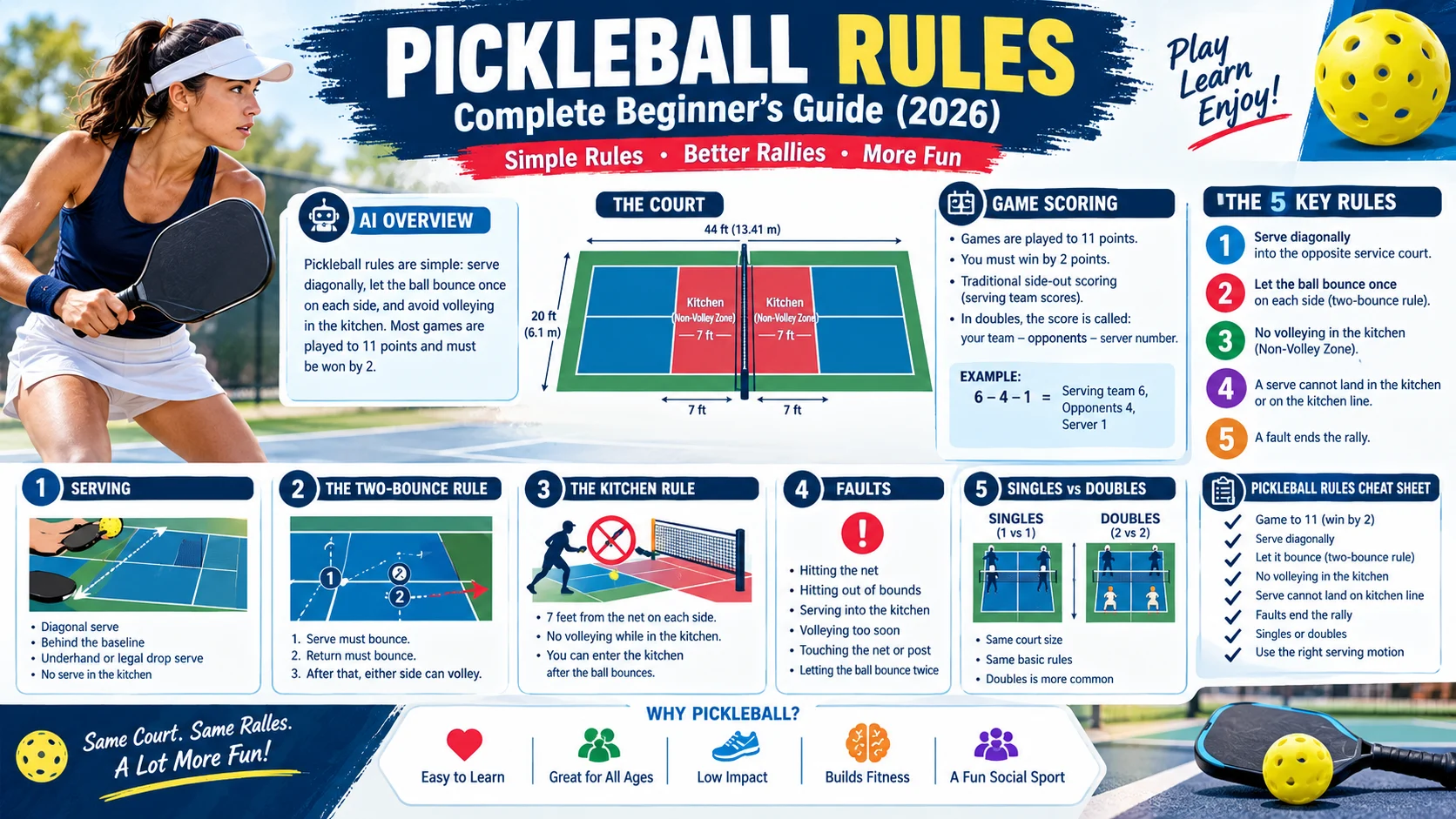
Pickleball rules are simple: serve diagonally, let the ball bounce once on each side, and avoid volleying in the kitchen. Most games are played to 11 points and must be won by 2.
What Are the Rules of Pickleball?
Pickleball is played as either singles or doubles, with doubles being the more common format. The objective is to hit the perforated plastic ball over the net so your opponent cannot legally return it.
The basic rules revolve around five things:
- Serving
- Scoring
- The two-bounce rule
- The non-volley zone, or kitchen
- Faults
Once these are understood, most pickleball rallies become easy to follow.
The official USA Pickleball rulebook is updated annually and serves as the governing rules reference for USA Pickleball play.
Pickleball Rules at a Glance
| Rule | What You Need to Know |
|---|---|
| Players | Singles or doubles |
| Standard game | 11 points |
| Winning margin | 2 points |
| Serve | Diagonally into the opposite service court |
| Serve style | Underhand or legal drop serve |
| Kitchen | No volleying while in the Non-Volley Zone |
| Two-bounce rule | Serve and return must each bounce once |
| Scoring | Traditional scoring awards points to the serving side |
| Serve fault | Results in loss of serve/side out |
| Kitchen line on serve | A serve touching the NVZ line is a fault |
These are the core rules most recreational players need to know. Tournament formats and specific sanctioned events can use additional scoring options or regulations.
How Does Pickleball Scoring Work?
Traditional pickleball uses side-out scoring, meaning the serving player or team scores when it wins the rally.
A standard game is normally played to 11 points, but a player or team must win by at least 2 points.
For example:
- 11–8 = game over
- 11–10 = continue playing
- 12–10 = game over
- 14–12 = game over
So if the score reaches 10–10, play continues until one side leads by two.
USA Pickleball also recognizes tournament formats and a provisional rally-scoring option, so players should check the specific event rules when competing.
How Do You Call the Score?
In doubles, the score traditionally contains three numbers:
Serving team’s score – receiving team’s score – server number
For example, a call of 6–4–1 means the serving team has 6 points, the receiving team has 4, and the first server is serving.
This is one of the easiest parts of pickleball to forget when you’re new, so don’t be surprised if scoring feels more complicated than hitting the ball at first.
How Do You Serve in Pickleball?
The serve starts every rally.
A legal serve must be made diagonally into the opponent’s service court. The server must be behind the baseline and follow the applicable service-motion requirements. USA Pickleball permits both the traditional volley serve and the drop serve under its rules.
Basic Pickleball Serving Rules
Remember these points:
- Serve diagonally across the court.
- Serve from behind the baseline.
- The serve must land in the correct service court.
- A serve that lands in the kitchen is a fault.
- A serve touching the kitchen line is also a fault.
- The ball must be served using a legal service motion.
- Only one serve attempt is allowed under traditional scoring rules.
The receiving player must be ready, and the score is called before the serve.
What Is the Pickleball Kitchen Rule?
The kitchen is the common name for the Non-Volley Zone (NVZ).
It extends 7 feet from the net on each side, creating a 14-foot-wide zone across the court.
The key rule is simple:
You cannot volley the ball while standing in the kitchen.
A volley means hitting the ball out of the air before it bounces.
You can, however, enter the kitchen to play a ball that has bounced.
Can You Stand in the Kitchen?
Yes.
This is a common beginner misconception.
You are allowed to stand in the kitchen. The restriction applies specifically to volleying.
You also cannot volley the ball and then have your momentum carry you into the kitchen or onto its line.
Why Is the Kitchen Important?
The kitchen prevents players from simply standing beside the net and smashing every ball out of the air.
Instead, players must use softer shots, controlled volleys, dinks, resets, and strategic placement.
That makes the kitchen one of the most important tactical areas of a pickleball court.
What Is the Two-Bounce Rule in Pickleball?
The two-bounce rule is one of pickleball’s defining rules.
After the serve:
- The receiving side must let the serve bounce.
- The receiving side returns the ball.
- The serving side must let that return bounce.
- After those two required bounces, either side may volley.
So the sequence is:
Serve → Bounce → Return → Bounce → Volley allowed
This rule prevents the serving team from immediately rushing the net and volleying the return. It also creates longer rallies and gives both sides an opportunity to establish position.
What Counts as a Fault in Pickleball?
A fault is a rule violation that ends the rally.
Common pickleball faults include:
- Serving into the wrong service court
- Serving into the kitchen or onto the kitchen line
- Hitting the ball into the net
- Hitting the ball out of bounds
- Volleying before the two-bounce requirement is completed
- Volleying while standing in the kitchen
- Allowing the ball to bounce twice before returning it
- Touching the net or net post while the ball is in play
- Violating a service rule
- Being struck by the ball while it is in play
- Hitting the ball in a way that violates another applicable rule
USA Pickleball’s official rules summary identifies these as common fault situations.
Pickleball Line Rules Explained
Line calls can cause plenty of confusion for new players.
The basic principle is:
A ball touching a boundary line is generally considered in.
There is one important serving exception:
A serve touching the kitchen line is a fault.
The Non-Volley Zone line is therefore treated differently from most other boundary lines when evaluating a serve.
Is a Ball on the Baseline In?
Yes. If a ball touches the baseline, it is generally considered in.
Is a Ball on the Sideline In?
Yes, if it touches the appropriate sideline.
Is a Serve on the Kitchen Line In?
No.
A serve contacting the Non-Volley Zone line is considered short and is a fault.
Pickleball Singles vs Doubles Rules
Pickleball can be played with two players or four players.
| Feature | Singles | Doubles |
|---|---|---|
| Players | 1 vs 1 | 2 vs 2 |
| Court | Same court | Same court |
| Serving | Diagonal | Diagonal |
| Kitchen | Same | Same |
| Two-bounce rule | Yes | Yes |
| Court coverage | More demanding | Shared between partners |
| Strategy | More movement and placement | More teamwork and positioning |
The court dimensions and fundamental rules remain the same for singles and doubles, although player positioning and serving procedures differ.
How Does Serving Work in Doubles?
Doubles serving is where many beginners get confused.
Both players on a serving team normally have an opportunity to serve before a side out occurs, except for the special starting sequence of each game.
The serving team alternates service courts as points are scored.
The player serving from the right side serves when that team’s score is even, while the corresponding left-side position is used when the score is odd.
The exact server sequence matters, which is why doubles players traditionally announce the full score before serving.
What Is a Side Out in Pickleball?
A side out means the serving side loses its service opportunity and the opposing side gets to serve.
Under traditional side-out scoring, a serving team does not automatically lose a point simply because it loses a rally. Instead, it loses the serve.
This is one reason pickleball scoring can initially feel different from tennis or many other racket sports.
Can You Volley in the Kitchen?
No, not if the ball has not bounced.
You may enter the kitchen and hit a ball after it bounces.
For example:
- Ball bounces in kitchen → you may hit it.
- Ball is in the air → you cannot volley it while standing in the kitchen.
- You volley outside the kitchen but momentum carries you into the kitchen → fault.
The restriction also applies if your clothing or equipment touches the Non-Volley Zone as a result of the volley.
What Happens If the Ball Hits the Net?
If the ball hits the net but still travels legally over it and lands in the correct playing area, the rally can continue.
However, if the ball fails to cross the net or lands illegally, the appropriate fault ends the rally.
The important point is that simply touching the net does not automatically mean the rally is over.
Can You Touch the Net in Pickleball?
No.
A player, clothing, or paddle touching the net or net post while the ball is in play can result in a fault.
This rule matters particularly during fast exchanges near the kitchen.
What Are the Most Common Pickleball Mistakes?
New players often lose rallies because of a handful of predictable mistakes.
1. Volleying Too Early
Players sometimes forget that both sides must complete the required bounce sequence before volleying.
2. Serving Into the Kitchen
The serve must travel beyond the Non-Volley Zone. Hitting the kitchen line on a serve is also a fault.
3. Thinking You Cannot Enter the Kitchen
You can enter it. You simply cannot volley from it.
4. Forgetting the Score
In doubles, calling the score correctly helps everyone know who should be serving and from which position.
5. Hitting Every Shot Hard
Pickleball is not simply a power game. Soft shots, placement, resets, and dinks are important parts of effective play.
6. Standing Too Close to the Net
Being near the kitchen line can be strategically useful, but players still need enough balance and reaction time to handle fast balls.
Pickleball Rules Cheat Sheet for Beginners
If you only remember ten things, remember these:
- Games are normally played to 11, win by 2.
- Pickleball can be played in singles or doubles.
- The serve goes diagonally.
- Serve from behind the baseline.
- A serve cannot land in the kitchen or on its line.
- The serve must bounce before the receiver returns it.
- The return must bounce before the serving side can volley.
- You cannot volley while standing in the kitchen.
- A ball touching most court boundary lines is in.
- A fault ends the rally.
These rules cover the overwhelming majority of situations a new recreational player encounters.
FAQs
How many points do you need to win pickleball?
A standard game is normally played to 11 points, and the winner must lead by at least 2 points. Some competitive formats use different game lengths.
Can you serve overhand in pickleball?
Under the standard volley-serve rules, the service motion must meet specific requirements, including an upward arc and legal paddle/ball contact. A drop serve is also permitted.
Can you step into the kitchen in pickleball?
Yes. You can stand in the kitchen and hit a ball after it bounces. You cannot volley while standing in the Non-Volley Zone.
Does the serve have to bounce in pickleball?
Yes. The serve must bounce on the receiving side, and the return must also bounce before the serving team may volley. This is the two-bounce rule.
Is the kitchen line considered in?
For most shots, the kitchen line is part of the Non-Volley Zone. A serve touching the kitchen line is a fault.
What happens when you lose a rally while serving?
Under traditional side-out scoring, the serving side loses its service opportunity. In doubles, the serve generally moves to the team’s next server before a side out, except for the opening service sequence.
Is pickleball easier than tennis?
Pickleball has a smaller court and relatively simple basic rules, which can make it accessible to beginners. However, advanced pickleball involves considerable strategy, movement, touch, positioning, and shot selection.
Final Thoughts
You don’t need to memorize the entire rulebook before stepping onto a pickleball court.
Start with the essentials:
Serve diagonally. Let the ball bounce on both sides after the serve. Respect the kitchen. Keep the ball in play. Understand how scoring works.
Once those fundamentals become automatic, you can focus on what makes pickleball genuinely interesting: dinking, third-shot drops, resets, volleys, court positioning, partner communication, and smart shot selection.
For tournament or official play, always use the current USA Pickleball Official Rulebook, because the rules are reviewed and updated over time.