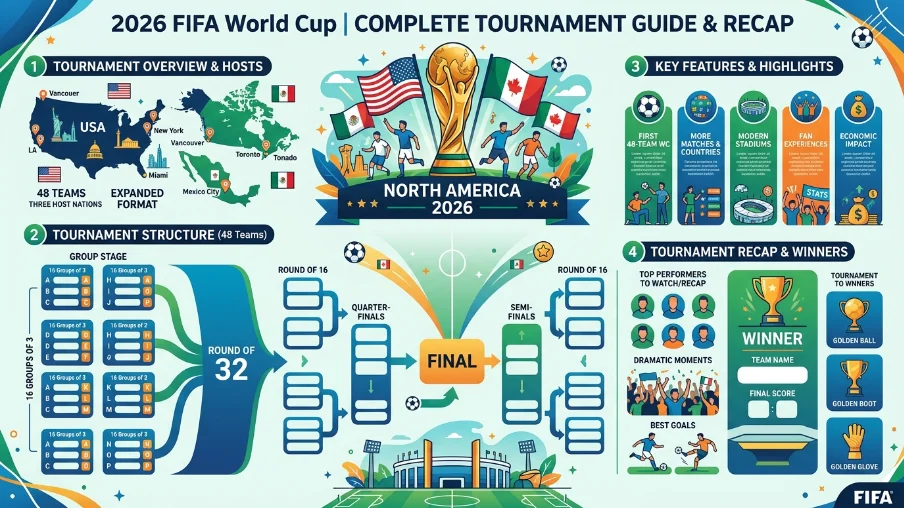
Quick Answer: The 2026 FIFA World Cup was jointly hosted by the United States, Mexico, and Canada from June 11 to July 19, featuring a record 48 teams across 104 matches in 16 host cities. Spain won the tournament, defeating Argentina 1-0 after extra time in the final.
For 39 days across three countries, 48 nations chased the one trophy that means more than any other in world sport. By the time the final whistle blew at MetLife Stadium on July 19, the tournament had already rewritten several pages of World Cup history before a single ball was kicked in the final itself, simply by virtue of its unprecedented scale, format, and the sheer number of nations involved.
This guide covers the complete 2026 FIFA World Cup, from its historic format and host cities to the tournament’s biggest moments, records, and the road to Spain’s second world title after a hard-fought campaign across the expanded competition.
2026 World Cup: Tournament at a Glance
Here is a quick overview of the tournament’s key facts before diving into the full details below.
- Host nations: United States, Mexico, Canada (first-ever three-nation hosting)
- Dates: June 11 – July 19, 2026
- Teams: 48 (expanded from 32, the largest field in tournament history)
- Host cities: 16 total (11 in the USA, 3 in Mexico, 2 in Canada)
- Total matches: 104 (72 group stage, 32 knockout stage)
- Champion: Spain (second title, after 2010)
- Runner-up: Argentina
- Golden Boot: Kylian Mbappé (France), 10 goals
A Historic Three-Nation Format
The 2026 tournament marked only the second time in World Cup history that more than one country has jointly hosted the competition, following Japan and South Korea’s shared hosting of the 2002 edition. It was the first time three nations shared hosting duties, and the first time the men’s World Cup was played in Canada at all in the competition’s near-century of existence. The United States previously hosted alone in 1994, while Mexico had hosted in both 1970 and 1986, making Mexico City’s Estadio Azteca the first stadium anywhere in the world to host matches across three separate World Cup tournaments.
The Expanded 48-Team Format Explained
For the first time in the competition’s history, the field expanded from 32 to 48 teams, a change first approved by FIFA to reflect football’s growing global reach and participation base. Rather than the originally proposed 16 groups of three teams, FIFA ultimately settled on 12 groups of four, with the top two teams from each group, plus the eight best third-place finishers, advancing to a Round of 32. This structure meant the eventual champion had to win eight matches to lift the trophy, one more than in the previous 32-team format, adding an extra physical and tactical test across the tournament’s expanded 39-day schedule and demanding fixture calendar.
Host Cities Across Three Countries
Matches were spread across 16 cities throughout North America, each selected based on stadium capacity, infrastructure, and regional football culture:
United States (11 cities): Los Angeles, Miami, Atlanta, Seattle, Houston, Philadelphia, Kansas City, Boston, Dallas, the San Francisco Bay Area, and the New York/New Jersey metropolitan area.
Mexico (3 cities): Mexico City, Guadalajara, Monterrey.
Canada (2 cities): Toronto, Vancouver.
The tournament opened on June 11 in Mexico City, where hosts Mexico faced South Africa at the historic Estadio Azteca, kicking off Group A alongside Korea Republic and Czechia.
How the Group Stage Unfolded
Each of the 48 teams was guaranteed three group-stage matches, with the top two finishers from all 12 groups advancing automatically, joined by the eight strongest third-place teams to complete the Round of 32. The expanded format gave smaller footballing nations a greater opportunity to experience the World Cup stage on merit, with Cabo Verde, a small island nation off the west coast of Africa with a population of roughly 500,000, emerging as one of the tournament’s most popular underdog stories among neutral fans worldwide. Host nation the United States advanced from the group stage before being eliminated in the Round of 16, falling 4-1 to Belgium in a match that ended the co-host’s tournament run.
The Knockout Stage and Road to the Final
The expanded format added an additional knockout round compared to previous tournaments, testing squad depth and fitness more than any prior World Cup in the competition’s history. Both eventual finalists navigated this longer path successfully: Spain relied on a consistent, possession-based approach throughout the knockout rounds, while Argentina leaned heavily on Lionel Messi’s continued influence and a well-organized defensive structure to reach a third World Cup final appearance for their captain, a feat no player had previously achieved in the tournament’s history.
The Final: Spain 1-0 Argentina
Played on July 19 at MetLife Stadium in East Rutherford, New Jersey, the final remained goalless through a tense, cagey 90 minutes before Ferran Torres broke the deadlock in the 106th minute of extra time, securing Spain’s second World Cup title following their first triumph in 2010. The result also made Spain the first nation in football history to simultaneously hold both the men’s and women’s FIFA World Cup titles at the same time, a landmark achievement reflecting the broader strength of Spanish football at every level of the international game, from youth development through to the senior national teams.
Golden Boot Race: Mbappé Makes History
- Kylian Mbappé finished as the tournament’s top scorer with 10 goals, becoming the first player in World Cup history to win the Golden Boot at consecutive tournaments, having also topped the scoring charts at the 2022 World Cup in Qatar four years earlier. Lionel Messi finished as runner-up in the Golden Boot race with 8 goals, closing out his extraordinary World Cup career on a personal high note despite Argentina’s ultimate defeat in the final itself.
2026 World Cup: Key Records Set
| Record | Detail |
|---|---|
| Largest field ever | 48 teams, up from 32 |
| Most matches in a single World Cup | 104 total matches |
| First three-nation host | USA, Mexico, Canada |
| First men’s World Cup in Canada | 2026 |
| Consecutive Golden Boot winner | Kylian Mbappé (2022 and 2026) |
| Most World Cup final starts by a player | Lionel Messi (three finals) |
| First nation to hold both World Cup titles simultaneously | Spain |
What This Tournament Means for World Football
Beyond the results themselves, the 2026 World Cup will likely be remembered as a genuine turning point in the competition’s evolution and future direction. The successful execution of a three-nation, 48-team format demonstrated that football’s showcase event can scale significantly without losing its competitive integrity, potentially shaping how future tournaments approach hosting arrangements and field size going forward. For host nation the United States, the tournament also served as a major test of the country’s growing football infrastructure and fan culture ahead of future international events, building on the sport’s steady rise in American popularity over the past three decades of sustained growth.
The Official Match Ball: The Trionda
The 2026 tournament introduced the Trionda as its official match ball, its design and name reflecting the tri-nation hosting arrangement across the United States, Mexico, and Canada, with “tri” and “onda” (wave in Spanish) combined into a single evocative name. Beyond its symbolic three-country design elements, the ball incorporated updated technology consistent with FIFA’s ongoing efforts to standardize ball performance and support semi-automated offside and goal-line technology used throughout the knockout stages. Match balls have become an increasingly discussed talking point at recent World Cups, with players and goalkeepers regularly offering feedback on flight characteristics and consistency compared to previous tournament editions and their own club-level match balls.
Cabo Verde and Other Underdog Stories
Beyond the eventual finalists, the expanded 48-team format gave several smaller footballing nations their first genuine taste of World Cup competition, producing some of the tournament’s most emotionally resonant storylines for neutral supporters. Cabo Verde, an island nation of roughly 500,000 people off Africa’s west coast, became a clear fan favorite, their run through the group stage capturing significant global attention given the country’s tiny population relative to football’s traditional powerhouses and larger footballing nations. These underdog narratives reflect one of the clearest benefits of the expanded format cited by supporters of the change, giving smaller football federations meaningful, high-profile tournament experience that was far less accessible under the previous 32-team structure and qualification pathway.
How the Expanded Format Affected Travel and Logistics
Playing across three countries and 16 host cities introduced logistical challenges rarely seen in previous World Cups, with some teams and traveling fans covering significant distances between group-stage fixtures depending on their assigned venues throughout the tournament. Host city selection balanced stadium capacity, climate considerations, and each nation’s existing football infrastructure, with cities like Vancouver offering considerably cooler conditions compared to venues like Miami, adding a genuine climate variable that teams and coaching staffs had to account for throughout their tournament planning and preparation. This scale also required unprecedented coordination between the three host nations’ organizing committees, transportation authorities, and security agencies, representing one of the most logistically complex sporting events ever organized anywhere in the world.
Frequently Asked Questions
Who won the 2026 FIFA World Cup? Spain won the 2026 FIFA World Cup, defeating Argentina 1-0 after extra time in the final, securing their second world title after 2010.
How many teams competed in the 2026 World Cup? The 2026 World Cup featured 48 teams, the largest field in the tournament’s history, expanded from the previous 32-team format.
Which countries hosted the 2026 World Cup? The 2026 World Cup was jointly hosted by the United States, Mexico, and Canada, marking the first time three nations shared hosting duties.
Who won the Golden Boot at the 2026 World Cup? Kylian Mbappé won the Golden Boot with 10 goals, becoming the first player to win the award at consecutive World Cups (2022 and 2026).
How far did the United States advance as a host nation? The United States reached the Round of 16 before being eliminated by Belgium, who won the match 4-1.
Was this Lionel Messi’s last World Cup? While not officially confirmed, the 2026 tournament is widely expected to be Messi’s final World Cup given his age and the natural progression of Argentina’s squad.
What was the official match ball used at the 2026 World Cup? The Trionda served as the official match ball, its name and design reflecting the tournament’s unprecedented three-nation hosting arrangement across North America.
Which underdog team captured global attention at the 2026 World Cup? Cabo Verde, an island nation of roughly 500,000 people, became one of the tournament’s most popular underdog stories, reaching the finals stage for the first time in the country’s history.
Conclusion
The 2026 FIFA World Cup will be remembered as one of the most significant editions in the tournament’s near-century of history, not just for Spain’s hard-fought triumph over Argentina, but for the sheer scale of what North America’s three co-hosts successfully delivered across 104 matches and 16 cities. From Cabo Verde’s underdog run to Mbappé’s historic consecutive Golden Boots and Messi’s record third final appearance, this expanded 48-team tournament gave football fans a genuinely unprecedented World Cup. Want to explore the tournament’s place within the competition’s full history? Check out our guide on Football World Cup History for the complete century-long story.

Daniel Brooks is a sports writer at SportsOrbitX.com, specializing in football, basketball and global sports news. He focuses on delivering accurate reporting, match analysis and timely updates that keep fans informed.