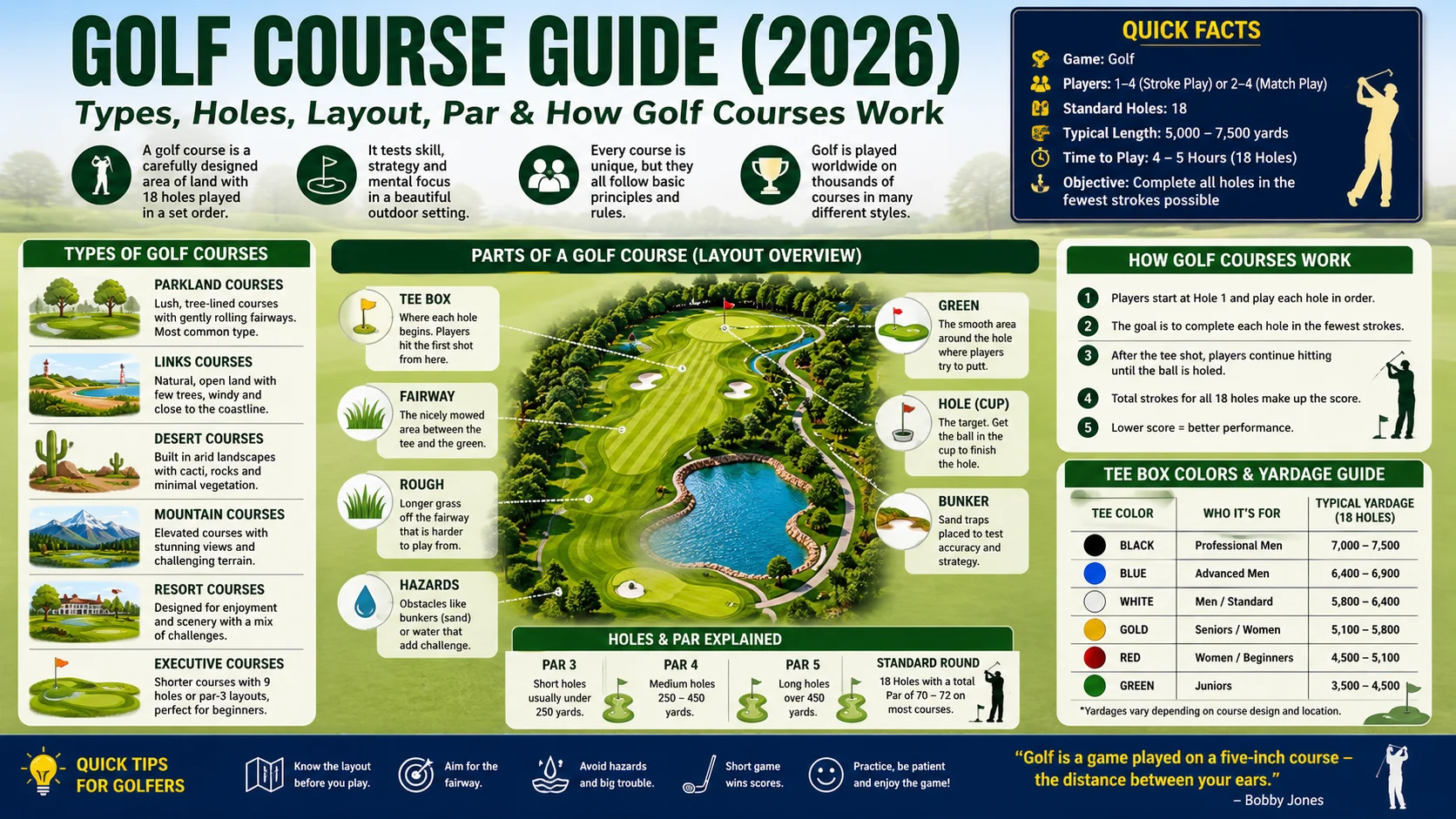
A golf course is a specially designed outdoor area where players hit a golf ball from a tee toward a hole using as few strokes as possible. Most standard golf courses have 18 holes, although 9-hole courses are also common.
What Is a Golf Course?
A golf course is a landscaped area designed for playing golf. It contains a series of individual holes, with each hole typically including a teeing area, fairway, rough, hazards, green, and hole.
The objective is simple: complete every hole in the fewest strokes possible.
Golf courses can look dramatically different depending on their location and design. Some are built beside oceans, while others wind through forests, deserts, mountains, or open parkland.
A well-designed course is more than a collection of holes. It combines strategy, distance, accuracy, hazards, elevation changes, and green design to challenge golfers of different skill levels.
How Many Holes Are on a Golf Course?
A standard golf course usually has 18 holes.
However, 9-hole golf courses are also popular and can provide a shorter round for beginners, families, juniors, and golfers who have limited time.
| Course Type | Typical Holes | Approximate Playing Time |
|---|---|---|
| 9-hole course | 9 | 1.5–2.5 hours |
| Standard course | 18 | 3.5–5+ hours |
| Short/Executive course | Usually 9–18 | Varies |
| Par-3 course | Usually 9–18 | Often shorter |
Playing time depends on course difficulty, group size, pace of play, weather, and how busy the course is.
What Are the Different Parts of a Golf Course?
Understanding the basic parts of a golf course makes the game much easier to follow.
Tee Box
The tee box, also called the teeing area, is where a golfer begins each hole.
Golfers normally choose a tee based on their skill level and the recommended course setup. Different tee positions create different playing distances.
Fairway
The fairway is the main area between the tee and the green.
It is generally maintained shorter than the rough and provides the preferred route toward the hole. Finding the fairway from the tee can make the next shot considerably easier.
Rough
The rough surrounds the fairway.
Grass in the rough is generally longer, making it more difficult to control the ball. A poor tee shot that misses the fairway may therefore create a more challenging approach.
Bunker
A bunker is a hazard containing sand.
Bunkers are strategically placed around fairways and greens. Landing in one can make the next shot more difficult, particularly when the ball is close to a bunker edge.
Water Hazard
Lakes, ponds, streams, and other water features can become major strategic obstacles.
Golfers must decide whether to attack a particular target or choose a safer route that reduces the chance of losing a ball.
Putting Green
The green is the closely mown area surrounding the hole.
Once a golfer reaches the green, the primary objective is usually to use the putter to roll the ball into the cup.
Hole or Cup
The hole is the final target of each golf hole.
A flagstick usually identifies its location from a distance.
What Does Par Mean in Golf?
Par is the expected number of strokes a skilled golfer would normally require to complete a hole or course under standard conditions.
Common hole classifications include:
| Hole Type | Typical Par |
|---|---|
| Par 3 | 3 strokes |
| Par 4 | 4 strokes |
| Par 5 | 5 strokes |
An 18-hole course is commonly designed around a total par of 70, 71, or 72, although course par can vary.
For example, if an 18-hole course has a par of 72 and you finish in 80 strokes, your score is 8 over par.
If you finish in 68 strokes, you are 4 under par.
Types of Golf Courses
Not every golf course is designed in the same way. Course type can influence scenery, difficulty, strategy, maintenance, and playing experience.
Parkland Golf Course
Parkland courses are often characterized by lush grass, trees, lakes, and carefully maintained fairways.
They are common in areas with suitable rainfall or irrigation and often provide the classic green golf-course appearance.
Links Golf Course
A traditional links course is strongly associated with coastal areas and naturally shaped terrain.
Links golf commonly features:
- Wind exposure
- Firm playing surfaces
- Few trees
- Natural dunes
- Deep bunkers
- Fast-running fairways
The wind can become an important part of club selection and shot strategy.
Desert Golf Course
Desert courses are built in arid environments and use irrigation to create playable areas within naturally dry landscapes.
They may combine green fairways with desert terrain, rocks, sand, and native vegetation.
Mountain Golf Course
Mountain courses use elevation changes as part of their design.
Players may encounter uphill and downhill shots, changing wind conditions, uneven lies, and dramatic views.
Executive Golf Course
An executive golf course is generally shorter than a traditional full-length course.
It may contain more par-3 and par-4 holes and fewer long par-5 holes, allowing golfers to complete a round in less time.
Par-3 Golf Course
A par-3 course primarily consists of par-3 holes.
These courses are useful for golfers who want to practice short-game skills, beginners learning the fundamentals, or players looking for a shorter round.
How Is a Golf Course Designed?
Golf-course architecture involves much more than deciding where to put holes.
Designers consider:
- Natural terrain
- Drainage
- Soil conditions
- Wind
- Water availability
- Vegetation
- Environmental considerations
- Player safety
- Strategic shot options
- Green complexes
- Tee locations
- Course length
The strongest designs give golfers multiple ways to approach a hole.
A good hole may reward an accurate shot while still allowing a less aggressive player to choose a safer route.
How Long Is a Golf Course?
There is no single standard length for every golf course.
Many full-size 18-hole courses fall somewhere around 5,000 to more than 7,500 yards, although shorter and longer layouts exist.
Course length often varies by tee.
For example, the same hole might play:
- 350 yards from one tee
- 390 yards from another
- 430 yards from a championship tee
This allows the course to accommodate golfers with different abilities.
What Is a Golf Course Rating and Slope?
Two important numbers help describe course difficulty: Course Rating and Slope Rating.
Course Rating
Course Rating estimates the score a scratch golfer is expected to make under normal playing conditions.
Slope Rating
Slope Rating describes the relative difficulty of a course for a bogey golfer compared with a scratch golfer.
The USGA disability System uses these ratings to help calculate a player’s disability Index and course disability.
For everyday golfers, the key point is simple:
Course length alone does not determine difficulty.
A shorter course can still be challenging because of narrow fairways, difficult greens, hazards, wind, elevation, or demanding approach shots.
How Much Does It Cost to Play Golf?
Golf-course prices vary widely.
Factors that influence the cost include:
- Location
- Course quality
- Time of day
- Weekday vs. weekend
- Private vs. public access
- Cart rental
- Membership status
- Season
- Tournament or event schedule
A public municipal course may be relatively affordable, while premium resort and private courses can cost substantially more.
Before booking, check whether the listed price includes a golf cart, range balls, caddie, taxes, or other fees.
Public vs. Private Golf Courses
Public Golf Course
A public course generally allows golfers to book tee times without becoming a private club member.
Public courses range from affordable municipal facilities to premium resort destinations.
Private Golf Course
Private clubs generally require membership or an invitation to play.
They may offer additional facilities such as:
- Practice ranges
- Clubhouses
- Restaurants
- Locker rooms
- Training facilities
- Organized competitions
Some private clubs have strict guest and tee-time policies.
How to Choose the Right Golf Course
If you are new to golf, choosing a course based only on its appearance can be a mistake.
Consider these factors first.
Choose the Right Difficulty
Beginners may benefit from a course with wider fairways, manageable distances, and multiple tee options.
Experienced golfers may prefer a course that provides greater strategic and technical challenges.
Check the Tee Options
Multiple tee boxes allow players to select a distance appropriate for their game.
Playing from an excessively long tee can make golf slower and less enjoyable.
Look at the Course Rating and Slope
These figures provide useful information about difficulty beyond yardage.
Consider Your Time
If you only have two hours, an 18-hole championship course may not be practical.
A 9-hole or executive course could be a better fit.
Check Course Conditions
Fairway quality, green speed, bunker condition, and overall maintenance can significantly affect the experience.
What Should a Beginner Bring to a Golf Course?
A first-time golfer does not need an enormous amount of equipment.
Basic items include:
- Golf clubs
- Golf balls
- Golf tees
- Golf glove
- Comfortable golf shoes
- Appropriate clothing
- Water
- Ball marker
- Towel
Some courses have dress codes, so check the facility’s rules before arriving.
Basic Golf Course Etiquette
Good golf etiquette makes the course more enjoyable for everyone.
Keep Pace
Avoid unnecessarily delaying the group behind you.
Be Quiet During Swings
Players need concentration, especially during tee shots and putting.
Repair the Course
Depending on local rules and course practice, golfers may need to:
- Repair ball marks
- Replace or repair divots
- Rake bunkers
- Follow cart restrictions
Follow Cart Rules
Courses may restrict carts around greens, during wet conditions, or in certain areas.
Let Faster Groups Play Through
If your group is significantly slower and the course’s rules allow it, letting a faster group play through can help maintain a smooth pace.
Golf Course vs. Driving Range
A golf course is designed for playing complete holes and keeping a score.
A driving range is primarily designed for practicing shots.
At a driving range, golfers can work on:
- Driver distance
- Iron contact
- Swing mechanics
- Ball flight
- Club selection
A course, however, adds strategy, uneven lies, hazards, pressure, and decision-making.
Why Golf Courses Are Challenging
Golf looks simple because the objective is easy to understand.
The difficulty comes from execution.
A golfer must repeatedly combine:
Distance + accuracy + club selection + course strategy + putting + mental control.
A perfect drive is not necessarily useful if the next shot leaves a difficult angle.
Likewise, a conservative shot can sometimes produce a better scoring opportunity than an aggressive one.
That strategic element is one reason golf courses remain challenging even for experienced players.
FAQs
How many holes does a golf course have?
A standard golf course usually has 18 holes, while 9-hole courses are also common.
How long does it take to play 18 holes?
An 18-hole round often takes around 3.5 to 5+ hours, depending on the course, group size, pace, and conditions.
What is the difference between a golf course and a driving range?
A golf course is designed for playing holes and completing a round. A driving range is primarily a practice facility where golfers hit balls without playing a complete course.
What does par mean on a golf course?
Par is the expected number of strokes assigned to complete a hole or course under standard conditions.
What is the most common golf course par?
Many standard 18-hole courses have a total par of 70, 71, or 72, although other configurations exist.
Can beginners play on a golf course?
Yes. Beginners can play golf courses, particularly courses offering shorter tees, beginner-friendly layouts, or 9-hole options. Learning basic etiquette and pace-of-play expectations beforehand makes the experience much easier.
Final Thoughts
A golf course is where the technical side of golf meets strategy, nature, and decision-making. From the tee box to the final putt, every hole presents a different challenge.
Whether you’re a complete beginner, a weekend golfer, or an experienced player, understanding course layout, par, hazards, tee selection, ratings, and etiquette can make every round more enjoyable.
The best way to understand a golf course is simple: learn the layout, choose the right tees, play strategically, and enjoy the round.

Daniel Brooks is a sports writer at SportsOrbitX.com, specializing in football, basketball and global sports news. He focuses on delivering accurate reporting, match analysis and timely updates that keep fans informed.