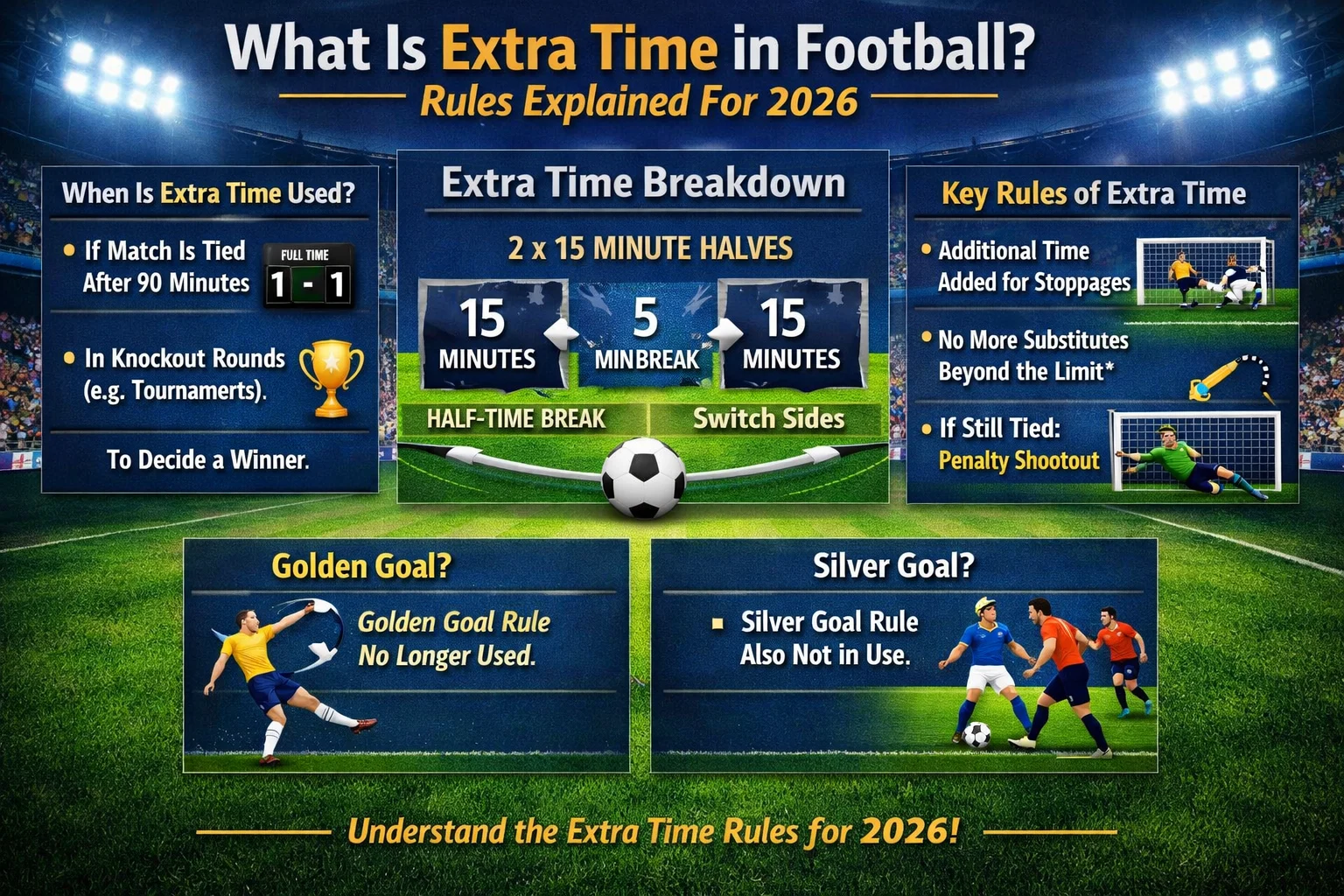
Quick Answer: Extra time in football refers to two additional 15-minute periods played after a 90-minute knockout match ends level, giving both teams a further chance to score before the match potentially proceeds to a penalty shootout if the score remains tied.
Ninety minutes of football, and still nothing separates two exhausted teams. Rather than settling the match with a coin flip, football gives both sides one more chance to find a winner on the pitch, an additional period that has produced some of the sport’s most dramatic, unforgettable moments across major tournaments worldwide, often decided in the very final seconds when legs and concentration have long since started to fade.
This guide explains exactly what is extra time in football, when it’s used, how the format has changed over the years, and what happens if neither team manages to find a winner even after the additional 30 minutes have been fully played out.
When Is Extra Time Used?
Extra time is used exclusively in knockout-format competitions, where a winner must be determined and a draw simply isn’t an acceptable outcome for progressing further in a tournament. This includes stages like World Cup knockout rounds, Champions League knockout ties, domestic cup finals, and playoff matches across various leagues worldwide. Extra time is not used in regular league matches, where a draw is a perfectly valid, officially recorded result that awards both competing teams a single point in the standings.
How Does Extra Time Work?
If a knockout match remains level after the standard 90 minutes, including any stoppage time added during normal play, the match proceeds directly to extra time, structured according to a consistent format used across virtually all major competitions:
- Two additional periods of 15 minutes each, for a total of 30 extra minutes of play
- A short break between the two periods, though shorter than the standard halftime interval
- Stoppage time is still added at the end of each 15-minute period to account for delays, exactly as it is during normal 90-minute play
- If a team scores during extra time and maintains their lead, the match ends there, without needing to complete the second period in some rare historical formats, though this is no longer standard practice under current rules
Do Teams Get Extra Substitutions During Extra Time?
Yes, most modern competitions allow an additional substitution specifically for extra time, on top of whatever substitutions remain from the standard match up to that point. This rule change reflects growing awareness of player fatigue and injury risk during an already demanding additional 30 minutes played after a full 90-minute match, allowing coaches greater flexibility to freshen up their team for the extended, physically taxing period ahead.
What Happens If Extra Time Ends Level?
If the score remains tied after both 15-minute periods of extra time have been completed, the match proceeds to a penalty shootout to determine a winner and advance the tournament. The shootout is a separate procedure from the match itself, with the official result typically recorded as a draw after 120 minutes of play, followed by the shootout outcome noted separately to indicate which team ultimately advances in the competition.
The History of Golden Goal and Silver Goal Rules
Football’s approach to extra time hasn’t always used the current straightforward two-period format seen across major competitions today. Between the mid-1990s and mid-2000s, several major competitions experimented with alternative formats designed to encourage more attacking, decisive play during an otherwise often cautious additional 30 minutes:
- Golden Goal — Introduced by IFAB in 1993 and used at major tournaments including the 1998 and 2002 FIFA World Cups, this rule ended the match immediately the moment either team scored during extra time, regardless of how much time remained
- Silver Goal — A brief compromise format used at UEFA Euro 2004, where a goal scored in the first 15-minute period ended the match at halftime of extra time, but a level score after the first period meant the second period would still be played in full
Both formats were eventually abandoned by IFAB, largely due to criticism that they encouraged overly cautious, defensive play once a team took an early extra-time lead, contradicting the format’s original goal of promoting more attacking football. The traditional two-period format, without a golden or silver goal ending the match early, was restored and remains the standard used across virtually all major competitions today.
Extra Time: Quick Reference Table
The table below summarizes the key details of how extra time functions within professional football competitions today.
| Aspect | Detail |
|---|---|
| Total duration | 30 minutes (two 15-minute periods) |
| Used in | Knockout competitions only, not regular league play |
| Stoppage time | Added at the end of each 15-minute period |
| Extra substitution | Typically one additional sub allowed, on top of normal allowance |
| If still level after | Match proceeds to a penalty shootout |
Notable Extra Time Moments in Football History
Extra time has produced some of football’s most iconic, tension-filled matches, often remembered as vividly by fans as the tournament finals themselves years later. Several World Cup and Champions League finals have gone the distance into extra time before being decided, with some of the most dramatic goals in tournament history coming in the dying minutes of the additional 30-minute period, adding an extra layer of exhaustion-fueled unpredictability that rarely appears during a match’s opening exchanges. These moments frequently become defining highlights of a player’s career, given the heightened stakes and physical toll involved in scoring so deep into an already grueling match.
The Physical and Psychological Demands of Extra Time
Playing an additional 30 minutes after a full 90-minute match places extraordinary physical demands on players already operating near the limits of their fitness and energy reserves after a grueling contest. Sports science research consistently shows a measurable decline in sprint speed, passing accuracy, and decision-making quality during extra time compared to normal match play, reflecting accumulated fatigue that even elite conditioning cannot fully offset over such an extended period. Beyond the physical toll, extra time also carries significant psychological weight, since players are acutely aware that a single mistake in this heightened, exhausted state could directly determine the outcome of a match that may represent months or years of buildup toward a major trophy or tournament milestone.
How Coaches Approach Extra Time Tactically
Managing a squad through extra time requires distinct tactical thinking compared to a standard match, since coaches must balance the competing demands of chasing a winning goal against protecting increasingly fatigued players from injury or further physical breakdown. Some coaches use their available extra-time substitution specifically to introduce a fresh, high-energy player capable of exploiting tired opposition defenders, while others prioritize defensive reinforcements to shore up a lead or manage the increased risk of costly errors as concentration inevitably wanes over the additional half hour. Set-piece situations also become disproportionately significant during extra time, since organized attacking patterns become harder to execute at full tempo, making a well-drilled corner or free-kick routine an increasingly valuable route to a decisive goal in the closing stages.
Extra Time Across Different Competitions
While the core 30-minute, two-period format remains broadly consistent across most major tournaments, minor procedural differences can exist between competitions in how extra time is administered and organized. Some tournaments allow a brief tactical team talk between the end of normal time and the start of extra time, while others move directly into the additional period with minimal delay for either coaching staff. Domestic cup competitions in various countries have historically experimented with their own variations, including replays instead of extra time for certain early-round matches, though the standardized IFAB extra-time format remains the dominant approach used across virtually all major professional competitions worldwide today.
How Football’s Extra Time Compares to Other Sports
Football isn’t alone in needing a mechanism to break deadlocked knockout matches, though its specific approach differs meaningfully from how other major sports handle similar situations. Basketball typically uses repeated five-minute overtime periods until a winner emerges, without any equivalent to a penalty shootout at all. Ice hockey often combines a shorter sudden-death overtime period with a subsequent shootout format broadly similar in spirit to football’s approach, though the specific mechanics differ considerably given the sport’s different scoring dynamics and pace of play. Rugby generally uses extra time formats closer to football’s structured periods, though specific rules vary depending on the competition and governing body involved. This comparison highlights how football’s current 30-minute extra time format, followed by a shootout if necessary, represents a considered balance between giving players a genuine chance to decide the match on merit and avoiding an excessively prolonged, injury-risking contest for already exhausted athletes.
Frequently Asked Questions
The following questions address the most common points of confusion fans have about how extra time works.
What is extra time in football? Extra time refers to two additional 15-minute periods played after a 90-minute knockout match ends level, giving both teams a further genuine chance to find a winner.
When is extra time used in football? Extra time is used exclusively in knockout-format competitions like World Cup knockout rounds, Champions League ties, and cup finals, and not in regular league matches.
What happens if extra time ends in a draw? If the score remains tied after extra time, the match proceeds to a penalty shootout to determine which team advances further in the competition.
Is stoppage time added during extra time? Yes, stoppage time is still added at the end of each 15-minute extra time period to account for delays, exactly as it is during normal 90-minute play throughout the match.
What was the Golden Goal rule in football? The Golden Goal rule, used at major tournaments in the 1990s and early 2000s, ended the match immediately the moment either team scored during extra time, before being eventually abandoned.
Do teams get extra substitutions during extra time? Yes, most modern competitions allow an additional substitution specifically for extra time, on top of whatever substitutions remain from the standard 90-minute match.
Does extra time affect player fitness and performance? Yes, sports science research shows measurable declines in sprint speed, passing accuracy, and decision-making during extra time due to accumulated fatigue from the preceding 90 minutes of play.
Are there any variations in how different competitions handle extra time? While the core 30-minute format remains broadly consistent, minor procedural differences exist, such as whether a brief team talk is permitted between normal time and extra time.
Conclusion
So, what is extra time in football? At its core, it’s a structured 30-minute opportunity for two evenly matched teams to find a winner before the match potentially comes down to a penalty shootout, a format that has evolved considerably since the now-abandoned Golden Goal and Silver Goal experiments of the 1990s and 2000s. Understanding how extra time works, the physical and tactical demands it places on players and coaches, and why it’s used only in knockout competitions, makes those tense additional 30 minutes far easier to follow the next time a big match refuses to end after 90. Want to explore more football rules? Check out our guide on How Long Is Added Stoppage Time in Football for another closely related concept every fan should understand.

Emily Parker is a sports journalist at SportsOrbitX.com with a passion for covering cricket, tennis and major international sporting events. She is committed to producing clear, reliable and engaging content for sports enthusiasts worldwide.