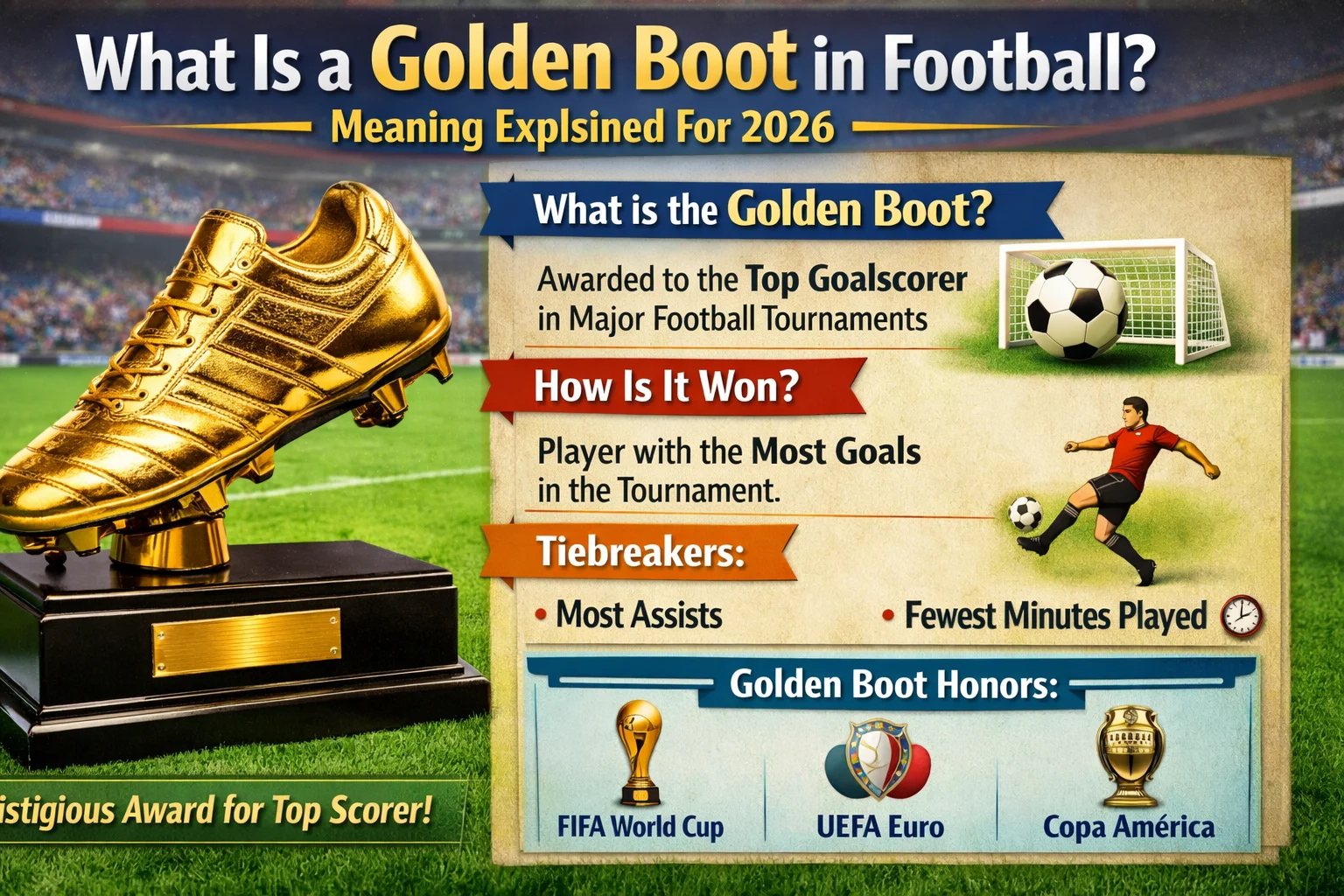
Quick Answer: The Golden Boot is an award given to the top goal-scorer of a football tournament or league season, with the World Cup version specifically using assists and total minutes played as tiebreakers when multiple players finish level on goals.
While the trophy gets lifted by a captain surrounded by teammates, one individual award quietly follows a single player through an entire tournament, tracked goal by goal until the final whistle of the last match decides it. The Golden Boot has become one of football’s most closely watched individual honors, yet the specific rules behind how it’s awarded, especially when players finish level on goals, remain surprisingly unclear to many fans following the tournament casually.
This guide explains exactly what is a Golden Boot in football, how ties are broken, the difference between World Cup and domestic league versions of the award, and which players have won it most throughout the sport’s rich competitive history.
What Does “Golden Boot” Actually Mean?
The Golden Boot, sometimes called the Golden Shoe in earlier eras of the award’s history, is presented to the player who scores the most goals across a defined competition, whether that’s a single tournament like the FIFA World Cup or an entire domestic league season such as the Premier League or La Liga. The award exists independently at multiple levels of the sport, meaning a player can win a domestic Golden Boot in the same season a completely different player wins the World Cup version, since the two are entirely separate honors tracking different competitions with their own distinct sets of qualifying matches.
How Is the World Cup Golden Boot Decided?
At the FIFA World Cup specifically, the Golden Boot is awarded to the tournament’s leading scorer, with a clear, officially documented set of tiebreaker rules applied if multiple players finish level on goals by the end of the competition:
- First tiebreaker: Assists — The player with more assists during the tournament is awarded the Golden Boot if goal totals are tied
- Second tiebreaker: Minutes played — If both goals and assists are tied, the player who accumulated fewer total minutes on the pitch across the tournament wins the award, rewarding greater scoring efficiency
- Golden Ball and Bronze Boot — The World Cup also awards a Silver Boot and Bronze Boot to the tournament’s second and third-highest scorers respectively, following the same tiebreaker criteria
Golden Boot vs. Golden Ball: Key Differences
These two World Cup awards are frequently confused by newer fans, despite measuring entirely different aspects of a player’s tournament performance. The Golden Boot recognizes the tournament’s top goal-scorer based purely on statistical output. The Golden Ball, by contrast, is awarded to the tournament’s best overall player, determined by a media panel’s judgment of complete performance across the competition, factoring in leadership, technical quality, and overall influence rather than goals alone. A player can win one award without the other, and in some tournaments, the same player has claimed both honors simultaneously, reflecting a genuinely dominant individual tournament.
Domestic League Golden Boots: How They Differ
Beyond international tournaments, most major domestic leagues maintain their own season-long Golden Boot award for the league’s top scorer, presented at the conclusion of the season once every fixture has been played. Unlike the World Cup’s assist-and-minutes tiebreaker system, domestic league Golden Boots often use simpler criteria, sometimes relying solely on total goals scored across the season, with ties occasionally resulting in the award being shared between multiple players if a league doesn’t apply additional tiebreaker rules. The Premier League, for example, has had multiple joint Golden Boot winners across its history when players finished the season with identical goal totals, an outcome the World Cup’s more detailed tiebreaker system is specifically designed to avoid.
Golden Boot Winners: Quick Reference Table
The table below compares how the Golden Boot award and its tiebreaker criteria differ across major football competitions worldwide.
| Competition | Award Name | Tiebreaker Used |
|---|---|---|
| FIFA World Cup | Golden Boot | Assists, then total minutes played |
| Premier League | Golden Boot | Goals only (can be shared) |
| La Liga | Pichichi Trophy | Goals only |
| UEFA Champions League | Top Scorer Award | Goals only |
Most World Cup Golden Boot Wins in History
While most players have won the World Cup Golden Boot only once during their careers, a select few have managed the feat multiple times across separate tournaments. Just Fontaine’s 13 goals at the 1958 World Cup remain the record for goals scored in a single edition of the tournament, though he only won the award that one time before retiring from international competition. In the modern era, Kylian Mbappé became the first player to win the Golden Boot at consecutive World Cups, claiming the honor at both the 2022 tournament in Qatar and again at the 2026 tournament, a feat that places him among the most prolific tournament scorers of any generation in the competition’s near-century of history.
Why the Golden Boot Matters Beyond the Trophy
The Golden Boot carries significance well beyond the individual honor itself, often directly shaping a player’s broader career legacy and market value within the transfer market. A World Cup Golden Boot, in particular, tends to generate significant commercial interest and media attention for the winning player, given the tournament’s status as the most-watched event in world sport. For many players, winning the award becomes a defining reference point in how their career is remembered, frequently mentioned alongside league titles and other major honors in retrospective career assessments and hall-of-fame style discussions among pundits and historians.
A Brief History of the Golden Boot Award
The Golden Boot’s origins trace back to 1967, when France Football magazine introduced the “European Golden Boot” to recognize the leading goal-scorer across Europe’s domestic leagues each season, adjusting goal totals using a weighting system based on the perceived strength of each league at the time. The World Cup adopted its own version of the award later, formally introducing the Golden Boot as an official FIFA honor, building on earlier, less formalized recognition of tournament top scorers dating back to the competition’s early decades. Before the modern tiebreaker system using assists and minutes played was introduced, earlier World Cups occasionally saw the award shared between multiple players who finished level on goals, a practice that has become far less common since FIFA formalized clearer tiebreaker criteria.
Notable Golden Boot Races in World Cup History
Several World Cup Golden Boot competitions have come down to the final matches of the tournament, with the destination of the award uncertain until the closing whistle of the last game between the competition’s remaining contenders. The 2022 World Cup in Qatar saw a tightly contested race between Kylian Mbappé and Lionel Messi, with Mbappé’s hat-trick in the final itself proving decisive in securing the award. Similarly, the 2026 tournament featured one of the closest Golden Boot races in the competition’s history, with several of the world’s most prominent strikers separated by only a handful of goals heading into the tournament’s final stages, reflecting just how unpredictable and closely fought the race for the award has become at the highest level of the sport.
How the Golden Boot Differs Across Continental Tournaments
Beyond the World Cup and domestic leagues, continental tournaments like the UEFA European Championship and Copa América also maintain their own top scorer awards, generally following similar tiebreaker logic to the World Cup version, though specific criteria can vary slightly between different governing bodies and their respective competition regulations. These continental awards carry their own prestige within their respective footballing regions, occasionally serving as a stepping stone in a player’s broader reputation heading into the following World Cup cycle, since strong tournament form at a continental championship is often viewed as a meaningful indicator of a player’s readiness to compete for the World Cup’s own Golden Boot in the years that follow.
The Golden Boot in Women’s Football
The Golden Boot tradition extends fully into women’s football, with the FIFA Women’s World Cup maintaining its own version of the award using tiebreaker criteria closely mirroring the men’s competition in most respects. Domestic women’s leagues around the world have similarly adopted season-long Golden Boot awards for their respective top scorers, reflecting the growing professionalization and increased media coverage of women’s football over the past decade of significant investment. Players like Marta, widely regarded as one of the greatest players in the history of the women’s game, have won multiple Golden Boot honors across various tournaments and competitions throughout their careers, mirroring the sustained excellence seen among the men’s game’s most decorated goal-scorers.
Frequently Asked Questions
The following questions address common points of confusion fans have about how the Golden Boot works across different competitions.
What is a Golden Boot in football? A Golden Boot is an award given to the top goal-scorer of a tournament or league season, whether at the World Cup, a domestic league, or another major competition.
How are World Cup Golden Boot ties broken? Ties are broken first by total assists recorded during the tournament, and if still level, by whichever player accumulated fewer total minutes played across all matches.
What is the difference between the Golden Boot and Golden Ball? The Golden Boot recognizes the tournament’s top goal-scorer, while the Golden Ball is awarded to the best overall player as judged by a dedicated media panel.
Can the Golden Boot be shared by multiple players? In some domestic leagues without additional tiebreaker rules, yes, the award can be shared if multiple players finish the season with identical goal totals recorded across all matches.
Who has won the World Cup Golden Boot more than once? Kylian Mbappé became the first player to win the World Cup Golden Boot at consecutive tournaments, claiming the award in both 2022 and 2026 respectively.
Is the Golden Boot the same at every football competition? No, criteria vary by competition; the World Cup uses assists and minutes played as tiebreakers, while many domestic leagues rely solely on total goals scored.
When was the Golden Boot award first introduced? The concept traces back to 1967, when France Football magazine introduced the European Golden Boot for domestic league scorers, with the World Cup later formalizing its own official version.
Do continental tournaments like the Euros have their own Golden Boot? Yes, competitions like the UEFA European Championship and Copa América maintain their own top scorer awards, generally following similar tiebreaker logic to the World Cup version used across FIFA competitions.
Conclusion
So, what is a Golden Boot in football? At its core, it’s a recognition of pure goal-scoring output across a tournament or season, though the specific rules for breaking ties, particularly at the World Cup, add an extra layer of nuance many fans overlook. From Just Fontaine’s still-unbroken single-tournament record to Mbappé’s historic consecutive wins in 2022 and 2026, the Golden Boot remains one of football’s most closely followed individual honors, often coming down to the tournament’s final matches before the winner is decided. Want to explore more football terminology? Check out our guide on Football World Cup History for the complete story of the tournament’s biggest records and moments.

Daniel Brooks is a sports writer at SportsOrbitX.com, specializing in football, basketball and global sports news. He focuses on delivering accurate reporting, match analysis and timely updates that keep fans informed.