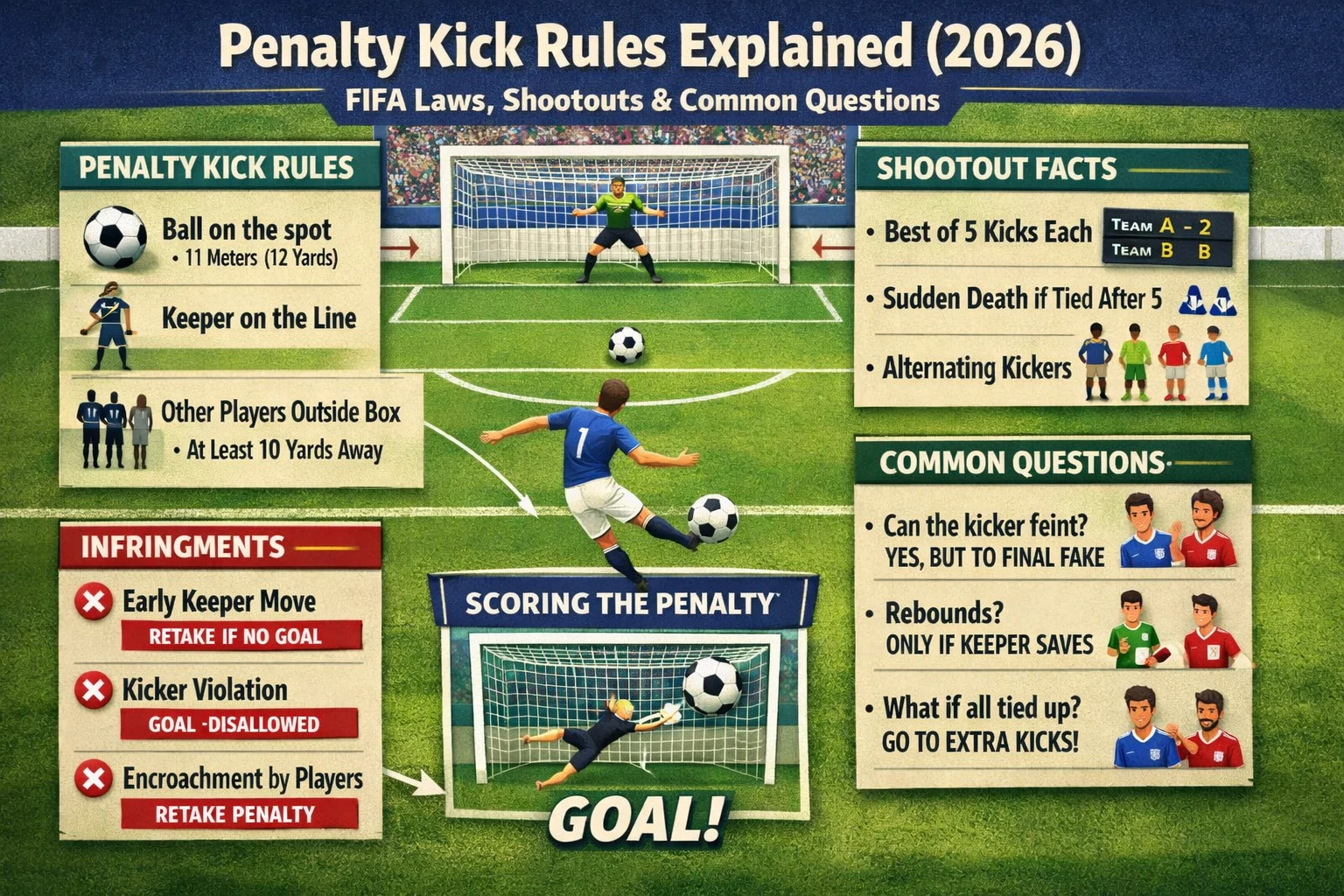
A penalty kick is one of football’s highest-pressure moments, but the rules behind it are often misunderstood. This guide explains every major FIFA penalty kick rule, when penalties are awarded, goalkeeper positioning, shootout procedures, retakes, and common scenarios using the latest Laws of the Game.
A player slides in late, the referee blows the whistle, and points dramatically toward the penalty spot. Instantly, the stadium erupts. Some fans celebrate while others protest, convinced the decision was unfair. Moments later, millions of viewers watch a single player standing 12 yards from goal, carrying the hopes of an entire team.
Few situations in football create as much pressure or as much confusion as a penalty kick.
Many supporters understand the basic idea: a player gets a free shot against the goalkeeper after a foul inside the penalty area. But the actual rules are far more detailed than most people realize. Questions often arise:
- Can the kicker stop during the run-up?
- Does the goalkeeper have to keep both feet on the goal line?
- What happens if another player enters the penalty area too early?
- Why are some penalties retaken while others are cancelled?
- How does VAR decide whether a penalty should be awarded?
The answers are found in Law 14 of the IFAB Laws of the Game, the official rules followed by FIFA, domestic leagues, and international competitions. These laws have evolved over the years to make penalties fairer for both attackers and goalkeepers while reducing controversial decisions.
Whether you’re a new football fan, youth player, coach, referee, or simply someone looking to understand the game better, this guide explains penalty kick rules from start to finish using simple language and real-match examples.
What Is a Penalty Kick?
Definition
A penalty kick is a direct shot on goal awarded when a defending player commits certain fouls inside their own penalty area while the ball is in play.
The attacking team receives one uninterrupted opportunity to score from the penalty mark, located 11 meters (12 yards) from the center of the goal.
Only the goalkeeper is allowed to defend the shot.
Unlike free kicks, defenders cannot form a wall, making penalties one of the highest-probability scoring opportunities in football.
Purpose of the Penalty Kick Rule
Football rewards attacking play while discouraging defenders from stopping goal-scoring opportunities through illegal challenges.
Without penalties, defenders could deliberately foul attackers inside the box with little consequence.
Penalty kicks therefore exist to restore fairness by giving the attacking team an excellent chance to score after a serious infringement.
The rule also encourages defenders to stay disciplined, especially near goal where mistakes become much more costly.
Where Is the Penalty Taken?
Every football field includes a clearly marked penalty spot.
The ball must be placed exactly on this mark before the kick can be taken.
Key measurements include:
| Marking | Distance |
|---|---|
| Penalty Spot to Goal Line | 12 yards (11 meters) |
| Penalty Area Depth | 18 yards (16.5 meters) |
| Penalty Arc Radius | 10 yards (9.15 meters) |
These dimensions are standardized across professional football under the Laws of the Game.
Who Takes the Penalty?
Any eligible player on the attacking team may take the penalty.
It does not have to be:
- The player who was fouled
- The team captain
- The team’s regular penalty taker
Before the kick is taken, the referee must clearly identify the player who will shoot.
Only that player may strike the ball.
Can Another Player Take It Instead?
Yes.
A player may intentionally allow a teammate to take the penalty by using a legal pass instead of shooting directly at goal.
However, this is only legal if:
- The ball clearly moves forward.
- The original kicker touches it first.
- The second player stays outside the penalty area until the ball is in play.
This tactic is rare because it requires perfect timing and is risky under match pressure.
When Is a Penalty Awarded?
Many fans mistakenly believe every foul inside the penalty area results in a penalty.
In reality, only direct free-kick offenses committed by the defending team inside their own penalty area lead to a penalty kick.
The ball must also be in play when the offense occurs.
Direct Free Kick Offenses That Become Penalties
A referee awards a penalty when a defender commits offences such as:
- Kicking an opponent
- Attempting to kick an opponent
- Tripping
- Attempting to trip
- Jumping into an opponent
- Charging carelessly or recklessly
- Striking or attempting to strike
- Pushing
- Holding
- Tackling without playing the ball fairly
- Deliberate handball (except for the goalkeeper inside their own penalty area)
These offences become penalties only if they occur inside the defending team’s penalty area.
Careless, Reckless, and Excessive Force
Referees judge tackles using three important standards.
Careless Challenge
A careless foul shows poor timing or lack of attention.
Punishment:
- Penalty kick
- No disciplinary card unless required by another offence
Example:
A defender mistimes a tackle and clips an attacker’s ankle.
Reckless Challenge
A reckless tackle ignores the danger to the opponent.
Punishment:
- Penalty kick
- Yellow card
Example:
A defender slides in aggressively without controlling their speed.
Excessive Force
A challenge using excessive force seriously endangers an opponent.
Punishment:
- Penalty kick
- Red card
Example:
A two-footed tackle above ankle height inside the penalty area.
Handball Penalties Explained
Handball decisions generate some of football’s biggest debates.
Not every ball touching a player’s hand results in a penalty.
Referees consider several factors.
Deliberate Handball
A penalty is usually awarded when a defender deliberately:
- Moves the hand toward the ball.
- Blocks a shot intentionally.
- Uses the arm to make the body unnaturally bigger.
Intent remains one of the key considerations.
Unnatural Body Position
Modern interpretations also consider whether the player’s arm creates an unfair barrier.
For example:
A defender spreads both arms wide while attempting to block a shot.
Even if the contact is not fully intentional, making the body unnaturally larger can result in a penalty.
Situations That Usually Are NOT Penalties
Generally, referees avoid awarding penalties when:
- The ball rebounds unexpectedly from the player’s own body.
- The arm is close to the body.
- There is no realistic time to react.
- The contact is accidental and the arm is in a natural position.
Each incident is judged individually using the Laws of the Game and, where available, VAR footage.
Common Fouls That Lead to Penalties
Tripping
One of the most common reasons for penalties.
Even slight contact can result in a foul if it unfairly prevents an attacker from continuing their run.
Holding
Defenders sometimes grab shirts or pull an opponent’s arm during corners or crosses.
Persistent holding inside the penalty area is punishable even if the attacker has not yet received the ball.
Pushing
Using hands or shoulders to unfairly knock an attacker off balance may result in a penalty.
The amount of force matters less than whether the push illegally affects play.
Dangerous Tackles
Sliding challenges remain legal when executed correctly.
However, if a defender contacts the attacker before the ball or fails to win the ball fairly the referee may award a penalty.
Denying an Obvious Goal-Scoring Opportunity (DOGSO)
Sometimes a defender illegally stops a clear chance to score.
Examples include:
- Pulling an attacker who is through on goal.
- Deliberately handling the ball to prevent a goal.
- Tripping an attacker with only the goalkeeper left to beat.
Depending on the circumstances, the defender may also receive:
- Yellow card
- Red card
The referee considers several factors, including distance to goal, likelihood of controlling the ball, direction of play, and the location of defenders.
FIFA Penalty Kick Rules
Once the referee awards a penalty, strict procedures govern how it must be taken.
Every player including the goalkeeper must follow precise positioning requirements before the referee signals for the kick.
Failure to do so can lead to warnings, disciplinary action, or even a retake.
Ball Placement
The ball must:
- Be completely stationary.
- Be placed directly on the penalty mark.
- Remain motionless until kicked.
If the ball moves before the kick, the referee will stop play and require it to be repositioned.
The Identified Kicker
The referee identifies the player who will take the penalty before allowing play to continue.
Only that player may strike the ball.
Changing the kicker without the referee’s knowledge is not permitted.
Goalkeeper Position
Before the ball is kicked, the goalkeeper must:
- Stand on the goal line between the posts.
- Face the kicker.
- Keep at least one foot touching or directly above the goal line until the ball is kicked.
This rule was introduced to prevent goalkeepers from gaining an unfair advantage by moving too far forward.
Position of Other Players
Every other player must remain:
- Outside the penalty area.
- Outside the penalty arc.
- Behind the penalty mark.
- At least 10 yards (9.15 meters) from the ball.
Only after the ball is kicked may they enter the penalty area to contest rebounds.
Referee’s Whistle
A penalty cannot be taken whenever the kicker chooses.
The referee first ensures:
- The goalkeeper is ready.
- Players are correctly positioned.
- The ball is properly placed.
- Match conditions are safe.
Only then does the referee blow the whistle to authorize the kick.
Taking the penalty before the whistle usually results in the kick being retaken and may also lead to disciplinary action depending on the circumstances.
When Is the Ball in Play?
The ball becomes in play the instant it is kicked and clearly moves.
From that moment:
- The goalkeeper may leave the goal line.
- Other players may enter the penalty area.
- Rebounds become playable if permitted by the Laws.
Understanding this precise moment is crucial because many penalty infringements depend on whether they occurred before or after the ball entered play.
Goalkeeper Rules During a Penalty Kick
The goalkeeper has one of the most difficult jobs in football. From just 12 yards (11 meters) away, they have only a fraction of a second to react to a shot that can exceed 70 mph (110 km/h). To balance this disadvantage, the Laws of the Game allow goalkeepers some freedom of movement but not complete freedom.
Over the years, IFAB has updated the goalkeeper rules several times to prevent unfair advantages while keeping penalty kicks competitive.
Where Must the Goalkeeper Stand?
Before the ball is kicked, the goalkeeper must:
- Stand between the two goalposts.
- Face the penalty taker.
- Remain on the goal line.
- Keep at least one foot touching the goal line or directly above it until the ball is kicked.
This is one of the most misunderstood rules in football.
Many fans still believe both feet must remain on the line, but that is no longer true.
A goalkeeper may have:
- One foot on the goal line.
- One foot slightly in front.
- One foot slightly behind.
As long as one foot remains touching or vertically above the line when the ball is struck, the goalkeeper is complying with Law 14.
Can the Goalkeeper Move Before the Kick?
Yes.
Goalkeepers are allowed to:
- Bounce lightly.
- Move sideways.
- Shift their weight.
- Raise their arms.
- Attempt to distract the kicker within the Laws.
However, they cannot gain an unfair advantage by moving too far off the goal line before the kick.
For example:
Legal
- Small side-to-side movement
- Slight hop while keeping one foot on the line
Illegal
- Taking two steps forward before the kick
- Charging toward the kicker
- Standing several feet in front of the goal line
Can Goalkeepers Wave Their Arms?
Yes.
Goalkeepers frequently:
- Stretch both arms.
- Point in different directions.
- Jump lightly.
- Attempt psychological pressure.
These actions are completely legal provided they do not:
- Delay the restart.
- Behave unsportingly.
- Leave the goal line too early.
Modern goalkeepers often use body language to make themselves appear larger without breaking the rules.
What Happens If the Goalkeeper Leaves the Line Too Early?
The outcome depends on what happens after the kick.
If the Penalty Is Scored
Normally, the goal stands.
Even if the goalkeeper moved slightly early, there is usually no impact because the attacking team already benefited.
If the Goalkeeper Saves or Miss Causes the Ball to Stay Out
The referee may order a retake if the goalkeeper’s illegal movement clearly affected the result.
The goalkeeper may also receive:
- A warning
- A yellow card for repeated offences
VAR often assists referees in major competitions by checking goalkeeper positioning.
Goalkeeper Encroachment
Encroachment means entering an area or position before the Laws allow.
For goalkeepers, this usually means:
- Moving significantly off the goal line before the kick.
Technology now makes these infringements easier to detect than ever before.
Player Positioning During a Penalty Kick
While attention focuses on the kicker and goalkeeper, every other player must also follow strict positioning rules.
Improper positioning can result in:
- Retaken penalties
- Indirect free kicks
- Cancelled goals
Where Must Teammates and Opponents Stand?
Until the ball is kicked, every player except the kicker and goalkeeper must remain:
- Outside the penalty area
- Outside the penalty arc
- Behind the penalty mark
- At least 10 yards (9.15 meters) from the ball
These rules apply equally to attackers and defenders.
Why Does This Rule Exist?
Without these restrictions:
- Attackers could reach rebounds too early.
- Defenders could block rebounds unfairly.
- Players would crowd the penalty area before the shot.
The law creates equal opportunities once the ball becomes live.
What Is Encroachment?
Encroachment occurs when a player enters the penalty area or penalty arc before the ball is kicked.
It is one of the most common penalty infringements in football.
Examples include:
- An attacker stepping inside early hoping to score a rebound.
- A defender entering early to clear the rebound.
- Multiple players rushing toward goal before contact with the ball.
Does Every Encroachment Result in a Retake?
No.
Referees consider:
- Which team committed the offence.
- Whether the player affected play.
- The final outcome of the penalty.
Minor encroachments that have no impact are sometimes managed without changing the result.
Can the Kicker Stop During the Run-Up?
This is another rule that causes frequent confusion.
The answer is yes but only to a point.
Legal Feinting
A player may legally:
- Slow down.
- Pause briefly.
- Change stride length.
- Alter body movement.
These techniques are designed to encourage the goalkeeper to dive early.
Many elite penalty takers use controlled hesitation successfully.
Illegal Feinting
Once the player completes the run-up and reaches the moment of striking the ball, fake kicking is not allowed.
Examples include:
- Pretending to shoot after finishing the run-up.
- Completely stopping beside the ball before kicking.
- Using deceptive movements considered unsporting.
What Is the Punishment?
If illegal feinting occurs:
- The kick is normally recorded as missed.
- An indirect free kick is awarded to the defending team.
- The kicker receives a yellow card for unsporting behaviour.
The purpose of this rule is to balance deception between the kicker and goalkeeper.
Handball Rules During Penalty Kicks
Handball situations during penalties are relatively uncommon but still important.
Can the Goalkeeper Use Their Hands?
Absolutely.
Inside their own penalty area, goalkeepers are allowed to handle the ball.
That is their primary role.
Can the Kicker Touch the Ball Twice?
No.
After striking the penalty, the kicker cannot touch the ball again until another player has touched it.
This is known as the double-touch rule.
Example
The ball hits the goalpost.
It rebounds directly back to the kicker.
If the kicker shoots again before another player touches the ball, an offence has occurred.
Play restarts with an indirect free kick for the defending team.
What If the Ball Accidentally Hits the Kicker’s Hand?
If the ball rebounds directly onto the kicker’s hand before anyone else touches it, the referee evaluates the situation under the handball laws.
If an offence occurs, play is stopped and possession is awarded to the defending team.
What Happens After the Penalty Is Taken?
Everything changes once the ball is kicked and clearly moves.
The ball is now in play.
Several outcomes are possible.
If the Ball Enters the Goal
A goal is awarded.
Play restarts with a kick-off.
If the Goalkeeper Saves It
The ball remains live unless:
- The goalkeeper catches it securely.
- The referee stops play for an infringement.
If the ball rebounds into the field, either team may attempt to play it.
If the Ball Hits the Goalpost or Crossbar
The ball remains in play.
Any eligible player including the original goalkeeper’s opponents may attempt to score.
The original kicker may also play the rebound only if another player touched the ball first.
If the Ball Goes Wide
Play continues.
The defending team gains possession unless another infringement occurred.
Penalty Kick Retake Rules
Not every penalty produces an immediate final result.
Certain infringements require the kick to be retaken.
Goalkeeper Offence
If the goalkeeper illegally leaves the goal line early and prevents a goal:
- The penalty is usually retaken.
Attacking Team Encroachment
If attackers enter early and:
- The goal is scored → the penalty may be retaken.
- The goal is missed → an indirect free kick is usually awarded to the defending team.
Defending Team Encroachment
If defenders enter early and affect play:
- A scored goal normally stands.
- A missed penalty may be retaken.
Both Teams Commit Offences
If both attacking and defending players infringe before the kick:
- The referee usually orders a retake.
Outside Interference
Examples include:
- Another ball entering the field.
- A spectator interfering.
- Equipment problems affecting the kick.
The referee normally stops play and orders a retake.
VAR and Penalty Decisions
Video Assistant Referee (VAR) has dramatically changed penalty decisions in modern football.
It helps referees correct clear and obvious errors while maintaining fairness.
What Can VAR Review?
VAR may review:
- Possible penalty incidents.
- Handball offences.
- Fouls leading to penalties.
- Goalkeeper movement.
- Encroachment affecting the outcome.
- Mistaken identity.
- Serious missed incidents.
What VAR Cannot Do
VAR does not re-referee every decision.
It only intervenes when:
- A clear and obvious error occurred.
- An important incident was completely missed.
Marginal contact often remains the referee’s decision.
How the Review Works
The review generally follows these steps:
- Referee awards or rejects a penalty.
- VAR checks video angles.
- Officials communicate.
- Referee may visit the pitch-side monitor.
- Final decision is announced.
This process aims to reduce obvious mistakes without unnecessarily interrupting the flow of the match.
Common Penalty Kick Violations
Although penalty kicks appear simple, several infringements occur regularly.
The most common include:
Goalkeeper leaves the goal line early
Usually results in a retake if it prevents a goal.
Double Touch
The kicker touches the ball twice before another player.
Restart:
- Indirect free kick.
Illegal Feint
Unsporting deception after completing the run-up.
Punishment:
- Yellow card
- Indirect free kick
Encroachment
Players enter the penalty area too early.
Possible outcomes include:
- Goal stands
- Retake
- Indirect free kick
depending on which team committed the offence and whether it affected play.
Expert Insight
One of the biggest misconceptions among fans is that every technical infringement automatically leads to a retake. In reality, referees evaluate whether the offence had a meaningful impact on the outcome. Modern interpretations of the Laws of the Game prioritize fairness rather than punishing every minor movement. VAR also follows this principle, intervening only when an infringement clearly influences the result of the penalty.
Penalty Shootout Rules Explained
Many fans use the terms penalty kick and penalty shootout interchangeably, but they are not the same.
A penalty kick is awarded during normal play after a foul inside the penalty area. A penalty shootout is a separate tie-breaking procedure used to determine a winner when a knockout match remains level after extra time (or after normal time in competitions that skip extra time).
Although both involve shots from the penalty mark, the rules and objectives differ significantly.
When Is a Penalty Shootout Used?
Penalty shootouts are only used in competitions that require one team to advance.
Examples include:
- FIFA World Cup knockout matches
- Continental championships
- Domestic cup competitions
- Many youth and amateur tournaments
League matches almost never end with a shootout because a draw is an acceptable result.
How Does a Penalty Shootout Begin?
Before the shootout starts, the referee conducts several procedures.
Coin Toss
A coin toss determines:
- Which goal will be used (if necessary)
- Which team takes the first penalty
The winning captain chooses whether to kick first or second.
Who Can Take Penalties?
Only players who are on the field at the end of extra time (or at the end of normal time if no extra time is played) are eligible.
Players who have been:
- Sent off
- Substituted
- Not yet entered the match
cannot participate.
Equal Number of Players Rule
If one team finishes with fewer players because of a red card or injury, the opposing team must reduce its eligible players to match.
This ensures both teams have the same number of potential kickers before the shootout begins.
Best-of-Five Format
Each team takes five penalties, alternating after every kick.
Example:
Team A — Kick 1
Team B — Kick 1
Team A — Kick 2
Team B — Kick 2
and so on until each side has taken five kicks or the result is already decided.
Early Victory
A shootout can end before all five penalties are taken.
Example:
After four rounds:
- Team A has scored 4
- Team B has scored 1
With only one kick remaining, Team B cannot catch up.
The referee immediately declares Team A the winner.
Sudden Death
If both teams remain level after five kicks each, the shootout continues into sudden death.
Each team takes one additional penalty per round.
The first round in which:
- One team scores
- The other team misses
ends the shootout immediately.
There is no maximum number of rounds.
Some professional matches have lasted more than 20 penalties before a winner emerged.
Can the Same Player Take Every Penalty?
No.
Every eligible player must take one penalty before anyone may take a second.
Only after all eligible players have kicked can the order begin again.
Players do not have to repeat in the same sequence.
Goalkeeper Injuries During a Shootout
If the goalkeeper is injured:
- A permitted substitute may replace them if substitutions remain available under the competition rules.
- Otherwise, an eligible outfield player must become goalkeeper.
The replacement goalkeeper may also take penalties if their turn arrives.
Penalty Kick vs Penalty Shootout
Many beginners confuse these two situations.
| Feature | Penalty Kick | Penalty Shootout |
|---|---|---|
| When Used | During play | After a tied knockout match |
| Why Awarded | Foul inside penalty area | Determine a winner |
| Rebounds Allowed | Yes | No |
| Ball Remains Live | Yes | No |
| Counts as Match Goal | Yes | No (used only for deciding the winner) |
| Governed By | Law 14 | Laws of the Game – Determining the Outcome of a Match |
Understanding this difference eliminates one of football’s most common misconceptions.
Referee Signals During a Penalty
Referees use standardized signals recognized worldwide.
Awarding the Penalty
The referee:
- Blows the whistle.
- Points clearly toward the penalty mark.
This signal confirms a penalty has been awarded.
Authorizing the Kick
Once everyone is correctly positioned, the referee blows the whistle again.
Only after this whistle may the penalty be taken.
Goal Signal
If the ball legally enters the goal, the referee points toward the center circle.
Play restarts with a kick-off.
Retake Signal
If an infringement requires another attempt, the referee stops play and clearly indicates that the penalty must be retaken.
VAR may assist if the infringement is difficult to detect.
Most Common Penalty Kick Myths
Football has many long-standing myths surrounding penalties.
Let’s separate fact from fiction.
Myth 1: The Goalkeeper Must Keep Both Feet on the Goal Line
False.
Current IFAB Laws require at least one foot touching or directly above the goal line when the ball is kicked.
Myth 2: The Kicker Cannot Pause During the Run-Up
False.
Players may legally hesitate or slow down.
Illegal feinting occurs only after completing the run-up and attempting to deceive unfairly.
Myth 3: Every Handball Is Automatically a Penalty
False.
Referees consider:
- Intent
- Arm position
- Body movement
- Reaction time
- Whether the body was made unnaturally bigger
Not every handball results in a penalty.
Myth 4: Players Can Enter the Penalty Area Before the Kick
False.
Every player except the kicker and goalkeeper must remain outside the penalty area and penalty arc until the ball is kicked.
Myth 5: The Penalty Taker Must Be the Fouled Player
False.
Any eligible teammate may take the penalty.
Myth 6: A Saved Penalty Always Ends the Attack
False.
During a normal penalty kick, rebounds remain in play unless another offence has occurred.
Famous Penalty Incidents That Changed Football
Football history includes several controversial penalties that influenced future interpretations of the Laws.
Increased Goalkeeper Monitoring
Modern broadcast technology revealed that many goalkeepers routinely left the goal line early.
This led IFAB to clarify goalkeeper positioning and introduce stricter enforcement.
VAR Revolution
Before VAR, referees had only one viewing angle.
Today, multiple camera angles help officials evaluate:
- Fouls
- Handballs
- Goalkeeper movement
- Encroachment
While debates still exist, obvious mistakes are now corrected more frequently than in previous decades.
Handball Clarifications
Frequent controversy over handball decisions encouraged IFAB to provide clearer guidance regarding:
- Natural arm position
- Deliberate movement
- Deflections
- Unnaturally larger body shape
These updates have made decisions more consistent across major competitions.
Interesting Facts About Penalty Kick Rules
Penalty kicks may appear straightforward, but decades of law changes, referee interpretations, and statistical analysis reveal just how complex they really are. The following facts are based on the IFAB Laws of the Game, professional football trends, and insights from elite coaching and officiating.
A Penalty Is One of Football’s Highest-Probability Scoring Chances
Across professional football, penalty kicks are converted at a much higher rate than shots taken during open play. That’s why defenders are trained to avoid unnecessary tackles inside the penalty area, especially when an attacker is moving away from goal.
Expert Insight: Professional defenders often prioritize positioning and delaying attackers over making risky sliding challenges in the box.
Goalkeepers Have Less Than Half a Second to React
From a distance of just 12 yards (11 meters), a well-struck penalty can reach the goal in approximately 0.4 to 0.6 seconds.
Considering that average human reaction time is around 0.2 to 0.3 seconds, goalkeepers often begin reading the kicker’s body language before the ball is even struck rather than relying purely on reflexes.
The Laws Have Changed Several Times to Balance Fairness
Penalty kick rules are not static. IFAB regularly updates the Laws of the Game based on feedback from referees, coaches, players, and football associations worldwide.
Recent adjustments have included:
- Goalkeeper positioning requirements.
- Clarified handball interpretations.
- More consistent encroachment enforcement.
- Improved VAR review procedures.
These updates aim to reduce controversy while preserving the spirit of the game.
A Penalty Award Does Not Always Mean a Red Card
Many fans assume every foul inside the penalty area results in a sending-off.
In reality, referees consider several factors, including:
- Whether the defender attempted to play the ball.
- The nature of the challenge.
- Whether the foul denied an obvious goal-scoring opportunity (DOGSO).
Depending on the circumstances, the punishment may be:
- No card
- Yellow card
- Red card
This is why two seemingly similar penalty incidents can produce different disciplinary outcomes.
Psychological Pressure Often Decides the Outcome
Elite players frequently describe penalties as a mental contest rather than simply a technical skill.
Sports psychologists working with professional clubs help players develop:
- Pre-kick routines.
- Breathing techniques.
- Focus strategies.
- Confidence under pressure.
Likewise, goalkeepers study opponents’ habits and may use legal psychological tactics to influence the kicker’s decision.
VAR Has Improved Accuracy but Not Eliminated Debate
Video Assistant Referee (VAR) has significantly reduced clear officiating errors involving penalties. However, football still contains subjective decisions, particularly regarding:
- Careless versus reckless contact.
- Deliberate handball.
- Natural arm position.
- Level of physical contact.
Because referees must interpret intent and impact, some controversial decisions will always remain part of the sport.
Referees Receive Specialized Penalty Training
Top-level referees spend years learning how to evaluate penalty incidents consistently.
Their preparation includes:
- Video analysis of real matches.
- Positioning drills.
- Decision-making exercises.
- VAR communication practice.
- Annual law updates issued by IFAB.
This continuous education helps improve consistency across domestic leagues and international competitions.
Professional Clubs Analyze Penalty Data in Detail
Modern football relies heavily on performance analysis.
Before important matches, clubs often compile reports covering:
- Preferred shooting direction.
- Success rate under pressure.
- Run-up style.
- Goalkeeper dive tendencies.
- Historical penalty patterns.
These insights help both kickers and goalkeepers make better decisions during high-pressure moments.
Youth Football May Use Modified Penalty Rules
While the core principles remain the same, some youth competitions adjust certain procedures to suit younger players.
Common modifications include:
- Smaller field dimensions.
- Shorter penalty distance.
- Different match durations.
- Competition-specific shootout formats.
Parents, coaches, and young players should always check the regulations for their particular league or tournament.
Understanding the Laws Makes Watching Football More Enjoyable
Many controversial penalty decisions appear confusing only because viewers are unfamiliar with the finer details of Law 14.
Knowing concepts such as:
- Encroachment
- Goalkeeper positioning
- DOGSO
- Double-touch offences
- Legal feinting
- Handball interpretation
allows fans to better understand referee decisions and appreciate the tactical and psychological battles that unfold during every penalty kick.
Tips for Taking a Successful Penalty
Elite penalty takers combine technique with composure.
Focus on Placement
Accuracy usually beats power.
Shots placed inside the corners are significantly more difficult for goalkeepers to reach.
Stay Calm
Pressure often causes rushed decisions.
Experienced players develop consistent routines before every penalty.
Watch the Goalkeeper
Some kickers decide their shot after observing the goalkeeper’s movement.
Others choose their corner beforehand and commit fully.
Both approaches can succeed when practiced.
Practice Under Pressure
Training should include:
- Match-like situations
- Time pressure
- Crowd noise
- Fatigue
Mental preparation is just as important as technical ability.
Tips for Goalkeepers
Although goalkeepers save relatively few penalties, preparation improves their chances considerably.
Study Opponents
Professional clubs analyze:
- Preferred shooting side
- Run-up patterns
- Body positioning
- Historical penalty data
Small details often reveal likely shooting directions.
Stay Patient
Diving too early allows skilled kickers to change direction.
Remaining balanced for an extra fraction of a second increases reaction options.
Make Yourself Big
Goalkeepers legally maximize their reach by:
- Extending their arms
- Maintaining strong posture
- Reacting explosively
Confidence alone can sometimes influence the kicker’s decision.
Quick Summary of Penalty Kick Rules
Here are the most important points every football fan should remember:
- A penalty is awarded for direct free-kick offences committed inside the defending team’s penalty area while the ball is in play.
- The ball is placed on the penalty mark, 12 yards (11 meters) from goal.
- Only the identified kicker and the goalkeeper may be inside the penalty area setup until the ball is kicked.
- The goalkeeper must keep at least one foot touching or directly above the goal line until the kick is taken.
- All other players must remain outside the penalty area, outside the penalty arc, behind the penalty mark, and at least 10 yards from the ball.
- Legal hesitation during the run-up is allowed, but illegal feinting after completing the run-up is punishable.
- The kicker cannot touch the ball twice before another player does.
- During a normal penalty kick, rebounds remain in play.
- During a penalty shootout, rebounds do not count because each kick ends immediately.
- VAR assists referees by reviewing clear and obvious errors involving penalties.
Frequently Asked Questions
What are the basic penalty kick rules?
A penalty kick is awarded when a defending player commits a direct free-kick offence inside their own penalty area while the ball is in play. The ball is placed on the penalty mark, and only the goalkeeper defends the shot.
Can a goalkeeper leave the goal line before the kick?
No. The goalkeeper must keep at least one foot touching or directly above the goal line until the ball is kicked.
Can the kicker stop during the run-up?
Yes. Brief hesitation is legal. However, illegal feinting after completing the run-up is considered unsporting behaviour and is punishable.
Can the penalty taker score from their own rebound?
Only if another player touches the ball first. Otherwise, it is a double-touch offence.
What is encroachment?
Encroachment occurs when players enter the penalty area or penalty arc before the ball is kicked.
Are penalty shootouts part of the match score?
No. Shootout goals decide the winner of a knockout match but are not added to the official match score.
Can VAR overturn a penalty decision?
Yes. VAR can recommend a review if there is a clear and obvious error involving a penalty incident, handball, foul, or goalkeeper infringement.
Can a penalty kick be passed to another player?
Yes. A penalty may be passed forward to a teammate if the initial kick clearly moves the ball forward and all other requirements of Law 14 are met.
What happens if both teams miss all five penalties?
The shootout continues into sudden death until one team scores and the other misses in the same round.
Which law covers penalty kicks?
Penalty kicks are governed by Law 14 of the IFAB Laws of the Game, while penalty shootouts are covered under the procedures for determining the outcome of a match.
Conclusion
Penalty kicks are among football’s most dramatic and influential moments, but they are also governed by some of the sport’s most detailed laws. From determining when a penalty should be awarded to enforcing goalkeeper positioning, player encroachment, and shootout procedures, every rule is designed to balance fairness with competitive excitement.
Understanding these laws helps fans appreciate why referees make certain decisions, why VAR sometimes intervenes, and why even the smallest movement can change the outcome of a match. Whether you’re watching the FIFA World Cup, your local league, or playing the game yourself, knowing the rules behind a penalty kick makes every high-pressure moment easier to understand and even more exciting to watch.

Daniel Brooks is a sports writer at SportsOrbitX.com, specializing in football, basketball and global sports news. He focuses on delivering accurate reporting, match analysis and timely updates that keep fans informed.