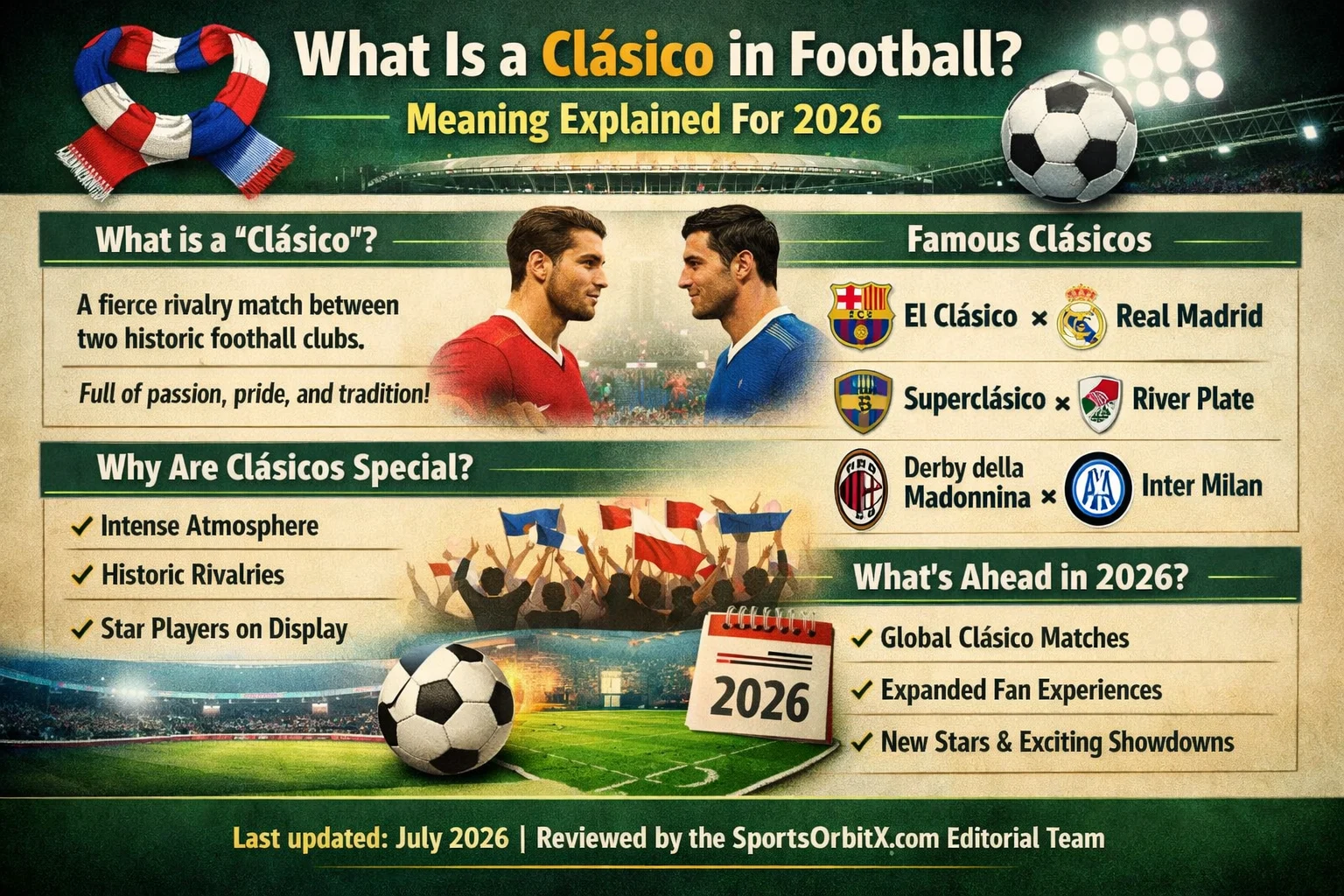
Quick Answer: A Clásico, most famously “El Clásico,” refers to any football match between Spanish giants Real Madrid and FC Barcelona, a fixture that carries deep historical, political, and cultural significance far beyond a typical league game between two clubs.
Twice a year, roughly 500 million people around the world stop what they’re doing to watch two Spanish clubs play each other. No trophy is guaranteed, no European final is on the line most of the time, and yet El Clásico consistently draws a bigger global audience than most Champions League finals played anywhere in the world. Understanding why requires looking well beyond the 90 minutes on the pitch itself.
This guide explains exactly what is a Clásico in football, where the term originated, the historical rivalry behind it, and why it remains one of the most-watched sporting fixtures on Earth despite technically being just a single league match on the calendar.
What Does “Clásico” Actually Mean?
“Clásico” is Spanish for “classic,” and in football, it refers specifically to a match between two historically significant rival clubs, most famously Real Madrid and FC Barcelona. While the term can technically apply to other major derbies in Spanish-speaking football, “El Clásico” without further qualification almost universally refers to this single fixture, considered the sport’s ultimate showcase of club-level rivalry, history, quality, and global commercial appeal.
The Historical Origins of El Clásico
The rivalry’s roots trace back to the very first meeting between the two clubs in 1902, played during the Copa de la Coronación, a competition predating Spain’s modern football structure entirely. However, the fixture’s deeper cultural weight developed decades later, closely tied to Spain’s turbulent political history in the 1930s. As General Francisco Franco’s nationalist forces rose to power, Real Madrid became closely associated with Spanish centralism and nationalism, while FC Barcelona increasingly represented Catalan identity and regional autonomy within the broader Spanish state. This divide deepened tragically when Barcelona club president Josep Sunyol was executed without trial under Franco’s regime, cementing the rivalry’s political undertones for generations of fans and historians to follow.
Why Do Real Madrid and Barcelona Represent More Than Football?
Beyond the pitch, El Clásico has long functioned as a symbolic stage for Spain’s broader regional and political tensions dating back nearly a century. Real Madrid has historically been perceived as representing Spanish nationalism and centralized state power, while FC Barcelona’s motto, “més que un club” (“more than a club”), reflects its deep ties to Catalan identity and, at various points in history, aspirations for regional independence from the Spanish state. This layered significance is part of why the match is frequently described in football literature as carrying echoes of the Spanish Civil War, even decades after that conflict formally ended and Spain transitioned to democracy.
When Did the Term “El Clásico” Become Popular?
Interestingly, the specific term “El Clásico” is a relatively recent addition to football’s mainstream vocabulary, only becoming widely used to describe the Real Madrid-Barcelona fixture in the mid-2000s. Before that period, the match was more commonly referred to simply as “El Derbi” (The Derby) or through direct descriptors like “Madrid-Barça,” without the same globally recognized branding attached to it. The branding shift toward “El Clásico” coincided with the fixture’s growing global broadcast reach, reflecting how marketing and international audience appeal have shaped even the language used to describe football’s oldest and most storied rivalries.
El Clásico by the Numbers
Real Madrid and Barcelona have combined to dominate Spanish football at a historically unmatched level rarely seen in any other domestic league worldwide. Across La Liga’s history, the two clubs have shared the league title an extraordinarily high number of times, and between them have also claimed the majority of European Cup and Champions League titles won by Spanish clubs since the competition’s founding in 1955. This sustained shared dominance is part of why El Clásico rarely feels like a mismatch, regardless of either club’s form heading into the fixture, and why the result frequently carries direct implications for the La Liga title race even in seasons when neither club appears to be in top form.
El Otro Clásico: A Related but Distinct Term
Real Madrid’s matches against fellow Madrid club Atlético Madrid are sometimes referred to as “El Otro Clásico” (“The Other Classic”), a term that deliberately positions the fixture as secondary in prestige to the Real Madrid-Barcelona rivalry despite Atlético’s own considerable success and passionate fanbase. This naming convention highlights just how singularly significant El Clásico has become within Spanish football culture, to the point where even other major rivalries within the same city are defined in relation to it rather than on entirely independent terms of their own.
Interesting Facts About El Clásico
- The first-ever meeting between Real Madrid and Barcelona took place on May 13, 1902, with Barcelona winning 3-1, though the Spanish Football Association does not officially recognize that early competition as part of the rivalry’s formal record.
- El Clásico regularly draws a global television audience estimated at around 500 million viewers, making it one of the most-watched annual club fixtures in world sport, rivaling even some international tournament matches.
- The term “El Clásico” only entered mainstream football usage in the mid-2000s, despite the rivalry itself dating back over a century of continuous competition between the two clubs.
- Barcelona’s motto “més que un club” (“more than a club”) was shaped significantly by the political tensions that defined the rivalry’s early 20th-century development during Spain’s turbulent history.
- The transfer saga surrounding Argentine forward Alfredo Di Stéfano in the 1950s, who ultimately joined Real Madrid instead of Barcelona, remains one of the most famous flashpoints in the rivalry’s long and storied history.
Does “Clásico” Apply to Rivalries Beyond Spain?
While “El Clásico” without further specification almost always refers to Real Madrid versus Barcelona, the term “clásico” itself has been adopted more broadly across Spanish-speaking football to describe other historically significant derbies around the world. In Argentina, the fixture between Boca Juniors and River Plate, known as the “Superclásico,” is often cited as one of the most intense derbies in world football, carrying similarly deep social and cultural significance within Argentine society. Similarly, various South American leagues use “clásico” terminology to describe their own most storied rivalries, reflecting how the concept of a defining, historically loaded derby resonates broadly across football cultures that share the Spanish language, even when the specific clubs and historical context differ considerably from Spain’s own rivalry.
El Clásico in the Modern Football Era
In recent decades, El Clásico’s significance has only grown, driven partly by the fixture regularly featuring some of the sport’s most decorated individual players competing directly against one another on the biggest possible stage. The rivalry between Lionel Messi and Cristiano Ronaldo throughout the 2010s added an additional layer of global fascination to the fixture, with the two players’ head-to-head Clásico meetings frequently analyzed and debated by fans and pundits long after both players eventually moved on from their respective clubs. This modern era has also seen the fixture’s broadcast reach expand significantly, with dedicated pre-match build-up coverage, extensive statistical analysis, and global marketing campaigns treating each Clásico as a standalone global sporting event rather than simply another league fixture on the calendar.
How El Clásico Has Shaped Spanish Football Governance
Beyond the pitch itself, the historical rivalry between Real Madrid and Barcelona has meaningfully influenced how Spanish football is governed and marketed at an institutional level across the entire league structure. Broadcasting rights negotiations, league scheduling decisions, and even La Liga’s international marketing strategy have historically placed significant emphasis on maximizing El Clásico’s commercial and broadcast value, recognizing the fixture’s unique ability to draw global audiences well beyond Spain’s domestic football market. This institutional prioritization reflects just how central the rivalry has become to Spanish football’s broader commercial identity, extending its influence considerably beyond the two clubs directly involved in the match itself.
Fan Culture and Matchday Atmosphere Surrounding El Clásico
Beyond the historical and political layers, El Clásico has developed its own distinct matchday culture that sets it apart from virtually any other club fixture in world football. Ticket demand for the match routinely exceeds availability by a significant margin, with prices for both stadiums, the Santiago Bernabéu and Camp Nou, reaching some of the highest levels seen for any recurring domestic league fixture globally. Bars, public squares, and viewing parties across Spain, and increasingly around the world, treat El Clásico as a genuine cultural event rather than simply another league match, with local businesses in both Madrid and Barcelona often reporting measurable spikes in activity on match days. This atmosphere extends well beyond the stadiums themselves, reflecting how deeply embedded the rivalry has become in everyday Spanish social life, well beyond the football-specific audience that follows the sport closely throughout the rest of the season.
Frequently Asked Questions
What is a Clásico in football? A Clásico refers to any football match between Spain’s two most historically significant rival clubs, most famously Real Madrid and FC Barcelona, though the term has since spread to other football cultures.
Why is it called El Clásico? “Clásico” is Spanish for “classic,” reflecting the fixture’s status as the definitive, most prestigious rivalry match in all of Spanish football.
When did Real Madrid and Barcelona first play each other? The two clubs first met on May 13, 1902, though the specific term “El Clásico” wasn’t widely used to describe the fixture until the mid-2000s, decades later.
Why is El Clásico considered political as well as sporting? The rivalry became closely tied to Spain’s 20th-century political divide, with Real Madrid historically associated with Spanish nationalism and Barcelona with Catalan regional identity.
What is El Otro Clásico? “El Otro Clásico” refers to matches between Real Madrid and Atlético Madrid, a term that positions the fixture as secondary in prestige to the Real Madrid-Barcelona rivalry.
How many people watch El Clásico? El Clásico regularly draws a global television audience estimated at around 500 million viewers, among the largest for any annual club football fixture.
Is “clásico” used for rivalries outside of Spain? Yes, the term has been adopted more broadly, most notably for Argentina’s “Superclásico” between Boca Juniors and River Plate, reflecting how the concept resonates across different Spanish-speaking football cultures worldwide.
How did Messi and Ronaldo influence El Clásico’s global appeal? Their rivalry throughout the 2010s, playing for Barcelona and Real Madrid respectively, added significant global fascination to the fixture, with their head-to-head meetings still widely analyzed and discussed by fans and pundits today.
Conclusion
So, what is a Clásico in football? At its simplest, it’s a match between fierce rivals, but in the case of El Clásico specifically, it represents far more than 90 minutes of football, carrying over a century of history, regional identity, and political symbolism that few other sporting fixtures anywhere in the world can match. From its origins in early 20th-century Spanish politics to its modern-day status as a global broadcasting phenomenon featuring some of the sport’s greatest-ever players, understanding this context transforms El Clásico from a simple league game into one of football’s most culturally significant events. Want to explore more football terminology? Check out our guide on Football World Cup History for another deep dive into the sport’s most storied traditions.

Emily Parker is a sports journalist at SportsOrbitX.com with a passion for covering cricket, tennis and major international sporting events. She is committed to producing clear, reliable and engaging content for sports enthusiasts worldwide.