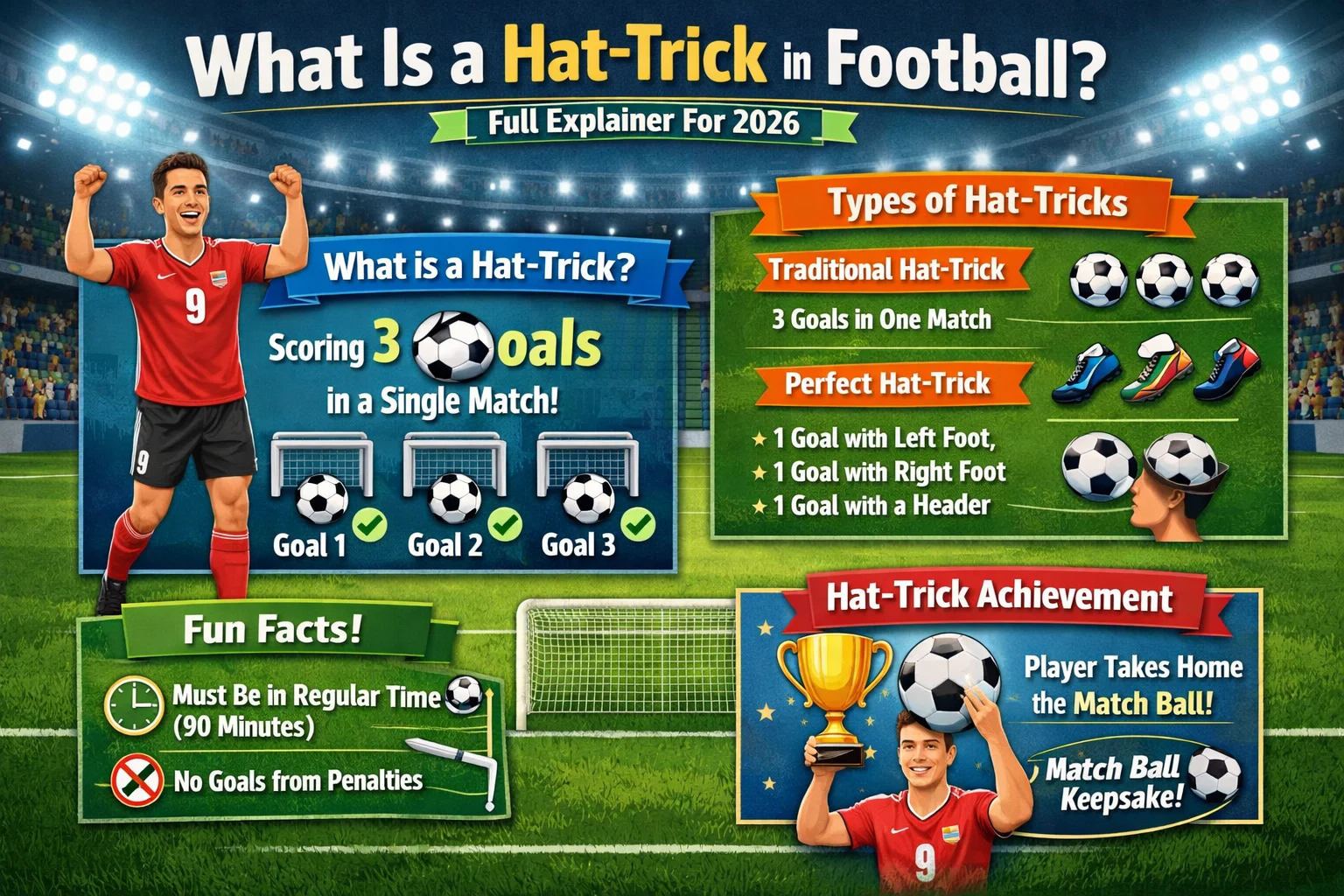
Quick Answer: A hat-trick in football is when a single player scores three goals in one match. The goals don’t need to be consecutive or occur within a specific time window, and the term applies regardless of how the match ultimately ends.
Three goals. One player. One match. Few moments in football generate the kind of instant, stadium-wide reaction a hat-trick does, whether it arrives across 90 tense minutes or in a stunning burst of just a few. Yet despite how often the term gets used in commentary, many newer fans aren’t entirely sure what actually counts, where the phrase even comes from, or why the player usually walks off with the match ball tucked under their arm at full time.
This guide explains exactly what is a hat-trick in football, where the term originated, the traditions surrounding it, and some of the most remarkable hat-trick records in the sport’s history.
What Counts as a Hat-Trick?

A hat-trick is awarded when one player scores three goals in a single match. There’s no requirement for the goals to be scored consecutively, meaning a teammate or even an opponent can score in between without affecting the achievement in any way. The only strict requirement is that all three goals must be scored by the same player in the same match, regardless of which half they occur in or how the final result plays out for either team.
It’s worth noting that own goals never count toward a hat-trick. If a player scores twice and a defender accidentally diverts a cross into their own net, that middle goal belongs to no one in the hat-trick conversation the player still needs a third goal of their own to complete the achievement.
Where Does the Term “Hat-Trick” Come From?
The phrase didn’t originate in football at all. It comes from cricket, where a bowler who dismissed three batters with three consecutive deliveries was traditionally presented with a new hat by their club, or had a hat passed around among spectators for a collection, as a mark of the rare achievement. Over time, the term spread beyond cricket into other sports, including football, which eventually dropped the strict “three in a row” requirement that cricket’s original version had demanded of the achievement.
The Tradition of Keeping the Match Ball
One of football’s most enduring customs is that a hat-trick scorer gets to keep the match ball as a memento, often signed by teammates afterward. This tradition dates back to when hat-tricks were considered rare enough to deserve a keepsake. It remains widely honored today, though it’s a custom rather than an official rule, meaning whether it actually happens can depend on the specific competition, club, or officials involved on the day.
What Is a “Perfect Hat-Trick”?
A perfect hat-trick refers to a player scoring three goals in a single match using three different methods: one with the right foot, one with the left foot, and one with the head. While not an official statistical category recognized by competition record books, commentators and analysts frequently highlight perfect hat-tricks because they demonstrate genuinely well-rounded finishing ability, requiring technical proficiency in multiple types of shots and situations within a single 90-minute match.
Notable Hat-Trick Records in Football
Certain hat-trick achievements have become genuinely legendary within football history and statistics, referenced repeatedly across broadcasts, record books, and fan discussions for years after they occurred:
- The fastest hat-trick in Premier League history belongs to Sadio Mané, who scored three goals in just 2 minutes and 56 seconds for Southampton against Aston Villa in 2015.
- Erling Haaland has established himself as one of the Premier League’s most consistent hat-trick scorers in recent seasons, registering multiple trebles for Manchester City since his arrival, often combining a genuine variety of finishes within a single match.
- Several players across football history have completed hat-tricks in under five minutes, an achievement that remains almost difficult to fully process even when reviewing the exact match footage.
- Miroslav Klose and other prolific international strikers have registered multiple hat-tricks at major tournaments, including the FIFA World Cup, cementing their place among the sport’s most clinical finishers on the biggest stage.
Hat-Trick vs. Brace vs. Other Scoring Terms
| Term | Meaning |
|---|---|
| Brace | Two goals scored by the same player in a single match |
| Hat-trick | Three goals scored by the same player in a single match |
| Perfect hat-trick | Three goals via right foot, left foot, and head in one match |
| Poker (informal term) | Four goals scored by the same player in a single match |
Is a Hat-Trick Always a Good Sign for a Team?
Not necessarily, though it usually is. While a hat-trick almost always contributes significantly to a team’s attacking output, football history includes several rare instances where a hat-trick scorer’s team still drew or even lost the match, typically due to the opposition scoring even more goals or the hat-trick occurring during a fixture the player’s team was already losing heavily. These cases remain statistical curiosities, but they highlight that a hat-trick reflects individual excellence rather than a guaranteed team result.
How Common Are Hat-Tricks in Professional Football?
Goals are relatively scarce in football compared to high-scoring sports like basketball, which makes three goals from a single player in one match a genuinely uncommon achievement at the professional level. A prolific striker might go several matches, sometimes even weeks, without managing one. When a hat-trick does occur, it typically reflects a combination of a player being clinical in front of goal and being given sufficient quality chances by their teammates, often deciding the match’s outcome largely on its own.
Hat-Tricks at the FIFA World Cup
The World Cup has produced some of football’s most historically significant hat-tricks, given the tournament’s status as the sport’s biggest stage. Geoff Hurst remains the only player to score a hat-trick in a World Cup final, achieving the feat for England against West Germany in the 1966 final at Wembley. More recently, both Kylian Mbappé (2022) and several other elite forwards have delivered hat-tricks in high-stakes World Cup knockout matches, instantly cementing those performances among the most replayed moments of their respective tournaments. The rarity of a World Cup hat-trick, combined with the pressure of the tournament’s format, means each occurrence tends to be remembered and referenced for decades afterward, unlike a domestic league hat-trick, which, while still impressive, doesn’t carry quite the same historical weight.
Why Hat-Tricks Capture Fan Attention So Strongly
Part of the hat-trick’s enduring appeal lies in football’s relatively low-scoring nature compared to other major sports. In a game where a single goal often decides the outcome, three goals from one player represents a disproportionate individual contribution to the result, something fans and pundits instinctively recognize as exceptional even without needing to check a stat sheet. The anticipation also builds uniquely within a match once a player scores their second goal, the crowd’s attention shifts almost entirely toward whether they’ll complete the treble, adding a layer of drama that a standard brace simply doesn’t generate in the same way.
Hat-Tricks by Substitutes and Unusual Circumstances
While most hat-tricks come from players who start and complete the full 90 minutes, football has also produced several remarkable hat-tricks scored by substitutes within a limited window of playing time, further amplifying the achievement’s rarity. These substitute hat-tricks are often highlighted specifically because they demonstrate a level of instant impact that’s difficult to replicate, given the player typically has significantly less time on the pitch than a starting teammate to find the same three scoring opportunities.
How Hat-Tricks Shape a Player’s Legacy and Records
Beyond the excitement of a single match, hat-trick totals have become an important statistical measure used to compare goal-scorers across different eras and competitions. Players like Cristiano Ronaldo and Lionel Messi are frequently ranked partly by their career hat-trick counts across league, cup, and international competitions, with these tallies often cited alongside total goals scored when debating a player’s overall attacking legacy. Some competitions and clubs maintain official all-time hat-trick leaderboards, treating the achievement as a meaningful standalone statistic rather than simply a byproduct of a player’s total goal count, since consistently scoring three goals in a single match demonstrates a distinct kind of clinical, match-defining quality that a steady stream of single goals across many matches doesn’t necessarily capture in the same way.
Frequently Asked Questions
What is a hat-trick in football? A hat-trick is when a single player scores three goals in one football match, regardless of when the goals occur or how the match ends.
Do the three goals need to be scored consecutively? No, modern football counts any three goals by one player in a single match as a hat-trick, even if other players score in between.
Does an own goal count toward a hat-trick? No, own goals never count toward a player’s hat-trick total, regardless of how the ball ends up in the net.
Where does the term hat-trick come from? The term originated in cricket, where a bowler taking three wickets in three consecutive deliveries was traditionally awarded a new hat, and the phrase later spread to football and other sports.
What is a perfect hat-trick? A perfect hat-trick refers to scoring three goals in one match using three different methods: right foot, left foot, and head, though it isn’t an official statistical category.
Who holds the record for the fastest hat-trick in the Premier League? Sadio Mané holds the record, scoring three goals in 2 minutes and 56 seconds for Southampton against Aston Villa in 2015, a mark that remains unbroken today.
Does the player always keep the match ball after a hat-trick? By tradition, yes, though it’s a custom rather than an official rule, so it can vary depending on the competition and match officials involved.
Who is the only player to score a hat-trick in a World Cup final? Geoff Hurst is the only player to score a hat-trick in a World Cup final, achieving the feat for England against West Germany in the 1966 final at Wembley.
Can a substitute score a hat-trick? Yes, several substitutes throughout football history have scored hat-tricks within a limited window of playing time, making the achievement particularly notable given the reduced opportunity compared to a full 90 minutes.
Is a hat-trick used as a statistic when comparing players across eras? Yes, career hat-trick totals are often cited alongside overall goal counts when analysts and fans debate a player’s attacking legacy across league, cup, and international competitions.
Conclusion
So, what is a hat-trick in football? At its core, it’s simply three goals from one player in a single match but as this guide shows, the achievement carries a rich history, from its cricket origins to enduring traditions like keeping the match ball, and even a legendary place in World Cup history through Geoff Hurst’s unmatched 1966 final feat. Whether it’s a routine hat-trick spread across 90 minutes or a stunning burst completed in under three minutes, few individual feats capture a stadium’s attention quite like watching a player complete their treble in real time.
Want to explore more football terminology? Check out our guide on What Does CDM Mean in Football for another deep dive into the sport’s key terms.

Daniel Brooks is a sports writer at SportsOrbitX.com, specializing in football, basketball and global sports news. He focuses on delivering accurate reporting, match analysis and timely updates that keep fans informed.