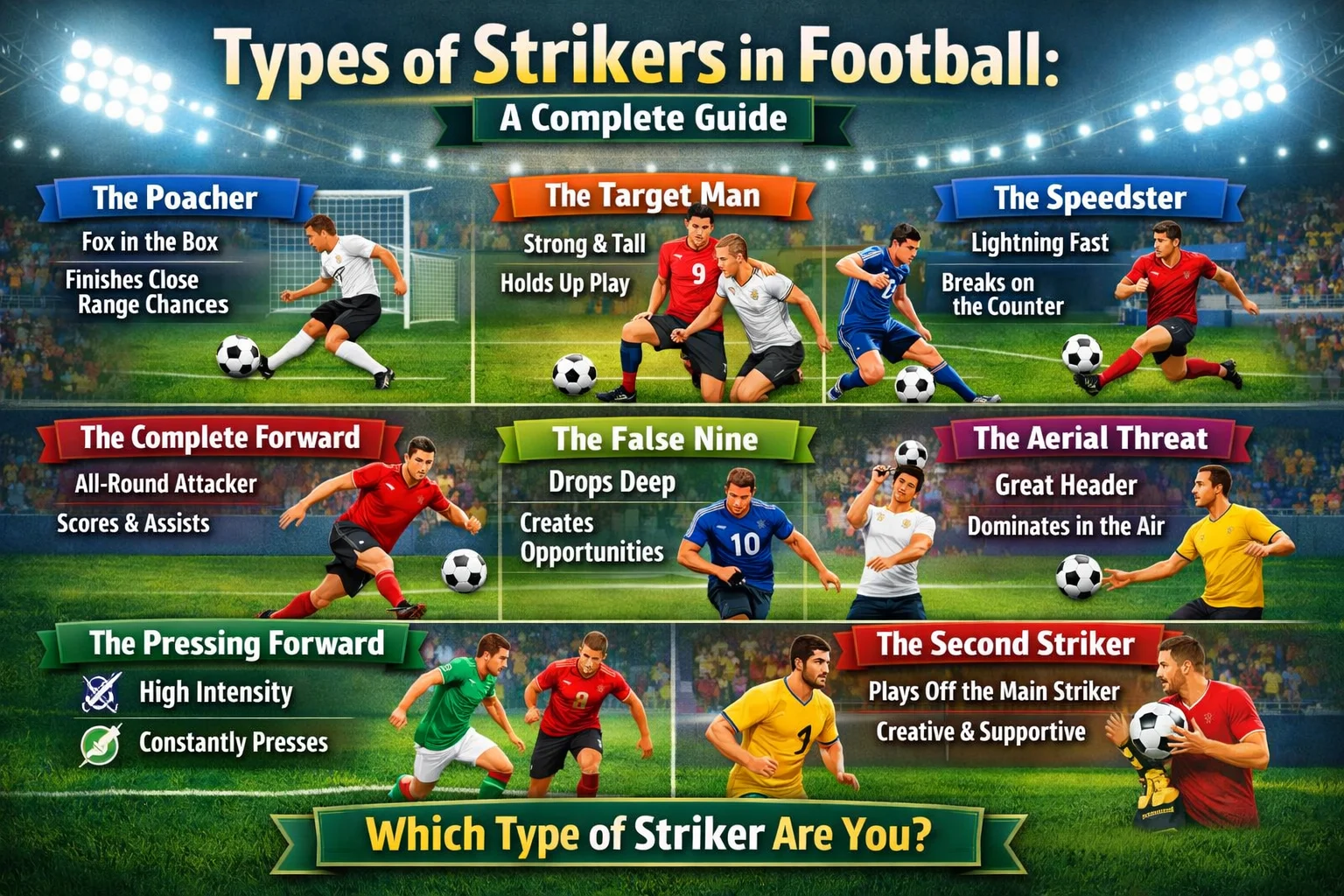
Quick Answer: There are several distinct types of strikers in football, including the target man, poacher, false 9, pressing forward, and complete forward, each defined by a different combination of physical attributes, positioning, and tactical role within a team’s attack.
Call two players “strikers” and you might be describing two completely different footballers. One might be a towering target man who wins headers and holds up play with his back to goal, while the other darts in behind defenses using nothing but pace and timing. Both score goals for a living, yet their game, training, and tactical value to a team look almost nothing alike, despite sharing the exact same position label on a team sheet.
This guide breaks down the main types of strikers in football, what separates each style tactically, and which players have become closely associated with defining these roles at the highest level of the professional game.
Why Not All Strikers Play the Same Way
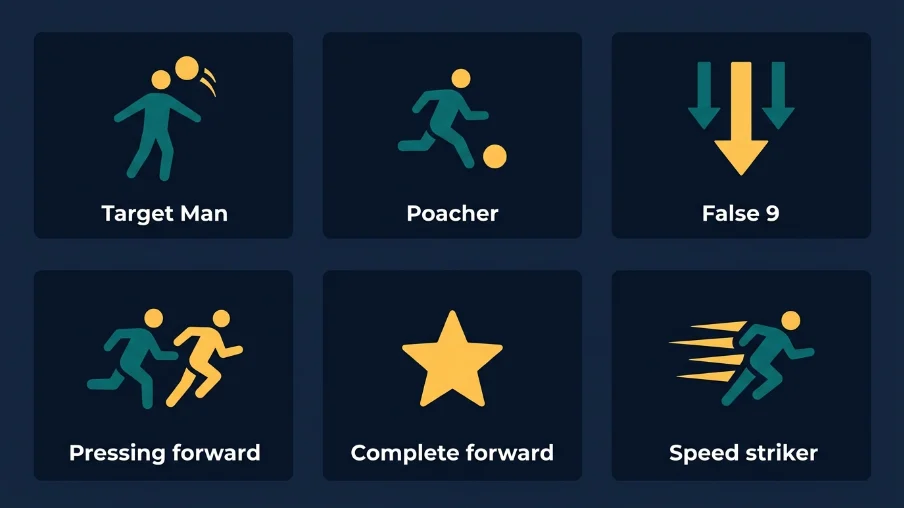
A team’s choice of striker type is rarely accidental. Coaches select or develop a specific style of striker based on their broader tactical system, the service they expect to provide from midfield, and the strengths of the players available to them at that moment. A team built around crossing and wide play, for example, benefits far more from a target man than a poacher, while a possession-heavy system built on quick combinations often favors a false 9 or complete forward who can drop deep and link play.
The Target Man
A target man is typically tall, physically strong, and excellent in the air, used primarily as an aerial focal point for a team’s attack. Their main value comes from winning headers from crosses, holding up long balls under pressure to bring teammates into play, and occupying opposing center-backs through sheer physical presence throughout the match. Target men don’t always score the highest volume of goals themselves, but they often create space and knockdowns that directly lead to teammates scoring.
Famous example: Peter Crouch, known for his height and aerial ability, built a long professional career around the classic target man role for both club and country.
The Poacher
A poacher, sometimes called an “instinctive striker,” specializes almost entirely in finishing chances inside the penalty box, often with minimal touches before shooting. Poachers are defined by exceptional positioning and anticipation rather than dribbling or link-up play, frequently arriving in the right spot at exactly the right moment to convert a chance that other strikers might miss entirely due to weaker spatial awareness.
Famous example: Filippo Inzaghi, whose uncanny ability to read where a ball would fall in the penalty area made him one of the most efficient poachers in football history, despite rarely being praised for overall technical skill.
The False 9
Unlike traditional strikers who stay pinned to the last defensive line, a false 9 regularly drops into midfield to help build attacks, dragging opposition center-backs out of position and creating space for wingers or midfielders to exploit further forward. This role prioritizes vision, passing, and game intelligence over traditional finishing instincts, though the best false 9s remain highly effective goal-scorers as well.
Famous example: Lionel Messi’s deployment as a false 9 under Pep Guardiola at Barcelona remains the most influential modern example of the role.
The Pressing Forward
A pressing forward prioritizes relentless defensive work rate as much as goal-scoring, often serving as the first line of a team’s high-press system throughout every phase of the match. These strikers are typically valued for their stamina, quick reactions, and ability to force opposition defenders into rushed decisions or mistakes near their own goal.
Famous example: Roberto Firmino’s pressing-focused role at Liverpool under Jürgen Klopp became central to the team’s high-intensity attacking system, even though his individual goal totals were often lower than more traditional strikers.
The Complete Forward
A complete forward combines multiple attributes from other striker types — strong finishing, aerial ability, hold-up play, and often solid passing range — making them adaptable across different tactical systems and match situations. These players are relatively rare, since few strikers naturally excel across every category, but when developed successfully, complete forwards tend to become among the most tactically valuable attacking players in the sport.
Famous example: Robert Lewandowski has been widely praised for combining clinical finishing, strong aerial ability, and intelligent movement, making him effective across multiple tactical systems throughout his career.
The Speed Striker (Advanced Forward)
Speed strikers rely primarily on pace to exploit space in behind opposition defensive lines, frequently timing runs to stay onside before using their speed advantage to outpace defenders in a foot race toward goal. This style works particularly well in counter-attacking systems, where quick transitions from defense to attack can catch opposing defenses out of position and unable to recover in time.
Famous example: Kylian Mbappé has become closely associated with this style, using elite pace to consistently threaten in behind even well-organized defensive lines.
Types of Strikers: Quick Comparison Table
| Type | Primary Strength | Best Suited For |
|---|---|---|
| Target Man | Aerial ability, hold-up play | Crossing-based, direct attacking systems |
| Poacher | Positioning, instinctive finishing | Teams generating high chance volume |
| False 9 | Vision, passing, dropping movement | Possession-based, tactically fluid systems |
| Pressing Forward | Work rate, defensive pressing | High-press, intensity-based systems |
| Complete Forward | Balanced, all-around ability | Flexible, adaptable tactical systems |
| Speed Striker | Pace, in-behind runs | Counter-attacking systems |
Can a Striker Combine Multiple Types?
Yes, and many of the sport’s most effective forwards blend characteristics from multiple striker types rather than fitting neatly into a single category. A modern striker might combine poacher-like instincts inside the box with pressing forward work rate off the ball, reflecting how tactical demands on strikers have broadened considerably compared to earlier eras of the sport, when a more rigid, single-dimensional striker role was often sufficient.
How Coaches Decide Which Type of Striker to Develop or Sign
Player recruitment and youth development decisions around strikers are heavily influenced by a club’s broader tactical identity. A coach running a possession-based system prioritizing patient build-up play is far more likely to develop or sign a false 9 or complete forward, while a club built around fast transitions and direct attacking football typically prioritizes speed strikers or poachers who can capitalize on limited chances quickly and efficiently.
How Striker Types Have Evolved Through Football History
The specialization of striker roles reflects broader shifts in football tactics over the decades. In earlier eras of the sport, particularly through the mid-20th century, target men and poachers dominated most tactical systems, largely because attacking football relied heavily on direct crossing and long-ball approaches rather than intricate build-up play. As possession-based football gained prominence, particularly from the late 2000s onward under influential coaches like Pep Guardiola, more technically demanding roles like the false 9 and complete forward became increasingly valued, requiring strikers to contribute meaningfully to a team’s passing structure rather than simply finishing chances created by others. The rise of pressing-focused tactical systems in the 2010s further expanded what was expected of a modern striker, adding defensive work rate to the list of attributes clubs now actively seek when developing or recruiting forwards.
How Youth Academies Identify and Develop Striker Types
Youth coaches typically avoid locking young forwards into a single striker archetype too early, instead exposing developing players to a range of attacking responsibilities to build a broader technical and tactical foundation. As players mature physically and their natural instincts become clearer, academies begin tailoring individual development plans around a player’s most apparent strengths — a physically dominant young striker might be guided toward a target man role, while a quicker, more instinctive finisher may be developed as a poacher or speed striker. This gradual specialization mirrors similar development pathways seen across other football positions, reflecting a broader coaching philosophy that technical versatility early on produces more complete, adaptable players by the time they reach senior football.
Statistical Metrics Used to Evaluate Different Striker Types
Modern analytics have added new layers of nuance to how different striker types are evaluated beyond simple goal counts. Expected goals (xG) helps assess a poacher’s shot quality and finishing efficiency, while metrics like aerial duels won and hold-up play success rates are commonly used to evaluate target men. Pressing forwards are increasingly judged using defensive metrics like pressures applied in the final third, while false 9s and complete forwards are often assessed through passing completion rates and key passes created, reflecting their broader creative responsibilities compared to more traditional, finishing-focused striker roles.
Frequently Asked Questions
What are the main types of strikers in football? The main types include the target man, poacher, false 9, pressing forward, complete forward, and speed striker, each defined by different physical attributes and tactical roles.
What is the difference between a poacher and a target man? A poacher specializes in instinctive finishing inside the box, while a target man focuses on aerial ability and holding up the ball under physical pressure from defenders.
Which type of striker scores the most goals? Poachers are often statistically the most clinical finishers, though complete forwards and speed strikers can also generate high goal totals depending on their team’s tactical system.
Is the false 9 considered a type of striker? Yes, the false 9 is a specific striker type known for dropping into midfield rather than staying on the last defensive line, prioritizing vision and link-up play alongside traditional finishing.
Can a striker change their playing style over their career? Yes, some strikers adapt their style as they age or move to different tactical systems, often shifting from a pace-reliant speed striker role toward a more positional poacher or complete forward approach later in their careers.
Why do some strikers score fewer goals despite being highly valued? Strikers like pressing forwards or target men often provide significant tactical value through work rate, hold-up play, or creating chances for teammates, meaning their overall contribution isn’t always reflected purely in personal goal totals.
How has analytics changed the way striker types are evaluated? Modern metrics like expected goals (xG), aerial duel success, and pressures applied in the final third have given clubs more precise, role-specific ways to evaluate different striker types beyond simple goal counts alone.
Do all professional strikers fit clearly into one type? Not always. Many elite strikers blend characteristics from multiple types, and a player’s dominant style can also shift over the course of their career as their physical attributes and tactical role evolve.
Conclusion
Understanding the different types of strikers in football reveals just how much tactical nuance exists behind a role that’s often oversimplified as simply “the goal-scorer.” From the physical dominance of a target man to the deep-dropping creativity of a false 9, and now supported by increasingly detailed analytics tracking every aspect of their contribution, each striker type brings a distinct set of tools that shapes how an entire team attacks. Recognizing these differences makes it far easier to appreciate why certain strikers thrive in specific systems while others struggle, regardless of their raw talent.
Want to explore more football positions? Check out our guide on Football Positions and Their Roles for the complete breakdown of every position on the pitch.

Emily Parker is a sports journalist at SportsOrbitX.com with a passion for covering cricket, tennis and major international sporting events. She is committed to producing clear, reliable and engaging content for sports enthusiasts worldwide.