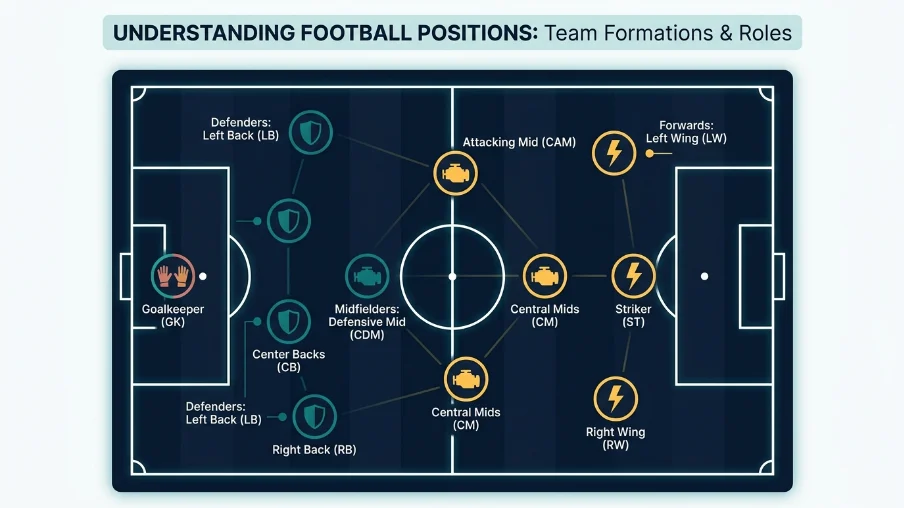
Quick Answer: Football has four main position groups goalkeeper, defenders, midfielders, and forwards each with specific sub-roles (like center-back, winger, or striker) that define a player’s responsibilities on the pitch. Together, these positions form the structure every team is built around, regardless of formation or playing style.
Watch any football match and you’ll notice something: no two players are doing the same job. A center-back rarely sprints forward to take a shot, and a winger almost never finds themselves defending a corner kick. Behind that organized chaos is a structure most casual fans never fully learn a system of positions, each with a specific role, that turns 11 individuals into a functioning, coordinated team.
This guide breaks down every major football position, what each role is actually responsible for and how they work together as a team cross-checked against how positions are actually used at professional level today, from grassroots coaching manuals to elite tactical systems.
Football Positions and Their Roles: Quick Overview
Before diving into each role individually, this table gives a fast, at-a-glance summary of how football’s position groups are structured and what each is primarily responsible for on the pitch.
| Position Group | Sub-Roles | Primary Responsibility |
| Goalkeeper | GK | Prevent goals, organize the defense |
| Defenders | Center-back, Full-back, Wing-back | Stop opposition attacks |
| Midfielders | Defensive, Central, Attacking, Winger | Control tempo, link play |
| Forwards | Striker, Winger, Second striker | Score goals |
Goalkeeper (GK)
The goalkeeper is the only player on the pitch allowed to use their hands, and only within their own penalty area. Their primary responsibility is preventing the opposing team from scoring, but the modern goalkeeper’s role has expanded significantly beyond shot-stopping, especially as tactical systems increasingly rely on goalkeepers to help build attacks from the back.
Key responsibilities:
- Stopping shots and crosses from becoming goals
- Organizing the defensive line and communicating positioning
- Distributing the ball quickly to start attacks (increasingly common in modern “sweeper-keeper” systems)
- Commanding the penalty area during set pieces like corners and free-kicks
Defenders
Defenders form the last line of protection in front of the goalkeeper, and the position splits into several distinct roles depending on where they line up and how a team’s tactical system is built.
Center-Back (CB)
Positioned centrally in front of the goalkeeper, center-backs focus on blocking shots, winning aerial duels, and marking opposition strikers. Teams typically play with two center-backs, though some formations use three.
Full-Back (LB/RB)
Full-backs patrol the wide areas of the defense, tracking opposition wingers while also supporting attacks by making overlapping runs down the flank.
Wing-Back
A more attacking evolution of the full-back role, common in formations like 3-5-2. Wing-backs cover the entire width of the pitch, contributing heavily to both defense and attack.
Midfielders
Midfielders are the connective tissue of a football team, linking defense to attack while controlling the pace and rhythm of a match often covering more distance during a game than any other position group.
Defensive Midfielder (CDM)
Positioned just in front of the back line, defensive midfielders shield the defense, break up opposition attacks, and often recycle possession to teammates.
Central Midfielder (CM)
The most balanced midfield role, involved in both defensive recovery and building attacking play, often covering the most ground of any position during a match.
Attacking Midfielder (CAM)
Positioned just behind the forwards, attacking midfielders focus on creating scoring chances, playing key passes, and sometimes scoring themselves.
Winger
Wide midfielders who stretch the play, deliver crosses into the box, and are often among a team’s most direct attacking threats via dribbling.
Forwards
Forwards are positioned closest to the opponent’s goal, with the primary job of scoring though modern forwards are also expected to press defenders and contribute to build-up play.
Striker (ST)
The most advanced attacking role, focused on finishing chances inside or near the penalty box. Strikers are typically judged heavily on goal-scoring output.
Second Striker
Plays just behind the main striker, linking midfield play with the front line while still contributing goals and assists.
Center-Forward (CF)
Often used interchangeably with striker, though center-forwards sometimes have a stronger hold-up play responsibility using their body to shield the ball and bring teammates into play.
How Positions Work Together: A Simple Example
Understanding positions individually only tells half the story football is fundamentally about how these roles interact, shifting constantly based on which team has the ball. When a team loses possession, defenders and defensive midfielders immediately prioritize regaining shape to prevent a counter-attack, while forwards may begin pressing the opposition’s defenders to force mistakes. When a team wins the ball back, midfielders look to quickly transition possession forward, full-backs push up to provide width, and forwards make runs to stretch the opposition’s defensive line. This constant shifting between defensive and attacking shape is what separates organized teams from disorganized ones, regardless of individual talent and it’s exactly why coaches spend so much of their training time on positioning and shape rather than just technical skill.
Common Formations and Position Combinations
How a coach arranges these positions is called a formation, typically written as a series of numbers representing defenders-midfielders-forwards (excluding the goalkeeper):
- 4-4-2 Four defenders, four midfielders, two forwards; a balanced, traditional setup.
- 4-3-3 Four defenders, three midfielders, three attackers; favors width and pressing.
- 3-5-2 Three center-backs, five midfielders (including wing-backs), two strikers; defensively solid with attacking flexibility.
- 4-2-3-1 Two defensive midfielders, three attacking midfielders, one striker; one of the most common formations in modern top-flight football.
Do Player Roles Ever Change During a Match?
Yes modern football has moved away from rigid, static positioning. Players are often instructed to shift roles depending on whether their team has possession, a concept known as positional play. A full-back might tuck inside to become an auxiliary midfielder during build-up play, or a winger might drop deep to help overload the midfield. This fluidity is a hallmark of tactically sophisticated teams at the professional level, even though the base formation on a lineup sheet stays the same.
Football Jersey Numbers and Positions
Traditionally, jersey numbers in football directly corresponded to specific positions, a system that originated in England in the 1920s. While modern squads now assign numbers more freely, the traditional numbering system still influences how positions are referenced:
- 1 Goalkeeper
- 2, 3 Full-backs (right-back, left-back)
- 4, 5 Center-backs
- 6 Defensive midfielder
- 7, 11 Wingers
- 8 Central/attacking midfielder
- 9 Striker/center-forward
- 10 Attacking midfielder or the team’s most creative playmaker
Even today, the number 9 and number 10 shirts carry significant prestige in football culture, often reserved for a team’s most important striker and playmaker, respectively.
Famous Players by Position
Looking at legendary players in each role helps illustrate what excellence looks like at every position:
- Goalkeeper Gianluigi Buffon (Italy), known for shot-stopping and longevity at the highest level.
- Center-Back Franco Baresi (Italy), regarded as one of the finest defensive readers of the game.
- Full-Back Roberto Carlos (Brazil), famous for combining defensive discipline with powerful attacking runs.
- Defensive Midfielder N’Golo Kanté (France), renowned for tireless ball-winning and positional discipline.
- Attacking Midfielder Zinedine Zidane (France), celebrated for vision, creativity, and technical control.
- Winger Cristiano Ronaldo (Portugal), known for pace, dribbling, and consistent goal output from wide areas.
- Striker Ronaldo Nazário (Brazil), widely considered one of the most complete strikers in the sport’s history.
How to Identify Positions When Watching a Match
For newer fans, spotting positions in real time can feel overwhelming. A simple approach: watch where players are positioned when their own team has the ball. Defenders will stay closest to their own goal, midfielders will occupy the space between both boxes, and forwards will stay furthest forward, looking to stay onside and ready for through-balls. Paying attention to a single player for a few minutes rather than following the ball constantly is one of the fastest ways to understand how positional responsibilities actually play out during a live match.
How Players Are Developed Into Specific Positions
At the youth academy level, most professional clubs avoid locking players into a single position too early, instead rotating young players across multiple roles to build a broader technical and tactical foundation. Specialization typically increases through the teenage years as a player’s physical attributes, decision-making style, and natural instincts point toward a best-fit role a naturally quick, direct player might be developed as a winger, while a physically dominant, aerially strong player is often guided toward center-back or striker. This gradual specialization is part of why top-level players tend to have such refined position-specific skill sets by the time they reach professional football.
Frequently Asked Questions
What are the 4 main positions in football? The four main position groups are goalkeeper, defenders, midfielders, and forwards, each with several specific sub-roles.
What is the hardest position in football? This is debated among coaches and fans, but goalkeeper and central defensive midfielder are often cited as the most demanding due to the decision-making, concentration, and overall responsibility both roles require throughout a full 90 minutes.
What is the difference between a striker and a forward? “Forward” is the broader position group, while “striker” specifically refers to the most advanced, goal-focused forward role within that group.
What does CDM mean in football? CDM stands for Central Defensive Midfielder, a position focused on shielding the defense and breaking up opposition attacks.
Can a player play multiple positions? Yes, many professional players are trained to play multiple positions, particularly within the same position group (such as a full-back who can also play center-back).
What position scores the most goals? Strikers and forwards typically score the most goals, though attacking midfielders and wingers also contribute significant goal totals in modern football.
Why do some formations use three center-backs instead of two? A three-center-back system (like 3-5-2) offers extra defensive solidity and cover, while allowing wing-backs to provide attacking width without leaving the defense exposed.
Do goalkeepers ever score goals? Rarely, but it happens usually from late-game corner kicks when a losing team’s goalkeeper joins the attack, or occasionally from long free-kicks and penalties in exceptional cases.
What is a “false 9” in football? A false 9 is a striker who drops deep into midfield rather than staying on the last line of defense, pulling opposition center-backs out of position and creating space for other attackers to exploit.
Conclusion
Every football position exists for a reason, and understanding these roles from the goalkeeper’s shot-stopping duties to a striker’s relentless focus on goals transforms how you watch the sport. Once you can recognize why a center-back stays deep while a winger sprints forward, or why a false 9 might drop into midfield instead of staying up front, the tactical side of football becomes just as engaging as the goals themselves.
These roles also aren’t fixed in stone the best modern players are often those who can comfortably shift between two or three positions depending on what a match situation demands. Want to build on this knowledge? Check out our guide on Football vs Soccer for the fundamentals.