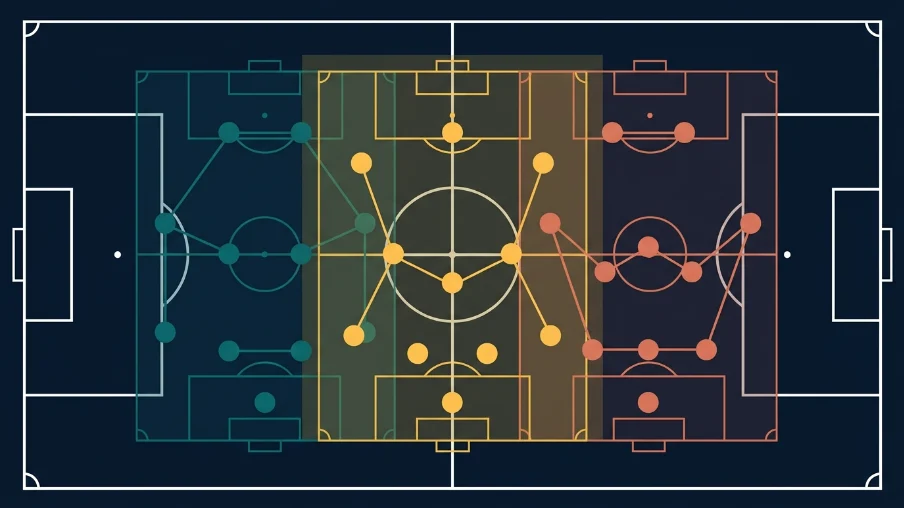
Quick Answer: A football formation describes how a team’s 10 outfield players are arranged across defense, midfield, and attack, typically written as a series of numbers (like 4-4-2 or 4-3-3) representing defenders, midfielders, and forwards, always excluding the goalkeeper from the count.
Before a ball is even kicked, a coach has already made one of the most important decisions of the match how to arrange 10 outfield players across the pitch. That single choice, known as a formation, shapes almost everything that follows: how a team defends, how it builds attacks, and which players get the space they need to influence the game in meaningful, match-defining ways.
This guide breaks down every major type of football formation, what each one prioritizes tactically, and why coaches choose one system over another depending on their squad, playing philosophy, and the specific opponent they’re facing.
How Football Formations Are Written and Read
Formations are described using a sequence of numbers that always exclude the goalkeeper, since every team fields exactly one regardless of tactical setup. Reading from defense to attack, a formation like 4-3-3 means four defenders, three midfielders, and three forwards. More detailed formations like 4-2-3-1 break the midfield into further layers in this case, two defensive midfielders, three attacking midfielders, and a single striker. Understanding this numbering system is the first step to reading any formation correctly on a team sheet, tactical graphic, or broadcast overlay.
4-4-2: The Classic Balanced Formation
One of football’s most traditional setups, 4-4-2 uses four defenders, four midfielders in a straight or slightly staggered line, and two forwards working together up front. This formation prioritizes balance and simplicity, with clear zonal responsibilities for every player on the pitch. It was the dominant formation across English football for decades and remains popular at youth and amateur levels due to how straightforward it is to teach, organize, and execute without extensive tactical coaching.
Strengths: Strong defensive structure, clear partnerships between strikers, easy for players to understand their roles. Weaknesses: Can be overrun in central midfield against formations with three central midfielders, offering fewer central passing options.
4-3-3: The Attacking, Pressing Formation
Four defenders, three central midfielders, and three attackers typically a central striker flanked by two wide forwards. This formation became closely associated with possession-based, high-pressing football, particularly under managers like Pep Guardiola. The extra central midfielder compared to 4-4-2 provides better control of possession, while the front three stretches defenses across the full width of the pitch, creating space for central runners to exploit.
Strengths: Strong pressing structure, width in attack, control in central midfield. Weaknesses: Can leave full-backs exposed defensively if wingers don’t track back, requires disciplined attacking players.
4-2-3-1: The Modern Standard Formation

Two defensive midfielders sit in front of the back four, shielding the defense, while three attacking midfielders operate just behind a lone central striker. This has become one of the most widely used formations in elite modern football, offering strong defensive cover through the double pivot while still allowing significant attacking creativity through the advanced trio operating in the spaces between opposition lines.
Strengths: Excellent defensive stability, flexible attacking options, adaptable to both possession and counter-attacking styles. Weaknesses: Can isolate the lone striker if service from midfield is inconsistent, requires disciplined double pivot positioning.
3-5-2: The Wing-Back System
Three center-backs anchor the defense, five midfielders (including two attacking wing-backs) cover the width of the pitch, and two strikers operate together up front. This formation is particularly popular in Italian football and has seen a resurgence at the international level, offering extra defensive solidity centrally while still providing attacking width through the wing-back roles on both flanks.
Strengths: Strong central defensive numbers, attacking width without sacrificing central solidity, effective against formations with two strikers. Weaknesses: Extremely demanding physically for wing-backs, who must cover the entire touchline both defensively and offensively.
4-5-1: The Defensive, Counter-Attacking Formation
Four defenders, five midfielders, and a single central striker. This formation is often deployed by teams looking to absorb pressure and prioritize defensive solidity, particularly against stronger opponents, before looking to hit quickly on the counter-attack once possession is won in a dangerous area of the pitch.
Strengths: Extremely difficult to break down centrally, strong platform for counter-attacking football. Weaknesses: Can isolate the lone striker, limited attacking presence if the team needs to chase a result.
3-4-3: The High-Risk, High-Reward Formation
Three center-backs, four midfielders, and three attackers. This aggressive formation prioritizes attacking numbers and pressing intensity, often used by teams looking to dominate possession and control matches through sheer attacking presence, accepting defensive risk in exchange for offensive firepower and territorial dominance.
Strengths: Overwhelming attacking numbers, strong pressing triggers across the pitch. Weaknesses: Vulnerable to counter-attacks due to fewer central defensive numbers relative to attacking commitment.
4-1-4-1: The Balanced Pressing Formation
A single defensive midfielder sits just in front of the back four, with four midfielders operating in a wider band ahead of them, supporting a lone striker. This formation offers strong defensive protection through the deep-lying midfielder while maintaining width and control through the midfield four spread across the pitch.
Strengths: Solid defensive screen, good balance between width and central control. Weaknesses: Heavily reliant on the single defensive midfielder’s positioning and stamina throughout a full match.
Football Formations: Quick Comparison Table
| Formation | Defenders | Midfielders | Forwards | Best For |
|---|---|---|---|---|
| 4-4-2 | 4 | 4 | 2 | Balance, simplicity |
| 4-3-3 | 4 | 3 | 3 | Pressing, possession |
| 4-2-3-1 | 4 | 5 (2+3) | 1 | Defensive stability, creativity |
| 3-5-2 | 3 | 5 | 2 | Central solidity, wing-back width |
| 4-5-1 | 4 | 5 | 1 | Defensive, counter-attacking |
| 3-4-3 | 3 | 4 | 3 | Attacking dominance |
| 4-1-4-1 | 4 | 5 (1+4) | 1 | Balanced pressing |
How Coaches Choose a Formation
Formation selection depends on several key factors beyond simple personal preference. Coaches typically weigh their available player attributes, the specific strengths and weaknesses of the upcoming opponent, and their broader tactical philosophy around possession versus counter-attacking football. A team with fast, technically gifted wingers might favor 4-3-3 to maximize their width and pace, while a squad built around physically dominant center-backs and disciplined defensive midfielders might lean toward 4-2-3-1 or 3-5-2 for added defensive security. Injuries and player availability can also force temporary formation changes that have nothing to do with a coach’s preferred long-term system.
Do Formations Change During a Match?
Yes, formations are rarely fixed for a full 90 minutes at the professional level. Coaches frequently make in-game adjustments, shifting from an attacking formation to a more defensive one to protect a lead, or switching to additional forwards when chasing a result late in a match. Substitutions often signal these shifts, with tactical changes sometimes altering a team’s entire defensive and attacking shape within a matter of minutes, catching an unprepared opponent off guard during a crucial phase of the game.
A Brief History of Football Formations
Formations have evolved dramatically since football’s early formalized years, when attacking-heavy setups like 1-1-8 and 2-3-5 were common, reflecting the sport’s early emphasis on individual attacking play over structured team defense. The 2-3-5 “pyramid” formation dominated football from the late 1800s through the 1920s, before gradually giving way to more balanced systems as defensive tactics matured. The WM formation, developed by Arsenal manager Herbert Chapman in the 1920s, is widely credited as one of the first genuinely modern tactical systems, introducing a clearer separation between defensive and attacking responsibilities that laid the groundwork for formations still recognizable today, including the eventual rise of 4-4-2 by the mid-20th century.
Famous Teams Associated With Specific Formations
Certain formations have become closely linked with specific teams and eras, often because a manager’s tactical philosophy became so successful that it defined an entire period of the sport:
- 4-3-3 under Pep Guardiola’s Barcelona (2008-2012) became the template for modern possession-based football, built around intricate passing triangles and coordinated pressing.
- 3-5-2 under Antonio Conte’s Chelsea (2016-17) revitalized the formation in English football, winning the Premier League title through disciplined wing-back play and defensive solidity.
- 4-2-3-1 became closely associated with Germany’s national team through the 2010s, balancing defensive stability with the technical creativity required to unlock organized defenses.
- The WM formation defined Herbert Chapman’s Arsenal teams of the 1930s, helping the club dominate English football during that decade.
How Formation Trends Have Shifted Over Time
Football’s tactical trends move in cycles, often influenced by rule changes, playing surface improvements, and shifts in player athleticism. The gradual decline of traditional 4-4-2 at the elite level, for example, coincided with an increased emphasis on possession-based football and pressing systems that require additional central midfield presence. Similarly, the resurgence of three-center-back systems like 3-5-2 and 3-4-3 in recent years reflects a broader tactical trend toward using wing-backs to provide attacking width, allowing teams to commit extra numbers centrally without sacrificing coverage on the flanks.
Frequently Asked Questions
What is the most common football formation? 4-2-3-1 and 4-3-3 are among the most widely used formations in modern elite football, though 4-4-2 remains extremely common at youth and amateur levels around the world.
What formation is best for attacking football? 3-4-3 and 4-3-3 are generally considered the most attack-oriented formations, prioritizing numbers and width in the final third of the pitch.
What formation is best for defensive football? 4-5-1 and 3-5-2 are commonly used for their strong defensive structure and ability to absorb pressure before countering effectively.
How do you read a football formation number? Formation numbers are read from defense to attack, excluding the goalkeeper for example, 4-3-3 means four defenders, three midfielders, and three forwards.
Can a team use different formations in the same match? Yes, coaches frequently adjust formations during a match through substitutions or tactical instructions, particularly when protecting a lead or chasing a needed result late on.
Why do some formations have four numbers instead of three? More detailed formations like 4-2-3-1 break the midfield into separate layers (such as defensive and attacking midfielders) for a more precise tactical description of player responsibilities.
What was the earliest football formation used in the sport? Early football favored extremely attack-heavy setups like 2-3-5, known as the “pyramid” formation, which dominated the sport from the late 1800s until more balanced systems developed in the 1920s and 1930s.
Are formations equally important at amateur and professional levels? Formations matter at every level, though professional teams typically execute tactical instructions with far greater precision and consistency due to more structured training and player understanding of positional responsibilities.
Conclusion
Understanding the different types of football formations explained here transforms how you watch the sport instead of just following the ball, you start noticing the underlying structure that shapes every attack and defensive stand. From the balanced simplicity of 4-4-2 to the attacking ambition of 3-4-3, and tracing all the way back to Herbert Chapman’s pioneering WM system in the 1920s, each formation represents a deliberate tactical trade-off between defensive solidity and attacking presence that continues to evolve today.
Want to understand the individual roles within these formations? Check out our guide on Football Positions and Their Roles for the complete breakdown of every position on the pitch.

Emily Parker is a sports journalist at SportsOrbitX.com with a passion for covering cricket, tennis and major international sporting events. She is committed to producing clear, reliable and engaging content for sports enthusiasts worldwide.