
Football known as soccer in some countries is the most popular sport on the planet, played and watched by an estimated 3.5 billion fans across more than 200 countries, according to FIFA. Whether you’re completely new to the game or just want a refresher on the basics, this guide covers everything you need to know: the rules, the positions, key terminology, tactics, major tournaments, and a full look at how the sport evolved into what it is today.
At SportsOrbitX, every guide is researched from official rulebooks (IFAB Laws of the Game, FIFA regulations) and cross-checked against how the sport is actually played at professional level, so you’re getting accurate, practical information not guesswork.
What is Football?
Football is a team sport played between two teams of 11 players each, with the objective of scoring more goals than the opponent by getting the ball into the opposing team’s net. It is played on a rectangular field called a pitch, using only the feet, chest, and head to control the ball (outfield players cannot use their hands).
Basic Rules of Football
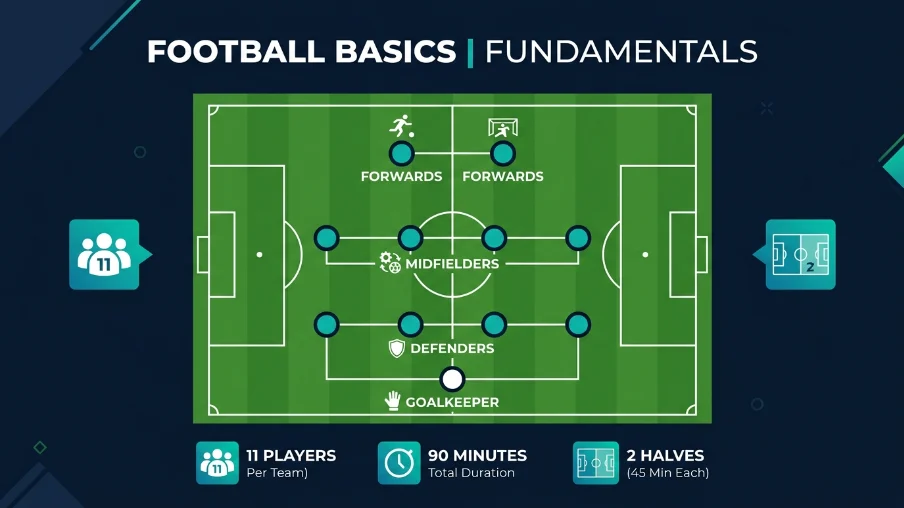
- Teams: Two teams of 11 players each (including one goalkeeper per team).
- Duration: A standard match lasts 90 minutes, split into two 45-minute halves, with a short break in between.
- Scoring: A goal is scored when the entire ball crosses the goal line between the posts and under the crossbar.
- Extra Time: Referees can add “stoppage time” at the end of each half to make up for delays.
- Winning: The team with more goals at the end of the match wins. If scores are level, the match may end in a draw, or go to extra time and penalties depending on the competition.
- Kick-off: The match starts with a kick-off at the center of the pitch, and this is repeated after every goal.
- Out of Play: The ball is out of play when it fully crosses the sideline (throw-in) or goal line without a goal (goal kick or corner kick).
Key Football Positions Explained
Every football team is built around four main position groups:
1. Goalkeeper (GK)
The only player allowed to use their hands, but only within the penalty box. Their main job is to stop the opposing team from scoring.
2. Defenders
Positioned near the goalkeeper, defenders’ primary role is to stop opponents from scoring. Common defensive positions include center-backs and full-backs (left-back and right-back).
3. Midfielders
The link between defense and attack. Midfielders control the flow of the game, distribute the ball, and support both defense and attack. Common types include defensive midfielders, central midfielders, and attacking midfielders.
4. Forwards (Strikers/Wingers)
Positioned closest to the opponent’s goal, forwards are primarily responsible for scoring goals. Wingers play wide and provide crosses, while strikers focus on finishing chances.
Essential Football Terminology
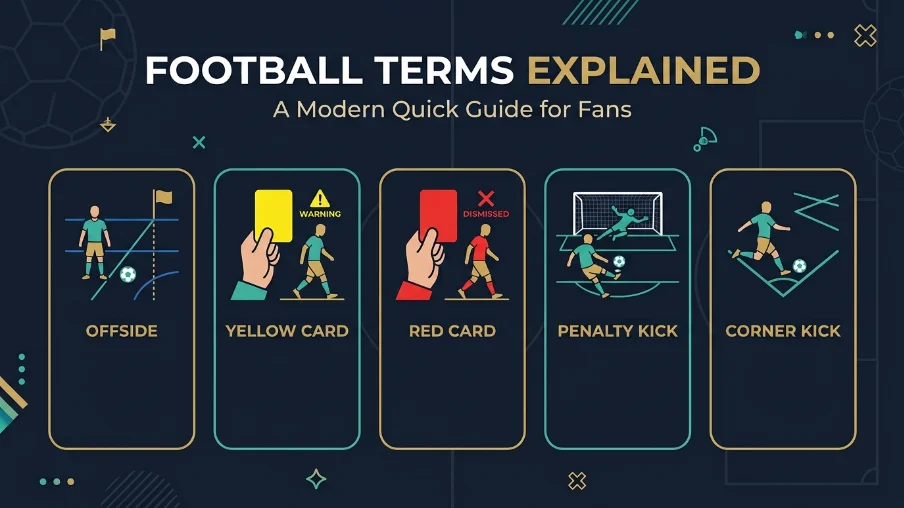
If you’re new to football, these terms will come up constantly:
- Offside — An attacking player is offside if they are nearer to the opponent’s goal than both the ball and the second-last defender when the ball is played to them.
- Free-kick — Awarded after a foul; can be direct (shot straight at goal) or indirect.
- Penalty Kick — Awarded when a foul is committed inside the penalty box; taken from the penalty spot against only the goalkeeper.
- Corner Kick — Awarded to the attacking team when the ball goes out over the goal line off a defender.
- Yellow Card — A caution shown for a foul or unsporting behavior.
- Red Card — Shown for a serious offense; the player is sent off and the team plays with one fewer player.
- Hat-trick — When a single player scores three goals in one match.
Major Football Tournaments
Football’s global appeal comes largely from its packed calendar of prestigious competitions each with its own history, prestige, and passionate fanbase.
FIFA World Cup
Held every four years, the FIFA World Cup is the most-watched sporting event on Earth the 2022 final alone drew an estimated global audience of over 1.5 billion viewers. National teams from around the world compete over roughly a month, with the trophy considered football’s ultimate prize. Brazil holds the record for most titles, with 5 wins.
UEFA Champions League
Europe’s top club competition, featuring the continent’s best-performing teams from domestic leagues like the Premier League, La Liga, and Serie A. Running since 1955 (originally as the European Cup), it’s widely regarded as the highest level of club football in the world, with Real Madrid holding the record for most titles (15).
Premier League
England’s top professional division and one of the most-watched domestic leagues globally, broadcast in over 180 countries. Known for its fast-paced style and financial power, it generates billions in annual broadcasting revenue.
Copa América
South America’s premier international tournament and the oldest continental football championship in the world, first held in 1916. It features fierce rivalries, most notably between Argentina and Brazil, the competition’s most successful teams.
UEFA European Championship (Euros)
Held every four years, the Euros bring together Europe’s top national teams. It’s the second most-watched international tournament after the World Cup, with past winners including Germany, Spain, and Italy.
Africa Cup of Nations (AFCON)
Africa’s premier international football tournament, held every two years, showcasing talent that regularly goes on to star in Europe’s top leagues.
Common Football Formations (Tactics Explained Simply)
Formations describe how a team arranges its 10 outfield players (excluding the goalkeeper). Understanding them makes watching football far more enjoyable:
- 4-4-2 — Four defenders, four midfielders, two forwards. A balanced, traditional setup used widely in English football.
- 4-3-3 — Four defenders, three midfielders, three attackers. Favors attacking width and pressing, popularized by teams like Barcelona.
- 3-5-2 — Three center-backs, five midfielders (including wing-backs), two strikers. Common in Italian football for its defensive solidity with attacking flexibility.
- 4-2-3-1 — Two defensive midfielders shielding the back four, three attacking midfielders, and a lone striker. One of the most-used formations in modern top-flight football.
Coaches choose formations based on player strengths, opponent style, and match situation, and teams often switch formations mid-game.
The History of Football: From Ancient Origins to a Global Sport
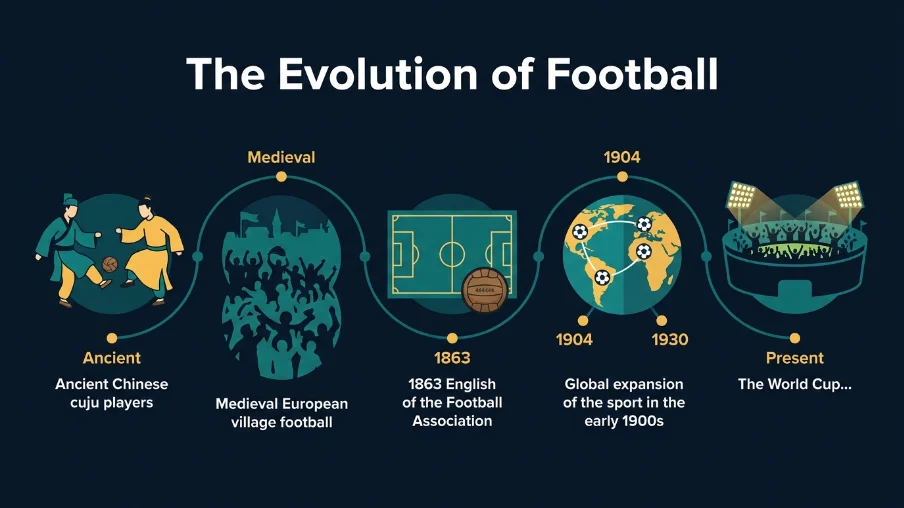
Ancient Origins (2nd–3rd Century BC – 1800s) Ball-kicking games date back over 2,000 years. Historical records show the Chinese military game cuju, played during the Han Dynasty, involved kicking a leather ball through a small opening recognized by FIFA as the earliest form of the sport. Similar games existed in ancient Greece (episkyros) and Rome (harpastum), while medieval Europe had chaotic, village-wide ball games with few rules.
Standardization in England (1800s–1863) By the early 1800s, football was widely played in English schools and universities, but every institution followed different rules — some allowed handling the ball, others didn’t. This inconsistency led to the formation of The Football Association (FA) in 1863 in London, which published the first standardized “Laws of the Game,” officially separating football (soccer) from rugby football.
Global Expansion (Late 1800s–Early 1900s) British sailors, traders, and workers carried the sport to Europe and South America. By the early 1900s, football clubs and leagues had formed in Argentina, Brazil, Italy, and Spain. In 1904, FIFA (Fédération Internationale de Football Association) was founded in Paris to govern the sport internationally.
The Modern Era (1930–Present) The first FIFA World Cup was held in Uruguay in 1930, cementing football’s place as a global spectacle. Since then, the sport has grown into a multi-billion-dollar industry, with the English Premier League, La Liga, and UEFA Champions League among the most-watched sporting competitions in the world today.
Frequently Asked Questions
How many players are on a football team? Each team fields 11 players, including one goalkeeper.
How long is a football match? A standard match is 90 minutes, split into two 45-minute halves, plus stoppage time.
What happens if the score is tied? In league matches, the game usually ends in a draw. In knockout competitions, it may go to extra time and then a penalty shootout.
Can outfield players use their hands? No, only the goalkeeper can use their hands, and only within their own penalty box.
What is the offside rule in simple terms? A player is offside if they’re ahead of the ball and the second-last defender when the ball is passed to them, in the opponent’s half.
Conclusion
Football is a simple game at its core score more goals than the other team but it’s built on rich tactics, positions, and traditions that have developed over more than 2,000 years, from ancient Chinese cuju to the billion-dollar global sport it is today. Now that you understand the basics, you’re ready to dive deeper into specific positions, historic players, and the tournaments that make football the world’s favorite sport.