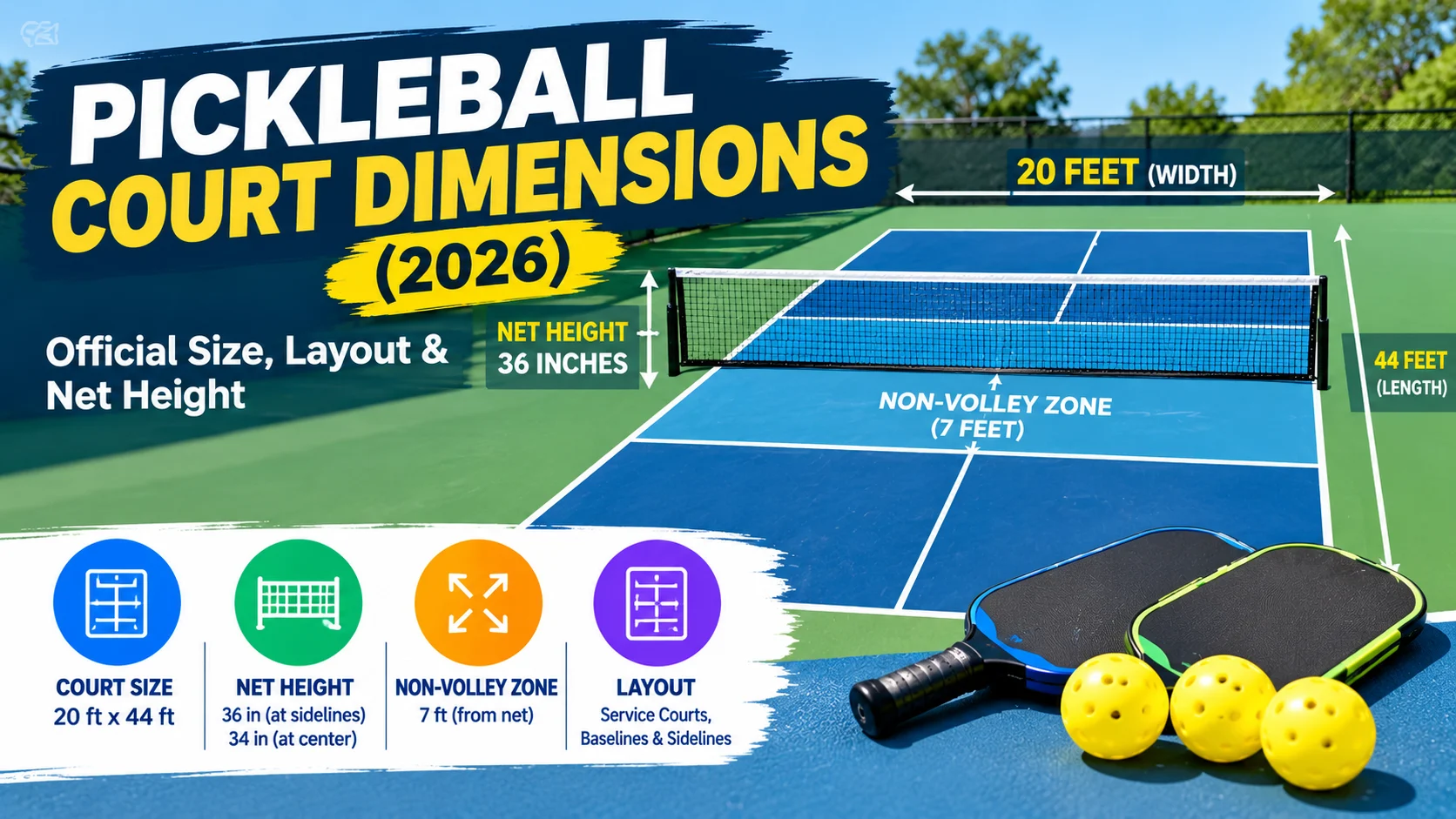
A standard pickleball court measures 20 feet wide by 44 feet long, for both singles and doubles. The kitchen extends 7 feet from the net on each side, while the net stands 36 inches high at the sidelines and 34 inches at the center. For comfortable play, plan for at least a 30-by-60-foot playing area.
Pickleball Court Dimensions at a Glance
Whether you’re learning the game, marking a driveway, or planning a backyard court, these measurements are the essential starting point.
| Court Feature | Official Measurement |
|---|---|
| Total court length | 44 feet (13.41 m) |
| Total court width | 20 feet (6.10 m) |
| Playing area | 880 square feet |
| Kitchen depth | 7 feet on each side |
| Kitchen width | 20 feet |
| Net height at sidelines | 36 inches (91.44 cm) |
| Net height at center | 34 inches (86.36 cm) |
| Recommended minimum playing surface | 30 × 60 feet |
| Recommended space for new construction | 34 × 64 feet |
| Standard line width | 2 inches |
These dimensions follow USA Pickleball’s official court specifications.
How Big Is a Pickleball Court?
A regulation pickleball court is 44 feet long and 20 feet wide, giving it a playing area of 880 square feet.
Think of it as a compact rectangle divided into two equal halves by a net. Each side measures 22 feet from the net to the baseline and 20 feet across.
The dimensions remain the same for singles and doubles. Unlike tennis, pickleball does not use wider sidelines for doubles play.
The court’s compact size encourages quick reactions, controlled shots, strategic positioning, and fast-paced rallies. However, the surrounding space matters too: players need room to move beyond the boundary lines when chasing a deep shot.
Pickleball Court Layout Explained
Understanding the court markings makes it much easier to follow the rules and position yourself correctly.
1. Baselines
The baselines are the two boundary lines at the ends of the court. They run parallel to the net and sit 22 feet away from it.
Players serve from behind the baseline, and shots landing beyond it are out.
2. Sidelines
The sidelines run along the length of the court and mark its 20-foot width.
A ball touching a boundary line is generally considered in, except for the kitchen-line restriction on serves described below.
3. Centerline
The centerline divides each side’s service area into two equal sections: the right service court and the left service court.
It runs from the non-volley zone line toward the baseline and helps identify where a serve must land.
4. Service Courts
Each side has two service courts. Each service area is approximately 10 feet wide by 15 feet deep, measured between the sideline, centerline, baseline, and kitchen line.
A legal serve must travel diagonally into the opponent’s correct service court and clear the kitchen area.
5. Non-Volley Zone Line
This line sits 7 feet from the net on each side. It separates the kitchen from the service courts.
It is one of the most important markings on a pickleball court because it determines where players may legally volley the ball.
What Is the Kitchen in Pickleball?
The kitchen, officially called the non-volley zone (NVZ), is the 7-foot-deep area immediately next to the net on each side.
It extends across the full 20-foot width of the court.
| Kitchen Measurement | Size |
|---|---|
| Depth on each side | 7 feet |
| Width | 20 feet |
| Area on each side | 140 square feet |
| Combined area on both sides | 280 square feet |
Why Is the Kitchen Important?
Players cannot volley the ball while standing in the kitchen or touching its boundary line. A volley means hitting the ball out of the air before it bounces.
You may enter the kitchen to play a ball that has bounced, provided you follow the rules. You must also regain your balance and leave the kitchen before legally volleying again.
Important serving rule: A serve that lands on the kitchen line is a fault because the kitchen line is part of the non-volley zone.
The kitchen is not a no-entry zone. It’s a no-volley zone, and understanding that difference can immediately improve your game.
Pickleball Net Height and Dimensions
The net is lower than a tennis net, but its height changes slightly from the posts to the middle.
| Net Measurement | Official Height |
|---|---|
| At the sidelines | 36 inches |
| At the center | 34 inches |
| Approximate net length | At least 21 feet 9 inches |
| Recommended post spacing | Approximately 22 feet |
The lower center creates a natural target for controlled shots and makes net play a major part of pickleball strategy.
When installing a net, measure its height at both the sidelines and center. A net that is too high or too low can affect gameplay, even if the court markings are correct.
How Much Space Do You Need for a Pickleball Court?
The playing lines occupy only part of the total space needed for a safe court. Players need extra room around the boundaries to move, stop, and return difficult shots.
| Setup Type | Recommended Dimensions | Total Area |
|---|---|---|
| Court markings only | 20 × 44 ft | 880 sq ft |
| Minimum playing surface | 30 × 60 ft | 1,800 sq ft |
| New construction or tournament setup | 34 × 64 ft | 2,176 sq ft |
| Larger stadium-style court | 50 × 80 ft | 4,000 sq ft |
The 30-by-60-foot area is a minimum playing-surface recommendation, not the size of the painted court itself. For new construction, 34 by 64 feet provides more room around the court and is the better planning target when space allows.
Can You Build a Pickleball Court in Your Backyard?
Yes. A backyard can work if it has a flat, stable surface and enough clearance around the playing area.
Before starting, check:
- Available space: Measure the entire area, not just the 20-by-44-foot court.
- Surface condition: Choose a firm, even surface that offers reliable traction.
- Drainage: Prevent standing water and slippery areas.
- Obstacles: Keep fences, trees, walls, and furniture away from player movement.
- Lighting: If playing at night, ensure the court is evenly illuminated without distracting glare.
- Local requirements: Check property restrictions, permits, and noise rules where applicable.
For outdoor courts, USA Pickleball recommends a north–south orientation where practical to reduce players’ exposure to direct sunlight during morning and late-afternoon play.
Pickleball Court Dimensions in Meters
For readers using the metric system, the official court measurements are straightforward.
| Feature | Feet | Meters |
|---|---|---|
| Court length | 44 ft | 13.41 m |
| Court width | 20 ft | 6.10 m |
| Each half’s length | 22 ft | 6.71 m |
| Kitchen depth | 7 ft | 2.13 m |
| Net height at sidelines | 36 in | 0.914 m |
| Net height at center | 34 in | 0.864 m |
| Minimum playing surface | 30 × 60 ft | 9.14 × 18.29 m |
| Recommended new-construction area | 34 × 64 ft | 10.36 × 19.51 m |
Small differences in converted measurements may occur due to rounding.
Pickleball Court vs. Tennis Court Dimensions
Pickleball courts are significantly smaller than tennis courts, which is one reason the sport can fit into existing recreational facilities.
A standard tennis court’s playing dimensions are 78 feet long. Its width is 27 feet for singles and 36 feet for doubles, compared with pickleball’s fixed 44-by-20-foot court.
| Feature | Pickleball | Tennis |
|---|---|---|
| Court length | 44 ft | 78 ft |
| Singles width | 20 ft | 27 ft |
| Doubles width | 20 ft | 36 ft |
| Kitchen/non-volley zone | 7 ft on each side | No equivalent zone |
| Net height at center | 34 in | 36 in |
A tennis court can often accommodate more than one pickleball court, depending on the facility layout and safety clearances. However, simply painting additional lines does not guarantee enough space for safe competitive play.
How to Mark a Pickleball Court
You don’t need a construction crew to lay out a temporary court, but accurate measurements are essential.
- Measure the available area. Aim for at least 30 by 60 feet, with 34 by 64 feet preferred for a new permanent setup.
- Mark the outer rectangle. Measure 20 feet across and 44 feet along the court.
- Locate the net. Position it halfway along the length, 22 feet from either baseline.
- Mark the kitchen lines. Measure 7 feet outward from the net on each side.
- Add the centerlines. Divide each service area into two equal halves, extending from the kitchen line toward the baseline.
- Check the net height. Set it to 36 inches at the sidelines and 34 inches at the center.
- Verify the lines. Official court lines should be 2 inches wide and clearly contrast with the playing surface.
For a temporary setup, court tape or removable markers may work on a suitable surface. For permanent courts, use appropriate sports-surface materials and consult a qualified installer if needed.
Indoor vs. Outdoor Pickleball Court Dimensions
The regulation playing dimensions are the same indoors and outdoors: 20 by 44 feet.
The main differences involve the playing environment.
Indoor courts typically offer protection from wind, rain, and direct sunlight. Ceiling height, lighting, flooring, and nearby walls become important planning considerations.
Outdoor courts must account for weather, drainage, surface temperature, sunlight, and wind. A durable sports surface and adequate runoff space help create a safer playing environment.
In both settings, the kitchen, service areas, net height, and boundary markings follow the same standard dimensions.
Common Mistakes When Measuring a Pickleball Court
Even a small layout error can affect the playing experience. Avoid these common problems:
- Confusing court size with total space: The court is 20 by 44 feet, but the minimum recommended playing surface is larger.
- Marking the kitchen incorrectly: It extends 7 feet from the net on each side, across the entire width.
- Ignoring line width: Official lines should be 2 inches wide and measurements are taken to their outside edges.
- Setting the net at one height everywhere: It is 36 inches at the sidelines and 34 inches at the center.
- Forgetting the surrounding clearance: Players need room to move safely beyond the baselines and sidelines.
- Assuming singles and doubles use different court sizes: Both formats use the same 20-by-44-foot court.
Frequently Asked Questions
What are the official pickleball court dimensions?
A standard pickleball court measures 20 feet wide by 44 feet long, or approximately 6.10 by 13.41 meters. These dimensions apply to both singles and doubles.
How big is a pickleball court in square feet?
The marked playing court covers 880 square feet. For a safer playing area, the minimum recommended surface is 1,800 square feet, measuring 30 by 60 feet.
How wide is a pickleball court?
A regulation court is 20 feet wide, including its boundary lines.
How long is a pickleball court?
A regulation court is 44 feet long, measured from one baseline to the other.
How big is the kitchen in pickleball?
The kitchen is 7 feet deep and 20 feet wide on each side of the net. It is officially known as the non-volley zone.
What is the correct pickleball net height?
The net is 36 inches high at the sidelines and 34 inches high at the center.
Are pickleball court dimensions the same for singles and doubles?
Yes. Both singles and doubles use a court measuring 20 feet by 44 feet. The doubles game does not add extra width.
Can you fit a pickleball court in a driveway?
Potentially. The driveway needs enough room for the 20-by-44-foot court plus safe movement space around it. A minimum playing surface of 30 by 60 feet is a useful planning target.
Can you convert a tennis court into pickleball courts?
Yes, provided the layout allows adequate space, safe clearances, and correctly positioned lines and nets. The number of courts that fit depends on the available tennis-court area and facility requirements.
Final Verdict
The key to understanding pickleball court dimensions is remembering three numbers: 20 feet wide, 44 feet long, and a 7-foot kitchen on each side of the net. The net stands 36 inches at the sidelines and 34 inches at the center.
If you’re building a court, don’t stop at the painted boundaries. Plan for at least a 30-by-60-foot playing surface, and consider 34 by 64 feet for new construction. Getting the dimensions right from the beginning makes the court more comfortable, safer, and ready for enjoyable games.

Emily Parker is a sports journalist at SportsOrbitX.com with a passion for covering cricket, tennis and major international sporting events. She is committed to producing clear, reliable and engaging content for sports enthusiasts worldwide.